June 4, 2026
The Regulatory Architecture Shaping Large-Scale Bauxite Mining in Sensitive Ecosystems
Few sectors in Australian resources face the convergence of pressures currently confronting bauxite mining in Western Australia's Darling Range. Globally, the aluminium supply chain is under intense scrutiny for its environmental footprint, while domestically, the evolution of environmental law is redefining how legacy mining operations interact with protected landscapes and critical water infrastructure. The way regulators handle large-scale bauxite extraction within ecologically significant zones is not merely a local compliance story. It is a live test case for how Australia balances industrial output with environmental stewardship at scale.
Understanding the Alcoa WA bauxite mining regulations situation requires more than a surface-level reading of permit timelines. It demands engagement with the layered legal architecture, the financial instruments embedded in compliance conditions, and the broader regulatory evolution reshaping resource project approvals across Australia. Furthermore, global bauxite production trends make this an increasingly significant issue for international supply chains.
When big ASX news breaks, our subscribers know first
How Western Australia's Regulatory System Actually Works for Bauxite Operations
The Environmental Protection Act 1986 as the Primary Instrument
Western Australia's framework for managing environmental risk from mining begins with the Environmental Protection Act 1986. Part IV of this legislation governs the formal Environmental Protection Authority (EPA) assessment process for significant projects. Unlike routine approvals, a Part IV assessment triggers comprehensive environmental review, examining a project's potential impacts across multiple domains including water, biodiversity, and human health.
What makes Alcoa's current situation particularly significant is that the EPA's formal assessment of its Mining and Management Programs was initiated not through standard regulatory review, but through third-party referrals. This mechanism allows community organisations, environmental groups, and private individuals to trigger formal assessment of projects that may not have otherwise entered the EPA's assessment pipeline. The use of this pathway by civil society actors introduced a level of regulatory uncertainty that operators working within familiar approval frameworks had not necessarily anticipated.
State Agreement Acts and the MMP Structure
Alcoa's WA bauxite operations sit within a distinct legal category. Rather than operating under standard mining lease conditions, the company's extraction activities are governed through a State Agreement Act framework, a structure created for large, nationally significant industrial operations that require a higher degree of negotiated regulatory certainty.
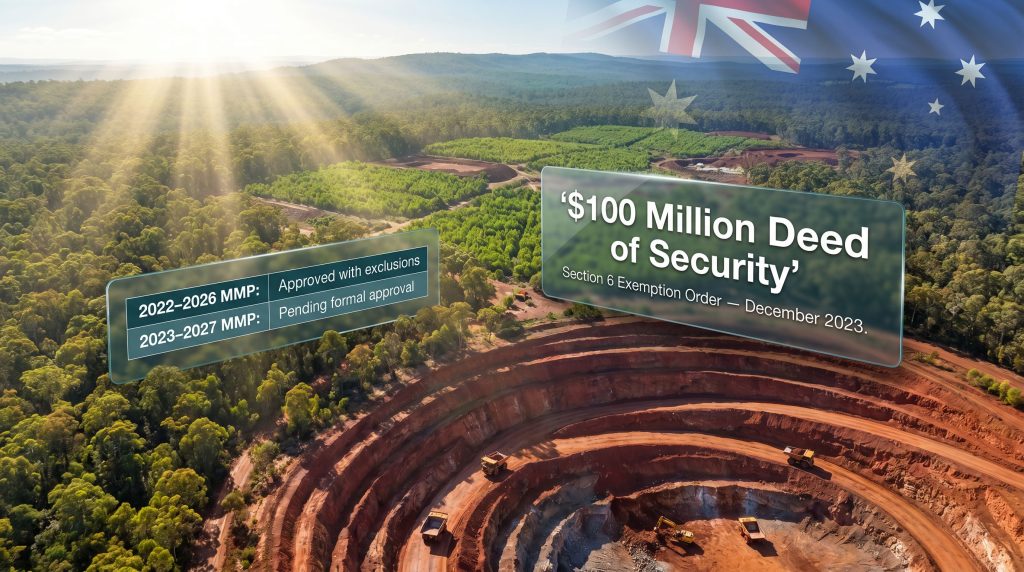
Within this framework, Alcoa's operations are organised around rolling five-year Mining and Management Programs (MMPs), each of which must receive regulatory approval before implementation. MMPs define the geographic footprint of planned extraction, outline environmental management commitments, and set rehabilitation obligations for mined land. The following table summarises the current status of the two most recently submitted MMPs:
| MMP Period | Approval Status | Key Notes |
|---|---|---|
| 2022–2026 | Approved with exclusions | Certain areas excluded from operational scope |
| 2023–2027 | Pending formal approval | Subject to active EPA Part IV assessment |
The overlap between these two programs reflects a structural feature of rolling MMP cycles, where sequential programs can exist in different stages of regulatory assessment simultaneously. This creates a planning complexity that operators, regulators, and community stakeholders must all navigate.
What a Section 6 Exemption Order Actually Does
A Section 6 Exemption Order under the Environmental Protection Act 1986 is a conditional interim instrument that allows a mining operator to continue implementing an approved program while the EPA's formal assessment of related activities is still underway. It does not represent final environmental approval and carries specific compliance conditions that must be met throughout its duration.
The WA Minister for Environment issued such an order in December 2023, enabling Alcoa's Huntly and Willowdale mines to remain operational while the EPA works through its Part IV assessment of the 2022–2026 and 2023–2027 MMPs. The exemption applies specifically to those components of both programs that became subject to formal assessment following the third-party referrals.
Critically, this is an interim mechanism with ongoing compliance obligations, not a regulatory green light. The distinction between conditional operational continuity and full environmental approval carries real significance for long-term planning. In addition, bauxite mine expansion scrutiny at other operations demonstrates how heightened public and regulatory attention is reshaping the sector more broadly.
The Environmental Stakes: What the EPA Is Actually Examining
The Northern Jarrah Forest and Its Dual Significance
Alcoa's Huntly and Willowdale mines operate within the Northern Jarrah Forest of the Darling Range, a zone that carries dual significance as both a high-value biodiversity corridor and the catchment system supplying much of Perth's metropolitan drinking water. This overlap is not incidental. It is the central tension that makes Alcoa WA bauxite mining regulations one of the most watched environmental compliance stories in the state.
The EPA's assessment scope covers a substantial range of activities, each carrying its own risk profile:
- Native vegetation clearing across active mining areas
- Haul road construction, expansion, and ongoing use
- Primary extraction operations at both mine sites
- Transport and logistics infrastructure supporting the supply chain
- Mineral exploration activities within the broader operational zone
- Post-mining rehabilitation programs and their effectiveness over time
Each of these activities interacts differently with the forest ecosystem and the underlying hydrology of the catchment. Haul roads, for instance, create linear disturbances that can fragment habitat and alter surface water flows in ways that persist well beyond active mining periods.
Refinery vs. Mine: A Regulatory Boundary That Matters
A point frequently overlooked in public discussion is that Alcoa's alumina refining operations at Pinjarra and Wagerup sit in a completely separate regulatory category from bauxite extraction. The current Section 6 Exemption Order and the EPA's Part IV assessment apply exclusively to upstream mining activities. Refinery operations are governed by their own distinct approval and compliance frameworks.
This distinction matters for two reasons. First, it clarifies the actual scope of regulatory risk currently in play. Second, it highlights the vertically integrated nature of Alcoa's WA operations, where disruption to upstream mining could affect downstream refining capacity even when refinery approvals remain intact. The Willowdale mine fact sheet provides further operational detail on how this integration functions at site level.
The $100 Million Security Deed: Financial Risk as Regulatory Signal
Perhaps the most striking feature of the current compliance architecture is the $100 million Deed of Security embedded within the Exemption Order conditions. This financial instrument becomes payable if Alcoa's bauxite mining operations are demonstrated to adversely affect Perth's metropolitan drinking water supply.
The size and specificity of this instrument communicates something important about how seriously the EPA and the WA Government are treating catchment risk. A financial security of this magnitude is not a standard feature of mining approvals. Its inclusion reflects regulatory acknowledgment that the water supply consequences of mining activity in the Darling Range catchment are material, quantifiable, and warranting a financial backstop.
For industry observers and investors, the deed also functions as a forward-looking risk indicator. The potential for a $100 million liability creates strong operational incentives for rigorous catchment management practices throughout the assessment period.
Compliance Monitoring: How the Interim Arrangement Is Policed
DWER's Assurance Framework
The Department of Water and Environmental Regulation (DWER) administers the compliance assurance program that runs alongside the Exemption Order. Monitoring activities are concentrated across three risk domains:
- Water resources — ongoing assessment of catchment integrity, surface water quality, and groundwater behaviour in areas adjacent to mining operations
- Biodiversity — tracking of native vegetation condition, fauna habitat quality, and the connectivity of ecological corridors within and around the operational footprint
- Human health — evaluation of proximity impacts on communities and the ongoing safety of Perth's drinking water supply
Monthly Reporting as a Transparency Mechanism
One of the more distinctive features of the current arrangement is the requirement for monthly compliance reporting. Alcoa must publish these reports throughout the Exemption Order period, creating a reporting cadence that is substantially more frequent than the annual environmental reporting standard for most mining operations in Australia.
This high-frequency disclosure model serves multiple functions simultaneously. It provides regulators with near real-time operational data, gives community groups and environmental organisations an ongoing evidence base, and creates a documented record that will inform the EPA's final assessment findings. For investors, monthly reporting also provides a regular signal about whether operational conditions are being maintained within acceptable parameters. The EPA WA referral process for the Darling Range operations offers further context on how community input has shaped this oversight structure.
Consequences of Non-Compliance
The enforcement architecture behind the Exemption Order is substantive. A confirmed breach of compliance conditions carries the following escalation pathway:
- Immediate notification obligations to DWER
- Potential suspension of mining activities in affected areas
- Activation risk for the $100 million security deed under water supply impact scenarios
- Regulatory escalation under Part IV of the Environmental Protection Act 1986
- Potential flow-on effects for MMP approval timelines
The combination of financial exposure and operational suspension risk creates a compliance incentive structure that extends well beyond standard regulatory deterrence.
Operational Context: The Mines, the Refineries, and the Supply Chain
Huntly and Willowdale: Scale and Function
| Mine | Location | Primary Function |
|---|---|---|
| Huntly | Darling Range, south of Perth | Principal bauxite extraction site |
| Willowdale | Darling Range, south of Perth | Secondary bauxite extraction site |
Both mines remain operational under the interim Exemption Order framework as of mid-2026. Their combined output sustains alumina production at the Pinjarra and Wagerup refineries, which are critical nodes in Australia's aluminium supply chain. The vertically integrated structure of this system means that regulatory constraints on mining activity have direct implications for refinery throughput, employment, and regional economic activity.
Rehabilitation of mined areas is not merely a compliance box to tick. The EPA's assessment places significant weight on whether post-mining rehabilitation programs are restoring ecological function in the Northern Jarrah Forest over time. Jarrah forest regeneration following bauxite mining has been an area of active research, and Alcoa's rehabilitation track record across decades of operations will likely feature prominently in the EPA's assessment findings.
Why Rehabilitation Quality Is More Technically Complex Than It Appears
Rehabilitating jarrah forest following bauxite extraction involves far more than replanting native species. The Northern Jarrah Forest has a distinctive understorey ecology, complex mycorrhizal soil networks, and hydrological characteristics that are difficult to fully reconstruct once disturbed.
Regulators and ecologists have long recognised that surface revegetation metrics alone are insufficient proxies for genuine ecosystem recovery. The EPA's assessment is expected to scrutinise the depth and long-term durability of rehabilitation outcomes, not simply the area of land returned to vegetation cover. For context, the leading bauxite mines globally demonstrate varying standards of rehabilitation practice, making the WA approach particularly instructive.
The Broader Regulatory Horizon: Federal Law and Industry Precedent
The Environment Protection Reform Bill 2025 and Its Implications
The passage of the Environment Protection Reform Bill 2025 at the federal level adds a further dimension to the regulatory environment facing large-scale bauxite mining in WA. The bill, which the resources industry labelled as inferior and disappointing upon its passage in late 2025, signals a federal appetite for greater oversight of projects with potential national environmental significance.
The interaction between state-level frameworks like the Environmental Protection Act 1986 and the federal Environment Protection and Biodiversity Conservation Act 1999 (EPBC Act) creates a dual-jurisdiction complexity for operators. Where federal triggers are engaged, projects must satisfy both regulatory layers. The reform bill's emphasis on stronger federal environmental standards could affect how future MMP approval processes unfold, particularly where Matters of National Environmental Significance are determined to be relevant.
A Precedent in the Making
The way WA regulators handle Alcoa WA bauxite mining regulations in this current situation is being watched across the industry for several reasons:
- It demonstrates how the Section 6 Exemption Order mechanism functions in practice for a large, legacy operation
- It tests the capacity of monthly compliance reporting to provide genuine accountability rather than procedural paperwork
- It establishes how financial security instruments at the $100 million scale can be embedded in interim approval conditions
- It will inform how third-party referral mechanisms are used in future assessments of ecologically sensitive mining operations
The outcome of the EPA's Part IV assessment will carry precedential weight for other operators working in comparable environments across Western Australia and potentially other jurisdictions. Furthermore, WA bauxite project benefits in emerging operations will be shaped by the standards established through this process. Similarly, Bauxite Hills production outcomes in Queensland illustrate how different regulatory settings can produce markedly different operational results.
The next major ASX story will hit our subscribers first
Frequently Asked Questions: Alcoa WA Bauxite Mining Regulations
Is Alcoa currently permitted to mine bauxite in Western Australia?
Yes. Alcoa's Huntly and Willowdale mines are operating under a Section 6 Exemption Order issued in December 2023, which permits continued mining while the EPA completes its formal Part IV assessment of both the 2022–2026 and 2023–2027 Mining and Management Programs.
What does the EPA's current assessment actually cover?
The assessment covers a wide range of upstream mining activities within the Northern Jarrah Forest, including native vegetation clearing, haul road infrastructure, active extraction, exploration, and the quality and long-term effectiveness of post-mining rehabilitation programs.
Why does the $100 million Deed of Security exist?
It functions as both a financial deterrent and a remediation funding mechanism, payable if Alcoa's bauxite mining operations are found to adversely impact Perth's metropolitan drinking water supply. Its inclusion reflects the EPA's assessment that catchment risk in the Darling Range is a material, not theoretical, concern.
What is a Mining and Management Program (MMP)?
An MMP is a five-year operational plan required under Alcoa's State Agreement Act framework. Each MMP specifies extraction areas, environmental management commitments, and rehabilitation obligations, and must receive regulatory approval before Alcoa can implement the activities described within it.
How frequently does Alcoa report on its compliance?
Monthly compliance reports are required under the conditions of the Section 6 Exemption Order, representing a significantly higher reporting frequency than the annual environmental reporting standard applied to most Australian mining operations.
Could Alcoa's operations be suspended?
Yes. Non-compliance with the Exemption Order's conditions could trigger suspension of mining activities in affected areas, with additional regulatory escalation possible under Part IV of the Environmental Protection Act 1986.
Key Regulatory Parameters at a Glance
| Regulatory Element | Detail |
|---|---|
| Governing Legislation | Environmental Protection Act 1986 (WA), Part IV |
| Operational Framework | State Agreement Act, five-year MMPs |
| Interim Mechanism | Section 6 Exemption Order (December 2023) |
| Compliance Administrator | Department of Water and Environmental Regulation (DWER) |
| Reporting Frequency | Monthly compliance reports |
| Financial Security Condition | $100 million Deed of Security (water supply risk) |
| Active Assessment Scope | Northern Jarrah Forest, vegetation, water, biodiversity, rehabilitation |
| Mines Currently Operating | Huntly and Willowdale (Darling Range) |
| Refineries Supplied | Pinjarra and Wagerup |
The Alcoa WA bauxite mining regulations framework currently in place represents one of the most structured interim compliance arrangements in Western Australian mining history. Operations continue, but under conditions that carry real financial, reputational, and operational consequences if not rigorously maintained. The EPA's final assessment outcome will determine the long-term shape of bauxite mining in one of Australia's most ecologically and hydrologically significant landscapes.
This article is intended for informational purposes only and does not constitute financial or legal advice. Regulatory frameworks and approval statuses may change. Readers should refer to official EPA Western Australia and DWER publications for current compliance documentation.
Want to Track the Next Major ASX Mineral Discovery as It Happens?
Discovery Alert's proprietary Discovery IQ model delivers real-time alerts on significant ASX mineral discoveries across more than 30 commodities — turning complex geological announcements into clear, actionable insights for both short-term traders and long-term investors. Explore Discovery Alert's discoveries page to understand how historic finds have generated substantial returns, and begin your 14-day free trial today to position yourself ahead of the broader market.