May 9, 2026
The Hidden Mineral Architecture Driving the Clean Energy Transition
Most discussions about the clean energy transition focus on the metals people already know: lithium, cobalt, copper. Yet beneath that familiar narrative, a quieter transformation is underway in how industrial nations are rethinking the full mineral stack that modern technology depends on. Niobium and strontium rarely appear in mainstream headlines, but their absence from a supply chain would be felt immediately across steel manufacturing, electric motor production, and wind turbine assembly. It is precisely this low-profile criticality that makes the Aldoro Resources Kameelburg niobium and strontium discovery in central Namibia so significant to anyone tracking where the next wave of critical minerals energy transition supply will actually originate.
When big ASX news breaks, our subscribers know first
What the Kameelburg Carbonatite System Reveals About Geological Opportunity
Carbonatite complexes occupy a unique position in economic geology. These rare igneous intrusions, formed from carbonate-rich magmas rather than the silicate melts that produce most rocks, have an unusual geochemical affinity for elements that do not concentrate easily elsewhere. Rare earth elements, niobium, and strontium tend to partition into carbonatite systems during crystallisation, which is why these geological structures are responsible for a disproportionate share of global critical mineral endowments despite representing a tiny fraction of the Earth's crustal volume.
The Kameelburg carbonatite complex sits within north-central Namibia, positioned between the towns of Otjiwarongo and Omaruru in a region geologically associated with the Central Damara Orogenic Belt. This tectonic corridor has long been recognised as one of Africa's more mineralogically prospective terranes, hosting a variety of intrusive bodies that formed during periods of continental collision and subsequent rifting.
What distinguishes the Kameelburg structure is its Cretaceous age and its classification as an approximately 1.4 kilometre diameter carbonatite plug. Plugs of this geometry often extend significantly at depth, and the open-at-depth characterisation of the system suggests that tested mineralisation down to the 300 to 500 metre horizon represents only a fraction of the deposit's total potential. For exploration geologists, an open-at-depth system is not simply encouraging language; it is a technical signal that resource boundaries have not yet been defined by the drilling programme, meaning the currently quantified mineralisation likely understates the deposit's full size.
Phase II Drilling: What the Numbers Actually Mean
The Phase II programme at Kameelburg comprised 15 diamond drillholes totalling 7,190 metres of core. Diamond drilling is the standard methodology for this deposit type because it recovers intact core samples that allow accurate grade measurement, structural interpretation, and metallurgical sampling, unlike reverse circulation methods that recover only chips.
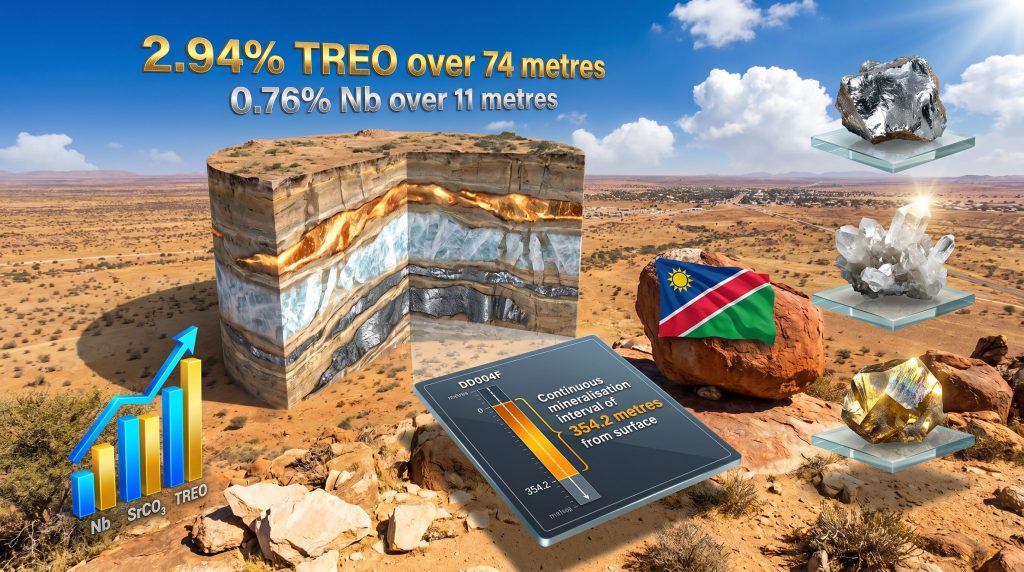
The headline intercept from drill hole DD004F returned 354.2 metres of continuous mineralisation from surface, a result that carries particular weight because surface-to-depth continuity dramatically reduces the stripping complexity of any future open-pit scenario. Within that broader zone, a 57-metre interval graded 1.85% Total Rare Earth Oxides (TREO), accompanied by 5.56% strontium carbonate (SrCO₃) and 0.16% niobium pentoxide (Nb₂O₅). These are not isolated high-grade splices but sub-intervals within a much longer mineralised envelope, which is the geological outcome that resource modellers most value when constructing a maiden or updated estimate.
Other results from the Phase II programme include:
- Peak rare earth grade of 2.94% TREO over 74 metres, confirming that high-grade rare earth zones exist within the deposit at meaningful widths
- Highest-grade niobium intercept of 0.76% Nb₂O₅ over 11 metres, which is a notable niobium concentration by global carbonatite standards
- Multiple strontium zones consistently exceeding 5% SrCO₃, often coincident with elevated rare earth grades rather than occurring in isolation
The co-occurrence of elevated niobium, strontium, and rare earth grades within the same drill intercepts is one of the deposit's most commercially significant characteristics. Multi-commodity carbonatites with this kind of grade overlap provide economic redundancy that single-commodity deposits structurally cannot.
Understanding Why Niobium and Strontium Are More Critical Than Their Profiles Suggest
Niobium: The Invisible Strengthener in Everything Steel
Niobium's primary industrial function is as a micro-alloying agent in high-strength, low-alloy steel. Even tiny additions, often less than 0.1% by weight, can increase steel's tensile strength by 30% or more while simultaneously improving its resistance to heat-related deformation. This makes niobium-bearing steel the material of choice for automotive body structures, pipeline infrastructure, shipbuilding, and high-rise construction.
What makes this commodity strategically sensitive is the extraordinary concentration of its global supply. A single country, Brazil, accounts for the overwhelming majority of the world's niobium production, with the Araxá deposit operated by CBMM (Companhia Brasileira de Metalurgia e Mineração) alone representing a dominant share of global output. This near-monopoly structure means that any supply disruption, whether logistical, political, or geological, could send ripple effects through every steel-dependent manufacturing sector on the planet.
Beyond steel, niobium is increasingly relevant to advanced technology applications. Furthermore, the critical minerals demand surge for these applications is accelerating:
- Superalloys for jet turbine blades and aerospace components requiring extreme heat tolerance
- Superconducting niobium-titanium and niobium-tin alloys used in MRI machines and particle accelerators
- Emerging research into niobium oxide as an anode material in next-generation lithium-ion batteries, where its layered structure may enable faster charging than conventional graphite anodes
Strontium Carbonate: The Quiet Backbone of Permanent Magnets
Strontium carbonate (SrCO₃) is the precursor material for strontium ferrite, the most widely produced permanent magnet material in the world by volume. Strontium ferrite magnets, also called ceramic magnets, are found in virtually every electric motor that does not require the extreme power density of rare earth magnets: household appliance motors, small industrial drives, loudspeakers, and the auxiliary motors throughout electric vehicles.
The clean energy transition's dependency on strontium is less visible than its dependency on lithium or rare earths, but it is structurally real. Wind turbine pitch control systems, EV power steering actuators, and regenerative braking motors all rely on strontium ferrite components. As global EV production scales from millions to tens of millions of units annually, strontium demand will scale in proportion.
| Mineral | Primary Industrial Use | Clean Energy Application | Key Supply Risk |
|---|---|---|---|
| Niobium (Nb₂O₅) | HSLA steel micro-alloying | EV battery anodes, superconductors | Near-monopoly supply concentration in Brazil |
| Strontium Carbonate (SrCO₃) | Strontium ferrite magnet manufacturing | Wind turbine motors, EV auxiliary drivetrains | Limited primary mine production globally |
| Rare Earth Elements (TREO) | Electronics, catalysts, permanent magnets | EV traction motors, wind turbine generators | Processing chain heavily concentrated in China |
How Kameelburg Compares Within Namibia's Critical Mineral Landscape
Namibia's emergence as a critical minerals jurisdiction is not built on a single project. The country's geological endowment spans uranium at the Rössing and Husab operations, diamonds across the Orange River corridor, and an expanding rare earth and base metal exploration pipeline that now includes the Lofdal heavy rare earth project operated by Namibian Critical Minerals.
The comparison between Kameelburg and Lofdal is instructive precisely because they are so different in character:
| Project | Location | Key Commodity Focus | Grade Profile | Development Stage |
|---|---|---|---|---|
| Kameelburg | Otjiwarongo-Omaruru corridor | REE + Nb + Sr (multi-commodity) | 2.94% TREO peak / 0.76% Nb₂O₅ / >5% SrCO₃ | Resource estimate pending |
| Lofdal | Khorixas District, Namibia | Heavy REE dominant | HREO-biased, xenotime-hosted | Advanced exploration / PEA stage |
Lofdal's value proposition is built on heavy rare earth element (HREE) grades, which command significant premiums over light rare earth elements due to their scarcity and importance in high-performance magnets. Kameelburg's strength, by contrast, lies in the sheer breadth of its commodity exposure. A development scenario at Kameelburg could generate revenue from three separate product streams simultaneously, providing a natural hedge against commodity price fluctuations that single-commodity operations cannot replicate.
This multi-stream architecture is one reason why the forthcoming Mineral Resource Estimate (MRE) will function as a genuine inflection point for the project. Understanding mineral deposit tiers is essential context here: under JORC 2012 standards, drilling results transition into formal resource classifications once sufficient geological confidence is established. The categories progress from Inferred, where geological continuity is conceptually established but not rigorously tested, through Indicated to Measured, where data density supports detailed mine planning. The Phase II programme's 7,190 metres of core across 15 holes is designed to provide the data density required to underpin an initial JORC-compliant estimate.
Funding Architecture and the Exploration Pathway Forward
Aldoro Resources has secured N$39 million (Namibian dollars) through an underwriting agreement to fund continued drilling operations at Kameelburg through to September 2026. The company's board confirmed that Phase II drilling revealed the deposit to be both larger in scale and more valuable in composition than the project's initial geological models anticipated, a finding that directly underpins the decision to commit expanded capital to the next exploration phase.
The structured underwriting approach reflects a particular discipline in how junior exploration companies can manage dilution risk at the pre-resource stage. By securing a committed funding facility rather than relying on episodic equity placements, the project retains financial continuity through the critical data-collection phase when interruptions are most costly to geological interpretation.
The exploration milestone sequence from this point follows a logical critical path:
- Completion and release of remaining Phase II assay results and three-dimensional geological modelling
- Publication of the updated JORC-compliant Mineral Resource Estimate incorporating all Phase II drill intercepts
- Bulk sampling programme using the Smart 8 drilling rig to generate material for metallurgical test work on REE, Nb, and Sr recovery
- Scoping study to assess large-scale mining viability, processing infrastructure requirements, and project economics at varying commodity price scenarios
- Strategic partner and offtake engagement with industrial economies actively seeking to diversify critical mineral supply chains
The transition from a drill result to a JORC-classified resource estimate is the single most important de-risking event in an exploration project's lifecycle. It transforms geological inference into a quantified, independently verifiable asset that institutional capital can evaluate with confidence.
Namibia's Position in the Global Critical Minerals Reconfiguration
Namibia's role in global critical mineral supply chains is not simply a matter of geological luck. The country brings a combination of mineral endowment, political stability, established mining regulation, and proximity to export infrastructure that few peer African jurisdictions can match simultaneously.
The Namibian Ministry of Mines and Energy operates within a legal and regulatory framework that has historically supported transparent foreign direct investment in the resource sector. Combined with access to Walvis Bay, one of southern Africa's most strategically positioned deep-water ports, and an existing rail network connecting mining regions to coastal export terminals, Namibia's infrastructure profile materially reduces the logistics risk that often undermines otherwise attractive African mineral projects.
The international interest directed at Namibia's critical minerals sector reflects a coordinated diversification strategy among industrial economies. Japan and European Union member states have each developed formal frameworks for securing supply chains in minerals classified as strategically critical. The European critical raw materials framework, which came into force in 2024, designates niobium and rare earth elements among the materials requiring active supply chain diversification away from single-country dependency. Japan's bilateral critical minerals investment approach similarly targets African producers as part of its long-term industrial security planning.
What Business Insider Africa has characterised as a mutually beneficial dynamic is economically precise: industrial economies gain access to raw materials essential to their clean technology manufacturing ambitions, while Namibia gains investment capital, technology transfer, and the foundation for domestic processing capacity rather than simply exporting unprocessed ore. This value-addition dimension is increasingly central to how Namibia's government approaches mineral development policy, with ambitions to evolve from a raw material exporter toward a processing hub servicing both Asian and European industrial demand.
Namibia Versus Peer African Critical Mineral Jurisdictions
The Democratic Republic of Congo dominates cobalt supply but carries substantial governance and infrastructure risk. Zimbabwe holds significant lithium resources but has faced policy unpredictability that has complicated foreign investment. South Africa's established mining sector is being tested by energy supply constraints and regulatory complexity. Against this peer group, Namibia's combination of political stability, English-language legal system, and transparent mining code positions it favourably for the risk-conscious institutional capital that increasingly flows into critical minerals investment.
The next major ASX story will hit our subscribers first
Frequently Asked Questions: Aldoro Resources Kameelburg Niobium and Strontium Discovery
What minerals were discovered at Kameelburg?
The Aldoro Resources Kameelburg niobium and strontium discovery confirmed the presence of high-grade niobium (Nb₂O₅), strontium carbonate (SrCO₃), and rare earth elements (TREO) within a Cretaceous-age carbonatite complex in central Namibia. These findings place the project among the more significant multi-commodity carbonatite discoveries in recent years.
Where is the Kameelburg project located?
The project sits in north-central Namibia between the towns of Otjiwarongo and Omaruru, within the geological corridor of the Central Damara Orogenic Belt.
What are the highest-grade results recorded?
The peak rare earth grade reached 2.94% TREO over 74 metres. The highest niobium intercept returned 0.76% Nb₂O₅ over 11 metres, and multiple strontium zones consistently exceeded 5% SrCO₃, often co-occurring with elevated rare earth grades within the same intervals. The Extractor Magazine has noted these results as particularly notable by global carbonatite standards.
How much funding has been secured for continued exploration?
Aldoro secured N$39 million through an underwriting agreement, with proceeds allocated to expanded diamond drilling operations running through to September 2026.
What is the next major milestone for the project?
The release of a JORC-compliant Mineral Resource Estimate incorporating all Phase II drilling results represents the primary near-term catalyst, followed by bulk sampling and metallurgical test work to assess recoverable grades for each commodity stream.
Why are niobium and strontium considered strategically important?
Niobium is essential for high-strength steel manufacturing and is emerging as a material of interest in advanced battery anode research, with global supply concentrated in Brazil. Strontium carbonate is the primary feedstock for ferrite permanent magnets used throughout electric vehicle drivetrains and wind turbine motor systems. In addition, the broader context of rare earth supply chains highlights why multi-commodity discoveries of this nature attract serious institutional attention.
What the Kameelburg Discovery Signals for the Critical Minerals Decade
The broader significance of the Aldoro Resources Kameelburg niobium and strontium discovery extends beyond a single project's drill results. It reflects a structural pattern now visible across multiple African mineral jurisdictions: the convergence of underexplored geology, improving exploration technology, and urgent international demand for supply chain diversification.
For junior exploration companies specifically, Namibia represents a compelling intersection of geological prospectivity and jurisdictional quality that is genuinely rare at the global scale. The country's existing mining infrastructure, regulatory transparency, and export logistics reduce the timeline from discovery to potential production relative to greenfield projects in frontier jurisdictions with no established mining framework.
From an investor perspective, the Kameelburg project sits at a particularly interesting stage in its development lifecycle. The gap between a well-drilled carbonatite system with multi-commodity high-grade results and a formally classified JORC resource is one of the most asymmetric risk-reward positions available in junior resource investment. The capital required to bridge that gap, as evidenced by the N$39 million underwriting facility, is modest relative to the potential valuation rerating that accompanies a credible resource estimate in a mineral category experiencing genuine supply-side anxiety from industrial consumers.
The long road from exploration to production for a project at Kameelburg's scale would typically involve a scoping study, prefeasibility assessment, feasibility study, permitting, and mine construction over a timeline measured in years rather than months. That timeline is accompanied by substantial capital requirements and multiple technical risks, including metallurgical recovery rates that can only be fully understood through systematic test work on bulk samples. Investors evaluating the project at this stage must consequently weigh the significant upside of a multi-commodity carbonatite in a stable jurisdiction against the execution risks inherent in taking any exploration-stage asset toward commercial production.
What is not speculative, however, is the direction of demand. Every credible projection for clean energy technology deployment points toward accelerating consumption of the minerals that Kameelburg holds. Whether it is the niobium in high-strength structural steel for offshore wind tower foundations, the strontium ferrite in EV auxiliary motors, or the rare earth oxides in wind turbine generators, the end-use trajectory is consistent and compounding. The Aldoro Resources Kameelburg niobium and strontium discovery does not guarantee a mine. But it meaningfully expands the geography of where the minerals underpinning the next industrial era might come from.
This article contains forward-looking statements and projections based on information available at the time of writing. Mineral exploration involves significant uncertainty, and exploration results do not guarantee the discovery of an economically viable deposit. Readers should conduct independent research and seek qualified financial advice before making investment decisions related to any company or project discussed herein.
For additional context on Namibia's emerging role in the global critical minerals sector, Business Insider Africa provides ongoing coverage of mineral development trajectories and international investment partnerships across the continent. Visit africa.businessinsider.com for updates.
Want to Catch the Next Major Critical Minerals Discovery Before the Market Does?
Discovery Alert's proprietary Discovery IQ model scans ASX announcements in real time, instantly identifying significant mineral discoveries across niobium, rare earths, strontium, and more than 30 other commodities — translating complex data into clear, actionable opportunities for both traders and long-term investors. Explore how historic discoveries have generated substantial returns on Discovery Alert's dedicated discoveries page, and begin your 14-day free trial today to position yourself ahead of the market.