July 21, 2026
When a Gemstone Becomes a Geopolitical Statement
Rare mineral discoveries rarely arrive without context. In the coloured gemstone trade, a single extraordinary find can reshape supply expectations, reignite ethical debates, and expose the fault lines running beneath an entire industry. The enormous ruby discovered in Myanmar in April 2026 does all three simultaneously, and understanding why requires looking well beyond the stone itself.
When big ASX news breaks, our subscribers know first
What the 2026 Myanmar Ruby Actually Represents
Scale, Weight, and What 11,000 Carats Means in Practice
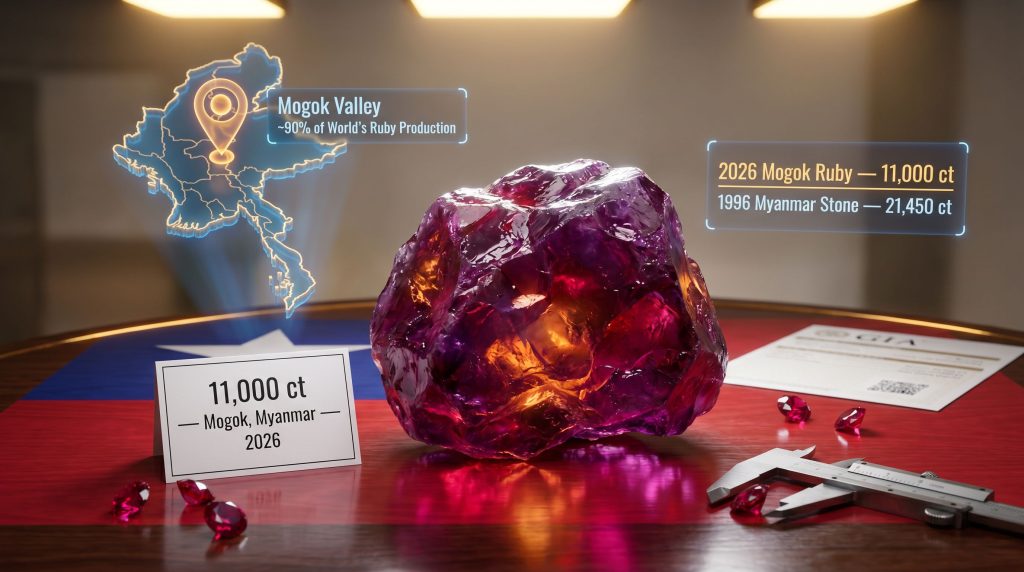
The ruby unearthed near Mogok in Myanmar's upper Mandalay region in mid-April 2026 weighs 11,000 carats, equivalent to 2.2 kilograms or roughly 4.8 pounds. For context, a standard engagement ring ruby typically weighs between 0.5 and 2 carats. This single rough stone contains the equivalent of thousands of such gems within its mass.
For non-specialists, carat is a unit of mass rather than size: one carat equals 0.2 grams. At 11,000 carats, the Mogok find represents one of the most significant ruby discoveries in recorded gemological history, though it is not the heaviest on record.
The comparison table below contextualises this discovery against other historically significant large rubies:
| Ruby | Carat Weight | Year Found | Location | Notable Feature |
|---|---|---|---|---|
| 2026 Mogok Ruby | 11,000 ct (2.2 kg) | 2026 | Mogok, Myanmar | Superior colour and clarity relative to weight |
| 1996 Myanmar Stone | 21,450 ct (4.29 kg) | 1996 | Mogok, Myanmar | Largest known ruby by raw weight |
| Liberty Bell Ruby | 8,500 ct | 1950s | East Africa | Carved into a liberty bell shape |
| Sunrise Ruby | 25.59 ct (cut) | Unknown | Myanmar | Among the highest per-carat prices achieved at auction for a ruby |
The 2026 ruby weighs approximately 51% of the 1996 stone's mass, yet is assessed as more valuable. This distinction is fundamental to understanding how professional gemstone valuation actually works.
Why Colour and Quality Outweigh Raw Mass
The 2026 discovery is described as having a purplish-red hue with yellowish undertones, high colour grade, moderate transparency, and a highly reflective surface. These characteristics place it in a category that commands significant market premiums regardless of carat weight. Furthermore, the enormous ruby discovered in Myanmar has drawn international media attention precisely because of these exceptional qualities.
In ruby valuation, colour saturation is the dominant value driver. The gemological concept sometimes described as ideal ruby colouration refers to a vivid, deeply saturated red with a fluorescent quality under daylight conditions. Stones exhibiting this characteristic from Myanmar's Mogok Valley have historically commanded per-carat prices that can exceed those of equivalent-weight diamonds.
Industry Insight: In the coloured gemstone trade, a stone with exceptional colour saturation and provenance documentation from Mogok can realise multiples of the price of a heavier stone with inferior colour. Raw carat weight is simply one input in a multi-variable valuation equation that prioritises hue, saturation, tone, clarity, and origin above all else.
Inside the Mogok Valley: Geography, Geology, and Centuries of Production
Why Myanmar Dominates Global Ruby Supply
Myanmar produces an estimated 90% of the world's rubies, with output concentrated in two primary regions: Mogok in the upper Mandalay district, and Mong Hsu in Shan State. These two zones represent structurally different deposit types and quality profiles. Understanding the mineralogy of ores present in these regions helps explain why such extraordinary specimens continue to emerge.
Mogok has operated as a gem-producing region for centuries, with documented mining activity predating colonial administration. Its geological conditions involve marble-hosted corundum deposits formed through metamorphic processes, which produce rubies with the characteristic colour properties associated with the finest specimens. The relative absence of iron in the host rock allows chromium-driven fluorescence to dominate, contributing to the vivid red tones Mogok stones are celebrated for.
Mong Hsu, identified as a significant producer since the 1990s, tends to yield stones with different colour characteristics, often requiring heat treatment to achieve commercially acceptable colour grades. This treatment distinction matters significantly in premium markets, where untreated or minimally treated Mogok stones carry substantial provenance premiums. In addition, metamorphic ore deposits like those at Mogok represent some of the world's most geologically distinctive gem-bearing formations.
From Rough Stone to Market: The Processing Journey
Understanding how an 11,000-carat rough ruby moves from extraction to commercialisation reveals why valuations at the rough stage are highly speculative. Consequently, the following steps illustrate the complex journey from mine to market:
-
Extraction — Manual or mechanised removal from alluvial gravels or hard-rock marble deposits in Mogok's mining pits
-
Initial assessment — Visual grading by experienced sorters evaluating colour zoning, inclusion patterns, and structural integrity to determine cutting potential
-
Cleaving and shaping — Critical decisions about how to maximise either yield (total carat weight retained) or quality (per-carat value of finished stones), as these objectives often conflict
-
Heat treatment — Industry-standard thermal processing used in the majority of commercial rubies to improve colour saturation and reduce visible inclusions; Mogok stones treated this way retain significant value, unlike some other origins
-
Certification — Independent laboratory grading by institutions such as the Gemological Institute of America (GIA) or the Gübelin Gem Lab in Switzerland, which document origin, treatment history, and quality grades
-
Market placement — Allocation to auction houses, private treaty sales, or wholesale trade channels depending on stone quality and buyer relationships
A rough stone of this size would almost certainly be divided into multiple cut gems rather than preserved as a single unit. The yield from cutting rough ruby can vary dramatically based on inclusion patterns and colour distribution, meaning the eventual commercial output of this 11,000-carat stone cannot be determined without detailed internal assessment.
Myanmar's Military and the Gem Revenue Machine
How the Mining Industry Became a Junta Asset
The enormous ruby discovered in Myanmar arrives in a political context that transforms its significance far beyond the gemological. Myanmar's gem sector has functioned as a consistent revenue stream for successive military governments across multiple decades, a structural relationship documented by international bodies and human rights organisations alike.
In 2019, the United Nations Human Rights Council published findings linking two major conglomerates, Myanmar Economic Holdings Limited and Myanmar Economic Corporation, directly to senior military leadership, including President Min Aung Hlaing and Deputy Commander-in-Chief Vice Senior General Soe Win. Both entities, together with at least 26 of their subsidiaries, hold documented licences for jade and ruby mining operations across Kachin and Shan states.
The same UN investigation found that Myanmar's military, known as the Tatmadaw, committed international human rights and humanitarian law violations including forced labour and sexual violence in northern Myanmar in connection with these business activities.
Min Aung Hlaing, who led the 2021 military takeover that ousted the civilian government of Nobel Peace Prize laureate Aung San Suu Kyi, subsequently became President following elections characterised by human rights and opposition groups as illegitimate. He was photographed examining the newly discovered ruby at his office in Naypyitaw, a detail that crystallises the relationship between resource discovery and military power in Myanmar.
Accountability Context: The UN Independent International Fact-Finding Mission on Myanmar formally recommended that both Min Aung Hlaing and Vice Senior General Soe Win be investigated and prosecuted for genocide, crimes against humanity, and war crimes. These recommendations remain unresolved as of 2026.
The Dual-Funding Problem: Junta and Armed Groups
A less commonly understood dimension of Myanmar's gem trade is that mining revenues do not flow exclusively to the military junta. Gemstone extraction serves simultaneously as a primary funding source for ethnic armed organisations (EAOs) seeking territorial autonomy from the central government.
This dual-funding dynamic means that gems mined in conflict zones may benefit multiple armed actors simultaneously, complicating any ethical framework that attempts to draw clean lines between military-controlled and independent production. The resource itself is contested, with control shifting according to military fortunes rather than market or regulatory mechanisms. Furthermore, the intersection of minerals and geopolitics is nowhere more apparent than in Myanmar's contested gem-producing regions.
The Mogok Conflict: A Mining Region at War
Timeline of Control Over Myanmar's Most Important Ruby Zone
The security situation surrounding the 2026 discovery reflects years of escalating violence in Myanmar's gem-producing heartland:
-
July 2024: The Ta'ang National Liberation Army (TNLA), a guerrilla force representing the Palaung ethnic minority, captured Mogok and took operational control of its mines
-
Late 2024: A China-mediated ceasefire transferred control of Mogok back to Myanmar's military
-
Mid-April 2026: The enormous ruby was discovered in the region, now under military control following the ceasefire
-
May 9, 2026: The discovery was reported internationally, with Min Aung Hlaing photographed examining the stone at his Naypyitaw office
China's mediation role in the ceasefire is significant. Beijing holds substantial economic interests in regional stability and uninterrupted resource supply chains running through Myanmar, which shares a lengthy border with China's Yunnan province. The ceasefire that returned Mogok to military control reflects these overlapping strategic priorities rather than purely humanitarian considerations.
The TNLA's period of mine operation during its control of Mogok represents a case study in how resource-producing zones become both military objectives and economic assets in protracted civil conflicts. The broader geopolitical mining landscape across Southeast Asia continues to be shaped by precisely these kinds of resource-driven territorial disputes.
The Ethical Dimension: Who Bears Responsibility?
Supply Chain Opacity and the Traceability Problem
For consumers and jewellery brands attempting to exercise ethical purchasing decisions, Myanmar rubies present a structural challenge that distinguishes them from most other commodity categories. Gemstones can travel through multiple intermediary markets, including Thailand, India, and Hong Kong, before reaching end buyers, with paperwork that may obscure or misrepresent origin.
Unlike rough diamonds, which fall under the Kimberley Process Certification Scheme, coloured gemstones have no equivalent internationally mandated traceability framework. Gemological laboratories can perform origin determination testing using trace element analysis and inclusion fingerprinting, but these methods carry margins of uncertainty and are not universally applied across the supply chain.
Due Diligence Standard: The 2019 UN Mission Expert report stated that, given the documented extent of military involvement in jade and ruby mining in northern Myanmar, businesses and consumers across the entire supply chain — from mining enterprise to end consumer — bear responsibility for ensuring their purchases do not support enterprises owned or influenced by the Tatmadaw.
UK-based research and lobbying organisation Global Witness has actively called on the global jewellery industry to cease purchasing Myanmar-sourced gems, citing the sustained role of gem revenues in funding Myanmar's successive military governments.
The Sanctions Landscape
Several major economies have implemented formal restrictions on Myanmar gem imports, creating a patchwork of trade barriers that has reshaped but not eliminated international ruby commerce from this origin:
| Jurisdiction | Sanctions Instrument | Scope | Year Introduced or Updated |
|---|---|---|---|
| United States | JADE Act and Executive Orders | Prohibits import of Burmese jadeite and rubies | 2008, expanded post-2021 |
| European Union | Myanmar Sanctions Regime | Targets military-linked entities and gem exports | Updated 2021 |
| United Kingdom | UK Myanmar Sanctions | Mirrors EU framework following Brexit | 2021 |
The existence of these sanctions has not eliminated Myanmar ruby circulation in international markets. Intermediary re-export channels, particularly through Southeast Asian trading hubs, allow stones to enter commerce under documentation that does not reflect true origin. This structural gap between policy intent and market reality is one of the central challenges facing regulators and ethical consumers alike.
The next major ASX story will hit our subscribers first
The International Legal Framework and Its Implications
The ICJ Genocide Case
The January 2026 opening of formal hearings in The Gambia's genocide case against Myanmar at the International Court of Justice added a new legal dimension to the country's already fraught international standing. The Gambia's position, as presented to the court, described Myanmar as having targeted the Rohingya Muslim population with deliberate violence in 2017, including mass displacement, documented accounts of rape, arson, and murder, driving hundreds of thousands across the border into Bangladesh. Myanmar has denied all allegations.
An eventual ICJ judgment, if it proceeds, could influence international sanctions frameworks and the legal exposure of entities trading with Myanmar's military-linked industries. The timeline for such a judgment extends well beyond the near term, but the proceeding itself maintains international legal pressure on the junta.
The UN Special Rapporteur's Final Report
In April 2026, UN Special Rapporteur Tom Andrews released his concluding report, titled From Impunity to Justice, documenting decades of military attacks on civilian populations, persecution of ethnic minorities, and widespread sexual violence in Myanmar. The report emphasised that ending the crisis requires both dismantling the military's capacity for violence and establishing genuine accountability mechanisms for past violations.
The December 2019 UN General Assembly resolution had already formally condemned human rights abuses against Myanmar's Rohingya population and other minorities, including arbitrary arrests, torture, rape, and deaths in detention. The April 2026 report extended this documentation into a broader accountability framework.
Market Implications and the Future of Myanmar's Gem Trade
What the Discovery Signals About Mogok's Geological Productivity
The emergence of a significant ruby of this quality from Mogok in 2026 confirms that the valley retains substantial geological productivity despite centuries of intensive extraction. This matters for supply-side analysis of the global ruby market. However, demand for such specimens must also be considered in the context of rising critical minerals demand and shifting investor interest in high-value geological resources more broadly.
The critical question is not whether Mogok can produce exceptional stones, but whether those stones will ever enter legitimate international commerce. Under current sanctions regimes, any ruby traceable to Myanmar's military-controlled production channels cannot legally enter the United States, European Union, or United Kingdom markets. This creates a paradox: the world's most productive ruby region is simultaneously one of its least accessible for compliant buyers.
Laboratory-Grown Rubies and the Ethical Alternative
The ethical complications surrounding Myanmar rubies have accelerated consumer and industry interest in laboratory-grown alternatives. Synthetic rubies, produced through flame fusion or hydrothermal growth processes, are chemically and physically identical to natural stones and can be certified to specific colour grades. Their adoption by jewellery brands seeking to avoid supply chain complexity has grown substantially.
Their competitive pricing relative to natural Mogok rubies continues to pressure the natural stone market at lower and mid-tier price points. At the premium and collector market levels, however, provenance remains decisive. A certified natural ruby from Mogok with documented origin and ethical sourcing verification still commands premiums that no laboratory-grown alternative can replicate. This bifurcation of the market — between ethically-concerned mass-market buyers and provenance-focused collectors — is likely to intensify as international scrutiny of Myanmar's gem trade continues.
This article is based on publicly available reporting, including ABC News (May 9, 2026), and documentation from the UN Human Rights Council and UN Independent International Fact-Finding Mission on Myanmar (2019). Claims regarding valuations, geological characterisation, and market dynamics reflect currently available information and should not be construed as investment, purchasing, or legal advice. Sanctions regulations vary by jurisdiction and should be verified with qualified legal counsel.
Want to Stay Ahead of Significant Mineral Discoveries the Moment They Hit the ASX?
Discovery Alert's proprietary Discovery IQ model delivers real-time alerts on significant ASX mineral discoveries across more than 30 commodities, turning complex geological data into clear, actionable investment insights for traders and long-term investors alike. Explore how historic discoveries have generated extraordinary returns and begin your 14-day free trial today to position yourself ahead of the broader market.