May 20, 2026
When the Financial Map No Longer Matches the Territory
The maps investors use to navigate global markets were drawn in a different era. They assume stable alliances, dollar supremacy, predictable energy flows, and a rules-based order anchored by Western institutions. Every one of those assumptions is now under active stress. For those paying attention to the intersection of geopolitics and capital markets, the structural dislocation unfolding across Eurasia, the Persian Gulf, and the Atlantic alliance system is not background noise — it is the signal. Understanding how these forces translate into portfolio risk is what Alex Kranner on geopolitics and financial markets has been mapping for years, and his framework offers a lens that most conventional market analysts have yet to fully integrate.
When big ASX news breaks, our subscribers know first
The Structural Shift That Markets Are Still Pricing Wrong
From Unipolarity to Multipolarity: The Defining Macro Theme of the 2020s
For roughly three decades following the Cold War, the global financial system operated within a unipolar framework. Dollar hegemony, Western-controlled energy corridors, and U.S. military reach underwrote the assumptions baked into sovereign bond pricing, currency reserves, and commodity markets. That architecture is fracturing, and the multipolar world economy is no longer a distant forecast but an emerging reality.
Geopolitical analyst Sergey Karaganov has articulated a framework that Kranner finds particularly instructive: the core challenge for non-Western powers is not to defeat the United States but to help it transition from global hegemon to a normal major power with the least possible disruption. This framing reframes the entire geopolitical chess match. It is not about confrontation — it is about managed decline, and the pace and smoothness of that decline will determine the severity of financial market dislocations over the coming decade.
This transition is the defining macro theme of the 2020s. Investors who treat it as a geopolitical abstraction rather than a market-relevant variable are, in Kranner's assessment, ignoring the most consequential structural shift in the global economic order since the post-war Bretton Woods settlement.
What the U.S.-China Summit Actually Signalled
Misaligned Priorities at the Highest Level
Diplomatic summits between major powers are rarely what they appear on the surface, and the recent U.S.-China meeting was no exception. According to Kranner's analysis, the two delegations arrived with fundamentally different objectives. China's leadership was oriented toward long-term strategic architecture, including Eurasian trade integration, security frameworks, and the management of multipolar transition. The U.S. delegation, by contrast, was primarily focused on securing deliverable trade trophies for domestic political consumption ahead of midterm elections.
Analysts with reported contacts inside Chinese diplomatic circles indicated that the Chinese side found the American delegation underprepared, which constrained the summit's potential to produce meaningful strategic alignment. The public outcome reflected this mismatch: the U.S. framed the meeting around prospective purchases of American oil and aircraft, while Chinese officials offered measured, non-committal responses.
For markets, this divergence signals continued strategic ambiguity rather than resolution. Historically, persistent ambiguity between the world's two largest economies elevates risk premiums across emerging market assets, commodity supply chains, and technology sectors exposed to export controls.
The Thucydides Trap and What Xi's Question Actually Meant
Xi Jinping's invocation of the Thucydides Trap during the summit was not accidental. The concept, drawn from classical Greek history, describes the tendency toward conflict when a rising power threatens to displace an established dominant one. By framing his concern as a series of open questions rather than declarations, Xi was communicating something precise: China is building its future on a defined trajectory, and the question is whether the United States can participate in that transition without generating catastrophic disruption.
Kranner's reading is that this rhetorical framing, combined with subsequent statements from China's Ministry of Foreign Affairs identifying peace in the Persian Gulf as a top strategic priority, places the burden of de-escalation squarely on Washington. Whether the current administration can meet that challenge within its three-year effective horizon remains deeply uncertain. Furthermore, the broader geopolitical metals landscape is already responding to these shifting dynamics in ways that many portfolio managers have not yet accounted for.
The Russia-China-U.S. Triangle and Capital Flow Implications
Playing Different Time Horizons
One of the most underappreciated asymmetries in global geopolitics is the mismatch in strategic time horizons. Both Moscow and Beijing operate on decade-scale planning cycles. Washington, constrained by electoral cycles and the need for near-term wins, effectively operates on a three-year horizon at most. This asymmetry has profound implications for how each party approaches negotiation, infrastructure investment, and alliance-building.
| Geopolitical Actor | Strategic Horizon | Primary Objective | Market Implication |
|---|---|---|---|
| United States | ~3 years (electoral cycle) | Domestic wins, trade trophies | Short-term deal volatility |
| China | Decades | Multipolar Eurasian integration | Long-term commodity demand |
| Russia | Medium-long term | Secure Eurasian corridor, end Ukraine conflict | Energy price sensitivity |
| Iran | Near-term leverage | Regional dominance, sanctions relief | Strait of Hormuz risk premium |
Infrastructure as Geopolitical Signal
The viability of China's Belt and Road Initiative and Russia's International North-South Transport Corridor — a route designed to bypass both the Suez Canal and the Bab-el-Mandeb chokepoint — is directly tied to stability in the Persian Gulf. Both projects become significantly more viable if Iran retains its current dominant position in Western Asia. For commodity traders and logistics-sensitive equity investors, the progression of these infrastructure corridors over the next five years warrants close monitoring. Scholars examining China's geopolitics of Eurasia have documented how Beijing's western strategy is reshaping trade flows across the entire continent.
Iran: The Geopolitical Variable Most Markets Are Mispricing
From Maximum Pressure to Escalatory Dominance
Kranner's assessment of Iran's current strategic position is striking in its directness: after more than a century of colonial interference, sanctions regimes, and imposed conflicts, Iran has repositioned itself from a supplicant seeking relief to an actor exercising escalatory dominance in its own region. Control of the Strait of Hormuz, through which approximately 20% of the world's traded oil passes, gives Tehran a leverage instrument of extraordinary magnitude.
The nuclear dimension cannot be dismissed as a tail risk. Kranner notes that there are concerning indicators suggesting the possibility of extreme escalatory scenarios in the region. While not a base case, such outcomes would carry severe implications for global energy supply chains, shipping insurance markets, and sovereign debt spreads across energy-importing nations.
The Petrodollar Disruption Already Underway
Iran's control of the Strait of Hormuz is being used not merely as a military deterrent but as a financial instrument. Ships and cargoes transiting the strait are reportedly being conditioned on payment in currencies other than the U.S. dollar, with the Chinese yuan as the primary alternative. Kranner also notes an unverified but highly significant report suggesting that Iran has signalled to European counterparties that euro-denominated cargo payments may qualify for passage.
If accurate, this represents a strategically sophisticated move. European economies are acutely vulnerable to dollar liquidity constraints, relying on Federal Reserve swap lines to participate in global dollar-denominated trade. An Iranian-facilitated pathway to conduct energy trade in euros would directly address one of Europe's most significant financial vulnerabilities, potentially accelerating dedollarization far beyond what mainstream forecasters have modelled.
What is dedollarization? Dedollarization refers to the gradual reduction of the U.S. dollar's role in global trade settlement, central bank reserves, and commodity pricing. Geopolitical catalysts — including sanctions overuse, bilateral currency agreements, and Strait of Hormuz leverage — are compressing the timeline of this process.
Comparing Dollar Dependency Across Major Economies
| Economy | Dollar Dependency Level | Key Vulnerability | Potential Alternative |
|---|---|---|---|
| European Union | High | Federal Reserve swap line reliance | Euro-denominated energy trade |
| Japan | Very High | Energy imports priced in USD | Yen/yuan bilateral arrangements |
| China | Moderate (declining) | USD-denominated export receipts | Yuan internationalisation |
| United States | Structural | Reserve currency status | Domestic monetary flexibility |
NATO, Ukraine, and the Fracturing of European Security
Death by a Thousand Cuts
The Russia-Ukraine conflict has entered a phase characterised by Ukrainian drone warfare reaching deep inside Russian territory, targeting energy infrastructure and sensitive facilities. Kranner describes this as a death-by-a-thousand-cuts dynamic: individually manageable strikes that cumulatively generate significant pressure on Russian public opinion and the political class. Russian authorities have published lists of locations where certain drone systems are assembled, with the technical complexity of some weapons suggesting direct involvement of Western personnel.
The strategic danger, in Kranner's analysis, is deliberate. Some European NATO sponsors appear to be calibrating provocations to draw a Russian military response against a NATO member state, which could then be used to invoke Article 5 and escalate the conflict into a general European war. Putin's preference appears to be avoiding this outcome, however the political pressure within Russia from factions advocating a harder response is building.
Is NATO Already a Fractured Alliance?
Kranner's view on NATO's future is unambiguous: the alliance has already lost operational coherence and is unlikely to survive in its current form. The clearest evidence of this is the establishment of the Joint Expeditionary Force, a coalition of ten North European navies operating under British command and headquartered in London, entirely outside NATO's Brussels structure. All ten nations are NATO members, but the parallel command architecture signals that even committed alliance members no longer trust the institution to function as a credible security guarantee.
The intra-European rivalries further compound this fragmentation:
- France vs. Germany: Competing visions for European strategic leadership, with neither willing to cede primacy to the other.
- Germany vs. Poland: Historical tensions resurfacing in defence policy debates, particularly around force deployment and eastern flank strategy.
- Baltic States vs. Russia: Proximity-driven asymmetric threat perception pushing smaller nations toward high-risk postures.
- UK vs. EU: Post-Brexit realignment creating parallel security structures that deliberately operate outside EU and NATO frameworks.
The practical consequence for investors is a European defence spending trajectory that will remain elevated for a generation, with sovereign bond markets in affected countries absorbing additional fiscal pressure on top of already-deteriorating debt dynamics.
The next major ASX story will hit our subscribers first
How Geopolitical Decline Transmits Into Financial Instability
The 2021-2022 Bond Market Inflection Point
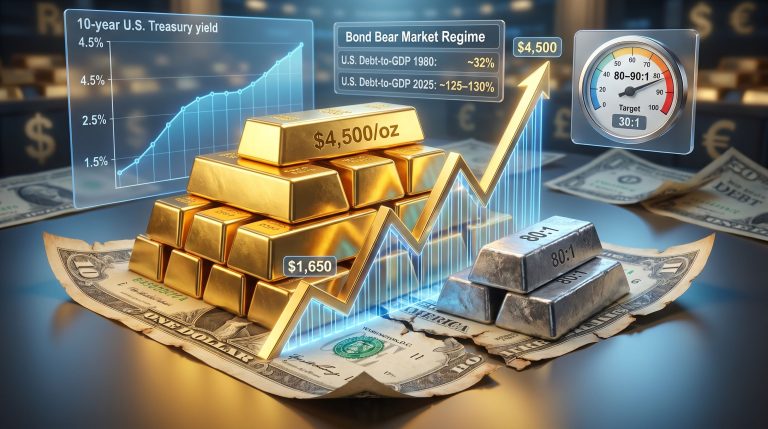
Kranner traces his awareness of the geopolitics-to-markets transmission mechanism to the U.S. withdrawal from Afghanistan in August 2021. Examining Western bond prices from that moment forward reveals a clear inflection: the bond markets of leading Western nations had already passed their peak. The commencement of war in Ukraine in February 2022 deepened the collapse, driving U.S. bonds into the worst bear market in over 240 years of recorded history. European and British bonds have since hit fresh 30-year lows, a development Kranner attributes directly to geopolitical overextension rather than purely monetary factors.
The Three-Stage Financial Syndrome of Declining Powers
Kranner identifies a recurring three-stage pattern that has played out across historical episodes of major power decline:
Stage 1: Bond Market Collapse
- Sovereign credibility deteriorates as overseas revenue streams and collateral shrink.
- Interest rates rise despite central bank resistance, as market pricing reflects underlying fiscal stress.
- European and British bonds have already entered this phase.
Stage 2: Equity Market Vertical Climb
- Central banks print liquidity to backstop banking sector losses from bad debts accumulated through failed overseas engagements.
- That liquidity gravitates toward equities as investors exchange depreciating currency for real productive assets.
- Stock markets appear to be performing well, but the gains are largely nominal rather than real.
Stage 3: Currency Collapse and Hyperinflation
- Historical precedents are stark: Zimbabwe (2009), Venezuela (2015–2016), Argentina (2012), and Weimar Germany in the early 1920s.
- In each case, currency debasement outpaced equity gains, leaving investors who stayed in stocks losing more than 90% of purchasing power in real terms despite nominal market highs.
The critical insight here is that a rising stock market during geopolitical decline is not a sign of prosperity. It is a symptom of currency failure. Investors who mistake nominal gains for real wealth preservation are walking into a trap that history has sprung repeatedly.
Historical Precedents: Stock Market Performance During Currency Collapses
| Country | Period | Stock Market Performance (Nominal) | Real Purchasing Power Outcome |
|---|---|---|---|
| Germany (Weimar) | Early 1920s | Extreme vertical climb | Near-total real value destruction |
| Zimbabwe | 2009 | World's best-performing market | Currency became worthless |
| Venezuela | 2015–2016 | World's best-performing market | Severe hyperinflationary collapse |
| Argentina | ~2012 | Strong nominal gains | Significant real purchasing power loss |
What Actually Preserves Wealth When Currencies Collapse
The Commodity Thesis and Gold's Structural Bull Market
If bonds deteriorate, equities provide only nominal protection, and currencies collapse, the question of where real value resides becomes urgent. Kranner's answer centres on commodities and hard assets, with gold occupying the primary position. In this context, understanding gold safe-haven dynamics has become an essential part of any serious portfolio framework for the current environment.
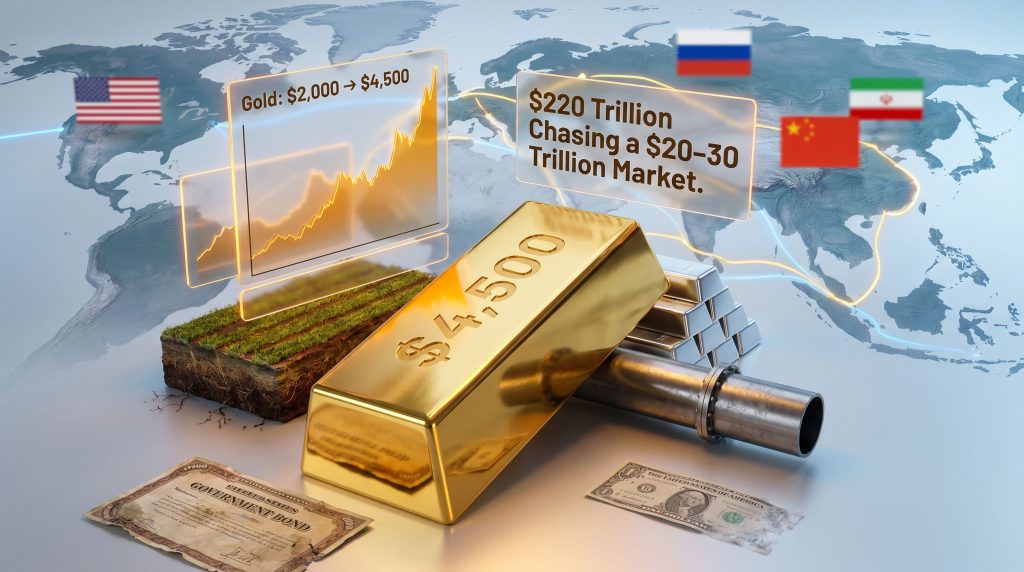
Gold has moved from approximately $2,000 three years ago to approximately $4,500, representing a 125% appreciation. Kranner identifies this as potentially the first leg of a much larger structural bull market rather than a cyclical peak. The mechanism driving this move is not simply inflation hedging — it is the scale of institutional capital that has yet to meaningfully reposition.
The shadow banking system, encompassing hedge funds, pension funds, endowments, insurance capital, and reinsurance companies, holds an estimated $220 trillion in liquid investable assets. The entire gold market, including all above-ground stocks and accessible reserves, is estimated at $20–30 trillion. The arithmetic is striking: even a marginal reallocation from a fraction of those institutional managers would produce a demand shock that the gold market's supply side cannot absorb without a dramatic price response.
Kranner traces the origin of this liquidity glut to Japan's adoption of large-scale quantitative easing beginning in 2000, which effectively launched the era of modern monetary expansion that subsequently spread across Western central banks. The result is an extraordinary monetary overhang chasing a finite universe of real assets.
Furthermore, central bank gold demand has emerged as another structural accelerant, with sovereign reserve managers accumulating at a pace that further constrains available supply for institutional buyers. The hockey-stick price patterns Kranner has observed across multiple asset classes over the past decade — including palladium and cobalt in 2015–2016, gold and silver more recently, and Bitcoin's trajectory from under $1,000 to over $100,000 — are not disconnected phenomena. They reflect the same underlying dynamic: a vast pool of institutional capital periodically converging on relatively small markets and generating exponential price moves.
On gold's ultimate price destination, Kranner's position is deliberately non-committal on specific numbers but unambiguous on direction. The structural conditions for a vertical move are already in place. The critical variable is timing, not trajectory.
Real Asset Hierarchy in a Currency Debasement Scenario
| Asset Class | Inflation Hedge Strength | Liquidity | Geopolitical Sensitivity | Long-Term Outlook |
|---|---|---|---|---|
| Gold and Silver | Very High | High | Moderate | Strongly Bullish |
| Arable Farmland | Very High | Low | Low | Strongly Bullish |
| Commodities (broad) | High | Moderate-High | High | Bullish |
| Equities (nominal) | Moderate | High | Moderate | Bullish nominally, uncertain in real terms |
| Bonds (long-duration) | Very Low | High | High | Bearish |
| Fiat Currency | None | Very High | Very High | Bearish to Severely Bearish |
Which Economies Face the Harshest Adjustment
The EU, UK, and Japan: Structurally Most Vulnerable
Kranner's framework identifies the European Union, United Kingdom, and Japan as the economies most exposed to the coming financial reckoning. The combination of energy dependency, military overextension through proxy conflicts, shrinking overseas revenue streams, and central bank liquidity injections that erode purchasing power creates a compounding vulnerability. Consequently, this differentiates these economies meaningfully from the United States.
The U.S. retains a meaningful structural advantage through reserve currency status, which provides additional time and monetary flexibility unavailable to other highly indebted economies. However, Kranner does not consider this a permanent shield, particularly as dedollarization accelerates and the geopolitical foundations of dollar primacy continue to erode. The ongoing global monetary shift driven by China's financial statecraft is among the most significant forces reshaping these foundations.
For European and British sovereign bond investors specifically, the thesis is particularly concerning: a bond market collapse that could approach zero in real terms, combined with currency deterioration and the fiscal demands of military rearmament, represents a scenario most conventional fixed-income models have not been designed to price.
Frequently Asked Questions
What is Alex Kranner's core investment thesis?
Kranner's central argument is that geopolitical fragmentation — including military overextension, dedollarization pressures, and the erosion of Western institutional credibility — is creating structural conditions where bonds and currencies in high-debt Western economies will deteriorate while real assets such as gold, silver, and farmland will preserve and potentially grow in real value. Alex Kranner on geopolitics and financial markets provides a distinctive lens through which to interpret these shifts.
Why does Kranner believe European bonds are particularly vulnerable?
The combination of military overextension through proxy conflicts, energy dependency on imported hydrocarbons, loss of overseas revenue streams, and central bank liquidity injections creates a compounding dynamic. European and British bonds have already hit 30-year lows, which Kranner treats as early confirmation of the thesis rather than a temporary anomaly.
What is the Thucydides Trap, and why does it matter for investors?
The Thucydides Trap, named after the ancient Greek historian's observation about Sparta and Athens, describes the structural tendency toward conflict when a rising power threatens to displace an established hegemon. Xi Jinping's invocation of the concept during the U.S.-China summit framed China's core strategic concern: whether the transition to multipolarity can be managed without military catastrophe. For investors, this framing signals that China's long-term strategic posture prioritises stability of the transition over short-term confrontational gains. Academic research published through institutions such as JSTOR's geopolitical studies has explored the historical patterns underpinning this dynamic in considerable depth.
Is gold a reliable hedge against hyperinflation?
Historical evidence suggests gold retains relative value during currency collapses more effectively than equities. However, even gold's real purchasing power gains can be partially eroded during extreme inflationary episodes. Diversification across multiple real asset classes, including silver, commodities, and productive land, represents a more robust strategy than any single-asset position.
How fast is dedollarization actually happening?
The process is gradual at the systemic level but is being accelerated by discrete geopolitical catalysts, including sanctions overuse, Strait of Hormuz leverage, and yuan-denominated bilateral trade arrangements. Kranner's view is that Iran's use of passage conditionality in the strait has already moved the timeline forward beyond what most mainstream forecasters anticipated.
Key Takeaways for Investors Navigating Geopolitical Fragmentation
- Bond markets in Europe, the UK, and Japan remain structurally vulnerable to further deterioration, with 30-year lows already breached.
- Equity markets may continue rising in nominal terms but should not be mistaken for real wealth preservation in a currency-debasement environment.
- Gold appears to be in the early stages of a multi-year structural bull market, with $220 trillion in shadow banking capital representing a demand overhang against a $20–30 trillion market.
- Dedollarization is an active and accelerating process, with Iran's Strait of Hormuz leverage serving as an unexpected accelerant.
- NATO's structural coherence is weakening, with parallel alliance structures such as the Joint Expeditionary Force emerging outside Brussels command.
- The U.S.-China relationship remains the most consequential bilateral dynamic for global capital markets, with divergent strategic time horizons creating persistent uncertainty.
- Real assets, including commodities, precious metals, and arable land, represent the most defensible long-term allocation framework in a geopolitically fractured world. The framework that Alex Kranner on geopolitics and financial markets has developed consistently points toward this conclusion.
This article draws on publicly available geopolitical and macroeconomic commentary and is intended for informational and educational purposes only. Nothing contained herein constitutes financial or investment advice. Readers should conduct independent research and consult a qualified financial adviser before making any investment decisions. Forward-looking statements and scenario projections involve inherent uncertainty and should not be treated as predictions of future outcomes.
Further commentary from Alex Kranner is available through his Substack publications, including the daily market newsletter I System Trend Compass, his personal publication Alex Kranner on Substack, and his YouTube channel Alex Kranner.
Ready to Turn Geopolitical Signals Into Actionable Mining Discoveries?
As real assets like gold and commodities emerge as the most defensible allocations in a fractured global order, Discovery Alert's proprietary Discovery IQ model scans ASX announcements in real time, instantly identifying significant mineral discoveries and transforming complex data into clear, actionable opportunities — just as historic finds by De Grey Mining and WA1 Resources rewarded early movers. Explore Discovery Alert's dedicated discoveries page to understand how major mineral discoveries have generated substantial returns, and begin your 14-day free trial today to position yourself ahead of the market.