July 14, 2026
The Supply Chain Fracture That Changed Everything for Mediterranean Phosphate
When a critical maritime chokepoint becomes contested, the ripple effects across global fertilizer supply chains are rarely immediate or obvious. They accumulate quietly, tightening raw material availability over weeks and months until producers in distant locations begin announcing curtailments. That is precisely the dynamic now reshaping the global phosphate market, and it explains why infrastructure decisions being made along Algeria's northeastern coastline carry consequences far beyond the country's borders.
The Algeria Annaba phosphate port expansion is not simply a construction project. It represents the physical manifestation of a long-developing strategic calculation: that North Africa's untapped phosphate potential has been constrained not by geology, but by logistics. Fixing that constraint, at scale and on schedule, could materially alter trade flows across Asia, Europe, and the broader fertilizer complex. For context, similar dynamics have played out in other emerging phosphate projects, such as the Ammaroo phosphate project in Australia and the Toolse phosphate project in Estonia, where logistics constraints have equally shaped commercial outcomes.
When big ASX news breaks, our subscribers know first
Engineering Specifications That Define the Project's Commercial Potential
Few infrastructure investments in North African mineral export history have been designed at this level of technical ambition. The centrepiece of the Annaba expansion is a 1,600-metre mineral quay engineered to a depth of 16 metres, purpose-built to accommodate Capesize-class vessels with carrying capacities of up to 80,000 deadweight tonnes.
This vessel class distinction matters more than it might initially appear. Capesize ships represent the most cost-efficient bulk carrier category for long-haul commodity transport, typically used in iron ore and coal trades. Their integration into phosphate logistics is relatively rare outside the largest established exporters. Furthermore, by engineering Annaba to this specification, Algeria is positioning itself to compete directly on per-tonne freight economics with Morocco's Jorf Lasfar terminal and Saudi Arabia's Ras Al-Khair facility, reflecting broader bulk commodity export economics at play globally.
| Infrastructure Feature | Technical Specification |
|---|---|
| Mineral Quay Length | 1,600 metres |
| Berth Water Depth | 16 metres |
| Maximum Vessel Class | Capesize (up to 80,000 DWT) |
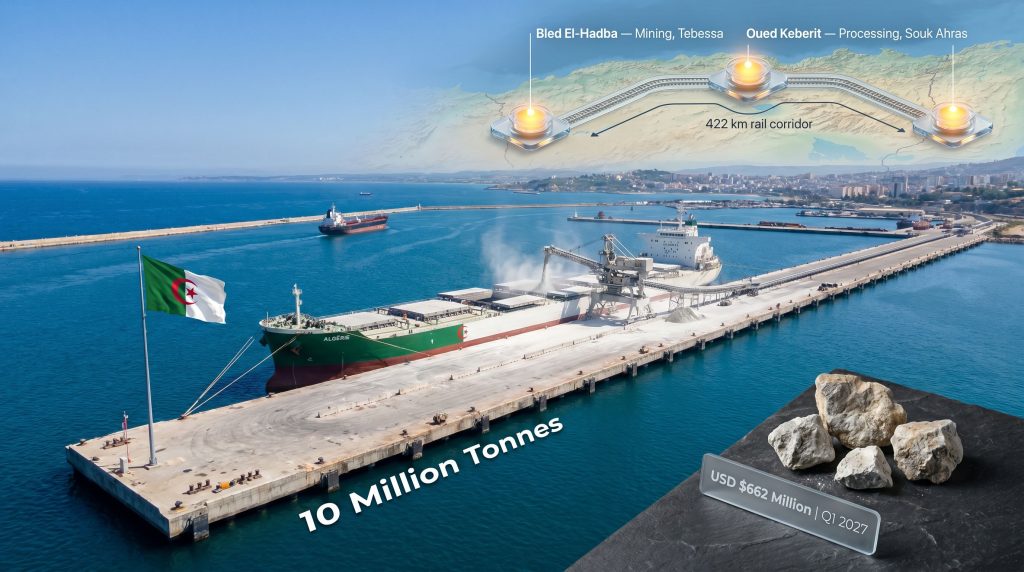
| Annual Throughput Capacity | 10 million tonnes |
| Rail Corridor Length | 422 kilometres (Eastern Mining Railway) |
| Estimated Project Cost | |
| Construction Consortium | China Harbor Engineering Company (CHEC), Cosider-Tp, MEDITRAM |
| Target Completion | Q1 2027 (March 2027) |
The construction consortium blending Chinese and Algerian civil engineering capacity reflects a pragmatic approach to delivery risk. China Harbor Engineering Company brings extensive deepwater port construction experience from projects across Asia and Africa, while Cosider-Tp and MEDITRAM provide domestic operational knowledge and logistical reach within the Algerian construction environment.
Algeria's Integrated Phosphate Project: A Three-Pillar Value Chain
To understand the Annaba port expansion properly, it must be viewed as one component of a larger vertical integration strategy. Algeria's Integrated Phosphate Project, developed as a joint initiative between state-owned energy company Sonatrach and state-owned mining firm Sonarem, is structured around three interlocking pillars:
- Mining: The Bled El-Hadba phosphate deposit in Tebessa province is already operational and actively accumulating stockpiles ahead of export readiness. This pre-production inventory build is a notable indicator of the project's synchronisation discipline.
- Processing: The Oued Keberit facility in Souk Ahras province will house a phosphoric acid plant with a capacity of 900,000 tonnes per year of P₂O₅, alongside sulphuric acid and ammonia production infrastructure.
- Export Logistics: The Annaba deepwater terminal serves as the maritime gateway for all product flows originating from the upstream pillars.
The processing facility at Souk Ahras is expected to consume approximately 3 million tonnes of phosphate rock per year at full capacity, according to commodity market analysts. This single demand figure dwarfs Algeria's entire current annual production baseline and illustrates why both the mining expansion at Djebel Onk and the port infrastructure at Annaba must be operationally ready at the same time.
The co-production of phosphoric acid, sulphuric acid, and ammonia at Souk Ahras adds substantial downstream value before any product leaves Algerian territory. Rather than exporting raw phosphate rock at commodity-grade pricing, Algeria will have the capability to export processed intermediates that command higher margins in Asian and European fertilizer markets. This is the economic logic behind the IPP's integrated architecture.
How Algeria Compares to Regional Phosphate Export Competitors
Algeria's current phosphate production footprint is modest relative to established regional players, but the trajectory is changing rapidly.
| Country | Primary Export Port | Annual Export Capacity | Key Producer |
|---|---|---|---|
| Morocco | Jorf Lasfar / Casablanca | ~40+ million tonnes | OCP Group |
| Algeria | Annaba (post-expansion) | ~10 million tonnes | Somiphos / IPP |
| Saudi Arabia | Ras Al-Khair | ~12+ million tonnes | Ma'aden |
| Egypt | Safaga / Sokhna | ~5-7 million tonnes | EFIC / El Nasr |
Morocco's OCP Group remains the dominant force in North African phosphate exports, with a scale advantage that Algeria will not approach in the near term. However, Algeria is not competing for OCP's market share so much as targeting the growing demand gap created by supply disruptions elsewhere. Morocco's position and Algeria's ambitions can coexist within a market where global phosphate demand continues to outpace supply growth.
Somiphos, the Sonarem subsidiary operating the Djebel Onk mine in Tebessa province, currently produces approximately 1.5 million tonnes per year of phosphate rock. A planned expansion of 1 million tonnes per year is targeted for completion by mid-2027, which would bring total Somiphos capacity to approximately 2.5 million tonnes per year.
The Pupuk Indonesia Agreement: Demand Certainty Before the Port Opens
One of the less-discussed but commercially significant elements of Algeria's phosphate strategy is the offtake framework established with Pupuk Indonesia, the Indonesian state-owned fertilizer group. Signed in January 2025, the agreement provides for the supply of up to 1 million tonnes per year of phosphate rock from the Djebel Onk operation.
This arrangement is strategically important for several reasons:
- It provides demand-side certainty before the Annaba terminal is complete, reducing the commercial risk associated with the capital investment.
- It targets Indonesia, one of the fastest-growing agricultural economies in Southeast Asia, where fertilizer import dependency creates a durable long-term demand base.
- It aligns the Djebel Onk expansion timeline with the port completion schedule, ensuring that incremental output has a confirmed buyer when export infrastructure becomes available.
Global Disruptions Creating a Window for Algeria
The geopolitical context surrounding Algeria's infrastructure acceleration cannot be separated from the commercial case for urgency. Ongoing disruptions to Strait of Hormuz shipping lanes have severely constrained phosphate and sulphur supply chains serving producers in North America and Brazil.
Mosaic, the US-based fertilizer producer, announced in July 2026 that it would further reduce phosphate output at facilities including its Bartow, Florida plant, Faustina, Louisiana facility, Riverview, Florida plant, and Uncle Sam, Louisiana operation. The reductions were directly attributed to sulphur inventory depletion caused by restricted supply availability through the Strait of Hormuz. Brazilian operations faced similar curtailments. Mosaic had previously withdrawn its full-year 2026 phosphate production guidance of at least 7 million metric tonnes.
Sulphur is the essential raw material input for sulphuric acid, which in turn is required to produce phosphoric acid and most downstream phosphate fertilizers. When sulphur supply chains are disrupted, the production cascade affects multiple fertilizer types simultaneously, compressing supply across DAP, MAP, and phosphoric acid markets in parallel.
This is precisely where Algeria's integrated model carries an underappreciated advantage. The Souk Ahras facility's internal sulphuric acid production capacity means the IPP is partially insulated from external sulphur supply volatility, provided its own feedstock procurement chains remain intact. For buyers in Asia and Europe seeking supply stability in a disrupted market environment, this integration premium is commercially meaningful.
The next major ASX story will hit our subscribers first
Construction Acceleration: What Doubling the Workforce Actually Delivers
Algeria's works and infrastructure ministry announced in July 2026 that the Annaba project workforce would be doubled, with additional heavy machinery deployed during July and August to accelerate civil progress on the deepwater quay structure. The stated objective is delivery against the Q1 2027 target. According to port infrastructure reporting, the mining quay is on course to reach operational readiness by late 2026, underpinning confidence in the broader delivery timeline.
Translating this commitment into execution involves several interdependent steps:
- Labour mobilisation: Additional shift crews enabling round-the-clock marine construction activity on the quay structure.
- Equipment reinforcement: Supplementary heavy lift and marine civil works machinery reducing bottlenecks in pile driving, quay deck construction, and dredging operations.
- Milestone governance: Heightened ministerial oversight creating accountability for construction progress reporting.
- Upstream coordination: The Bled El-Hadba mine continuing to accumulate phosphate rock inventory so that first export shipments can proceed immediately upon port commissioning.
Several risk factors remain capable of compressing the delivery window:
- Marine construction complexity at the Annaba coastal site, including weather-dependent works
- Equipment procurement lead times for specialised port handling machinery
- Coordination dependencies between the Annaba terminal and the 422-kilometre Eastern Mining Railway connecting Tebessa's mining districts to the coast
- Consortium management complexity across Algerian and Chinese construction entities
The Eastern Mining Railway: The Invisible Backbone of the Export Corridor
The Annaba port expansion attracts attention as the most visible element of the IPP logistics system, but the Eastern Mining Railway corridor spanning 422 kilometres from Tebessa to the coast is arguably the more strategically significant infrastructure investment. In many respects, it mirrors the kind of mine-to-port logistics strategy that has proven decisive in other major bulk commodity projects worldwide.
Dedicated mineral railways fundamentally change the unit economics of bulk commodity export by eliminating the cost inefficiencies of road haulage at scale. At volumes approaching 3 million tonnes per year of phosphate rock feedstock for the Souk Ahras processing facilities alone, the cost differential between truck and rail transport becomes substantial. Rail-to-port integration is the factor that allows Algeria's export product to compete on landed cost in Asian markets against established suppliers with lower-cost logistics systems.
Furthermore, the Algeria Annaba phosphate port expansion has been formally designated a national priority by Algerian authorities, signalling that political commitment to the Eastern Mining Railway modernisation is directly tied to the port's commercial viability.
Scenario Analysis: Three Pathways for Algerian Phosphate in Global Trade
The commercial trajectory of the IPP over the next two years depends heavily on delivery sequencing. Three broad scenarios frame the range of outcomes, each with distinct implications for global bulk trade trends and fertilizer market dynamics.
Scenario A: On-Time Delivery by Q1 2027
Port commissioning aligns with Souk Ahras production start-up and the Djebel Onk expansion completion. Algeria enters export markets during a period of constrained global phosphate availability, capturing favourable pricing and establishing long-term supply relationships with buyers in Indonesia, India, and Europe.
Scenario B: Moderate Delay into Mid-2027
A one to two quarter lag in port commissioning creates a period of domestic stockpile accumulation pressure as upstream production comes online ahead of export infrastructure. Revenue generation is deferred but the commercial case remains intact.
Scenario C: Extended Delay Beyond 2027
Compounding logistical, technical, or coordination challenges push commissioning into 2028 or beyond. Consequently, competing North African and Middle Eastern suppliers consolidate market share with key target buyers, increasing Algeria's cost of establishing trade relationships in a more normalised supply environment.
Key Takeaways for Market Observers
The Algeria Annaba phosphate port expansion sits at the intersection of long-cycle infrastructure development and short-cycle commodity market disruption. Several elements of this convergence are worth tracking closely:
- Algeria is committing approximately USD $662 million to transform Annaba into a 10 million tonne annual capacity phosphate export terminal, with Capesize vessel compatibility that directly targets cost-competitive long-haul trade routes.
- The IPP's vertically integrated structure, spanning mine to processing plant to deepwater terminal, provides Algeria with economic advantages that pure rock exporters cannot replicate once fully operational.
- The Q1 2027 synchronisation target between port readiness and upstream production start-up is the critical path dependency that will determine whether Algeria captures the current disruption-driven demand window.
- Mosaic's confirmed production curtailments across Florida, Louisiana, and Brazil represent a structural demand gap that Mediterranean suppliers with intact logistics chains are best positioned to fill.
- The Pupuk Indonesia offtake agreement anchors demand certainty for Djebel Onk's expanded output and validates the commercial rationale for the Djebel Onk capacity investment.
This article contains forward-looking analysis regarding project timelines, production targets, and market scenarios. All such projections are subject to execution risk, geopolitical developments, and commodity market conditions. Readers should conduct independent due diligence before making any investment or commercial decisions based on this content.
Want to Capitalise on the Next Major Mineral Discovery Before the Broader Market?
Discovery Alert's proprietary Discovery IQ model delivers real-time alerts on significant ASX mineral discoveries — transforming complex data across 30+ commodities into clear, actionable insights for investors at every level. Explore historic discoveries and their returns to understand the potential, then begin your 14-day free trial at Discovery Alert to position yourself ahead of the market.