August 9, 2026
Europe's Alumina Supply Chain and the Cost of Geopolitical Purity
Every sanctions regime eventually confronts the same uncomfortable question: at what point does economic self-harm undermine the strategic objective the sanctions were designed to serve? The European Union has wrestled with this tension across energy, finance, and commodities since February 2022. But the case of a single refinery on the Shannon Estuary in County Limerick, Ireland, has distilled that tension into its sharpest form yet. The Aughinish Alumina sanctions uncertainty debate is not simply a story about one industrial facility. It is a stress test of how the EU balances geopolitical obligation against the structural realities of its own industrial supply chains.
When big ASX news breaks, our subscribers know first
Alumina as the Critical Chokepoint Nobody Talks About
In public discourse, aluminium dominates the conversation. It is the finished product that appears in aircraft fuselages, electric vehicle battery housings, packaging, and construction. But alumina, the intermediate oxide compound refined from bauxite ore before being smelted into aluminium metal, is the step that makes everything else possible. Without a reliable alumina supply, smelters cannot operate regardless of how much electricity, capital, or workforce capacity they have available.
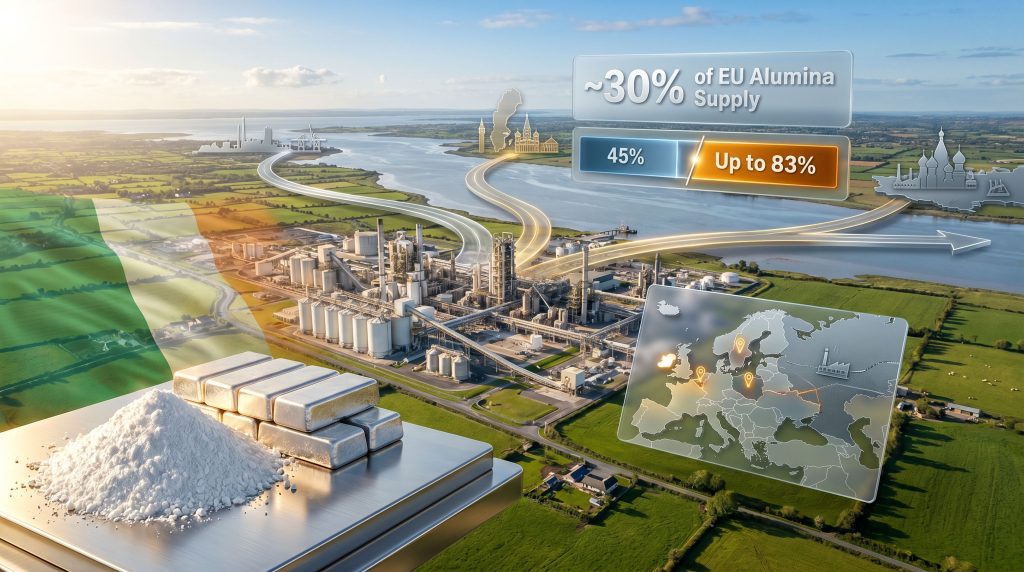
This is why Aughinish Alumina occupies a structurally irreplaceable position in European industrial geography. Located on the Shannon Estuary in County Limerick, it is the largest alumina refinery in Europe by output capacity, supplying approximately 30% of the total alumina requirements across the European Union. Its customer base extends to downstream aluminium smelting operations in Dunkirk, France, and facilities across Sweden, making it a linchpin of European primary metal production rather than simply an Irish industrial asset.
The refinery's workforce represents hundreds of direct employees, with the economic multiplier effect extending across supplier networks, logistics operators, and service businesses throughout the Limerick region. This community dependency is not incidental to the policy debate; it sits at its centre. Furthermore, the broader aluminium supply chain across Europe depends on facilities like Aughinish functioning without interruption.
Scale in Context: Aughinish Alumina's approximately 30% share of EU alumina supply cannot be replaced quickly through alternative sourcing. The lead times required to reroute equivalent volumes from Guinea, Australia, or Brazil, accounting for logistics complexity and cost differentials, are measured in years rather than months.
How the Refinery Became Entangled in Sanctions Architecture
The Investigative Reports That Triggered Regulatory Scrutiny
The regulatory pressure now surrounding Aughinish intensified in March 2026, when investigative reporting by the Organised Crime and Corruption Reporting Project (OCCRP) and the Irish Times alleged that alumina produced at the Shannon Estuary refinery may have reached sanctioned entities linked to Russian defence manufacturing. The allegation, if substantiated, would place the refinery's output within the supply chains supporting weapons systems used against Ukraine, a finding with profound legal and political implications.
Aughinish Alumina has maintained consistently that it operates in full compliance with EU sanctions and trade regulations, referencing an internal framework described as covering sanctions compliance and due diligence across its export activities. The legal distinction the refinery draws is significant: Russian ownership of an EU-registered industrial asset is not itself prohibited under existing sanctions law. What matters legally is whether the facility's output flows to specifically sanctioned entities or contributes materially to prohibited activities.
That distinction, however credible as a legal defence, does not resolve the underlying political and ethical questions that investigative reporting has elevated into public debate. According to analysis from RTÉ, the situation represents one of the most complex intersections of European industrial policy and sanctions enforcement seen in recent years.
The Export Ratio Dispute: Numbers That Define the Entire Debate
At the core of the Aughinish Alumina sanctions uncertainty controversy lies a deeply contested set of figures. The refinery's stated position for 2025 operations is that 45% of its exports were directed to Russia, with the remaining 55% supplying European and global markets. Investigative reporting, by contrast, suggests the Russian-bound share may have reached up to 83% of exports in early 2026, a figure that, if accurate, would fundamentally alter how the facility is characterised in policy terms.
| Data Source | Estimated Share to Russia | Estimated Share to EU and Global Markets |
|---|---|---|
| Company (Aughinish Alumina) | 45% (2025 full year) | 55% |
| Investigative Reports (OCCRP / Irish Times) | Up to 83% (early 2026) | Approximately 17% |
Note: Both sets of figures remain disputed as of July 2026. No independently verified trade data has been published to resolve the discrepancy. The gap between these two positions is consequential: a 45% Russian share frames Aughinish primarily as a European supplier with secondary Russian business, while an 83% share frames it as a facility primarily oriented toward the Russian market.
This distinction matters enormously in policy terms. A refinery sending the majority of its output to Russia, regardless of formal end-use declarations, operates very differently in geopolitical terms from one predominantly supplying European smelters. The entire regulatory and political debate hinges on which set of figures more accurately reflects operational reality.
Where the EU's Regulatory Position Stands
The European Commission's Deliberate Restraint
As of mid-July 2026, the European Commission has chosen not to include Aughinish Alumina or alumina exports as a category within its current sanctions package. Alumina remains unlisted in the EU's 21st sanctions package negotiations, a decision that reflects calculated risk management rather than indifference to the underlying allegations.
The Commission's implicit reasoning follows an established pattern in sanctions design theory: measures that inflict disproportionate harm on the sanctioning bloc relative to the target state are classified as self-defeating. Removing approximately 30% of EU alumina supply without an immediate replacement source would create inflationary pressure across European aluminium production, with cascading consequences for downstream manufacturing in automotive, aerospace, packaging, and construction sectors. In this respect, the broader EU metals strategy is being tested in real time.
Sanctions Architecture Insight: The concept of self-defeating sanctions is well-documented in policy literature. When a sanctioning coalition suffers acute supply disruptions from its own measures, political cohesion within that coalition typically weakens over time, undermining the long-term effectiveness of the regime.
The European Parliament's Non-Binding Resolution
Separately from Commission action, the European Parliament approved a non-binding resolution calling for a ban on EU alumina exports to Russia. The distinction between parliamentary resolutions and Commission-level regulatory action is critical to understanding how EU sanctions actually function.
EU sanctions require a formal Commission proposal followed by qualified majority approval within the Council of the EU, representing member state governments. The Parliament's resolution carries significant political weight as a signalling mechanism and can shape the agenda for future legislative packages, but it does not compel Commission action on a defined timeline.
Member states including Belgium and Poland have voiced support for restrictions on alumina exports to Russia, adding governmental pressure alongside parliamentary sentiment. Whether that pressure translates into Commission proposals in future sanctions rounds will depend substantially on the findings emerging from Ireland's own investigation. These aluminium trade pressures are compounding broader instability across global metals markets.
Ireland's Investigation and the Taoiseach's Position
The Irish Department of Enterprise launched a formal investigation into whether Aughinish's alumina output contributes to Russia's war economy. That investigation remained ongoing as of July 2026, with findings described as expected within the coming weeks. Taoiseach Micheál Martin has publicly characterised potential sanctions on the refinery as self-defeating, arguing that the harm to European industrial capacity would outweigh the geopolitical benefit.
Ireland's findings carry particular weight because the refinery is physically located within Irish jurisdiction. If the investigation concludes that Aughinish's output does materially support Russia's war economy, the political pressure on the Commission to act in subsequent sanctions rounds would intensify substantially. Conversely, if findings are inconclusive or exculpatory, the momentum toward sanctions would weaken.
Ukrainian President Volodymyr Zelenskyy has publicly welcomed Ireland's investigation and expressed the expectation that findings will be released promptly, signalling Kyiv's active interest in the regulatory outcome.
The Stakeholder Forum: A Governance Response to Regulatory Paralysis
Against this backdrop of unresolved regulatory uncertainty, Limerick Mayor John Moran has taken a proactive governance step. In a formal letter addressed to the Taoiseach and Minister for Enterprise, Trade and Employment Peter Burke, Moran proposed the establishment of a dedicated stakeholder forum to improve communication between government and the communities most exposed to potential disruption.
The proposed forum would bring together:
- Workers employed directly at the Aughinish refinery
- Trade union representatives
- Supplier businesses across the broader regional economy
- Community representatives from the Limerick region
The objectives Moran articulated extend beyond mere information sharing. The forum is intended to prepare the region for all possible regulatory outcomes, not just the most favourable ones, and to ensure that affected workers and families receive clear communication rather than being left to interpret conflicting signals from Brussels, Dublin, and Kyiv. Previous regional employment and economic taskforces were cited as structural models that could inform how such a forum is organised and governed.
Moran's framing is also politically significant. He argued explicitly that supporting Ukraine and protecting the livelihoods of Aughinish workers are not mutually exclusive objectives. This framing attempts to dissolve a false binary that has complicated the political debate, positioning the forum not as opposition to Ukraine solidarity but as responsible preparation for an uncertain regulatory future.
Governance Model Note: The stakeholder forum proposal represents a practical application of just transition principles to geopolitically induced industrial uncertainty. Rather than waiting for a regulatory decision to be imposed, the approach aims to build community resilience and informed preparedness in advance of any outcome.
What Closure or Sanctions Would Actually Mean for European Industry
Immediate and Medium-Term Supply Chain Consequences
The near-term consequences of a closure or severe production curtailment at Aughinish would be felt across the EU aluminium value chain in ways that extend well beyond Ireland's borders.
| Scenario | Near-Term Probability (July 2026) | Primary Impact |
|---|---|---|
| No sanctions, continued operations | High (current trajectory) | EU alumina supply remains stable; geopolitical pressure persists |
| Partial export restrictions to Russia | Moderate | Reduced Russian supply volumes; potential production cuts at Aughinish |
| Full sanctions leading to closure | Low in near term | Approximately 30% EU alumina supply disruption; smelter impacts across multiple member states |
| Ownership restructuring or divestment | Speculative | Addresses Russian ownership risk; legally and financially complex process with uncertain timeline |
European smelters dependent on Aughinish alumina supply, including facilities in Dunkirk and Sweden, would face immediate sourcing challenges. Alternative alumina suppliers in Guinea, Australia, and Brazil exist at the global scale, but redirecting equivalent volumes to European buyers involves:
- Negotiating new long-term supply contracts in a competitive market
- Managing significantly longer shipping routes and associated logistics costs
- Absorbing potential cost premiums relative to historically established Aughinish pricing
- Bridging an interim supply gap while new contracts are operationalised
The timeline for completing this transition without production curtailments at European smelters is unlikely to be less than 12 to 24 months under optimistic assumptions. Consequently, the supply chain disruption risks here are comparable in scale to those seen during recent global trade shocks.
Decommissioning and Environmental Obligations
A dimension of this debate that has received comparatively limited attention is the decommissioning framework established under an agreement reached in June 2026. Under this arrangement, Aughinish Alumina is contractually obligated to fund the costs of decommissioning the refinery and restoring the surrounding Shannon Estuary environment if the plant closes.
This obligation has meaningful implications for the refinery's financial planning under closure scenarios and creates a legal backstop against the site being abandoned without environmental remediation. It also signals that Irish authorities have been planning for closure contingencies even as the political debate over sanctions remains unresolved. The ownership structure of the alumina refining assets involved adds further complexity to any divestment or transition scenario.
The next major ASX story will hit our subscribers first
The Systemic Policy Question Beyond Aughinish
The Aughinish Alumina sanctions uncertainty case has surfaced a broader policy gap that extends well beyond this single facility. How many other Russian-owned or Russian-linked industrial assets operate within EU jurisdiction? What framework governs their continued operation, and under what conditions should ownership structure become a disqualifying factor for continued EU market access?
The handling of Aughinish is widely understood to set a precedent for how these questions are answered. A decision to sanction the refinery despite significant supply chain risks would signal a higher tolerance for economic self-harm in pursuit of geopolitical consistency. A decision to continue exempting it would reinforce the precedent that strategic industrial scale provides effective insulation against sanctions pressure regardless of ownership structure.
Neither outcome is cost-free. The EU's credibility as a sanctions enforcer, its industrial competitiveness, and its commitments to Ukraine are all simultaneously in play in a single facility on the Irish coast.
FAQ: Aughinish Alumina Sanctions Uncertainty Explained
Has Aughinish Alumina Been Sanctioned by the EU?
No. As of July 2026, neither Aughinish Alumina nor alumina as an export category to Russia has been included in EU sanctions. The European Commission did not propose such measures in the current round, citing risks to European industrial supply chains.
What Percentage of Aughinish's Production Goes to Russia?
This remains disputed. The refinery states that 45% of its 2025 exports went to Russia, while investigative reporting suggests the share may have reached up to 83% in early 2026. No independent verification has been published to resolve the discrepancy.
What Happens to EU Alumina Supply if the Refinery Closes?
Aughinish supplies approximately 30% of EU alumina requirements. Closure would create an immediate supply deficit affecting smelting operations across multiple member states, with no near-term replacement source available at equivalent scale or cost.
What Is the Irish Government's Current Position?
The Irish Department of Enterprise has been conducting a formal investigation, with findings expected imminently as of July 2026. Taoiseach Micheál Martin has publicly described potential sanctions as self-defeating, arguing the harm to EU industry would outweigh the geopolitical benefit.
What Is the Proposed Stakeholder Forum in Limerick?
Limerick Mayor John Moran formally proposed a government-convened forum bringing together refinery workers, trade unions, suppliers, and community representatives to improve communication and prepare the region for all possible regulatory outcomes.
What Is Ukraine's Stated Position on the Matter?
Ukrainian President Volodymyr Zelenskyy has publicly welcomed Ireland's investigation and expressed the hope that its findings will be published promptly, signalling Kyiv's active interest in seeing the matter resolved through transparent regulatory process.
This article is intended for informational purposes only and does not constitute investment, legal, or policy advice. Figures relating to export shares and regulatory timelines remain contested or subject to change. Readers should consult primary regulatory sources for the most current sanctions status.
Want to Stay Ahead of Major Mineral Discoveries Reshaping Global Supply Chains?
As geopolitical pressures expose critical vulnerabilities in alumina and broader metals supply chains, Discovery Alert's proprietary Discovery IQ model delivers real-time alerts on significant ASX mineral discoveries — instantly translating complex commodity data into actionable investment insights for traders and long-term investors alike. Explore how historic discoveries have generated substantial returns on Discovery Alert's dedicated discoveries page, and begin your 14-day free trial today to position yourself ahead of the next major market opportunity.