
August 9, 2026
The Regulatory Architecture That Made Venezuelan Crude a Closed Market
Commodity markets are typically shaped by geology, logistics, and price discovery. Yet for most of the period between 2019 and 2026, Venezuelan crude sanctions and PDVSA direct sales reshaped global oil trade under an entirely different logic: one where access was determined not by refining capacity or commercial appetite, but by regulatory permission. Understanding this requires looking first at the underlying policy mechanics, not the market headlines.
The U.S. sanctions framework targeting Venezuela's state oil company, Petróleos de Venezuela S.A. (PDVSA), was never designed as a simple import ban. Its architecture was far more targeted, and in practice, far more consequential for global trading dynamics. For a broader view, the crude oil market overview provides useful context on how these shifts rippled across global benchmarks.
When big ASX news breaks, our subscribers know first
How OFAC Sanctions Actually Restrict Venezuelan Crude Trade
A persistent misconception in energy media is that U.S. sanctions blocked Venezuelan oil from reaching international markets. The reality is more precise. The 2019 sanctions framework imposed by the U.S. Treasury's Office of Foreign Assets Control (OFAC) was engineered primarily as a payment-access restriction, not a supply prohibition.
Under this structure, Venezuelan crude could still physically move. What the sanctions controlled was who could legally receive payment proceeds and on what terms. Specifically:
- Proceeds from Venezuelan crude sales involving U.S.-connected counterparties were required to flow into blocked or escrowed accounts, denying PDVSA operational access to its own revenue.
- Buyers needed a specific OFAC licence authorising the transaction, the payment structure, and the permitted use of funds.
- Without such a licence, any financial institution processing a PDVSA-related payment faced secondary sanctions exposure, effectively making the trade off-limits for mainstream market participants.
This payment-targeting design created a structural anomaly: Venezuelan barrels were geologically available and physically exportable, but commercially inaccessible to virtually every major buyer. The scarcity was manufactured through licensing architecture, not geology.
The sanctions did not restrict Venezuelan crude from reaching global markets. They restricted who could legally pay for it, and on what terms. This regulatory chokepoint is the foundation for understanding how commodity traders captured extraordinary margins.
The Licensing Exclusivity Model: A Regulatory Moat in Practice
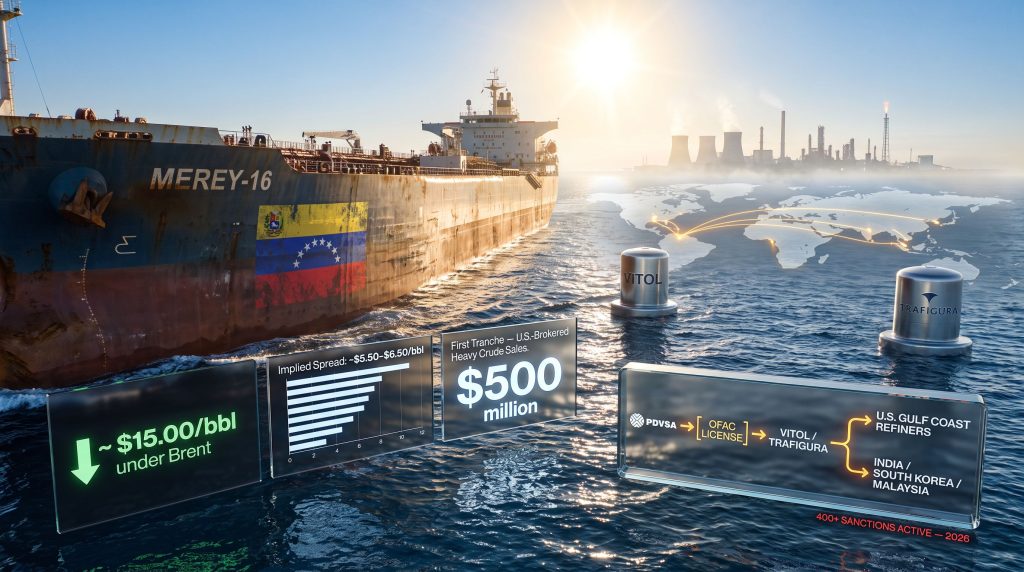
Following significant political developments in Venezuela in early 2026, U.S. policy on PDVSA crystallised into a structured two-firm framework. OFAC issued long-term exclusive licences to Vitol and Trafigura, designating them as the sole authorised purchasers and marketers of Venezuelan crude through June 2027. Every other buyer, regardless of refining sophistication or commercial interest, remained legally excluded.
This exclusivity was not the result of competitive tendering or market selection. It was a deliberate regulatory design choice, and its commercial consequences were profound.
The Numbers Behind the Windfall
| Metric | Estimated Figure |
|---|---|
| Combined barrels moved (approx. 6-month period) | 100+ million barrels |
| Merey-16 spot discount to Brent (U.S. Gulf Coast) | ~$8.50–$9.50/bbl |
| PDVSA supply price discount to licensed traders | ~$15.00/bbl under Brent |
| Implied gross intermediary spread | ~$5.50–$6.50/bbl |
| First tranche of U.S.-brokered Venezuelan crude sales | ~$500 million |
U.S. Energy Secretary Chris Wright confirmed publicly that the initial tranche of Venezuelan heavy crude purchases, valued at approximately $500 million, was structured at these discounted levels as an explicit tool to place downward pressure on domestic fuel prices. The policy therefore served a dual function: geopolitical leverage over Caracas and domestic energy pricing management.
Furthermore, the broader oil price rally occurring simultaneously made the discounted Venezuelan barrels even more commercially attractive to authorised buyers.
Why Operational Infrastructure Amplified the Regulatory Advantage
Licensing exclusivity alone did not fully explain the trading houses' dominance. Vitol and Trafigura also possessed the operational architecture to exploit the window at scale:
- Large, flexible tanker fleets capable of managing sanctioned-route logistics across multiple jurisdictions.
- Floating storage capacity at intermediary hubs, particularly Malaysia, enabling cargo accumulation and timed re-delivery.
- Balance-sheet depth sufficient to absorb multi-month freight, storage, and price volatility without forced liquidation.
When Middle Eastern supply chains experienced disruption, the two houses redirected Venezuelan heavy sour grades, including Merey-16, to secondary demand centres across India, South Korea, and Malaysia, consistently pricing cargoes at competitive discounts relative to alternative suppliers. The combination of licensing exclusivity and operational scale produced what may be one of the most concentrated margin-capture episodes in sanctioned-commodity trading history.
The Hidden Input Problem: Diluent Restrictions and Venezuela's Export Ceiling
One of the least-discussed dimensions of Venezuelan crude sanctions and PDVSA direct sales involves not the output side of the trade, but the input side. Venezuela's Orinoco Belt produces crude grades so heavy, including Merey-16 with an API gravity of approximately 16 degrees, that they cannot be transported through conventional pipelines or loaded onto tankers without first being blended with lighter hydrocarbons known as diluents or naphtha.
U.S. sanctions restricted American companies from supplying these critical blending inputs to PDVSA. This created a compounding constraint on Venezuelan production capacity:
- Payment access restrictions determined who could legally buy Venezuelan crude.
- Diluent supply restrictions determined how much Venezuelan crude could physically be produced and readied for export.
Licensed intermediaries who could source diluents through non-U.S. channels therefore held a second-order advantage that extended well beyond their purchasing authorisation. Understanding this dual-constraint structure is essential for assessing Venezuela's realistic production ceiling under any future sanctions configuration.
The Transition: From Intermediary Monopoly to Refiner Access
The licensing architecture that concentrated Venezuelan crude trade in two firms is now undergoing a structural dismantling. OFAC authorisations are progressively expanding beyond commodity trading intermediaries to include end-user refiners and integrated oil majors capable of purchasing directly from PDVSA.
Companies that have received or are prospectively positioned to receive direct purchasing licences include:
- Phillips 66
- Reliance Industries
- Repsol
- Eni
- Valero (anticipated)
Each new refiner licence does not represent incremental competition. It represents a categorical transfer of commercial rights, shifting margin capture from the intermediary layer to the refinery gate. The New York Times has reported that U.S. policymakers have framed these brokered sales, with over 400 individual sanctions still active against Venezuelan entities and individuals as of 2026, as part of a deliberate effort to support Venezuela's economic stabilisation whilst reshaping trade flows toward a more direct buyer-seller model.
What PDVSA Direct Sales Actually Means Under Sanctions Law
The term direct sales is frequently mischaracterised in energy coverage. It does not mean unrestricted free-market transactions between PDVSA and refiners. The regulatory framework remains active for every direct sale:
- A valid, specific OFAC licence must authorise the bilateral transaction.
- Payment must be routed through U.S.-controlled or OFAC-approved account structures.
- All remaining sanctions conditions apply, including restrictions on proceeds accessibility for PDVSA.
Policy clarification: PDVSA direct sales means the state company can negotiate supply terms bilaterally with licensed refiners or joint-venture partners, bypassing commodity trading intermediaries. It does not mean PDVSA has unrestricted access to its own revenue, nor that buyers face reduced compliance obligations. The regulatory architecture still governs every dimension of the transaction.
How Venezuelan Heavy Crude Compares to Global Heavy Sour Alternatives
Merey-16's commercial positioning in the global heavy sour market is a function of its extreme physical properties. At approximately 16 degrees API gravity and around 2.5% sulphur content, it sits at the ultra-heavy end of the tradeable crude spectrum, requiring complex refinery configurations, specifically coking units or hydroprocessors, to yield meaningful distillate outputs.
| Crude Grade | Origin | API Gravity | Sulphur Content | Primary Markets |
|---|---|---|---|---|
| Merey-16 | Venezuela | ~16° API | ~2.5% | U.S. Gulf Coast, India, South Korea |
| Arab Heavy | Saudi Arabia | ~27° API | ~2.8% | Asia-Pacific, Europe |
| Mars Blend | U.S. Gulf of Mexico | ~31° API | ~2.1% | U.S. domestic refiners |
| Urals | Russia | ~31° API | ~1.5% | India, China (post-2022) |
| Canadian Heavy | Canada | ~20° API | ~3.5% | U.S. Midwest refiners |
Venezuelan Merey-16 competes primarily with Canadian heavy grades and Arab Heavy for complex refinery slots. Its primary competitive advantage is discount depth, not physical quality. When sanctions architecture restricts buyer access, the discount widens substantially, making Venezuelan barrels highly attractive to refiners with appropriate processing configurations.
As direct licensing expands and more refiners gain authorised access, the extraordinary discount levels seen during the trading house exclusivity period are expected to partially compress. However, residual discounts will persist due to ongoing sanctions compliance costs, PDVSA's credit risk profile, and Venezuela's infrastructure constraints.
The next major ASX story will hit our subscribers first
Strategic Implications for Refiners Entering the Venezuelan Market
For refiners evaluating direct supply relationships with PDVSA, the economic case depends on several interacting variables:
- Discount depth relative to Brent or WTI at the point of negotiation.
- Freight cost from Venezuelan loading terminals to the refinery gate.
- OFAC compliance overhead, including licencing maintenance and payment infrastructure costs.
- Processing yield economics relative to lighter, lower-sulphur alternatives available at smaller discounts.
The window during which Venezuelan heavy crude offers its most advantageous feedstock economics is likely limited. As the number of authorised buyers increases, competitive bidding will compress the spread between PDVSA's supply price and market resale value. Refiners that establish direct bilateral supply terms during the current licensing expansion phase may lock in more favourable long-term economics than those that wait for full market normalisation.
Risk Factors Refiners Must Assess Before Entering Direct Supply Agreements
The sanctions on oil trading frameworks developed in other sanctioned markets offer instructive parallels here. Key risk factors include:
- Sanctions policy volatility: U.S. policy toward Venezuela has reversed multiple times since 2019. Existing licences can be revoked or materially modified with limited advance notice, creating significant contractual exposure.
- PDVSA operational reliability: Venezuela's production infrastructure has deteriorated substantially over the past decade. Supply volume commitments carry meaningful execution risk that must be reflected in contract terms.
- Payment complexity: OFAC-compliant payment routing adds administrative cost and counterparty friction even for fully licenced transactions.
- Reputational and governance exposure: Publicly listed companies operating in U.S.-regulated markets face heightened scrutiny from shareholders and compliance officers when entering direct commercial relationships with PDVSA.
Strategic caution: Refiners pursuing PDVSA direct supply agreements should conduct comprehensive OFAC compliance audits and establish robust sanctions monitoring protocols before finalising any procurement commitment. The licencing framework remains subject to revision as U.S.-Venezuela diplomatic conditions continue to evolve.
The Evolving Role of Vitol and Trafigura as Exclusivity Narrows
As their exclusive licensing window moves toward its June 2027 expiration, both trading houses face a fundamental business model transition in their Venezuelan operations. The probable trajectory involves three shifts:
- Principal-driven arbitrage (buying barrels at deep discount, reselling at narrower discount) will diminish progressively as direct refiner licences proliferate.
- Service-oriented logistics roles (cargo management, blending coordination, freight risk hedging) are likely to persist given the operational complexity of Venezuelan crude logistics.
- Niche intermediation for smaller or less operationally sophisticated buyers without independent tanker access or floating storage infrastructure will represent a residual but declining opportunity.
The Venezuelan trade is transitioning from what was effectively a regulatory rent to what will become a service margin business. The extraordinary economics of the exclusivity period will not be replicated once OFAC licencing is distributed across a competitive field of authorised buyers.
A Policy Lifecycle Framework for Sanctioned Commodity Markets
The Venezuelan crude sanctions and PDVSA direct sales story follows a recognisable regulatory lifecycle applicable to any sanctioned commodity market. Furthermore, understanding this lifecycle is increasingly relevant given the trade war impact on oil markets that has heightened policy sensitivity across multiple commodity classes.
- Sanctions imposition restricts payment access; supply remains technically available but commercially inaccessible to most buyers.
- Licensing exclusivity creates a narrow group of authorised intermediaries who capture extraordinary margins through regulatory gatekeeping.
- Operational moat formation occurs as licenced traders build logistics infrastructure that compounds their advantage beyond the regulatory grant itself.
- Policy evolution responds to shifting geopolitical and economic objectives; licences expand to end-users; intermediary margins compress.
- Market normalisation allows direct buyer-seller relationships to re-emerge; discounts partially narrow; trading houses transition to service roles.
The Venezuelan crude market in 2026 sits firmly at the stage 4 to 5 boundary of this lifecycle. For refiners, this transition window represents a time-limited opportunity to capture favourable feedstock economics before discount normalisation runs its course.
For commodity traders, the strategic imperative is to reposition service capabilities ahead of the principal arbitrage window's closure. For observers of sanctions policy more broadly, the Venezuelan case demonstrates how licencing architecture can function as a precision instrument, simultaneously influencing geopolitical outcomes, reshaping commodity trade flows, and managing domestic energy price dynamics, all without a single blanket import prohibition.
This article is intended for informational and analytical purposes only. It does not constitute financial, legal, or investment advice. Readers should conduct independent due diligence and consult qualified legal counsel before making decisions related to sanctioned-market commodity transactions. Sanctions frameworks are subject to revision by regulatory authorities without notice.
Want to Stay Ahead of the Next Major Commodity Market Shift?
Discovery Alert's proprietary Discovery IQ model scans ASX announcements in real time, delivering instant alerts on significant mineral discoveries across more than 30 commodities — transforming complex market data into clear, actionable investment opportunities for both short-term traders and long-term investors. Start your 14-day free trial at Discovery Alert and position yourself ahead of the market before the next major discovery is priced in.