August 8, 2026
The Quiet Power Shift Reshaping Global Bauxite Supply
Guinea picks Glencore as offtaker for state-owned bauxite miner in a move that signals far more than a routine commercial transaction. This decision reflects a structural realignment in how one of the world's most bauxite-rich nations intends to manage its mineral wealth. Guinea, the West African nation that supplies a larger share of the world's bauxite than any other country, is tightening its grip on export flows.
The decision by Guinea's government to select Glencore as the exclusive offtaker for state-owned Nimba Mining Co. is a structural signal: Guinea is moving from passive resource exporter to active supply architect. Furthermore, this shift could reverberate across global aluminium markets for years to come.
When big ASX news breaks, our subscribers know first
Guinea's Bauxite Dominance and Why Every Tonne Matters
Few commodities have such concentrated geographic origins. Guinea exported approximately 183 million tonnes of bauxite in the most recent full year, making it the undisputed anchor of global bauxite production. The country's deposits are not just large in volume — they are coveted for their quality.
Why Guinean Bauxite Stands Apart
Guinean bauxite is predominantly gibbsite-type, a mineralogical classification that matters enormously in processing economics. Gibbsite-bearing ores dissolve more readily during the Bayer Process, the standard industrial method used to extract alumina from bauxite. This translates into lower energy consumption and faster processing cycles at refineries, particularly those designed for low-temperature digestion.
It is one reason Chinese alumina refiners have invested so heavily in Guinea-sourced supply, reshaping their facility designs around the specific chemical characteristics of Guinean ore. China currently absorbs the vast majority of Guinea's annual bauxite shipments. As domestic Chinese bauxite reserves have been progressively depleted, particularly in Shanxi and Guizhou provinces, the structural reliance on West African imports has intensified.
This dependency creates a supply chain fragility that is rarely discussed openly in commodity markets, but is deeply understood by procurement teams at Chinese alumina smelters. Consequently, China's raw material demand continues to shape Guinea's strategic positioning as a supplier nation.
Nimba Mining Co.: From Disputed Concession to State Champion
The Emirates Global Aluminium Handover
To understand Nimba Mining Co.'s emergence, it is necessary to revisit a dispute that reshaped Guinea's mining landscape. Guinea Alumina Corp., a unit of Dubai-headquartered Emirates Global Aluminium, held a significant bauxite concession under terms that included an obligation to develop a domestic alumina refinery within Guinea. This condition reflected Guinea's long-standing ambition to move up the value chain by processing ore locally rather than exporting raw material indefinitely.
When EGA failed to fulfil that refinery commitment to the satisfaction of Guinean authorities, the government moved decisively. The concession was transferred to the newly established, wholly state-owned Nimba Mining Co. in August 2025. The transfer represented Guinea's broader strategic calculation that sovereign control over mineral assets was preferable to dependence on foreign operators whose commercial priorities did not align with national development goals.
Nimba Mining Co. then formalised its bauxite mining contract with the Guinean government in early August 2026, providing the legal foundation for its accelerated export programme.
Production Trajectory and Scale of Ambition
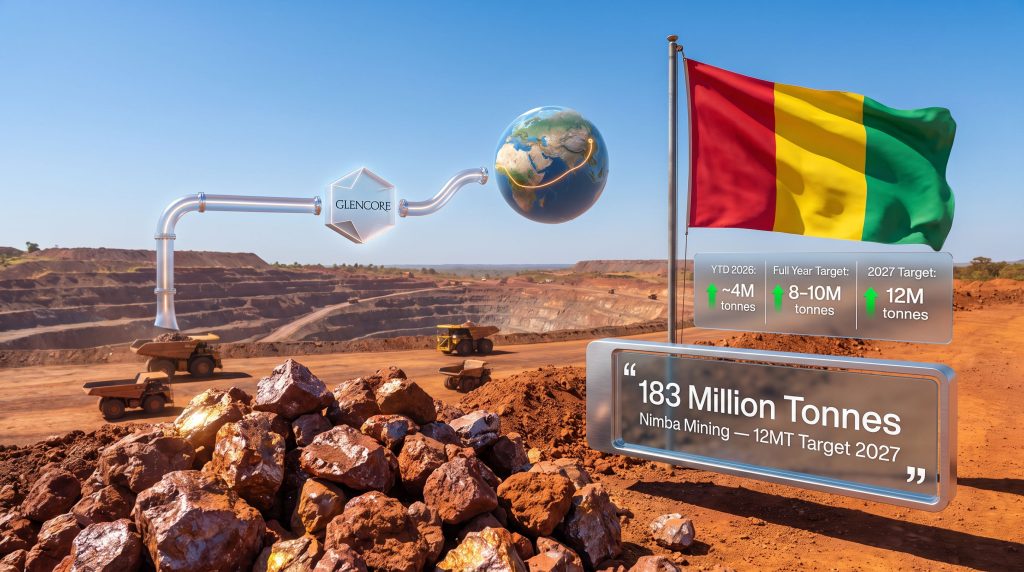
Nimba Mining's planned output ramp is aggressive by any measure. The figures laid out by Guinea's Minister of Mines and Geology, Bouna Sylla, illustrate a trajectory that moves from fledgling operation to material market participant within an 18-month window.
| Timeframe | Bauxite Output |
|---|---|
| Year-to-date 2026 | ~4 million tonnes exported |
| Full year 2026 target | 8 to 10 million tonnes |
| 2027 target | 12 million tonnes |
| Guinea national export (prior year) | ~183 million tonnes |
The scale of this ramp requires significant logistical coordination, including port access, shipping contracts, and end-buyer relationships. It is precisely here that the appointment of Glencore as offtaker becomes commercially critical. For context, the leading bauxite mines globally offer a useful benchmark against which Nimba's ambitions can be measured.
Why Guinea Picks Glencore as Offtaker: The Strategic Logic
Competitive Tender, Centralised Control
The selection of Glencore did not emerge from informal negotiations or pre-existing relationships. It was the outcome of a competitive international tender process managed through Guinea's Ministry of Mines and Geology. Minister Sylla confirmed the appointment publicly in Conakry, emphasising the structured nature of the selection.
What makes this arrangement particularly notable is the deliberate concentration of export authority. Rather than distributing Nimba Mining's output across multiple trading houses or buyers, the Guinean government opted to channel production through a single, globally significant commodity trader. This is a meaningful governance choice.
Offtake agreements of this structure typically give the trading entity substantial influence over pricing mechanics, destination markets, and logistics pathways, while providing the producing state with revenue predictability and guaranteed market access.
As of early August 2026, the formal contract terms between Glencore and Nimba Mining Co. remain under active negotiation. Glencore has declined to comment publicly on the arrangement.
Why Glencore's Infrastructure Makes It a Natural Fit
Glencore operates one of the most extensive commodity marketing and trading networks in the world, with particular depth in industrial minerals destined for Asian markets. Indeed, among the world's commodity trading giants, Glencore's existing relationships with Chinese alumina refiners, established shipping infrastructure, and experience managing large-volume supply agreements position it as a logical commercial partner for a state entity seeking to rapidly scale.
From Glencore's perspective, securing offtake rights over a growing state-owned bauxite operation provides:
- Volume certainty across a multi-year horizon
- Preferential positioning within the Guinea-to-China supply corridor at a time of tightening global alumina supply
- Commercial leverage within the broader aluminium raw material chain
This is not purely altruistic partnership. It is a strategic play by one of the world's most sophisticated commodity traders to embed itself within a supply node of growing geopolitical importance.
Guinea's Supply Management Strategy: OPEC Parallels and Market Mechanics
One dimension of Guinea's evolving posture that deserves more analytical attention is the supply volume management strategy that preceded the Nimba Mining developments. In March 2026, the Guinean government entered discussions with active mining operators about mechanisms to regulate the volume of bauxite released to global markets, with the explicit goal of protecting the country against price deterioration.
This approach draws a conceptual parallel with OPEC-style production governance, applied to a critical industrial mineral rather than crude oil. The mechanics are similar: a dominant supplier with concentrated market share deliberately moderates output to support pricing, rather than maximising volume at the expense of unit revenue.
Consolidating state production under a single international offtaker is, furthermore, structurally consistent with this supply management objective. When export flows pass through one commercial relationship, the state retains far greater ability to modulate volume and timing than it would across a fragmented network of buyers.
Beyond Bauxite: Nimba Mining's Diversification Ambitions
Minister Sylla has articulated a vision that extends well beyond raw bauxite exports. Nimba Mining Co. is described as a prospective mining champion, a concept implying downstream processing capability, diversified commodity exposure, and reduced dependence on any single revenue stream.
The diversification pipeline currently includes:
- Iron ore exploration and development
- Gold production through the Nimba Gold subsidiary
- Metals refining activities to be phased in over time
- A structured MOU with ASX-listed Resolute Mining for collaborative gold project development in Guinea
The Resolute Mining partnership is particularly instructive in terms of phasing. Rather than committing immediately to capital-intensive production infrastructure, the agreement begins with exploration activities before transitioning into full-scale operations. This measured approach reflects an understanding within the Guinean state structure that technical capacity must be built incrementally.
The next major ASX story will hit our subscribers first
Market Implications: What Buyers and Investors Should Watch
Supply Chain Concentration and Pricing Dynamics
The consolidation of Nimba Mining's output under a single trading house introduces a new layer of market concentration at the production-to-export interface. For Chinese alumina refiners who have structured their procurement around diversified Guinean supplier relationships, this shift has practical implications.
A state-directed offtake model reduces the number of commercial counterparties available for bilateral negotiation. Price discovery becomes less transparent, and buyers may find their negotiating leverage constrained relative to a more fragmented supply landscape. The major aluminium mining companies operating across Guinea will be watching these dynamics closely.
Comparing Export Models
| Model Type | Export Control | Price Transparency | Downstream Aspiration |
|---|---|---|---|
| State offtake via single trader (Nimba/Glencore) | High | Moderate | Actively pursued |
| Private concession with foreign operator (former EGA model) | Low | High | Contractually mandated |
| Mixed model (multiple West African operators) | Variable | Variable | Partial |
Investor Considerations
For investors tracking aluminium sector exposure, several key dynamics warrant close attention:
- Nimba Mining's ramp speed toward its 12-million-tonne 2027 target will test Guinea's port and logistics infrastructure
- Contract finalisation between Glencore and Nimba Mining will clarify pricing structures, which could set a market reference point
- Supply management signalling from Conakry has historically preceded tangible output adjustments across the Guinean mining sector
- Resolute Mining's MOU with Nimba Gold represents an early-stage but strategically positioned foothold in a country undergoing significant resource governance transformation
Disclaimer: This article contains forward-looking statements and speculative analysis based on publicly available information as of August 2026. It does not constitute financial advice. Investors should conduct independent due diligence before making any investment decisions.
Frequently Asked Questions
What Does an Offtaker Do in a Mining Context?
An offtaker is a commercial entity that agrees to purchase all or a specified portion of a mining operation's production output, typically through a long-duration supply contract. Offtake arrangements give the producer revenue certainty and the offtaker guaranteed supply access, often with negotiated pricing mechanisms tied to market benchmarks.
Has the Glencore and Nimba Mining Contract Been Signed?
As of early August 2026, contract terms are still being finalised. Glencore's selection as Guinea's choice to pick as offtaker for the state-owned bauxite miner was confirmed through the competitive tender process, but the formal agreement had not yet been executed at the time of reporting.
Why Did Guinea Remove Emirates Global Aluminium From Its Bauxite Concession?
The concession transfer in August 2025 followed a dispute over EGA's obligation to construct an alumina refinery within Guinea. When that condition was not met to the government's satisfaction, the asset was transferred to wholly state-owned Nimba Mining Co.
What Makes Guinean Bauxite Particularly Valuable?
Guinea's deposits are predominantly gibbsite-type bauxite, which processes more efficiently in alumina refineries designed for low-temperature digestion. This mineralogical characteristic reduces energy costs and processing time, making it commercially preferred by many Chinese and international alumina producers.
What Other Resources Is Nimba Mining Co. Pursuing?
In addition to bauxite, Nimba Mining Co. is developing interests in iron ore, gold through its Nimba Gold subsidiary, and metals refining. Its gold activities are being advanced through a phased MOU with ASX-listed Resolute Mining, beginning with exploration before committing to production-stage capital.
Want to Capitalise on the Next Major ASX Mineral Discovery Before the Broader Market?
Discovery Alert's proprietary Discovery IQ model scans ASX announcements in real time, instantly identifying significant mineral discoveries across bauxite, aluminium, gold, and 30+ other commodities — transforming complex data into actionable investment opportunities for both short-term traders and long-term investors. Begin your 14-day free trial today and position yourself ahead of the market.