August 8, 2026
The Hidden Cost of Going Green: Understanding India's Critical Minerals Import Dependence
Across the global economy, the shift away from fossil fuels is frequently framed as a liberation story, nations breaking free from the volatility of oil and gas markets to harness the boundless energy of sun and wind. Yet beneath this narrative sits a structural reality that receives far less attention: clean energy technologies are extraordinarily mineral-intensive, and the countries racing to deploy them are, in many cases, simply exchanging one form of import dependence for another.
For India, this substitution carries significant strategic weight. A nation that has spent decades managing the economic and geopolitical risks of petroleum imports is now confronting an equally complex challenge in the form of India critical minerals import dependence, a vulnerability that will only deepen as the clean energy transition accelerates toward the country's 2047 energy-security objectives.
When big ASX news breaks, our subscribers know first
A New Definition of Energy Security
Energy security has historically been measured in barrels of oil and cubic metres of gas. The infrastructure of vulnerability was pipelines, tanker routes, and refinery capacity. That framing is becoming increasingly incomplete, particularly when viewed through the lens of critical minerals and energy security.
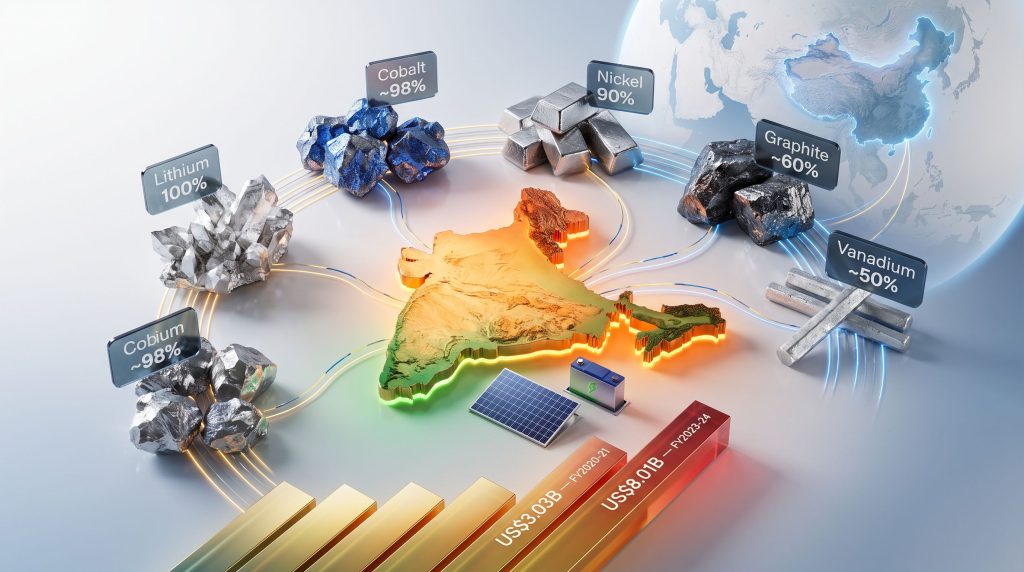
A joint analysis by the Confederation of Indian Industry (CII) and EY has assessed 23 minerals considered critical to clean energy systems and found that India is fully import-dependent for 15 of them. For at least 10 of these, including lithium, cobalt, nickel, vanadium, niobium, germanium, beryllium, tantalum, rhenium, and strontium, domestic production is effectively zero.
The country produces none of these materials in meaningful commercial quantities, meaning every battery cell, every solar inverter component, and every grid storage unit that relies on them must be sourced entirely from abroad. This is not a marginal exposure. It is a structural feature of India's clean energy ambition, and it demands a strategic response that matches the scale of the challenge.
The Depth of India's Critical Mineral Import Exposure
The scope of India's mineral vulnerability becomes clearer when laid out systematically. Several minerals sit at the absolute extreme of dependence, while others present partial but still significant risks.
| Critical Mineral | Estimated Import Dependence | Primary Clean Energy Application |
|---|---|---|
| Lithium | 100% | EV batteries, grid-scale storage |
| Cobalt | 100% | Battery cathodes |
| Nickel | 100% | Battery anodes, fuel cells |
| Vanadium | 100% | Grid-scale vanadium redox batteries |
| Niobium | 100% | High-strength steel alloys, superconductors |
| Zirconium | ~80% | Nuclear reactors, advanced ceramics |
| Graphite | ~60% | Battery anodes |
| Manganese | ~50% | Battery production, specialty steels |
What makes this picture particularly concerning from a strategic planning perspective is not simply the volume of imports, but the nature of the dependency. Many of these minerals cannot be easily substituted in their primary applications. Lithium-ion battery chemistry, for instance, is currently irreplaceable at commercial scale for electric vehicles and grid storage.
Cobalt remains critical to the thermal stability of high-energy-density cathode formulations. Graphite, despite being more abundant globally than lithium, requires highly specialised processing before it is suitable for battery-grade applications, and that processing infrastructure is heavily concentrated outside India. Furthermore, the battery raw materials market continues to tighten as global demand accelerates, compounding India's exposure.
China's Processing Dominance: The Real Risk Factor
Mining concentration draws attention, but refining concentration is the more dangerous vulnerability. A country can hold mineral reserves and still remain entirely dependent on foreign processing infrastructure to convert raw ore into usable industrial inputs. This distinction, often overlooked in policy discussions, sits at the heart of India's exposure.
In 2024, China controlled approximately 93% of global graphite refining, 85% of rare-earth processing, 79% of cobalt refining, 70% of lithium refining, and 44% of nickel refining. These figures reflect decades of deliberate industrial policy and infrastructure investment, not simply geographic good fortune.
When examined specifically through the lens of India's import origins, China's dominance becomes even more precise:
| Mineral | China's Share of India's Imports |
|---|---|
| Bismuth | ~85.6% |
| Lithium | ~82% |
| Silicon | ~76% |
| Titanium | ~50.6% |
| Tellurium | ~48.8% |
| Graphite | ~42.4% |
The risk embedded in these figures is not purely economic. When trade relationships between nations deteriorate, or when export restrictions are applied, countries with concentrated sourcing face immediate supply disruption with few available substitutes. China's export restrictions on gallium, germanium, and rare earth elements have already demonstrated how swiftly this leverage can be exercised. The lesson for supply chain planners is clear: concentration creates leverage, and leverage can be exercised.
A country's ability to execute its clean energy transition is ultimately constrained by its access to the physical inputs that technology requires. Diversifying those inputs is not optional for long-term energy sovereignty; it is a prerequisite.
An Import Bill Growing at Alarming Speed
The financial dimension of India critical minerals import dependence has escalated sharply in recent years. Between FY2020-21 and FY2023-24, India's annual spending on critical mineral imports more than doubled, rising from approximately US$3.03 billion to US$8.01 billion, an increase of roughly 164% in just three fiscal years.
This trajectory reflects several converging forces:
- Accelerating domestic deployment of solar, wind, and storage capacity, driving higher physical import volumes
- Global commodity price inflation in lithium, cobalt, and nickel following the EV demand surge of the early 2020s
- Expanding manufacturing ambitions in battery cells, solar modules, and electric vehicles requiring upstream mineral inputs
- Grid modernisation investment consuming significant quantities of copper, aluminium, and silicon
The forward-looking demand picture is even more striking. Projections covering the period from 2025 to 2070 suggest cumulative Indian demand across key transition minerals will reach extraordinary volumes:
- Copper: exceeding 66 million tonnes
- Graphite: approximately 46 million tonnes
- Silicon: approximately 19.5 million tonnes
- Phosphorus: approximately 16.7 million tonnes
- Nickel: approximately 11.5 million tonnes
These are not marginal requirements. They represent the material substrate of an entire economic transformation, and meeting them through imports alone, at current price trajectories, would represent an enormous and potentially destabilising transfer of economic value abroad. According to IEEFA's analysis of India's critical mineral imports, this trajectory underscores the urgency of supply diversification.
Sector-by-Sector Demand Drivers
Electric Mobility and Battery Chemistry
India's electric vehicle ambitions sit at the core of its mineral demand growth. The battery chemistries currently dominating global EV production, primarily lithium nickel manganese cobalt oxide (NMC) and lithium iron phosphate (LFP) variants, require inputs across multiple critical mineral categories. Even as battery technology evolves toward lower-cobalt or cobalt-free formulations, lithium and graphite remain structurally essential across all mainstream pathways.
Renewable Energy Infrastructure
Solar photovoltaic panels require silicon, silver, tellurium (in cadmium telluride variants), and indium. Wind turbines rely on rare earth elements, particularly neodymium and dysprosium, for the permanent magnets used in direct-drive generators. India's target of reaching 500 GW of non-fossil fuel capacity generates substantial, ongoing mineral requirements across both technologies.
Grid-Scale Storage and Nuclear Power
Grid-scale battery storage systems, essential for managing the intermittency of solar and wind, consume the same lithium, cobalt, and graphite inputs as EV batteries but at utility scale. Meanwhile, India's nuclear expansion programme introduces a distinct set of mineral requirements, including zirconium for reactor fuel cladding and hafnium for control rods, both of which currently carry significant import dependence.
Transmission Infrastructure
Frequently overlooked in minerals discussions, the expansion of India's transmission and distribution network requires vast quantities of copper and aluminium. Copper in particular sits at the intersection of nearly every electrification pathway, from EV charging infrastructure to transformer windings and underground cabling.
The next major ASX story will hit our subscribers first
The Consequences of Unmanaged Dependence
Several distinct risk categories emerge from India's current import exposure:
- Supply disruption risk: A geopolitical shock affecting key supplier relationships, whether through export controls, sanctions, or diplomatic breakdown, could interrupt the material flows underpinning India's entire clean energy deployment programme.
- Price volatility transmission: Global commodity price swings in lithium or cobalt translate directly into domestic clean energy cost inflation, complicating project economics and potentially slowing deployment.
- Technology lock-in risk: Countries that depend on imported minerals and imported processing technology risk becoming permanently embedded in foreign technology ecosystems, with limited ability to capture the manufacturing value of their own energy transition.
- 2047 goals at risk: India's vision of energy independence by the centenary of its founding requires not just generation capacity, but sovereign control over the supply chains that underpin it.
Strategies to Reduce India's Mineral Vulnerability
Domestic Exploration and Mining
India possesses unexplored geological potential in several critical mineral categories. Preliminary assessments have identified possible lithium occurrences in Rajasthan and Jammu and Kashmir, graphite deposits in Arunachal Pradesh and Odisha, and cobalt indicators in parts of Jharkhand. Translating geological potential into productive mines requires sustained investment in exploration, updated regulatory frameworks, and faster permitting pathways.
Building Refining and Processing Capacity
This is arguably the most consequential gap in India's mineral strategy. Even where raw materials can be sourced, without domestic refining infrastructure India cannot convert them into battery-grade or industrial-grade inputs. Developing this processing capability requires capital investment, technology transfer arrangements, and the cultivation of specialised technical workforces.
Strategic Stockpiling
Japan maintains a national reserve of rare earths and other critical minerals representing several months of industrial consumption. South Korea operates similar strategic buffer programmes. The United States has used the Defence Production Act to build reserves of materials considered essential to national security. India's stockpiling frameworks remain relatively underdeveloped compared to these peer economies, representing a near-term vulnerability reduction opportunity that does not require decade-long infrastructure development.
Supply Diversification Through Bilateral Agreements
Reducing the concentration of sourcing away from any single country, particularly for minerals where China currently dominates, requires proactive engagement with resource-rich nations across Africa, Latin America, and Oceania. India's lithium supply strategy with Australia represents one such model, demonstrating how targeted bilateral partnerships can begin to shift the sourcing calculus. Furthermore, Australia, Chile, the Democratic Republic of Congo, and Zambia each hold significant reserves of minerals critical to India's transition.
Critical Mineral Recycling
Battery recycling represents a domestic supply source that grows proportionally with deployment. As India's EV fleet expands over the coming decade, end-of-life batteries will become an increasingly significant feedstock for lithium, cobalt, nickel, and graphite recovery. Establishing robust collection, sorting, and hydrometallurgical processing infrastructure now, before the recycling feedstock wave arrives, positions India to capture this secondary supply rather than exporting it.
How India Compares Globally
India's mineral processing gap relative to China is well-documented, but the comparison with other major economies is equally instructive. The European Union's Critical Raw Materials Act establishes domestic targets requiring that at least 10% of annual consumption be extracted domestically, 40% processed domestically, and 15% recycled by 2030.
The United States has deployed the Inflation Reduction Act and the Defence Production Act to incentivise domestic mineral supply chain development with tens of billions of dollars in committed capital. India's policy architecture is developing but has not yet reached the implementation intensity of these frameworks. The gap between recognising the problem and executing the industrial policy response at scale remains the central challenge, particularly as critical minerals demand continues to surge globally. According to the India Brand Equity Foundation, strengthening domestic policy frameworks will be essential to supporting India's green energy transition ambitions.
Frequently Asked Questions: India Critical Minerals Import Dependence
Which critical minerals is India 100% dependent on imports for?
India is fully import-dependent for at least 10 minerals including lithium, cobalt, nickel, vanadium, niobium, germanium, beryllium, tantalum, rhenium, and strontium. Across the broader 23-mineral assessment conducted by CII and EY, India depends entirely on imports for 15.
Why does China's dominance in mineral refining matter so much for India?
Because mining ore and processing it into usable industrial inputs are entirely different operations. China controls the majority of global refining capacity for graphite, rare earths, cobalt, and lithium. Even if India sourced raw minerals from Africa or South America, converting them into battery-grade materials would still require access to Chinese processing infrastructure under current conditions.
How much does India currently spend on critical mineral imports annually?
As of FY2023-24, India's critical mineral import bill stands at approximately US$8.01 billion, more than double the US$3.03 billion recorded in FY2020-21.
What is the difference between mining dependence and refining dependence?
Mining dependence refers to reliance on other countries to extract raw ore from the ground. Refining dependence refers to reliance on other countries to process that ore into industrial-grade materials. Refining dependence is generally considered more strategically dangerous because processing infrastructure is more capital-intensive, technically complex, and geographically concentrated.
Which sectors in India will consume the most critical minerals over the next two decades?
Electric mobility, grid-scale battery storage, solar and wind energy infrastructure, nuclear power, and transmission network expansion are the primary demand drivers, with copper, graphite, lithium, silicon, nickel, and rare earth elements collectively accounting for the largest projected volumes through 2070.
Building a Resilient Critical Minerals Ecosystem: The Path Forward
In the near term, India's most actionable priorities involve securing supply through diversified bilateral sourcing arrangements, initiating strategic stockpile programmes for the highest-risk minerals, and accelerating geological survey work to better characterise domestic resource potential.
Over the medium term, the structural priority must shift toward building domestic processing and refining capability. This is the layer of the supply chain where India critical minerals import dependence is most acute, and where investment will deliver the greatest reduction in strategic vulnerability.
The long-term vision, genuinely sovereign mineral supply chains encompassing exploration, extraction, processing, and recycling within India or through deeply trusted bilateral partnerships, requires policy consistency over multiple electoral cycles, sustained capital deployment, and international engagement of a complexity that goes well beyond traditional commodity trade.
Readers seeking further detail on India's energy transition mineral challenges can explore related reporting from ET EnergyWorld, including coverage of the CII-EY joint report on India's critical energy-transition mineral vulnerabilities, available at energy.economictimes.indiatimes.com.
Disclaimer: This article contains forward-looking projections and demand forecasts drawn from third-party analyses. These figures are inherently uncertain and should not be treated as guarantees of future outcomes. Readers making investment or policy decisions should conduct independent research and seek professional advice.
Want to Capitalise on the Critical Minerals Driving India's Clean Energy Transition?
Discovery Alert's proprietary Discovery IQ model instantly identifies significant ASX mineral discoveries across lithium, cobalt, graphite, and the full spectrum of critical minerals reshaping global supply chains — delivering real-time alerts so subscribers can act on actionable opportunities before the broader market reacts. Explore how historic mineral discoveries have generated substantial returns and begin your 14-day free trial today.