August 8, 2026
When Scrap Becomes Strategy: Understanding the New Architecture of US Critical Mineral Controls
The history of industrial resource policy has rarely moved in straight lines. For decades, Western economies operated on the comfortable assumption that global commodity markets would always self-correct. That price signals alone would ensure the reliable flow of materials from wherever they happened to be cheapest to produce. That assumption is now being systematically dismantled, and the instrument doing the dismantling is not a new mine, a new refinery, or a new trade agreement. It is a policy of US bans on critical mineral exports, specifically recycled industrial scrap.
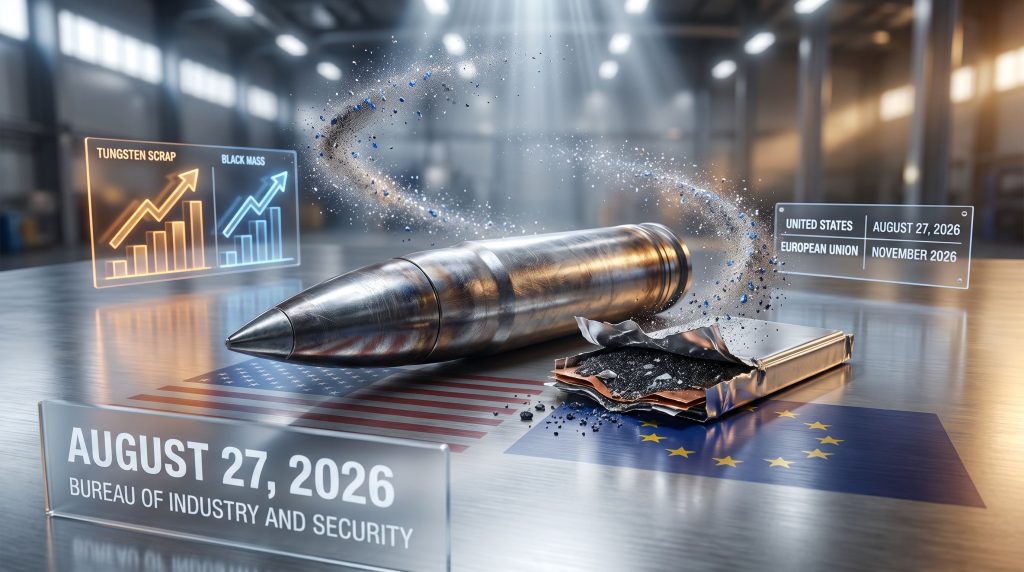
The United States decision to prohibit the export of black mass and tungsten scrap, taking effect August 27, 2026, is less a trade policy measure than a redefinition of what counts as a strategic asset. Understanding why that redefinition matters requires looking not at the policy itself, but at the supply chain architecture it is designed to correct.
When big ASX news breaks, our subscribers know first
Why Recycled Battery Scrap Now Carries the Weight of National Security
For most of its commercial history, black mass occupied the lower end of the industrial materials hierarchy. It is the powdered residue left behind when spent lithium-ion batteries are mechanically shredded, a heterogeneous mixture containing recoverable quantities of lithium, cobalt, nickel, manganese, and graphite. Its value was acknowledged but its treatment was essentially logistical: aggregate it, ship it to facilities in South Korea, Japan, or China capable of processing it at scale, and recover what can be recovered.
That processing geography reflected a structural reality. Asian facilities, particularly those in South Korea and China, built out hydrometallurgical and pyrometallurgical capacity for black mass processing well ahead of their Western counterparts. The economics followed the infrastructure, and for years, US black mass flowed eastward because there was simply nowhere domestic to send it at comparable efficiency or cost.
How BIS Expanded Its Mandate
The Bureau of Industry and Security (BIS), the Commerce Department agency now administering the export restrictions, has historically governed dual-use technologies with military and civilian applications — think encryption software, advanced semiconductors, and aerospace components. Its application of export licensing frameworks to recycled battery scrap represents, as commodity pricing agency Argus described it, a genuinely unprecedented expansion of its mandate. Furthermore, battery recycling in China had long absorbed much of this material, making the policy shift all the more consequential for existing trade flows.
The decision to place black mass under BIS jurisdiction signals that Washington now treats battery scrap not as a commodity surplus but as a recoverable defence input that must be retained within domestic industrial reach.
What changed? The answer lies less in the materials themselves than in the geopolitical architecture surrounding them. China's export restrictions on critical minerals, deployed as leverage during the broader US-China trade dispute, exposed with unusual clarity the structural fragility of depending on a single nation for materials embedded in everything from electric vehicle batteries to precision-guided munitions.
What Is Black Mass, and Why Does Its Chemistry Matter?
Black mass is not a uniform substance. Its composition varies significantly depending on the chemistry of the batteries from which it was derived. Lithium iron phosphate (LFP) cells, increasingly dominant in Chinese EV production and grid storage, yield black mass with lower cobalt and nickel content. Nickel manganese cobalt (NMC) and nickel cobalt aluminium (NCA) chemistries, more prevalent in Western and Korean EV manufacturing, produce black mass considerably richer in cobalt and nickel.
This matters for both economics and policy. The recoverable value embedded in a tonne of NMC-derived black mass is substantially higher than that from LFP feedstock, which partly explains why Asian processors have historically been willing to pay for US black mass imports. The US, with its large installed base of NMC-chemistry EVs, produces a relatively high-grade black mass stream.
Key Battery Metals and Their Strategic Relevance
Key battery metals recoverable from black mass include:
- Lithium: essential for all lithium-ion battery chemistries; the US has limited domestic processing capacity for battery-grade lithium carbonate or hydroxide
- Cobalt: over 70% of primary cobalt supply originates from the Democratic Republic of Congo, making domestic scrap recovery a meaningful offset to a single-country dependency
- Nickel: required for high-energy-density battery cathodes; also used in defence-grade superalloys
- Manganese: a lower-value but volumetrically significant component; increasingly relevant as LMR and LMFP cathode chemistries mature
- Graphite: the dominant anode material in lithium-ion cells; China controls approximately 80–90% of global synthetic and natural graphite processing capacity
The combination of these materials within a single recoverable stream makes black mass one of the more strategically dense secondary resources in the US industrial system. In addition, the broader critical minerals demand surge driven by the energy transition has further elevated the significance of retaining these materials domestically.
Tungsten Scrap: The Harder Problem
If black mass represents a recoverable opportunity, tungsten scrap represents an acute vulnerability. The United States has zero active tungsten mines. That is not a policy failure so much as a market outcome: decades of low-cost Chinese tungsten production made domestic primary mining economically unviable, and the industry atrophied accordingly. The US now depends entirely on scrap recovery and imports for its tungsten supply.
Tungsten's strategic importance is well understood within specialist circles but less commonly appreciated by the general public. Its extreme density (approximately 19.3 grams per cubic centimetre, nearly twice that of lead) and very high melting point make it the material of choice for kinetic energy penetrators, armour-piercing projectiles, shaped charge liners, and radiation shielding in certain weapons systems. There is no commercially viable substitute for tungsten in these applications at comparable performance levels.
| Material | Key Contained Metals | Primary Defence Use | Current US Domestic Production |
|---|---|---|---|
| Black Mass | Li, Co, Ni, Mn, Graphite | Battery systems, electronics | Near-zero processing capacity |
| Tungsten Scrap | Tungsten (W) | Munitions, armour, cutting tools | No active primary mining |
The timing of the restriction reflects an acute supply-demand imbalance. Global rearmament cycles driven by conflicts in Ukraine and the Middle East have sharply accelerated munitions consumption across NATO and allied nations. Simultaneously, energy security risks tied to compressed tungsten supply on global markets have reinforced the urgency of the domestic retention policy, contributing to a significant upward move in tungsten prices during 2026.
How the Export Restriction Actually Works
The mechanics of the new rule are straightforward but carry significant commercial implications for affected industries. According to reporting from the National Association of Manufacturers, the policy framework operates as follows:
- Directive origin: President Trump directed the Commerce Department to draft the restrictions, citing an inadequate domestic supply of specific metals posing escalating risks to national defence and security.
- Effective date: The rule takes effect on August 27, 2026, approximately three weeks after the announcement on August 5.
- Duration: The restriction runs for one year, subject to formal review and potential extension or scope expansion.
- Coverage: The initial scope is limited to black mass and tungsten scrap. The Commerce Department has indicated the framework could extend to additional recoverable critical minerals.
- Default obligation: US sellers of covered materials must direct sales exclusively to domestic buyers.
- Waiver pathway: Case-by-case exceptions are available for exporters who can demonstrate undue hardship or irreparable commercial harm, such as businesses with pre-existing long-term foreign supply contracts where no viable domestic alternative buyer exists.
The waiver mechanism is important context for affected businesses. It is not a blanket prohibition with zero flexibility; it is a default domestic obligation with an escape valve for genuinely constrained commercial circumstances. Whether the waiver process proves administratively accessible in practice will be one of the early implementation tests of the policy.
The Strategic Logic: Why This Is a Defence Procurement Instrument, Not Just a Trade Measure
The framing of the restriction as a trade policy measure understates its strategic intent. What the BIS action effectively creates is a domestic materials buffer for the US defence industrial base — a guaranteed feedstock pool of tungsten scrap and battery-critical metals that cannot be exported to competitor nations during a period of elevated geopolitical risk.
This logic mirrors, in reverse, the approach Beijing has used with its own critical mineral export controls. China's restrictions on gallium, germanium, graphite, and tungsten products were not primarily revenue measures; they were leverage instruments designed to impose costs on foreign industrial systems during a trade dispute. Washington has drawn the lesson and is now deploying the same instrument class on materials flowing in the opposite direction.
The broader strategic context includes several converging pressures:
- China controls dominant processing capacity across battery-grade metals, rare earths, and tungsten metal products
- Beijing's export restrictions demonstrated the speed at which supply chain dependencies can be weaponised
- Active conflicts in multiple theatres have accelerated munitions consumption beyond pre-conflict planning assumptions
- US defence industrial base planning now explicitly incorporates critical mineral availability as a readiness variable
The next major ASX story will hit our subscribers first
The International Dimension: A Coordinated Western Response Takes Shape
The US restriction does not exist in isolation. The European Union has independently announced plans to implement comparable restrictions on black mass exports, with an implementation target of November 2026. The EU's motivation parallels Washington's: reduce dependence on Asian processing, build domestic battery recycling capacity, and secure materials for European defence and EV supply chains.
| Jurisdiction | Policy Action | Target Materials | Timeline |
|---|---|---|---|
| United States | Export ban (BIS-administered) | Black mass, tungsten scrap | Effective August 27, 2026 (1 year) |
| European Union | Export restriction (planned) | Black mass | November 2026 |
| Canada and Japan | Strategic stockpiling discussions (under negotiation) | Broad critical minerals | To be confirmed |
The convergence of US and EU policy on black mass export controls within months of each other suggests a degree of strategic alignment among Western governments. However, whether this evolves into a formally coordinated allied framework, similar to the coordinated export controls on advanced semiconductors, remains to be seen. Consequently, Forbes analysis of the export restrictions notes the potential for further countries to adopt parallel measures in the months ahead.
Industry Consequences: Who Gains and Who Absorbs the Costs
For US battery recyclers and scrap processors, the restriction creates an immediate structural advantage. A supply of black mass that previously flowed to lower-cost Asian processing facilities is now legally required to remain within domestic market reach. This is, in effect, a captive feedstock policy, and it will accelerate investment in domestic processing infrastructure as the commercial case for building out capacity becomes significantly stronger.
The critical caveat is timeline. The US currently lacks sufficient processing infrastructure to efficiently absorb all redirected black mass material. In the near term, this creates a potential bottleneck: material that cannot be exported and cannot yet be processed domestically at scale. Managing this transition will require both infrastructure investment and potentially some tolerance for temporary inefficiencies in the recycling system.
For defence contractors and munitions manufacturers, tungsten scrap retention provides a more reliable domestic input stream for a material with no primary mining alternative. The risk of Chinese supply disruption, which had become a live planning concern given Beijing's export restriction track record, is partially mitigated by ensuring that domestically recovered tungsten stays within the US industrial system.
For global commodity markets, the removal of US export volumes from available supply will shift pricing dynamics for both black mass and tungsten scrap. Asian processors that previously imported US material will need to source feedstock from alternative origins, and upward price pressure on tungsten specifically is likely to persist given simultaneous demand growth from global rearmament and supply restriction from Chinese export curbs.
Could the Scope Expand? The Materials Most Likely to Be Next
The Commerce Department's explicit signalling that the initial two-material scope is a starting point rather than a ceiling has significant implications for industries handling other recoverable critical minerals. The one-year review window is a formal mechanism for scope expansion, and the materials most logically adjacent to the existing restrictions include:
- Cobalt scrap: primary cobalt supply is heavily concentrated in the Democratic Republic of Congo; domestic scrap recovery represents a meaningful but underutilised offset
- Nickel-bearing scrap: relevant to both high-energy battery cathode manufacturing and defence-grade superalloys used in aerospace and propulsion systems
- Rare earth element processing residues: currently exported with minimal domestic value recovery; REE dependency on Chinese processing represents perhaps the deepest structural vulnerability in the entire US critical mineral supply chain
- Natural graphite processing scrap: given China's near-total dominance of graphite processing, any recoverable domestic graphite stream carries significant strategic value
Investors and industry participants should note that scope expansion remains speculative at this stage and subject to the Commerce Department's formal review process. Policy decisions of this nature involve significant regulatory and commercial complexity, and timelines can shift considerably from initial signals.
Frequently Asked Questions: US Critical Mineral Export Restrictions
Does this ban apply to all critical minerals?
No. The current restriction covers only two specific material streams: black mass derived from shredded lithium-ion batteries, and tungsten scrap. The Commerce Department retains authority to expand coverage but has not yet done so.
When does the export ban take effect?
The restrictions become operative on August 27, 2026, and are set to remain in place for one year, with potential for extension or scope expansion following review.
Can US companies still export these materials under any circumstances?
Yes, but only through a formal waiver process. Exporters must demonstrate undue hardship or irreparable commercial harm to qualify for a case-by-case exemption.
Why does the US have no active tungsten mines?
Domestic tungsten mining became economically unviable as sustained low-cost Chinese production captured global market share over several decades. The US now relies entirely on scrap recovery and imports — a structural dependency the new policy partially addresses by ensuring domestically recovered material stays within the US industrial system.
Is the EU doing something similar?
Yes. The EU has announced plans to restrict black mass exports from November 2026, reflecting a parallel strategic assessment of battery material supply chain vulnerabilities among Western economies.
What makes black mass composition variable, and why does it matter?
The metal content of black mass depends directly on the chemistry of the batteries from which it is derived. NMC and NCA battery chemistries yield higher-value black mass with elevated cobalt and nickel content, while LFP chemistries produce lower-value streams. The US, with a substantial installed base of NMC-chemistry electric vehicles, generates a relatively high-grade black mass feedstock, which increases both the commercial and strategic value of retaining it domestically.
The Broader Shift: Export Controls as a Permanent Feature of the Critical Mineral Landscape
Perhaps the most significant long-term implication of the action to implement US bans on critical mineral exports is what it signals about the future of critical mineral trade. Export restrictions on recoverable materials were, until recently, instruments associated primarily with resource nationalism in authoritarian states. Their adoption by Western democracies as legitimate supply chain security tools represents a fundamental shift in the operating assumptions of the global commodities system.
For mining companies, recyclers, defence contractors, and battery manufacturers operating across international supply chains, the key takeaway is structural: export access to recovered critical materials can no longer be assumed as a commercial baseline. The policy landscape is now one where domestic processing infrastructure carries premium strategic value, where scrap streams are assessed through a national security lens, and where the regulatory environment governing material flows can change with relatively short notice periods.
The US decision to treat black mass and tungsten scrap as strategic retained assets rather than exportable commodities may prove to be the opening chapter of a much longer reorientation in how Western economies think about the materials embedded in their own industrial waste streams.
| Policy Dimension | Detail |
|---|---|
| Administering Agency | Bureau of Industry and Security (BIS), US Commerce Department |
| Materials Covered | Black mass (battery scrap), tungsten scrap |
| Effective Date | August 27, 2026 |
| Duration | One year, with review and potential extension |
| Waiver Availability | Yes, case-by-case for hardship or irreparable harm |
| Strategic Rationale | Reduce China dependence, strengthen defence supply chains, build domestic recycling capacity |
| Comparable International Action | EU black mass export restriction planned for November 2026 |
Want to Track ASX Discoveries Linked to the Critical Minerals Reshaping Global Supply Chains?
As Western governments move to secure domestic supplies of battery metals, tungsten, and other strategic materials, the investment implications for ASX-listed explorers and producers are significant — Discovery Alert's proprietary Discovery IQ model delivers real-time alerts on major ASX mineral discoveries, instantly translating complex data across 30-plus commodities into actionable insights for investors at every level. Explore historic examples of transformative mineral discoveries and their market returns, then begin your 14-day free trial to position yourself ahead of the next major find.