
August 8, 2026
Why Aluminium Scrap Is Now a Geopolitical Asset, Not Just a Recyclable Material
The economics of aluminium have always been shaped by energy. For decades, the location of smelters followed the geography of cheap electricity, from Iceland's geothermal fields to Norway's hydropower grid. But a quieter, less visible transformation is now underway, one that has less to do with where electrons are generated and everything to do with where discarded metal ends up. The race for aluminium scrap has become one of the most consequential competitive dynamics in global manufacturing, pulling together trade policy, industrial strategy, automotive procurement and carbon regulation into a single, high-stakes contest.
Understanding why this shift is happening requires looking beyond recycling rates and into the structural forces that are simultaneously accelerating demand for secondary aluminium while tightening the supply of the scrap that makes it possible.
When big ASX news breaks, our subscribers know first
The Reclassification of Scrap: From Waste Stream to Strategic Feedstock
For most of the twentieth century, aluminium scrap occupied a peripheral position in industrial planning. It was valuable, certainly, but it was treated as an opportunistic input rather than a planned strategic resource. That framing has collapsed.
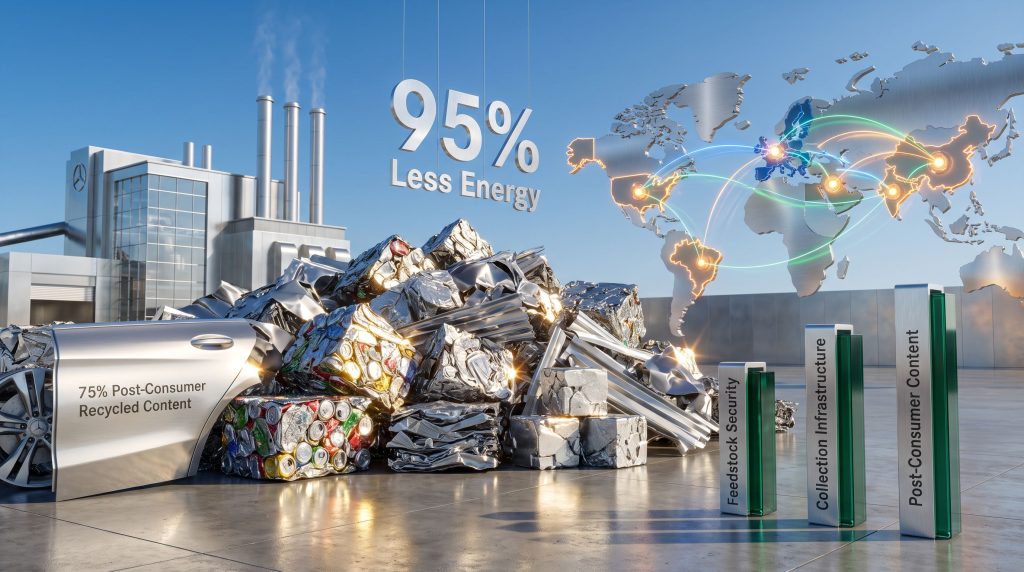
The energy arithmetic alone explains much of the shift. Producing aluminium from recycled scrap requires up to 95% less energy than smelting primary metal from bauxite and alumina. In an era defined by decarbonisation targets, carbon border adjustments and corporate emissions accounting, that differential is not just an environmental talking point. It is a structural cost advantage that every downstream buyer, from automotive OEMs to packaging manufacturers, is beginning to price into procurement decisions.
The problem is that demand for secondary aluminium is accelerating at precisely the moment when scrap availability is tightening. Five interconnected forces are driving this compression simultaneously:
- Primary supply tightness pushing buyers toward secondary metal as a substitute
- Export policy proliferation reducing the free movement of scrap across borders
- OEM recycled-content requirements creating new quality thresholds that most scrap streams cannot meet without advanced processing
- Carbon border adjustment mechanisms making verified low-carbon material a market access requirement rather than a premium option
- Government industrial strategy repositioning scrap as a national resource rather than a freely traded commodity
The interaction of these five forces is what makes the current moment structurally different from previous periods of scrap price volatility. This is not a cyclical tightening. It is a permanent reclassification.
Force 1: The Global Tightening of Aluminium Scrap Supply
How Regional Disruptions Are Revealing a Systemic Vulnerability
The clearest evidence of scrap's new strategic status comes from the pattern of trade disruptions that have emerged across multiple regions simultaneously. Each disruption, viewed in isolation, looks like a localised market event. Viewed together, they reveal a systemic vulnerability in the architecture of global secondary aluminium supply.
Brazil's rising scrap export volumes to China have reignited a domestic policy debate about whether valuable secondary material should remain within the country to support higher-value manufacturing. China's share of Brazilian aluminium scrap exports has risen sharply since 2022, with some estimates suggesting China accounted for close to a quarter of Brazil's total scrap export volume by the mid-2020s. Industry voices in Brazil have argued that retaining more scrap domestically could strengthen the circular economy and improve long-term competitiveness as demand for certified low-carbon aluminium grows globally.
In the United States, the Aluminum Association has formally urged policymakers to treat aluminium scrap as a strategic manufacturing resource rather than a recyclable by-product. The argument is that rising scrap exports are hollowing out domestic recycling capacity at precisely the moment when demand for secondary aluminium from electric vehicle manufacturers and infrastructure programs is accelerating. Furthermore, US aluminium tariffs have introduced additional complexity by creating asymmetric pricing pressures across the Atlantic trade corridor.
The most acute supply shock has played out in India. Export restrictions introduced by several Gulf states disrupted established scrap supply corridors, exposing Indian recyclers to sudden feedstock shortfalls and forcing a rapid, costly diversification toward alternative sourcing regions. Higher freight costs and longer shipping routes have compressed margins across the sector, demonstrating how quickly a policy decision in one jurisdiction can transmit economic pain to processors thousands of kilometres away.
Regional Scrap Supply Dynamics at a Glance
| Region | Key Supply Dynamic | Strategic Implication |
|---|---|---|
| Brazil | Rising export volumes to China | Domestic feedstock at risk; policy debate intensifying |
| United States | Industry push for strategic material classification | Export controls under consideration; recycling capacity under pressure |
| European Union | Scrap leakage to lower-cost processing markets | Commission exploring export restriction mechanisms |
| Middle East | Export restrictions introduced by Gulf states | Indian recyclers facing supply disruption and forced diversification |
| China | Expanding secondary capacity; active global scrap importer | Dominant buyer role reinforced; domestic retention policies tightening |
| India | Dependent on imported scrap; exposed to Gulf supply disruptions | Higher freight costs compressing margins; sourcing diversification required |
The Scrap Leakage Problem: Europe's Policy Dilemma
Within the European Union, the concern is framed as scrap leakage: the export of aluminium scrap from regions with advanced recycling infrastructure to lower-cost processing markets elsewhere, primarily in Asia. The consequence is a weakening of the domestic circular economy at the very moment when European industrial policy is oriented toward building one. Indeed, Europe's competitive advantage in recycling is increasingly seen as something worth actively protecting through trade policy.
The European Commission is examining whether export duties or equivalent trade measures could retain more scrap within the EU industrial base. The economic logic is straightforward: scrap processed domestically supports higher-value downstream manufacturing and reduces dependence on primary aluminium imports from jurisdictions with higher carbon intensity. The regulatory complexity, however, is significant. Export restrictions must be carefully designed to avoid conflict with World Trade Organization obligations and existing bilateral trade agreements, creating a policy design challenge that has no simple solution.
Key Insight: Scrap availability is no longer primarily a function of recycling rates. It is increasingly determined by export policy architecture, geopolitical relationships and the trade corridors that connect scrap generators to processors. A nation's recycling rate tells you how much scrap exists. Its trade policy tells you who gets to use it.
Force 2: Trade Policy Replacing Price Signals as the Primary Market Driver
The Politicisation of Aluminium Scrap Trade
For most commodities, price signals coordinate supply and demand. Scrap aluminium is rapidly becoming an exception. Trade flows are increasingly determined by industrial policy decisions rather than pure market price arbitrage, a shift with profound implications for traders, recyclers and downstream manufacturers alike.
Three policy instruments are reshaping scrap trade most powerfully:
- Export restrictions applied unilaterally by scrap-generating countries seeking to retain secondary material for domestic processing
- Critical materials classifications that trigger a broader toolkit of protectionist measures including domestic content requirements and supply chain security investments
- Bilateral trade agreement provisions that embed carbon compliance requirements and recycled content standards into market access conditions
The United States presents a particularly instructive case of tariff asymmetry. Import duties applied to primary aluminium but not to scrap have created price differentials that redirect European scrap volumes toward the U.S. market, intensifying competition within the Atlantic trade corridor and reducing the scrap available to European recyclers. Consequently, aluminium premiums trends across North America have shifted notably in response to these redirected flows.
Critical Materials Classification: The Policy Lever That Changes Everything
The Aluminum Association's push to classify aluminium scrap as a critical manufacturing resource carries implications that extend well beyond labelling. Once a material is designated as strategically critical, it becomes eligible for a fundamentally different set of policy interventions: export controls, domestic content requirements embedded in public procurement, and prioritised access to infrastructure investment. The precedent from rare earth minerals and battery-grade lithium shows how quickly critical materials classification can reshape global trade flows and investment patterns.
The risk of a cascade effect is real. When one major economy classifies scrap as strategic and implements export controls, trading partners face immediate pressure to respond with equivalent or retaliatory measures. The outcome could be a progressive fragmentation of global scrap trade into regional blocs, each governed by its own retention policies and domestic content requirements.
Strategic Warning for Traders and Recyclers: Dependence on a single sourcing region or established trade corridor now constitutes a material business risk. Policy-driven supply disruptions can materialise with very limited advance notice. The Gulf export restrictions that blindsided Indian recyclers were not preceded by prolonged regulatory signalling. Geographic sourcing diversification is no longer an optional risk management strategy. It is a baseline operational requirement.
Southeast Asia as an Emerging Scrap Processing Hub
One adaptive response to the proliferating patchwork of export restrictions has been the routing of scrap through intermediate processing hubs in Southeast Asia before re-export to final destinations. This hub-and-spoke model allows market participants to navigate jurisdiction-specific restrictions while capturing arbitrage opportunities created by regulatory asymmetries.
The longer-term implication is a reduction in trade flow transparency that complicates enforcement of any future export control regime. When scrap changes form and jurisdiction multiple times before reaching a final processor, tracking origin and destination becomes technically and legally challenging for regulators.
Force 3: Recycling Investment Evolving from Capacity to Feedstock Strategy
The New Investment Thesis for Secondary Aluminium
The previous generation of recycling investment was focused primarily on expanding melting and processing capacity. The emerging model is organised around a different constraint: securing reliable access to sufficient volumes of high-quality scrap feedstock. Furnace capacity that cannot be reliably fed with appropriate scrap is a stranded asset.
This reorientation produces a three-layer investment framework:
- Collection infrastructure – building or acquiring post-consumer scrap collection networks at sufficient scale and geographic coverage
- Sorting and processing technology – upgrading capability to handle mixed-grade and contaminated scrap streams that were previously uneconomic to process
- Remelting and alloy management – expanding furnace capacity and metallurgical expertise to convert diverse scrap inputs into specification-grade secondary aluminium that meets demanding downstream quality thresholds
The Dedicated Recycling Hub as an Operational Archetype
Speira's transformation of its Rheinwerk facility in Germany provides the clearest operational illustration of this strategic reorientation. Rather than expanding conventional smelting capacity, the company has committed approximately 46 million euros to convert the site into a dedicated recycling hub integrating expanded furnace capacity, enhanced scrap handling systems and greater utilisation of post-consumer aluminium. The strategic principle embedded in this investment is transferable: competitive recycling operations must be designed around feedstock security from the outset, not retrofitted to address scrap availability constraints after the fact.
Similar hub-based models are likely to emerge across Europe and North America as producers seek to lock domestic scrap supply into regional circular supply chains before export restrictions or competitive buyers claim it. In addition, the aluminum and alumina markets are facing parallel structural shifts that reinforce the case for integrated recycling investment.
How Automotive Demand Is Pulling Recycling Investment Forward
Featured Insight: Mercedes-Benz's commitment to sourcing aluminium containing a minimum of 75% post-consumer recycled content for its next-generation electric vehicles represents a structural demand signal embedded in core procurement specifications. When an OEM of that scale sets a recycled-content floor in its supplier requirements, it creates a durable, volume-based pull on secondary aluminium supply that recyclers can plan long-term capital allocation against.
The Mercedes-Benz partnership with Hydro CIRCAL carries a second important signal. The parallel use of Hydro REDUXA, a low-carbon primary aluminium product, alongside CIRCAL illustrates that future automotive supply chains will not treat recycled and low-carbon primary aluminium as simple substitutes. They will blend them strategically to meet both carbon performance and material specification requirements simultaneously.
The 75% post-consumer recycled content threshold is particularly significant because it sets a quality benchmark that most commodity scrap streams cannot satisfy without advanced sorting and contamination removal. This creates a quality premium for certified post-consumer scrap that is distinct from, and additional to, the basic price premium for scrap over primary metal. For reference, current aluminium scrap prices reflect these evolving quality and compliance dynamics across global markets.
Recycling Investment: How the Model Is Changing
| Investment Dimension | Previous Model | Emerging Model |
|---|---|---|
| Primary focus | Expanding melting capacity | Securing quality scrap feedstock |
| Value chain position | Processing-centric | Collection-to-remelting integration |
| Demand driver | Spot market pricing | Long-term OEM procurement contracts |
| Quality requirement | Mixed scrap acceptable | Post-consumer content thresholds required |
| Risk management approach | Volume-based | Feedstock security and supply chain resilience |
| Capital allocation priority | Furnace assets | Collection networks and sorting technology |
Force 4: Carbon Policy as a Structural Competitive Variable
Why Carbon Compliance Is Becoming an Access-to-Market Requirement
Carbon border adjustment mechanisms are transitioning from theoretical policy instruments discussed in academic and regulatory circles to operational market access requirements that aluminium exporters must navigate in real time. The India-EU Free Trade Agreement negotiations have placed the EU's Carbon Border Adjustment Mechanism squarely at the centre of aluminium trade planning, with both parties agreeing on a compliance roadmap and exploring mutual recognition of carbon costs already paid within India's domestic regulatory framework.
The competitive implication is structural: aluminium producers that cannot demonstrate transparent, verifiable carbon performance across their full value chain face progressive exclusion from premium markets regardless of price competitiveness. Carbon reporting infrastructure is ceasing to be a compliance cost and becoming a competitive asset.
The Hybrid Production Model: Carbon Strategy Built In, Not Bolted On
The Adani Group's proposed integrated aluminium complex in Odisha represents a case study in carbon-aware capital allocation. The project integrates bauxite mining, alumina refining, primary smelting and downstream manufacturing within a single industrial complex, with a 4,000 MW captive power facility complemented by a 400 MW renewable energy installation. The significance of this design is not the renewable energy component in isolation. It is the integration of carbon management into the project's foundational architecture rather than as a retrofit or offset strategy.
This hybrid power model reflects an emerging investment philosophy: future aluminium projects must be designed to meet both production efficiency targets and carbon compliance requirements simultaneously, because the market will increasingly treat these as inseparable.
The CBAM Ripple Effect on Global Investment Decisions
The second-order effects of carbon border adjustment mechanisms are already visible in investment planning across the sector:
- Producers in high-carbon-intensity jurisdictions face accumulating cost disadvantages as CBAM charges apply to each tonne of aluminium exported to regulated markets
- Investment capital is being redirected toward projects that combine renewable energy access with downstream manufacturing capability, because the combination maximises both carbon compliance and value-chain capture
- Carbon reporting infrastructure, including measurement, verification and certification systems, is emerging as a supply chain differentiator that affects both procurement eligibility and contract pricing
The next major ASX story will hit our subscribers first
Force 5: Government Intervention and the Industrial Policy Landscape
From Market Participant to Market Architect
Governments in major aluminium-producing and consuming economies are moving decisively from passive regulatory roles into active industrial strategy positions, deploying energy policy, trade measures and direct financial mechanisms to shape competitive outcomes. Three primary policy levers are in use:
- Energy support mechanisms providing affordable electricity access to energy-intensive smelters facing transition cost pressures
- Green industrial incentives including production credits and subsidies tied to renewable energy use or verified carbon performance
- Trade and scrap retention measures encompassing export restrictions, critical materials classifications and domestic content requirements
The Australian Policy Paradox
Australia provides an unusually instructive case study in the complexity of industrial policy design during an energy transition. Federal and New South Wales government negotiations to secure long-term affordable electricity supply for the Rio Tinto-operated Tomago aluminium smelter illustrate how energy cost management has become a direct government responsibility in the aluminium sector, not simply a market outcome. Furthermore, the Gladstone aluminium operations represent another dimension of this policy-driven transition playing out across Australian industrial sites.
The Bell Bay Aluminium situation presents an even sharper policy paradox. The smelter operates predominantly on renewable electricity yet was excluded from Australia's Green Aluminium Production Credit scheme. This outcome demonstrates that clean energy access alone does not guarantee policy support. Eligibility criteria, scheme design and political considerations all shape competitive outcomes independently of environmental performance.
Policy Design Insight: The Bell Bay exclusion illustrates a critical gap in green industrial policy. When eligibility criteria for clean energy incentives exclude facilities that are already operating on renewable power, the policy fails to reinforce the behaviour it is designed to reward. This design misalignment creates investment uncertainty that can threaten smelter viability and undermine the broader industrial strategy objectives the scheme was intended to support.
How Industrial Policy Is Diverging Across Major Economies
| Economy | Primary Policy Approach | Strategic Objective |
|---|---|---|
| European Union | CBAM plus potential scrap export restrictions | Protect domestic recycling base; enforce carbon standards on imports |
| United States | Critical materials classification plus tariff asymmetry | Secure domestic scrap feedstock; strengthen secondary aluminium capacity |
| India | FTA carbon compliance roadmap plus integrated project incentives | Maintain export market access; expand low-carbon production capability |
| Australia | Energy support negotiations plus green production credits | Preserve existing smelter capacity; manage energy transition costs |
| China | Domestic scrap retention plus secondary capacity expansion | Reduce import dependence; build self-sufficient circular aluminium economy |
| Brazil | Policy debate on scrap export management | Balance export revenue with domestic recycling feedstock security |
Three Scenarios for the Competitive Aluminium Ecosystem of 2030
Scenario 1: Fragmented Regionalism
Multiple jurisdictions implement uncoordinated export restrictions, fragmenting global scrap trade into competing regional blocs with limited cross-border material flow. In this scenario, regions with strong domestic post-consumer scrap pools and established collection infrastructure, primarily the EU and the United States, accumulate structural feedstock advantages. Import-dependent recyclers in South and Southeast Asia face persistent feedstock deficits and margin compression that cannot be resolved through sourcing diversification alone.
Scenario 2: Carbon Standards as the Universal Governing Framework
CBAM-style mechanisms proliferate across major economies, making verified carbon performance the primary basis for market access rather than price or volume alone. Scrap trade continues at meaningful scale but is increasingly governed by carbon accounting requirements, certified recycled content standards and supply chain transparency obligations. Winners are producers with integrated renewable energy, advanced sorting technology and robust carbon reporting infrastructure. Producers unable to meet verification requirements face progressive market exclusion regardless of cost competitiveness.
Scenario 3: Technology-Driven Scrap Pool Expansion
Advances in sorting technology, alloy separation capability and contamination removal processes expand the effective usable scrap pool by making previously unprocessable mixed and lower-grade streams viable feedstock. Competitive pressure on high-quality scrap eases as effective supply increases. Winners are technology investors and recyclers with advanced processing capability. Producers reliant on simple processing of clean, pre-sorted scrap face margin pressure as the quality premium for processed scrap narrows.
Strategic Implications: What Each Participant Should Be Doing Now
For Aluminium Recyclers: Building Feedstock Resilience
- Prioritise investment in post-consumer scrap collection networks over additional melting capacity, since feedstock security is the binding constraint on growth
- Diversify sourcing geography across multiple regions to reduce exposure to unilateral policy decisions in any single jurisdiction
- Develop technical capability to process lower-grade and mixed scrap streams, expanding the addressable feedstock pool beyond premium pre-sorted material
- Pursue long-term supply agreements with OEMs and downstream manufacturers to create predictable demand that justifies collection infrastructure investment
For Primary Producers: Integrating Circular and Low-Carbon Strategies
- Recognise that low-carbon primary production alone is insufficient for long-term competitiveness; future positioning requires integration of recycling capability, renewable energy and downstream manufacturing
- Design new capital projects with carbon compliance built into foundational project architecture, not treated as an add-on or offset
- Engage proactively with government energy support mechanisms while simultaneously developing independent renewable energy solutions to reduce policy dependency risk
For Downstream Manufacturers and OEMs: Securing the Circular Supply Chain
- Embed recycled content requirements into supplier specifications early, as first-mover advantage in securing certified secondary aluminium supply is likely to become a meaningful competitive differentiator as demand scales
- Develop supply chain transparency capabilities capable of verifying recycled content ratios and carbon performance across the full aluminium value chain
- Explore direct investment in or long-term partnership structures with recyclers to secure priority access to high-quality post-consumer scrap before competitive pressure on supply intensifies further
Frequently Asked Questions: The Race for Aluminium Scrap
What makes aluminium scrap strategically important in 2026?
Aluminium scrap has been reclassified from a low-value recyclable material to a critical industrial feedstock because of its 95% energy saving advantage over primary smelting, its role in meeting automotive recycled-content requirements and its centrality to carbon compliance strategies under mechanisms like CBAM. Demand is accelerating while supply is tightening due to export policy proliferation and intensifying competition among global buyers. Consequently, leading aluminium producers are restructuring their strategies to account for this fundamental shift in secondary material value.
Which regions face the most severe scrap supply pressure?
India faces the most acute near-term pressure following Gulf export restrictions that disrupted established supply corridors. Europe faces structural scrap leakage as material flows to lower-cost processing markets in Asia. Brazil faces a policy choice between export revenue and domestic feedstock retention. The United States faces competitive pressure from European scrap volumes redirected by tariff asymmetries. However, the race for aluminium scrap is reshaping procurement strategies across all of these regions simultaneously, not in isolation.
How is carbon policy changing aluminium investment decisions?
Carbon border adjustment mechanisms are making verified low-carbon performance a market access requirement rather than a premium differentiator. New projects like the proposed Adani integrated complex in Odisha are being designed with hybrid renewable and captive power from the outset, because future market access in regulated destinations will require demonstrable carbon performance across the full production value chain. In this environment, the race for aluminium scrap and the race for carbon compliance are becoming inseparable strategic imperatives for producers at every scale.
Disclaimer: This article is intended for informational and educational purposes only. It does not constitute financial, investment or legal advice. Forward-looking statements, scenario projections and strategic assessments contained in this article involve inherent uncertainty and should not be relied upon as predictions of future outcomes. Readers should conduct their own research and consult appropriate professional advisers before making any investment or business decisions.
Want to Stay Ahead of the Next Major ASX Mineral Discovery?
Discovery Alert's proprietary Discovery IQ model delivers real-time alerts on significant ASX mineral discoveries, instantly cutting through complex data to surface actionable opportunities across more than 30 commodities — explore historic discoveries and their returns to understand what's possible, then begin your 14-day free trial at Discovery Alert to position yourself ahead of the broader market.