August 8, 2026
The Geography of Pressure: Why One Narrow Waterway Holds the Global Economy Hostage
Few geographic features on Earth carry the concentrated economic weight of a single strait. Throughout history, control over narrow maritime passages has determined the rise and fall of empires, the direction of trade flows, and the pace of industrial economies. Today, no waterway better illustrates this principle than the passage between Iran and Oman, where roughly one-fifth of the world's entire petroleum supply squeezes through a channel barely wide enough for two-way tanker traffic.
The Iran Oman talks on Strait of Hormuz that have been developing through mid-2026 are not simply a bilateral diplomatic exercise. They sit at the intersection of nuclear politics, naval power, energy market volatility, and a five-month conflict that has already disrupted one of the most critical supply arteries in the global economy.
When big ASX news breaks, our subscribers know first
The Strait Itself: Dimensions, Volumes, and Vulnerabilities
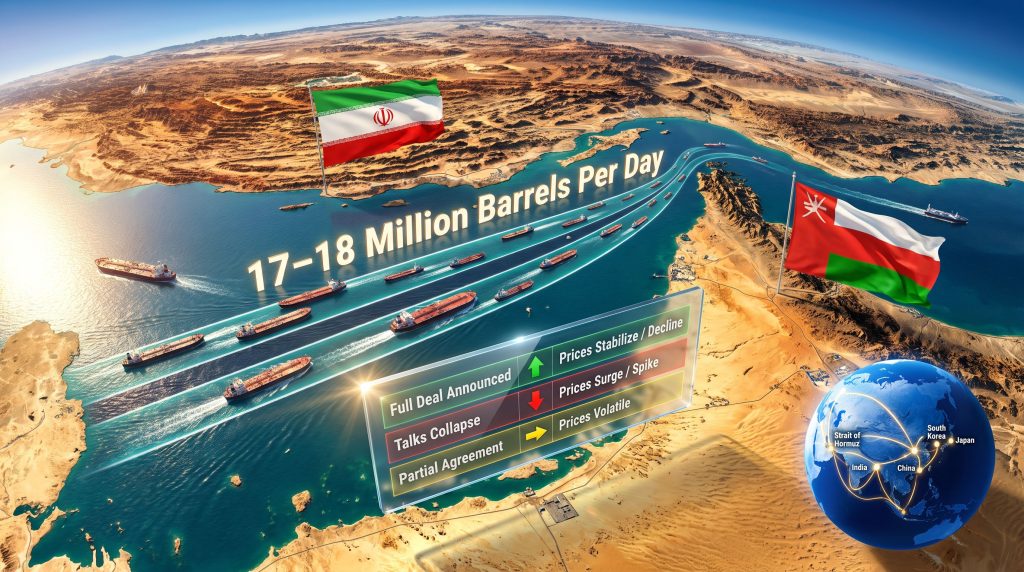
Understanding why these negotiations matter requires grasping the physical reality of what is being contested. The Strait of Hormuz measures approximately 33 kilometres at its narrowest navigable point, yet it handles an estimated 17 to 18 million barrels of petroleum liquids per day under normal operating conditions, according to data from the U.S. Energy Information Administration. That figure encompasses crude oil, condensate, and refined petroleum products collectively representing roughly 20 to 21% of global petroleum supply.
The strait's vulnerability is not simply a matter of physical narrowness. Furthermore, several compounding factors amplify its strategic fragility:
- The navigable shipping lanes are narrower than the strait's total width, with inbound and outbound traffic historically using separate two-mile-wide corridors
- The surrounding waters are shallow enough in several sections to make mine deployment operationally feasible
- Both coastal states, Iran and Oman, possess overlapping jurisdictional claims over portions of the passage
- Iran has, on multiple historical occasions, publicly rehearsed the capacity to close or disrupt the strait through asymmetric naval measures
President Trump acknowledged this mine risk directly in public remarks at the Oval Office in August 2026, noting that even a single mine in the waterway is sufficient to deter billion-dollar vessels from transiting, regardless of formal agreements. This observation captures a fundamental truth about Hormuz: the threat of disruption can be almost as economically damaging as disruption itself.
What the Iran-Oman Bilateral Framework Actually Proposes
The negotiations underway between Tehran and Muscat are structured around a surprisingly technical core: the formal designation of inbound and outbound shipping lanes with agreed geographic coordinates. This approach mirrors the traffic separation schemes recommended under the United Nations Convention on the Law of the Sea, which prescribes divided lane systems for high-density maritime corridors.
The proposed structural elements of the framework reportedly include:
- A designated inbound vessel lane positioned closer to Iranian territorial waters
- A designated outbound vessel lane aligned with Omani coastal jurisdiction
- A potential third navigation channel, referenced in some draft proposals but not yet publicly confirmed
- A joint working group of Iranian and Omani officials tasked with ongoing coordination and incident response
- Provisions for consultation with other maritime stakeholders and coastal states in the region
What makes this framework diplomatically significant is what it implicitly concedes. A formalised lane structure anchored in UNCLOS-compatible principles would represent an indirect Iranian acknowledgment of internationally recognised navigation norms, which Tehran has historically treated with ambiguity. Whether Iranian negotiators are willing to accept that framing, or whether they will insist on a bilateral sovereign arrangement that avoids UNCLOS language entirely, remains one of the less-reported tensions in the talks. The shifting geopolitical landscape in the broader region adds yet another layer of complexity to these already delicate proceedings.
The lane-assignment model closely mirrors international best practices under UNCLOS, which recommends traffic separation schemes in high-density maritime corridors. Iran's formal relationship with UNCLOS frameworks remains a point of ongoing diplomatic sensitivity.
Washington's Conditional Play: Blockade Relief as Negotiating Currency
How Has the U.S. Structured Its Involvement?
The United States has inserted itself into the Iran Oman talks on Strait of Hormuz not as a direct party but as a conditional guarantor. An anonymous U.S. official cited by Reuters confirmed in August 2026 that Washington has observed meaningful progress between Oman and Iran on the strait arrangement, and that a deal is expected in the near term.
Crucially, Washington has structured its own concession as a performance-dependent unlock. According to the same official, the U.S. will lift its naval blockade of Iranian ports once a formal agreement restoring unimpeded commercial shipping through the strait is announced and implemented. All subsequent U.S. actions will remain tied directly to Iran's fulfilment of its stated commitments.
This sequenced conditionality model is a recognisable feature of U.S. diplomatic strategy in high-stakes negotiations. It preserves American leverage at each stage while reducing the risk of unilateral concession. For Iran, it creates a clear incentive structure but also a credibility test: any failure to follow through on implementation would forfeit the blockade relief without triggering reciprocal U.S. concessions.
The current sticking points holding up formal announcement include:
| Issue | Current Status |
|---|---|
| Lane coordinate agreement | Reportedly finalised between parties |
| Joint statement language | Under review by Iranian officials |
| Maritime service fees | Unresolved, revenue-sharing model disputed |
| Third-party interference provisions | Iran has flagged U.S. involvement as a potential blocker |
| Broader peace agreement linkage | Described as a key stepping stone by U.S. officials |
The Fee Dispute Nobody Is Discussing
Among all the unresolved issues, the maritime service fee question deserves considerably more attention than it has received in mainstream coverage. At its core, this dispute concerns whether Iran would be permitted to levy charges on commercial vessels transiting lanes that pass through or adjacent to its territorial waters.
The implications extend well beyond the immediate negotiation:
- Precedent risk: A formalised fee structure would effectively grant Iran a degree of economic sovereignty over an internationally critical waterway, a precedent that major maritime powers have historically resisted with considerable force
- Revenue allocation ambiguity: How fees, if any, would be distributed between Iran and Oman under a joint framework has not been publicly addressed
- UNCLOS legal tension: Transit passage rights under UNCLOS are specifically designed to limit coastal state authority to impede or charge for through-traffic in international straits, creating a potential legal conflict with any Iranian fee structure
- Commercial operator hesitation: Shipping companies and their war-risk insurers will require complete clarity on fee obligations before committing large vessels to resumed transits
Consequently, this issue has the potential to outlast the lane coordinate agreement and delay commercial normalisation even if a headline deal is announced.
Iran's Defence Posture: Reading the Dual-Track Signal
While diplomatic channels remain active, Iran's defence establishment has maintained a publicly assertive posture that functions as a parallel form of negotiating communication. Iran's Acting Defence Minister Brigadier General Majid Ebn-e-Reza issued statements in early August 2026 emphasising that the country's armed forces were at full operational readiness to counter any external threat.
Ebn-e-Reza specifically highlighted Iran's domestically developed defence industry as the foundation of its military capability, asserting that indigenous Iranian defence technology outperforms competing regional hardware. This messaging serves two simultaneous functions:
- Domestic legitimacy signalling: Reinforcing the Islamic Republic's defence credentials to internal audiences at a time when the costs of the conflict are being felt
- Negotiating leverage maintenance: Communicating to counterparts that Iran retains credible deterrence capacity regardless of how the diplomatic track resolves
This dual-track posture — engaging diplomatically while projecting military strength — reflects Iran's long-established resistance diplomacy doctrine, which treats military credibility and negotiating flexibility as complementary rather than contradictory tools.
The next major ASX story will hit our subscribers first
Oman's Structural Role: Why Muscat Is Irreplaceable
Oman's position as the principal mediator in the Iran Oman talks on Strait of Hormuz is not a product of circumstance. It reflects decades of deliberate foreign policy architecture that has made Muscat uniquely valuable in precisely this type of standoff.
Several structural factors underpin Oman's indispensability:
- Geographic co-jurisdiction: Oman and Iran are the only two states with direct territorial adjacency over the strait, giving both a legitimate stake in any navigation framework that others lack
- Unbroken diplomatic continuity: Oman maintained functional relations with Tehran through the 1979 Islamic Revolution, through the Iran-Iraq War, and through every subsequent period of GCC-Iran friction, without severing ties
- Proven back-channel track record: Oman facilitated the discreet preliminary communications between Washington and Tehran that ultimately enabled the 2015 Joint Comprehensive Plan of Action negotiations to begin
- Economic interdependence: Oman imports natural gas from Iran via undersea pipeline, creating a structural economic incentive for Muscat to maintain functional bilateral relations regardless of broader regional politics
No other Gulf Cooperation Council member state combines geographic, historical, and economic factors in a way that would allow it to substitute for Oman in this architecture. Saudi Arabia and the UAE lack the diplomatic continuity. Qatar lacks the geographic co-jurisdiction. Bahrain and Kuwait lack the strategic independence. Muscat's mediator role is effectively irreplaceable in any near-term resolution scenario. Al Jazeera's coverage of the talks provides further insight into what each party stands to gain from a successful agreement.
Market Stakes: What Resolution Would Mean for Energy Prices
How Would a Deal Affect Global Energy Markets?
The economic implications of a successful Hormuz agreement extend across multiple layers of the global energy economy simultaneously. President Trump made this connection explicit in August 2026, linking progress in the negotiations to the prospect of lower domestic gasoline prices in the United States. Indeed, the crude oil price trends that have emerged during the conflict period illustrate just how sensitive markets are to Hormuz-related risk.
Scenario Analysis: Market Impact Pathways
| Scenario | Oil Price Trajectory | Market Confidence Effect |
|---|---|---|
| Full deal announced, lanes operational | Immediate downward pressure on Brent crude | High, supply certainty restored |
| Deal announced, implementation delayed | Modest short-term price relief | Moderate, uncertainty persists |
| Talks collapse, blockade maintained | Sustained upward price pressure | Low, risk premium expands |
| Partial agreement, contested lanes | Volatile pricing, elevated insurance premiums | Low to moderate |
Beyond headline crude prices, a Hormuz resolution would cascade through several interconnected markets. The WTI and Brent futures markets have remained particularly sensitive to developments in the strait, reflecting the weight traders place on any signals from the diplomatic track.
- War-risk shipping insurance: Premiums for vessels transiting the Gulf have risen sharply during the conflict period. A formal agreement would likely trigger rapid normalisation, reducing operating costs for tanker operators
- LNG market exposure: Qatar, which routes virtually all of its liquefied natural gas exports through the strait, faces disproportionate supply risk from any prolonged disruption. The wider implications for global LNG supply chains are considerable, given Qatar's status as one of the world's largest exporters
- Asian import security: Japan, South Korea, India, and China collectively account for the majority of Hormuz-transiting crude imports. All four nations carry strong economic and political incentives to support a durable resolution
- Refinery margin dynamics: Prolonged supply uncertainty elevates crack spreads, affecting downstream refining economics globally
Furthermore, analysts tracking the oil market impact of the broader geopolitical standoff note that insurance costs alone have materially increased the effective price of Gulf crude for Asian buyers.
The Nuclear Shadow Over Maritime Diplomacy
Can a Hormuz Deal Resolve the Deeper Conflict?
A clear-eyed assessment of the Iran Oman talks on Strait of Hormuz must account for what the negotiations cannot resolve. The strait framework is one component of a multi-front confrontation that encompasses Iran's nuclear programme, regional proxy networks, and a broader sanctions architecture that would remain largely intact even if a Hormuz deal is announced.
Trump reiterated in August 2026 that the United States remains firmly committed to preventing Iran from acquiring nuclear weapons capability, making clear that Hormuz-specific de-escalation does not represent a broader strategic accommodation.
A successful Hormuz shipping arrangement should be understood as a tactical de-escalation measure rather than a strategic resolution of the Iran-U.S. confrontation. It addresses a specific and economically critical symptom of a deeper conflict without resolving its underlying causes.
Three forward scenarios frame the range of outcomes:
Scenario 1: Rapid Deal Closure (Base Case)
Iran and Oman finalise coordinates and joint statement language within weeks. The U.S. lifts port blockades upon announcement. Commercial shipping normalises within 30 to 60 days. Brent crude retreats from conflict-elevated levels. This scenario requires Iran to accept a performance-based compliance framework and resolve the fee dispute through deferral or side agreement.
Scenario 2: Protracted Negotiation (Moderate Risk)
Talks continue but are delayed by Iranian domestic political review, fee disputes, or U.S. pressure dynamics. A provisional arrangement is announced but full commercial normalisation takes three to six months. Oil markets remain elevated but volatile, with periodic relief rallies on positive news flow.
Scenario 3: Collapse and Escalation (Tail Risk)
Negotiations break down over fee sovereignty, nuclear linkage demands, or a military incident in the strait. The U.S. maintains or intensifies its blockade. Iran activates asymmetric deterrence measures including mine deployment. Oil markets spike sharply. This scenario carries the characteristics of the most severe supply shock to global energy markets in decades. While currently assessed as lower probability, its economic consequences would be far-reaching.
Frequently Asked Questions: Iran Oman Talks on Strait of Hormuz
What Is the Strait of Hormuz and Why Does It Matter Globally?
It is the narrow waterway between Iran and Oman connecting the Persian Gulf to open ocean. Approximately 20 to 21% of global petroleum liquids transit this passage daily, making it the world's most consequential energy chokepoint.
Why Are Iran and Oman the Two Parties Negotiating?
They are the only two states with direct territorial jurisdiction over the strait. Any formalised navigation framework requires both parties to agree on lane coordinates, fee arrangements, and enforcement mechanisms.
What Has the United States Offered in Exchange for a Deal?
Washington has indicated it will lift its naval blockade of Iranian ports once a formal agreement restoring unimpeded commercial shipping is announced and implemented, with all actions remaining performance-based.
What Is Blocking Finalisation of the Agreement?
Key unresolved issues include joint statement language, maritime service fee arrangements, and Iran's concern that external pressure from the United States could complicate the process.
Why Is Oman the Facilitator Rather Than Another Gulf State?
Oman maintains continuous diplomatic relations with Tehran, shares geographic co-jurisdiction over the strait, has a proven back-channel track record including during JCPOA negotiations, and is economically linked to Iran through a natural gas pipeline.
What Would a Deal Mean for Oil Prices?
A successful agreement would likely exert immediate downward pressure on global crude prices, reduce war-risk shipping premiums, and improve energy supply certainty for major Asian importers. The knock-on effects would extend to LNG markets and downstream refining economics worldwide.
Disclaimer: This article contains forward-looking analysis and scenario projections based on publicly available information as of August 2026. Energy price forecasts and diplomatic outcome assessments are inherently speculative and should not be construed as investment advice. Readers should consult independent financial and geopolitical analysis before making investment decisions.
Want to Stay Ahead of the Market Moves Triggered by Major Geopolitical Events?
When critical developments like the Strait of Hormuz negotiations ripple across global energy and commodity markets, Discovery Alert's proprietary Discovery IQ model delivers real-time alerts on significant ASX mineral discoveries — ensuring subscribers can identify actionable opportunities before the broader market reacts. Explore historic discoveries and their market returns, then start your 14-day free trial today to position yourself ahead of the next major move.