August 8, 2026
The Hidden Economics of Extreme Freight: When Paying 12x the Benchmark Rate Is Still a Bargain
Global energy markets operate on a fundamental principle that most observers overlook: the cost of moving crude oil and the price of that crude are not independent variables. In disrupted markets, they become deeply entangled, and the ability to reason across both simultaneously separates the most sophisticated refining operators from the rest. The transaction involving Reliance Industries record freight for Iraqi crude, completed in August 2026, illustrates this principle with unusual clarity, offering a window into how the world's most consequential oil chokepoint is reshaping refining economics across Asia.
When big ASX news breaks, our subscribers know first
Understanding the Freight Rate That Stunned Ship Brokers
To appreciate why Reliance Industries' decision to pay $23 million to $25 million to charter a supertanker for Iraqi crude drew attention across shipping and energy markets, it helps to understand what the Worldscale benchmark system actually measures and why deviations from it matter so much.
Worldscale (WS) is the internationally standardised pricing index used to quote tanker voyage charters. A rating of WS 100 represents the flat benchmark freight rate for a specific route, calculated using a standardised formula that incorporates vessel size, voyage distance, port costs, and fuel consumption. Rates above or below WS 100 reflect market premiums or discounts relative to that neutral baseline.
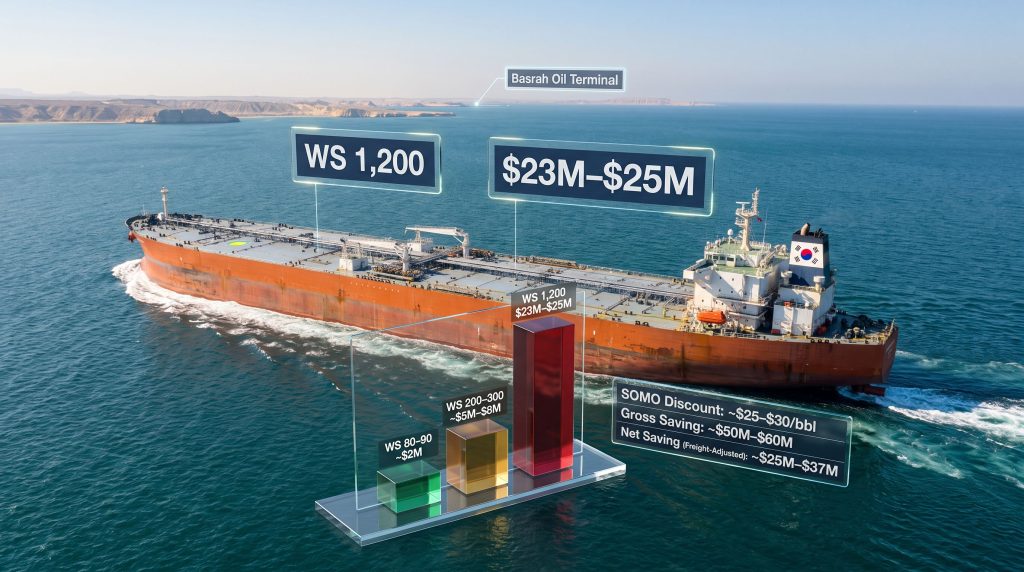
Before the Iran conflict disrupted Gulf shipping at the end of February 2026, freight rates on comparable tanker routes in the Persian Gulf were priced at WS 80 to WS 90, marginally below the benchmark, translating to a voyage cost of roughly $2 million for a very large crude carrier (VLCC) lifting two million barrels. The charter Reliance executed, however, was priced at WS 1,200.
| Metric | Pre-Conflict Level | August 2026 Level |
|---|---|---|
| Worldscale Rating | WS 80–90 | WS 1,200 |
| Estimated Charter Cost | ~$2 million | $23M–$25M |
| Multiple Above Benchmark | ~0.85x | ~12x |
| Cargo Volume | 2 million barrels | 2 million barrels |
Ship brokers characterised this transaction as representing the upper boundary of conflict-era tanker pricing, and crucially, it was not merely a quoted rate. It was transacted, meaning a buyer accepted the cost and a shipowner accepted the risk. That distinction matters enormously for understanding what it signals about genuine market conditions. Furthermore, understanding the broader crude oil market dynamics helps contextualise why such extreme pricing emerges during periods of acute supply chain disruption.
Why the Strait of Hormuz Has Become a Structural Pricing Problem
The Physics of a Chokepoint Under Siege
The Strait of Hormuz is approximately 33 kilometres wide at its narrowest navigable point, yet it handles roughly 20 to 21 million barrels of oil per day in normal conditions, representing close to one-fifth of global petroleum liquids consumption. There is no viable pipeline alternative for the volumes that Iraqi, Kuwaiti, and Iranian crude exports depend on.
Since the Iran conflict intensified, commercial shipping traffic through the Strait has fallen well below the pre-conflict average of 125 to 140 vessels per day. This is not simply a routing inconvenience. It represents a structural compression of the available tanker pool willing to operate within the waterway, driven by three converging pressures:
- Elevated and escalating attacks on commercial vessels transiting the Strait
- War risk insurance premiums that have surged to levels that make many voyages economically unviable before freight costs are even considered
- Crew welfare and liability concerns that have caused most major Western and Asian shipowners to suspend Gulf operations entirely
The result is a market where tanker pricing ceases to function through conventional supply and demand mechanics. When only a handful of operators remain willing to transit the Strait, those operators hold concentrated pricing power that bears no relationship to the Worldscale benchmark. They are pricing risk, not distance. The geopolitical oil logistics underpinning this shift have been building for some time, however the current conflict has accelerated the disruption dramatically.
South Korea's Sinokor: The Rare Willing Operator
Among the very few shipowners continuing to send tankers through the Strait of Hormuz is South Korean carrier Sinokor, which supplied the vessel for Reliance's Iraqi crude lifting. According to reports, Sinokor's willingness to operate in the waterway has positioned it as a premium-rate beneficiary in an environment where competition among suppliers has nearly vanished.
This dynamic is worth examining closely. Sinokor's ability to command WS 1,200 is not a function of superior vessels or exceptional service. It is a function of being willing to accept risk that its competitors have declined. In conflict-affected tanker markets, risk tolerance becomes the primary competitive advantage, and operators that correctly calibrate that tolerance can generate extraordinary returns.
"The tanker market has, in effect, bifurcated into two parallel realities: a global market where normal Worldscale economics apply, and a Gulf sub-market where pricing is determined by a handful of operators with the appetite to enter a contested waterway."
Iraq's SOMO Discount: The Economic Engine Behind Reliance's Freight Decision
How a $25–$30 Per Barrel Discount Changes Every Calculation
Iraq's state oil marketing organisation SOMO has been offering Basrah crude at discounts of approximately $25 to $30 per barrel below Dubai benchmark prices. This discount structure is not a long-term pricing policy. It is a specific mechanism designed to attract buyers willing to navigate the logistical and security challenges of lifting cargoes from terminals that sit inside the Strait of Hormuz.
At two million barrels per cargo, the arithmetic is decisive:
| Component | Estimated Value |
|---|---|
| Cargo Volume | 2 million barrels |
| SOMO Discount to Dubai Benchmark | ~$25–$30/bbl |
| Gross Discount Value on Cargo | ~$50M–$60M |
| Record Charter Freight Cost | $23M–$25M |
| Estimated Net Saving (Freight-Adjusted) | ~$25M–$37M |
Even after absorbing what ship brokers describe as among the highest freight costs recorded during the conflict, Reliance is estimated to retain a net saving of $25 million to $37 million relative to purchasing equivalent crude volumes at undiscounted market prices through safer supply routes. The freight cost, as extreme as it appears in isolation, is merely the entry fee to access a cargo that is generating a significantly larger gross saving. Consequently, the oil price movements driving SOMO's aggressive discounting strategy are themselves a product of broader market dislocation.
Why This Trade Structure Is Not Available to Everyone
Several Indian and Chinese refiners have sought vessels to enter the Strait and load crude at Iraq's Basrah Oil Terminal, drawn by precisely the same economic logic. As of the time of reporting, however, no additional vessels had been successfully chartered. The bottleneck is not demand. It is supply of willing vessel operators.
This creates a layered competitive advantage for Reliance that extends beyond the economics of any single cargo:
- Existing relationships with operators like Sinokor, built over years of commercial engagement, provide preferential access when vessel supply is critically constrained
- Balance sheet depth allows Reliance to commit to freight costs that smaller refiners cannot absorb without material earnings impact
- Refinery scale at the Jamnagar complex, which represents the world's largest single-site refining operation, means that a $23–$25 million freight cost is distributed across an enormous production base, improving per-barrel unit economics in ways unavailable to mid-scale operators
The Refining Margin Architecture That Makes This Work
Scale as a Structural Competitive Moat
Reliance's Jamnagar refining complex processes crude across a throughput capacity exceeding 1.4 million barrels per day across its two integrated refinery units. At that scale, the fixed cost of a record freight charter is absorbed across a substantially larger output base than any competitor of smaller scale could replicate.
Consider the per-barrel freight cost mathematics. A $25 million charter for two million barrels translates to $12.50 per barrel in freight cost. Against a SOMO discount of $25 to $30 per barrel, the net saving per barrel is approximately $12.50 to $17.50 even after paying the record freight rate. For a refiner processing those two million barrels alongside hundreds of millions of additional barrels annually, the strategic value of securing discounted feedstock at scale is compounding.
Historical Parallels: What Previous Tanker Wars Reveal
The current freight environment has meaningful historical precedent, though the scale of the WS 1,200 rate appears to exceed prior episodes. In addition, OPEC market influence during each of these historical periods shaped how quickly pricing normalised once tensions subsided:
- During the Iran-Iraq Tanker War of the 1980s, commercial operators progressively withdrew from Gulf routes as attacks on vessels intensified, concentrating pricing power among the remaining willing operators in patterns that closely mirror the current situation
- The 2019 Strait of Hormuz tensions, which followed attacks on tankers attributed to Iran, produced freight rate spikes that briefly elevated WS rates to the WS 200–300 range before normalising as tensions de-escalated
- The current conflict environment has produced sustained freight inflation at levels that dwarf both prior episodes, reflecting the combination of more intensive vessel attacks, broader operator withdrawal, and a war risk insurance market that has dramatically repriced Gulf exposure
| Historical Episode | Worldscale Rating | Approximate Charter Cost |
|---|---|---|
| Normal Gulf Conditions (Pre-2026) | WS 80–90 | ~$2 million |
| 2019 Hormuz Tensions | WS 200–300 | ~$5M–$8M |
| Current Conflict (August 2026) | WS 1,200 | $23M–$25M |
Structural Risks Now Embedded in Gulf Crude Supply Chains
Three Compounding Vulnerabilities for Asian Energy Security
The Reliance freight transaction illuminates risks that extend well beyond a single cargo booking. For energy analysts and policymakers across Asia, the structural implications deserve careful attention:
- Tanker operator concentration risk: When the pool of willing operators shrinks to a handful of players, any single operator's decision to suspend Gulf operations can create an immediate supply discontinuity. Pricing power concentration of this type is self-reinforcing: higher rates attract additional risk capital back into the market, but the process is slow and the interim period of constrained supply can be acute.
- War risk premium persistence: Insurance underwriters price Gulf war risk premiums based on loss experience and forward-looking conflict assessments. Once elevated, these premiums are slow to normalise even after physical conflict intensity declines, adding a persistent cost floor to Gulf crude liftings that compounds on top of freight rates.
- India's geographic exposure: Iraq is consistently among India's top three crude oil suppliers. The structural dependency of Indian refiners on Gulf crude flowing through the Strait of Hormuz creates systemic vulnerability that individual commercial decisions, however sophisticated, cannot fully mitigate.
The Procurement Diversification Imperative
The current disruption episode reinforces the strategic case for Indian refining operators and energy policymakers to accelerate supply diversification across alternative crude origins. West African grades, North Sea crudes, and US Gulf Coast exports all represent routes that bypass the Strait of Hormuz entirely. As conflict-driven freight premiums inflate the landed cost of Gulf crude, the price competitiveness of these alternatives improves, potentially accelerating a longer-term shift in Indian refiner procurement patterns.
Furthermore, the geopolitical trade tensions reshaping global energy flows are creating structural incentives for Asian buyers to diversify away from Hormuz-dependent supply routes well before any single conflict episode forces the issue. The irony of the current situation is that SOMO's steep discounting strategy, designed to sustain Iraqi crude sales volumes, may inadvertently accelerate the very diversification that would reduce Asian buyer dependency on Basrah grades over a longer time horizon.
The next major ASX story will hit our subscribers first
Frequently Asked Questions
What does WS 1,200 mean in practical terms?
Worldscale 1,200 means the charter rate was set at 12 times the standardised benchmark rate for the specific voyage route. Before the conflict, comparable Gulf routes were priced at WS 80–90, roughly 15 times lower than the rate Reliance paid in this instance of Reliance Industries record freight for Iraqi crude.
Why could Reliance absorb a $23–$25 million freight cost while others could not?
Reliance operates the world's largest single-site refinery at Jamnagar, giving it the throughput scale to spread the fixed freight cost across a vastly larger production base. Combined with balance sheet depth, this structural advantage allows Reliance to pursue high-freight, high-discount trades that would be economically damaging for smaller refining operators.
What is the SOMO discount, and why is Iraq offering it?
Iraq's state oil marketer SOMO has been offering Basrah crude at $25 to $30 per barrel below Dubai benchmark prices to attract buyers willing to lift cargoes from terminals inside the Strait of Hormuz. The discount is a direct response to the logistical risk deterrent that is suppressing buyer interest in Iraqi crude during the conflict.
Why have other Indian and Chinese refiners been unable to replicate Reliance's trade?
Despite active interest from multiple Indian and Chinese refiners, the critical constraint is vessel availability rather than buyer willingness. The vast majority of tanker operators have suspended Gulf operations, leaving only a tiny number of willing shipowners. With Sinokor among the very few remaining operators, available vessel capacity is severely limited regardless of the economic incentive on offer.
Disclaimer: This article contains forward-looking analysis and scenario projections based on publicly available market data and reported shipping transactions. Freight rate projections, net saving estimates, and structural risk assessments are analytical in nature and should not be construed as financial advice. Energy market conditions, particularly during active conflict periods, are subject to rapid change. Readers should conduct independent analysis before making any investment or commercial decisions.
Want to Stay Ahead of the Next Major Resource Discovery?
Discovery Alert's proprietary Discovery IQ model scans ASX announcements in real time, instantly identifying significant mineral discoveries across more than 30 commodities — transforming complex data into actionable investment opportunities before the broader market reacts. Begin your 14-day free trial at Discovery Alert today and position yourself at the forefront of the next major discovery.