August 8, 2026
America's Most Dangerous Import Problem Isn't Oil Anymore
For most of the twentieth century, energy dependency defined America's strategic vulnerability. Today, a quieter but equally consequential crisis has moved to the centre of national security planning: the United States cannot build a fighter jet, manufacture a smartphone, produce an electric vehicle battery, or operate advanced radar systems without materials it largely does not control. The Trump $2 billion critical minerals push, unveiled at an August 7, 2026 State Department roundtable, represents the most architecturally ambitious federal response to that problem in modern history.
Understanding why this moment matters requires looking beyond the dollar figure itself. The investment package is best understood not as a spending event but as a system-building exercise, one that simultaneously targets raw material production, processing capacity, strategic reserves, international diplomacy, and the human capital pipeline that all of the above depend upon.
When big ASX news breaks, our subscribers know first
The Structural Problem Behind the Headlines
The critical minerals demand surge across semiconductors, defence electronics, permanent magnets for missile guidance systems, battery cells for military vehicles, and advanced aerospace alloys all trace their material origins through supply chains that run predominantly through China.
Beijing's position is not accidental. Over several decades, China systematically invested in mining, mineral processing, and refining infrastructure across dozens of critical material categories, building expertise and scale that Western markets did not prioritise during the same period. The result is a structural dependency that market forces alone are unlikely to unwind quickly.
China's leverage operates through two distinct mechanisms that compound each other:
- Export restrictions on strategically important materials, including gallium, germanium, and rare earth processing compounds, which directly threaten downstream manufacturers in the West
- Below-cost supply flooding in categories where competing projects are attempting to gain a foothold, making it economically irrational for private capital to back new mines or refineries
Each year of inaction deepens both problems. New mines require a decade or more from discovery to production. Processing expertise takes years to build. Every delayed project extends the window during which China's dual-leverage position remains intact.
Commerce Secretary Howard Lutnick articulated the administration's position at the roundtable: the objective is to mine, process, refine, and manufacture domestically, creating American jobs while ending the dependency that leaves critical industries exposed to foreign supply decisions.
The $2 Billion Package: What Was Actually Announced
The investment commitments announced on August 7 span multiple federal financing mechanisms and target minerals at nearly every stage of the supply chain, from raw extraction through to advanced manufacturing inputs.
| Project / Recipient | Funding Amount | Funding Source | Mineral Focus |
|---|---|---|---|
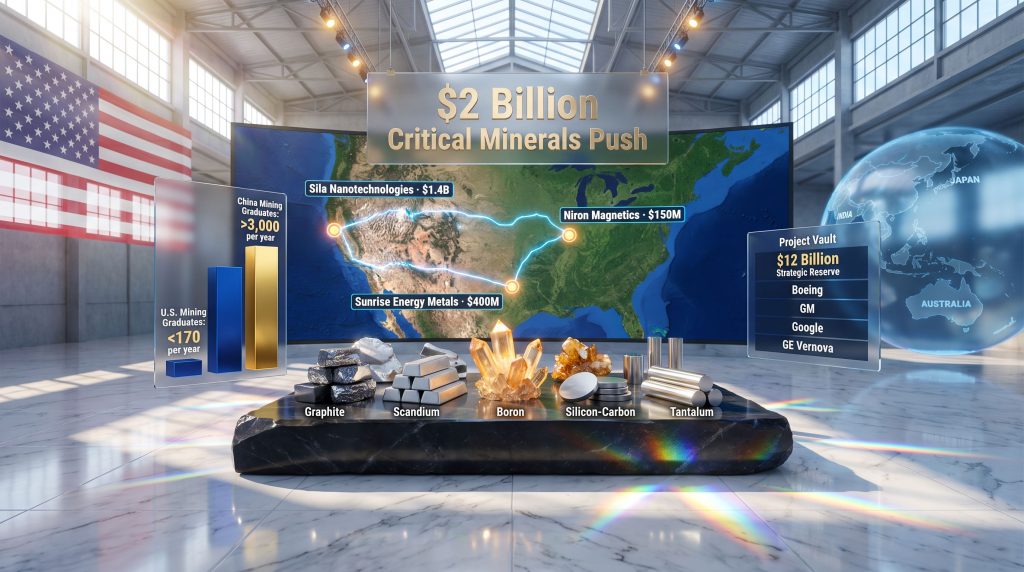
| Sila Nanotechnologies | $1.4 billion | Department of Defense | Silicon-carbon battery anodes, lithium-ion cells |
| Sunrise Energy Metals | $400 million | Department of Defense | Scandium value chain |
| Niron Magnetics | $150 million | Department of Defense | Rare earth-free permanent magnets |
| Standard Bauxite | $85 million | Department of Defense | Refractory-grade bauxite |
| Westwater Resources | $25 million | Export-Import Bank | Coosa Graphite Deposit, Alabama |
| Global Advanced Materials | $25 million | Export-Import Bank | Tantalum and niobium, Pennsylvania |
| 5E Advanced Materials | $8 million | Export-Import Bank | Boron, California |
| Harena Rare Earths | $4.8 million | Development Finance Corp | Rare earth mine, Madagascar |
Several of these investments address mineral categories that receive far less public attention than lithium or cobalt but carry significant strategic weight.
The Minerals Behind the Headlines
Scandium is one of the least understood materials on the critical minerals list. When alloyed with aluminium, even trace quantities produce dramatic improvements in strength-to-weight ratios, making scandium-aluminium alloys highly valuable for aerospace applications. The United States has never operated a primary scandium mine. The $400 million commitment to Sunrise Energy Metals targets what would be the world's first dedicated primary scandium production facility, a development that could fundamentally alter global supply dynamics for this material.
Silicon-carbon battery anodes represent the next generation of lithium-ion cell technology. Conventional graphite anodes are approaching their theoretical energy density limits, while silicon-carbon composite anodes can store significantly more charge per unit weight. The $1.4 billion Sila Nanotechnologies investment is the largest single allocation in the package precisely because this technology sits at the intersection of defence energy storage and civilian EV performance, two markets with enormous strategic importance.
Rare earth-free permanent magnets, targeted through the Niron Magnetics investment, address perhaps the most acute single vulnerability in U.S. defence manufacturing. The vast majority of permanent magnets used in defence systems today rely on neodymium, praseodymium, and dysprosium, all of which are processed predominantly in China. A scalable alternative that eliminates rare earth inputs entirely would remove a critical point of leverage from Beijing's supply chain toolkit. Furthermore, the rare earth processing challenges associated with existing dependencies make this innovation especially timely.
Boron is an emerging strategic material whose significance is frequently underappreciated. Beyond its established roles in glass manufacturing and agriculture, boron is increasingly recognised as a key component in next-generation permanent magnets and as a dopant in semiconductor fabrication. The 5E Advanced Materials investment in California targets domestic boron supply for these advanced industrial applications.
Refractory-grade bauxite, distinct from the metallurgical bauxite used in standard aluminium production, is required for high-temperature industrial applications, including furnace linings used in defence manufacturing processes. The Standard Bauxite investment reflects an understanding that supply chain security must extend to industrial inputs that rarely make headlines.
Project Vault: The Strategic Reserve Architecture
Running alongside the direct project investments is Project Vault, a $12 billion public-private initiative announced in February 2026 to establish a strategic mineral reserve for American manufacturers.
The structure is worth understanding in detail:
- $10 billion Export-Import Bank loan provides the primary financing mechanism
- $2 billion in initial private capital commitments from industrial partners
- Early participants include Boeing, Corning, GE Vernova, General Motors, Google, Stellantis, and Western Digital
A strategic minerals reserve fundamentally alters the investment calculus for domestic producers. By guaranteeing a buyer of last resort, Project Vault reduces the single greatest risk facing new mining and processing projects: demand uncertainty in markets where Chinese competitors can undercut on price at will.
This demand-certainty function is critical. One of the primary reasons private capital has historically avoided critical minerals projects is the inability to secure long-term offtake agreements at prices that justify the capital expenditure. When Chinese state-backed producers can flood the market to suppress prices whenever a competing project threatens their market share, the economics of Western mineral development become extremely difficult to underwrite. Project Vault changes this by creating a guaranteed buyer with sovereign-level financial backing.
FORGE: The International Dimension
Domestic investment addresses supply chains within U.S. borders. However, the total addressable volume of minerals required by Western economies, including allied nations, far exceeds what American mines and processing facilities can realistically supply within any near-term timeframe. This is where FORGE becomes architecturally essential.
The Forum on Resource Geostrategic Engagement was launched at the February 2026 Critical Minerals Ministerial, which convened representatives from 54 countries and the European Commission at the State Department. The U.S. assumed the FORGE chairmanship in July 2026.
FORGE operates across several policy dimensions simultaneously:
- Aligning trade policy among participating nations to reduce tariff and non-tariff barriers on critical mineral flows between allies
- Coordinating development finance to reduce duplication and maximise impact of investment across partner nations
- Exploring mineral price floor mechanisms to prevent Chinese price-flooding from undermining allied-nation projects
- Providing a diplomatic architecture through which bilateral agreements with Australia, Japan, the European Union, India, and more than 20 additional nations can be coordinated
In addition, the strengthening of rare earth supply chains among allied nations represents one of FORGE's most consequential long-term objectives. The two-layer logic is straightforward: domestic investment secures supply within the United States, while FORGE creates international markets large enough to sustain mines and processing facilities outside China's sphere of influence. Neither layer is sufficient without the other.
Notably, the historic critical minerals framework signed between President Trump and Prime Minister Albanese stands as one of the most significant bilateral developments within this broader FORGE architecture, demonstrating how allied partnerships are being formalised at the highest levels.
Biden vs. Trump: How the Policy Architectures Differ
| Policy Dimension | Biden Administration | Trump Administration |
|---|---|---|
| Primary funding mechanism | IRA grants, CHIPS Act | DoD loans, EXIM Bank, DFC |
| Diplomatic framework | Bilateral agreements | FORGE multilateral coalition |
| Strategic reserve policy | Limited | Project Vault ($12B public-private) |
| Workforce investment focus | General STEM | Mining-specific education programs |
| China competition framing | Supply chain resilience | National sovereignty and security doctrine |
Both administrations recognised the critical minerals problem as a federal priority requiring government intervention. The structural departure lies in the integration of diplomatic architecture alongside investment policy, and in the explicit framing of mineral dependency as a sovereignty issue rather than a supply chain resilience challenge.
Furthermore, Reuters has reported that the administration is also considering redirecting at least $2 billion in CHIPS Act funding toward critical minerals projects, which would meaningfully expand the total investment pool beyond the defence and export finance appropriations announced on August 7. The use of wartime powers for minerals and the invocation of the Defense Production Act further signal the administration's intent to treat this challenge as a matter of national urgency rather than incremental industrial policy.
The next major ASX story will hit our subscribers first
The Workforce Crisis: The Binding Constraint Nobody Discusses
Capital, permits, and diplomatic agreements are necessary but not sufficient conditions for a functioning domestic critical minerals industry. Every mine, processing facility, and refinery requires a workforce that the United States is not currently producing at anything close to the required scale.
The data is stark:
| Metric | Data Point |
|---|---|
| U.S. accredited mining engineering programs (1982) | 25 programs |
| U.S. accredited mining engineering programs (2026) | 14 programs |
| Annual U.S. mining engineering graduates | Fewer than 170 |
| Annual Chinese mining-related graduates | More than 3,000 |
| U.S. new engineers needed (mining sector, next decade) | ~6,000 (DOE estimate) |
The gap between fewer than 170 annual graduates and an estimated 10-year requirement of 6,000 engineers in mining alone is not a gap that federal investment can bridge without parallel action on educational capacity. The shortfall extends beyond engineers to geologists, metallurgists, materials scientists, and processing specialists, disciplines that underpin every stage of the supply chain that billions of dollars are being deployed to build.
China's educational pipeline advantage is as significant as its processing capacity advantage. More than 3,000 mining-related professionals graduating annually from Chinese institutions represent decades of compounding expertise accumulation, the human capital equivalent of the infrastructure gap Washington is now attempting to close.
The $180 Million Education and Workforce Response
The administration paired the project investment announcement with more than $180 million in education and workforce funding.
DOE PROSPECT Initiative
- Up to $100 million available through the Providing Opportunities for Specialised Education in Critical Technologies programme
- Target: double the number of graduates in mining, minerals, and associated supply chain technologies within two years
- Energy Secretary Chris Wright confirmed that a strong domestic mining workforce is essential to national security and ending dependence on foreign adversaries for industrial materials
Department of Defense University Investments
| Institution | Proposed Investment | Program Focus |
|---|---|---|
| Colorado School of Mines | $32.7 million | Critical Minerals Innovation and Commercialisation Hub |
| South Dakota School of Mines | $25 million | Critical Minerals Merit Scholars Consortium |
| Johns Hopkins University | $23.6 million | Multi-material recycling innovation hub |
The Colorado School of Mines hub is particularly significant because it targets pilot-scale technology development and materials qualification, functions that sit between academic research and full commercial deployment. This mid-scale capability is frequently the missing link between laboratory innovation and operational supply chains.
The Johns Hopkins recycling hub addresses a dimension of mineral security that primary mining investment cannot resolve on its own. Recycling and secondary recovery from defence platform scrap represents a long-term source of domestic mineral supply that reduces dependence on primary extraction and provides material security even if primary mine projects face delays.
Scenario Modelling: Three Possible Outcomes by 2032
Scenario A: Full Supply Chain Integration
Domestic production reaches meaningful self-sufficiency across battery, magnet, and semiconductor mineral categories. FORGE sustains enough allied supply to prevent Chinese price-flooding from undermining new projects. The PROSPECT workforce target is achieved, providing the human capital to operate new facilities. Outcome: functional mineral sovereignty across most strategic categories.
Scenario B: Capital Deployed, Workforce Gap Persists
Federal investment accelerates project development, but the talent shortage creates operational bottlenecks. New mines and processing facilities underperform or face delays due to insufficient skilled personnel. China retains processing dominance even as U.S. raw material production grows, producing a partial supply chain rather than a complete one. Outcome: strategic vulnerability shifts from access to processing capacity.
Scenario C: FORGE Fractures Under Trade Pressure
Allied nations face competing economic pressures that dilute their commitment to FORGE supply diversification. Without a large enough international market to sustain non-Chinese projects, Beijing's price competition undermines project economics beyond U.S. borders. Domestic investment becomes insufficient without the international demand architecture to support it. Outcome: the domestic strategy is necessary but not sufficient without durable multilateral commitment.
What the Strategy Still Needs to Solve
The Trump $2 billion critical minerals push is the most comprehensive federal effort in this space in modern U.S. history. However, several structural challenges remain unresolved:
- Permitting timelines remain a significant bottleneck. Federal investment does not automatically accelerate state and local approval processes, which can add years to project development timelines even after federal financing is secured
- Processing capacity, not mining, is where China's advantage is most entrenched and most difficult to replicate quickly. Raw material extraction is only the first step; the refining and separation expertise that transforms ore into usable industrial inputs took China decades to build
- FORGE coalition cohesion must be sustained through trade negotiations that may create competing pressures on partner nations, particularly those with significant economic relationships with China
- Workforce doubling targets are ambitious and will require sustained university funding commitments well beyond the initial $180 million package to achieve lasting structural change
Interior Secretary Doug Burgum's commitment at the roundtable, that the administration intends to put American mining back on the map, sets a clear benchmark against which the full policy architecture will ultimately be measured. The investments announced on August 7 represent a significant acceleration, but the distance between announcement and operational supply chain is measured in years of permitting, construction, commissioning, and workforce development. The architecture is being assembled. The test will be in the execution.
This article is intended for informational purposes only and does not constitute financial or investment advice. Forecasts, scenario projections, and policy outcomes discussed herein are subject to significant uncertainty. Readers should conduct their own due diligence before making any investment decisions related to the companies, sectors, or policy frameworks referenced above.
Want to Know Which ASX Miners Stand to Benefit From the Critical Minerals Boom?
Discovery Alert's proprietary Discovery IQ model delivers real-time alerts the moment significant ASX mineral discoveries are announced, transforming complex geological and commodity data into actionable investment insights — covering scandium, rare earths, graphite, and more than 30 other commodities relevant to today's strategic supply chain realignment. Explore how historic mineral discoveries have generated substantial returns and begin your 14-day free trial at Discovery Alert to position yourself ahead of the market.