August 8, 2026
The Fiscal Architecture of Resource Dependency: How Extractive Industries Shape Small Economies
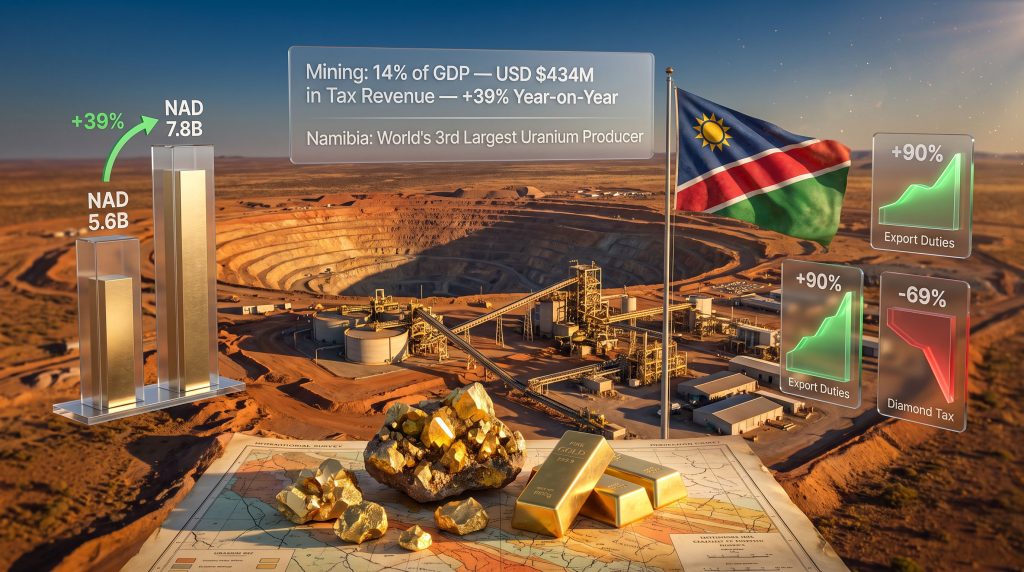
When a single industrial sector accounts for more than one-tenth of a nation's economic output, the relationship between that sector and the state undergoes a qualitative transformation. Fiscal planning, employment strategy, infrastructure investment, and sovereign creditworthiness all become tethered to the fortunes of commodities traded thousands of kilometres away. The Namibia mining sector contributes 14% of GDP with $434 million in taxes, making it one of the most instructive contemporary case studies in how a small open economy can harness extractive wealth whilst navigating structural vulnerabilities.
With a population of roughly three million people and a GDP that places it firmly in the lower-middle-income category by African standards, Namibia punches well above its demographic weight in global mining. The country's geological endowment spans uranium, diamonds, gold, zinc, copper, and a constellation of base metals. Collectively, these underpin an industry confirmed to represent 14% of national GDP, generating 7.8 billion Namibian dollars (approximately USD $434 million) in tax revenue during 2025, according to data released by the Namibian Presidency in August 2026.
Understanding what these figures actually mean, and what they obscure, requires moving beyond the headline numbers.
When big ASX news breaks, our subscribers know first
What the 2025 Mining Revenue Surge Actually Reveals
The 39% year-on-year increase in mining tax revenue, rising from 5.6 billion NAD (approximately USD $313 million) in 2024 to 7.8 billion NAD in 2025, is a number that rewards careful disaggregation. Aggregate growth of this magnitude rarely reflects uniform improvement across all commodity streams. In Namibia's case, it masks a pronounced internal rotation: gold ascending, diamonds retreating, and uranium positioned as the sector's long-term structural anchor.
A sector's share of GDP measures productive output within the economy. Its tax contribution measures how much of that output is captured by the state. These two figures can diverge significantly depending on royalty structures, profit repatriation rates, and the design of corporate tax frameworks. In Namibia's case, both metrics moved upward simultaneously in 2025, which is analytically significant.
Breaking Down the Revenue Composition
The table below captures the key movements across Namibia's mining fiscal streams:
| Revenue Stream | 2024 (NAD) | 2025 (NAD) | Change |
|---|---|---|---|
| Total Mining Tax Revenue | ~5.6 billion | ~7.8 billion | +39% |
| Mining Royalties | ~2.2 billion | ~2.4 billion | +9% |
| Export Duties | ~360 million | ~685 million | +90% |
| Non-Diamond Corporate Income Tax (FY2025/26 projection) | N/A | ~4.4 billion | +54% projected |
| Diamond-Related Tax Revenue (FY2025/26 projection) | N/A | ~74 million | -69% projected |
Source: Chamber of Mines of Namibia Annual Review 2025; Namibian Presidency official communications, August 2026.
Several dynamics embedded in this table deserve focused attention.
The Gold Price Leverage Effect
Strong gold mine performance was the primary engine behind the 2025 revenue expansion. What makes this particularly instructive from a fiscal design perspective is the leverage effect inherent in resource taxation. When commodity prices rise by 20%, the impact on taxable profits at mine level can be substantially larger, because operating costs are largely fixed in the short term. This mirrors broader trends seen in the gold price surge that reshaped precious metals markets during this period.
A mine producing gold at a fixed extraction cost captures the full benefit of price appreciation above that threshold, translating into a disproportionate increase in royalty assessments and corporate income tax liability. This operating leverage explains how a commodity price environment that improved meaningfully, but not dramatically, could produce a 39% surge in aggregate mining tax receipts. The mechanism is structural rather than exceptional, though it cuts both ways: a price reversal of comparable magnitude would compress revenues with equal ferocity.
Export Duties: The 90% Surge and Its Policy Signal
The 90% increase in export duty collections, from approximately 360 million NAD to 685 million NAD, is the figure in the dataset that most rewards interpretive scrutiny. Export duties on minerals are not simply revenue instruments. They are simultaneously a policy tool designed to incentivise domestic processing over raw commodity export.
When a government imposes or escalates export duties on unprocessed or semi-processed minerals, it creates a financial penalty for shipping raw ore abroad rather than adding value domestically. The 90% surge in collections could reflect a volume increase, a rate adjustment, or a combination of both. Regardless of its precise composition, the direction of travel is clear: Namibia is using its fiscal architecture to push mining companies toward beneficiation, a strategic objective that President Netumbo Nandi-Ndaitwah has explicitly reinforced through calls for accelerated local mineral processing.
The Diamond Collapse: Structural Disruption, Not a Cyclical Dip
Perhaps the most consequential data point in Namibia's 2025 mining fiscal picture is one that registers as a sharp decline. Diamond-related corporate tax is projected to fall 69% to approximately 74 million NAD (roughly USD $4.1 million) in the 2025/26 fiscal year. This is not a rounding error. It represents a near-total evaporation of what was historically one of Namibia's most significant revenue streams.
The structural forces behind this decline are well-documented globally. Laboratory-grown diamonds have achieved price parity with natural stones in many retail market segments, fundamentally disrupting the demand economics that underpinned natural diamond valuations for decades. Production profile changes at Namibian operations have compounded the effect, resulting in a revenue stream that has moved from strategic importance to marginal status within a remarkably short timeframe.
The simultaneous rise of gold and uranium revenues alongside the sharp decline in diamond tax receipts represents a fundamental recomposition of Namibia's mining fiscal base. This is not a sector-wide boom but a commodity rotation with long-term structural implications for how Namibia designs its fiscal dependency.
Regional Benchmarking: How Does 14% Compare?
Placing Namibia's mining GDP share in comparative context helps calibrate the degree of fiscal dependency involved.
| Country | Mining/Resources % of GDP (approx.) | Primary Commodity | Notes |
|---|---|---|---|
| Namibia | ~14% | Uranium, Gold, Diamonds | Re-anchoring after 2018 structural peak |
| Botswana | ~20-25% | Diamonds | Highly concentrated single-commodity exposure |
| Democratic Republic of Congo | ~15-18% | Copper, Cobalt | Informal sector not fully captured in official data |
| Zambia | ~12-15% | Copper | Fiscal reform agenda ongoing |
| Mongolia | ~20%+ | Coal, Copper | Landlocked resource economy with similar structural tensions |
Note: Figures are approximate, drawn from publicly available World Bank and IMF country data. Primary national statistics offices should be consulted for precision.
At 14%, Namibia occupies a position of meaningful but not extreme resource dependency by regional standards. Furthermore, what distinguishes its situation is the quality of its institutional framework and the relative transparency of its fiscal administration — factors that have historically contributed to a more stable sovereign credit profile than comparably sized resource economies.
The NamPPF Investment Framework and the $2.8 Billion Pipeline
Through the Namibia Public-Private Forum (NamPPF), Namibia's mining industry has committed to mobilising USD $2.8 billion in new investment and generating more than 18,000 direct jobs. These commitments are framed within the architecture of the Sixth National Development Plan (NDP6), which carries a national employment creation target of 500,000 jobs across all sectors of the economy.
The NamPPF functions as a structured coordination mechanism between the state and extractive industry operators, designed to align private capital deployment with national development objectives. Its investment mobilisation figure should be understood as a target rather than a confirmed capital expenditure schedule.
Announced investment commitments in extractive industries frequently face delays of two to five years between pledge and capital deployment. The USD $2.8 billion figure represents a mobilisation target contingent on commodity price trajectories, global financing conditions, regulatory stability, and the timely resolution of infrastructure bottlenecks, particularly water, power, and transport logistics.
Stress-Testing the Pipeline
Breaking down the investment pipeline reveals several categories of exposure:
- Uranium project development: The largest component, anchored by the Etango and Tumas projects, each requiring substantial upfront capital and extended lead times before production revenue materialises.
- Gold mine expansions: More near-term in their revenue impact, but sensitive to gold price movements that can alter project economics rapidly.
- Base metals and infrastructure: Supporting investment across copper, zinc, and logistics corridors that enable broader sector growth.
- Financing conditions: Rising global interest rates and ESG-linked lending requirements from international capital providers have lengthened due diligence timelines and increased cost of capital for frontier market mining projects.
Uranium: Namibia's Strategic Pivot in a Resurging Global Market
No single commodity will do more to determine the trajectory of Namibia's mining fiscal architecture over the next decade than uranium. The country holds its position as the world's third-largest uranium producer, a designation that carries growing geopolitical weight as nuclear energy experiences a renaissance across Asia and Europe. The broader context of uranium market volatility continues to shape how investors and governments alike approach long-term supply planning.
The global uranium market has undergone a structural repricing since the post-Fukushima lows of the early 2010s. Energy security concerns, accelerating nuclear power plant construction in China, India, and several European nations, and a concerted effort by Western utilities to diversify supply chains away from Russian-controlled production have all contributed to a demand environment meaningfully more favourable than the one that constrained Namibian uranium economics for much of the previous decade. Understanding the uranium market dynamics at play is essential for contextualising these shifting conditions.
The Etango and Tumas Projects
Two development-stage assets are central to the anticipated expansion of Namibian uranium output:
- Etango Project (Bannerman Energy): A large-scale heap leach development targeting the Erongo region's uranium mineralisation. The project's scale positions it as a potential material contributor to global supply once in production.
- Tumas Project (Deep Yellow): Distinguished by its use of in-situ recovery (ISR) methodology in certain project components. The in-situ leaching benefits of this technique include lower capital intensity and a reduced environmental footprint compared to conventional open-pit extraction, though it requires specific hydrogeological conditions to be viable.
According to the Chamber of Mines of Namibia, both projects are expected to significantly increase national uranium production during the second half of the 2020s and throughout the 2030s. This production ramp-up carries direct implications for the composition of mining tax revenues, progressively shifting the fiscal centre of gravity toward uranium as the dominant contributor.
The Beneficiation Imperative
One dimension of uranium economics that is frequently underappreciated outside specialist circles is the complexity of adding value within the nuclear fuel cycle. Unlike gold, which can be refined domestically with relatively accessible technology, uranium requires conversion to uranium hexafluoride (UF6) and subsequent enrichment before it becomes usable reactor fuel. These processing stages are capital-intensive, technically demanding, and subject to international non-proliferation oversight.
Kazakhstan has made meaningful progress in domestic conversion capacity, though enrichment remains concentrated in a small number of globally operating facilities. For Namibia, the beneficiation pathway in uranium is considerably more constrained than in base metals or even gold, making export duty design and joint venture requirements the more immediately accessible policy levers for capturing additional value. Notably, Namibia nuclear relations with key international partners further complicate the geopolitical dimensions of this strategy.
NDP6 and the Translation of Mining Wealth Into Broad Development
The Sixth National Development Plan represents Namibia's institutional framework for converting resource revenues into diversified economic development. Mining's role within NDP6 is simultaneously that of revenue generator and growth catalyst, funding infrastructure, education, and healthcare for a population of approximately three million people whilst also anchoring direct employment and stimulating linked industries.
The linkage effects extend across multiple sectors:
- Construction and engineering: Mine development phases generate substantial demand for civil construction, mechanical installation, and project management services.
- Logistics and transport: Ore movement from interior deposits to coastal export facilities, particularly through Walvis Bay, generates sustained freight demand.
- Energy: Large-scale mining operations are significant electricity consumers, creating both challenge and opportunity as Namibia develops its renewable energy capacity.
- Professional and financial services: Legal, accounting, insurance, and banking services all expand in proportion to mining sector activity.
The next major ASX story will hit our subscribers first
Key Risks to Namibia's Mining Revenue Outlook
Commodity Price Volatility
The pro-cyclicality of resource-dependent fiscal systems is their most persistent structural vulnerability. Namibia's 2025 revenue surge was driven in meaningful part by elevated gold prices. A 15% correction in gold prices, which commodity markets have demonstrated can occur within a single quarter, would materially compress royalty assessments and corporate income tax receipts from gold operations without any corresponding reduction in state expenditure commitments.
Uranium carries its own price risk profile. The current positive demand narrative is real, but reactor construction timelines are frequently extended, utility fuel purchasing cycles are long, and inventory management by major buyers can dampen spot market demand even in an ostensibly favourable policy environment.
Concentration and Structural Risk
The diamond revenue collapse is Namibia's live case study in what commodity-specific demand disruption looks like in real fiscal terms. A 69% projected decline in diamond-related corporate tax within a single fiscal year illustrates the speed with which structural market shifts can remove a revenue stream from the fiscal calculus entirely.
Emerging diversification pathways into rare earth elements, lithium, and additional base metals offer potential buffers, though each carries its own development timeline and market risk profile. Analysts have noted that taxing miners aggressively during periods of commodity weakness risks compounding the structural damage further.
Regulatory and ESG Considerations
International mining finance has become increasingly conditioned on ESG compliance, community benefit agreements, and environmental management standards. For Namibia, maintaining the social licence to operate across its arid, ecologically sensitive operating environments requires sustained investment in water management, tailings containment, and community engagement — all of which represent cost items that affect the net fiscal contribution of individual operations.
Namibia's mining sector faces a dual-track risk profile: short-term commodity price volatility capable of compressing revenues within a single fiscal year, and long-term structural disruption tied to synthetic diamond competition and the complex trajectory of global uranium demand.
Key Metrics: Namibia Mining Sector Fiscal Snapshot
| Metric | Value | Context |
|---|---|---|
| Mining % of GDP (2025) | 14% | Consistent with 2018 structural peak |
| Total Mining Tax Revenue (2025) | 7.8 billion NAD (~USD $434M) | +39% year-on-year |
| Mining Royalties (2025) | 2.4 billion NAD (~USD $137M) | +9% year-on-year |
| Export Duties (2025) | 685 million NAD (~USD $38M) | +90% year-on-year |
| Non-Diamond CIT Projection (FY2025/26) | 4.4 billion NAD (~USD $247M) | +54% projected |
| Diamond Tax Revenue Projection (FY2025/26) | 74 million NAD (~USD $4.1M) | -69% projected |
| NamPPF Investment Commitment | USD $2.8 billion | Mobilisation target, not confirmed capex |
| Direct Jobs Commitment | 18,000+ | Via NamPPF framework |
| NDP6 National Jobs Target | 500,000 | Across all sectors |
| Uranium Global Ranking | 3rd largest producer | Expansion projects in development pipeline |
Frequently Asked Questions
How much did Namibia's mining sector contribute in taxes in 2025?
The Namibia mining sector contributes 14% of GDP with $434 million in taxes, generating 7.8 billion Namibian dollars in total tax revenue during 2025. This represents a 39% increase from 5.6 billion NAD recorded in 2024, according to data released by the Namibian Presidency in August 2026.
What is driving Namibia's mining revenue growth?
Strong performance from gold mining operations, supported by elevated international gold prices, was the primary driver. Furthermore, a 90% surge in export duty collections and a projected 54% increase in non-diamond corporate income tax receipts for FY2025/26 contributed additional momentum.
Why is diamond tax revenue falling so sharply?
Diamond-related corporate tax is projected to decline 69% to approximately 74 million NAD in FY2025/26. The decline reflects softening global natural diamond demand, accelerating competition from laboratory-grown diamonds, and changes in Namibia's production profile.
What is Namibia's position in global uranium supply?
Namibia ranks as the world's third-largest uranium producer. Major expansion projects including Etango (Bannerman Energy) and Tumas (Deep Yellow) are expected to significantly increase national output during the second half of the 2020s and into the 2030s.
What does the $2.8 billion investment commitment represent?
Through the NamPPF, Namibia's mining industry has committed to mobilising USD $2.8 billion in new investment and creating more than 18,000 direct jobs. This figure represents a mobilisation target aligned with NDP6 development objectives, subject to commodity prices, financing conditions, and regulatory stability.
Disclaimer: This article contains forward-looking projections and fiscal forecasts drawn from government and industry sources. These figures are subject to revision based on commodity price movements, project delays, and macroeconomic conditions. Nothing in this article constitutes financial or investment advice. Readers should consult qualified advisers before making investment decisions related to any company or sector mentioned herein.
Want to Track the Next Major ASX Mineral Discovery Before the Broader Market Does?
Discovery Alert's proprietary Discovery IQ model scans ASX announcements in real time, delivering instant alerts on significant mineral discoveries across uranium, gold, and beyond — turning complex data into actionable insights for investors at every level. Explore Discovery Alert's dedicated discoveries page to understand how historic mineral discoveries have generated substantial returns, and begin your 14-day free trial today to secure a market-leading edge.