August 8, 2026
When Trade Routes Break, New Powers Emerge
Global energy markets have a long memory for disruption but a short attention span for structural change. For decades, the aviation fuel trade operated on a comfortable assumption: the Gulf produced it, tankers carried it through the Strait of Hormuz, and European airports burned it. That assumption held through oil price shocks, regional conflicts, and even the COVID-era collapse in air travel demand. What it could not survive was a simultaneous squeeze on the world's most critical maritime chokepoint combined with the arrival of an entirely new refining superpower on Africa's Atlantic coast.
The story of how the Dangote refinery became Europe's dominant jet fuel supplier is not simply a logistics story or a geopolitical story. It is a story about what happens when a supply chain built for efficiency rather than resilience meets a world that has grown structurally less predictable. Understanding that story requires examining not just what happened, but why the conditions for it existed at all.
When big ASX news breaks, our subscribers know first
Why Europe's Aviation Fuel Market Was Built to Break
The Depth of the Gulf Dependency
Before the disruptions of 2025 and 2026, European buyers sourced close to 75% of their imported jet fuel from the Gulf region, a volume equivalent to roughly 375,000 barrels per day, according to data compiled by Kpler and reported by Business Insider Africa. That figure understates the true degree of concentration risk because Europe's domestic refining capacity, while substantial in aggregate, was never configured to cover the full gap if Gulf flows collapsed.
Most European refineries were optimised during the 1980s and 1990s to maximise diesel and gasoline output, reflecting the then-dominant demand profile of road transport. Jet fuel yield in conventional European refining configurations typically falls between 8% and 12% of crude throughput, far below what would be required to displace imported volumes at scale. This meant that when Gulf supply routes came under pressure, European buyers could not simply pivot to domestic production. Furthermore, they had to find a new import source quickly, which is where the broader global crude steel outlook for industrial commodities began intersecting with energy trade realignments.
The United Kingdom illustrated the problem in sharp relief. As Europe's largest single aviation fuel consumer, the UK imports approximately 65% of its domestic jet fuel requirements, a figure cited by the International Energy Agency and reported by Reuters. A nation operating one of the world's busiest airspace systems, including Heathrow, the world's third-busiest airport by international passenger traffic, was sourcing nearly two-thirds of its critical aviation fuel from overseas suppliers concentrated in a single geopolitically exposed region.
The ARA Hub as a Barometer of Stress
The Amsterdam-Rotterdam-Antwerp trading hub functions as the nerve centre of European refined products distribution. When supply tightens anywhere in the Atlantic Basin, ARA inventories are among the first indicators to reflect the pressure. During the peak of the 2026 supply squeeze, ARA jet fuel storage levels fell to their lowest point since March 2023, a data point that carries more significance than it might initially appear.
March 2023 inventory levels were themselves depressed relative to historical norms due to the lingering logistics dislocations of the post-pandemic shipping environment. A return to those levels under different conditions signalled that the supply deficit was severe enough to draw down strategic buffers that had been painstakingly rebuilt over the preceding two years. For European procurement teams, it was an unambiguous signal that the traditional supply chain could no longer be assumed to function as designed.
The ARA hub's inventory drawdown in early 2026 was not merely a statistical anomaly. It reflected the physical reality that the Strait of Hormuz disruption had severed a supply corridor that European aviation depended on with almost no fallback infrastructure in place.
How the Dangote Refinery Rose to Become Europe's Largest Jet Fuel Supplier
A Compressed Timeline of Extraordinary Market Penetration
The speed with which the Dangote Petroleum Refinery moved from operational commissioning to global market leadership has no obvious precedent in the modern refining industry. The progression is worth examining in detail:
| Milestone | Date | Significance |
|---|---|---|
| Refinery commences operations | 2024 | Initial throughput below 650,000 bpd nameplate capacity |
| Full operational capacity achieved | February 2026 | All processing units commissioned |
| Designated world's largest jet fuel exporter | April 2026 | S&P Global Commodity Insights designation |
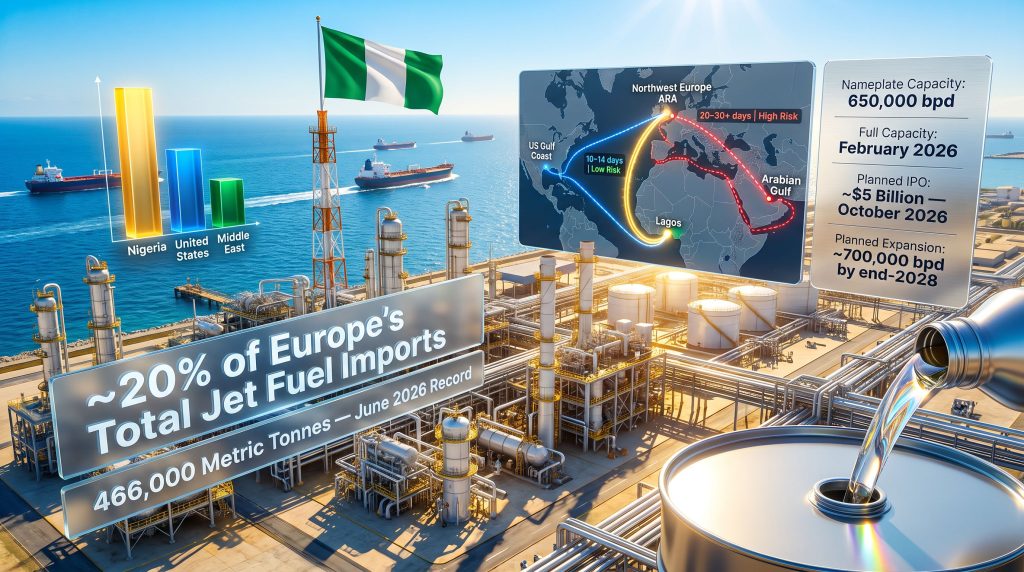
| First overtook US as Europe's top supplier | June 2026 | 466,000 metric tonnes delivered to Europe |
| Retained top position under reduced throughput | July 2026 | Over 400,000 metric tonnes; ~20% of EU imports |
The jump between May and June 2026 is particularly striking. Shipments to Europe nearly doubled from approximately 232,000 metric tonnes to 466,000 metric tonnes within a single month, a volume increase that exceeded total US exports to Europe during the same period, which stood at around 399,000 metric tonnes. This was not a gradual market share gain. It was a rapid and decisive capture of a supply vacuum that the Gulf could no longer fill.
The Production Pivot That Made It Possible
A detail that receives insufficient attention in most coverage of Dangote's European market breakthrough is the deliberate nature of the production mix decision. As reported by Business Insider Africa, Dangote Petroleum Refinery CEO David Bird stated in June 2026 that limited domestic African demand for aviation fuel created a substantial jet fuel surplus at the facility, one that had no natural absorption mechanism within the regional market.
This is a structurally important insight. The refinery was not simply producing jet fuel as a byproduct of its overall crude processing operations. It was actively weighting its output toward aviation fuel at a moment when global prices and demand signals made that the most commercially rational choice. A large, recently commissioned refinery with flexible processing configurations could respond to market signals in ways that older, less configurable facilities could not.
The economics aligned with the logistics. The refinery's cost structure, combined with its Atlantic coastal positioning, allowed it to deliver product competitively to European buyers even accounting for shipping costs, which for Nigerian origin vessels run approximately 8 to 12 days to Northwest European ports. Consequently, that compares favourably with Gulf origin shipments that require 20 to 30 or more days depending on routing through the Suez Canal or around the Cape of Good Hope. The shifting crude oil price trends during this period further reinforced the economic case for Atlantic Basin sourcing.
Nigeria's Atlantic Location as a Structural Advantage
The geographic dimension of Dangote's competitive position deserves systematic treatment because it is not temporary. Lagos sits on the Atlantic coast, meaning that vessels departing for European ports face no significant maritime chokepoints. There is no Strait of Hormuz equivalent, no Bab-el-Mandeb, no Suez Canal queuing risk. The route is direct.
| Supply Origin | Route to Northwest Europe | Chokepoint Exposure | Approximate Transit |
|---|---|---|---|
| Arabian Gulf | Hormuz then Suez or Cape of Good Hope | High | 20 to 30+ days |
| US Gulf Coast | Atlantic crossing | Low | 10 to 14 days |
| Nigeria (Lagos) | Direct Atlantic | Very Low | 8 to 12 days |
This geographic reality compounds into a meaningful cost advantage during periods of elevated maritime insurance premiums for Gulf routes, which spiked significantly during the Strait of Hormuz disruptions of early 2026. When risk-adjusted freight economics are modelled rather than simply nominal shipping distances, the Nigerian supply route becomes even more competitive relative to Gulf alternatives than raw mileage comparisons suggest.
What July 2026 Revealed About Structural Market Position
A Mechanical Disruption That Should Have Ended the Streak
The July 2026 performance of the Dangote Petroleum Refinery may ultimately be regarded as more analytically significant than the record-breaking June export figures. The reason is straightforward: June demonstrated capacity, while July demonstrated resilience.
According to data from Kpler, a malfunction involving the refinery's Flue Gas Steam Generator triggered unplanned maintenance work beginning around July 10, cutting crude throughput from an expected ~650,000 barrels per day to approximately 350,000 to 400,000 bpd. Kpler subsequently revised its monthly crude processing forecast downward to approximately 450,000 bpd for the full month, and estimated that jet fuel output alone ran roughly 50,000 bpd below planned levels, with additional shortfalls recorded across petrol and gasoil production streams.
A Flue Gas Steam Generator, for context, is an integral component of the refinery's fluid catalytic cracking unit heat recovery system. Failures in this equipment can force a partial or full FCC shutdown because the heat integration between the regenerator flue gas and steam generation is critical to both the unit's energy efficiency and its environmental compliance obligations. An unplanned FCC curtailment at a facility processing complex crude is not a minor operational interruption; it cascades across multiple product streams simultaneously.
Why Retaining Market Leadership Under These Conditions Matters
Despite this significant operational disruption, the refinery still delivered more than 400,000 metric tonnes of aviation fuel to European buyers in July, retaining market leadership ahead of both US Gulf Coast exporters and whatever residual Middle Eastern flows remained accessible. The significance of this outcome extends well beyond the headline volume.
In commodity markets, the distinction between a one-time record export month and a sustained market position is the difference between opportunism and structural embedding. A single exceptional export performance can be explained by coincidental alignment of vessel availability, inventory timing, and spot price incentives. A second consecutive month of market leadership, maintained through a period of materially reduced throughput, suggests something more durable. The commodity price impacts seen across global markets during this period also reinforced buyer urgency to secure alternative supply chains.
When a supplier retains the top position in a major global import market during a month when its own production was running at roughly 60 to 70% of expected capacity, that is not luck. That is the early signature of an embedded supply relationship.
Benchmarking Dangote Against Competing Suppliers to Europe
June and July 2026: A Comparative View
| Supplier Origin | June 2026 Exports to Europe | July 2026 Exports to Europe | July Market Share |
|---|---|---|---|
| Nigeria (Dangote) | ~466,000 metric tonnes | Over 400,000 metric tonnes | ~20% of total |
| United States | ~399,000 metric tonnes | Below Nigeria | Second position |
| Middle East (Gulf) | Significantly reduced | Reduced | Declining |
Data sourced from Kpler commodity intelligence tracking and S&P Global Commodity Insights, as reported by Business Insider Africa.
The April 2026 data established the trajectory that June and July confirmed. Nigerian jet fuel exports to Europe reached approximately 66,000 barrels per day during April, a record at the time, while US shipments were simultaneously surging. The simultaneous rise of two Atlantic Basin suppliers during April was the first clear signal that the established Gulf-centric trade structure was not merely being disrupted temporarily but was undergoing a more fundamental reorientation.
What distinguishes the Dangote trajectory from the US export surge is scale concentration. US jet fuel exports to Europe originate from multiple refining centres across the Gulf Coast and East Coast, distributed across numerous operators and trading counterparties. Dangote's volumes originate from a single facility, which means that 20% of European jet fuel imports in July 2026 flowed through one refinery. That degree of supply concentration in a single non-traditional source has no modern parallel in European energy import history.
What This Means for Nigeria's Petroleum Industry
Dismantling a Decades-Long Structural Paradox
For most of its post-independence history, Nigeria operated under an arrangement that is almost impossible to justify on pure economic grounds: one of Africa's largest crude oil producers consistently imported the majority of its refined petroleum products. Petrol, diesel, kerosene, and jet fuel consumed within Nigeria were largely purchased from international markets at refined product prices while the country's own crude was exported at raw commodity prices.
This arrangement persisted because Nigeria's domestic refining infrastructure, despite nominal capacity on paper, operated chronically below utilisation due to maintenance failures, funding gaps, and governance challenges. The gap between the country's hydrocarbon endowment and its refined product self-sufficiency represented one of the most glaring examples of the resource curse in modern economic history. In addition, the geopolitical mining landscape of the broader African continent has similarly shaped how resource-rich nations have historically struggled to capture downstream value.
The Dangote refinery's emergence as a global refined products exporter does not simply close that gap. It inverts the economic logic entirely. Nigeria is now simultaneously:
- Displacing imported refined products in its own domestic market
- Supplying refined fuels to neighbouring African economies
- Competing directly with the United States and Gulf producers in European aviation fuel markets
Each of these represents a distinct form of value capture that was previously being foregone. The aggregate economic significance, measured in terms of foreign exchange retention, employment in downstream processing, and geopolitical leverage, is difficult to overstate.
The Broader African Refining Narrative
Nigeria's transformation through the Dangote facility reflects a wider industrial maturation thesis for African energy markets. For investor communities evaluating African downstream exposure, the Dangote case provides the first large-scale empirical evidence that African refining capacity can be internationally competitive in both volume and quality terms, serving the most demanding refined product markets globally.
This matters for how institutional capital approaches African energy infrastructure more broadly. The assumption that African refining capacity serves only regional or domestic markets at second-tier quality standards has been directly refuted by two consecutive months of European market leadership. Furthermore, green steel pricing dynamics and the broader energy transition are increasingly shaping how global buyers evaluate the long-term viability of their supply relationships.
The next major ASX story will hit our subscribers first
Expansion Plans and the $5 Billion Capital Markets Moment
Doubling Capacity by 2028
The Dangote Group has announced plans to add approximately 700,000 barrels per day of new complex refining capacity at the Lagos facility, with a target completion date at the end of 2028. If completed as planned, combined Lagos capacity would reach approximately 1.35 million barrels per day, making it comfortably the largest refinery complex on the African continent and one of the largest globally.
The phrase complex refining capacity deserves emphasis here. Complex refining refers to configurations that include secondary processing units such as fluid catalytic crackers, hydrocrackers, and cokers, which convert heavier crude fractions into lighter, higher-value products including jet fuel, diesel, and gasoline. Simpler refineries that lack these units are constrained in their product yield flexibility and are less able to respond to changing market demand signals. A capacity expansion that adds complex refining is qualitatively different from one that merely adds crude distillation capacity.
East Africa and the 2.1 Million Barrel Vision
Beyond Lagos, the group has proposed a second major greenfield refinery in East Africa. If both the Lagos expansion and the East African facility are completed on the announced timelines, combined group refining capacity could reach approximately 2.1 million barrels per day, a figure that would place the Dangote group among the top ten refining entities globally by processing scale.
Africa's Potentially Largest-Ever Stock Market Listing
The commercial ambitions attached to these expansion plans are being underpinned by a landmark capital markets transaction. The company has announced plans to raise approximately $5 billion through an initial public offering of the refinery, targeted for October 2026. If completed at that scale, this transaction would represent the largest equity listing in African financial history.
The stated use of proceeds is funding the Lagos capacity expansion and the proposed East African facility. For international investors, the IPO would create the first publicly traded vehicle providing direct equity exposure to a world-scale African downstream refining operation with a demonstrated ability to compete in global refined product export markets.
Disclaimer: The $5 billion IPO target represents a stated commercial intention as reported by Business Insider Africa. IPO completions, sizes, and valuations are subject to market conditions, regulatory processes, and investor demand that cannot be predicted with certainty. Nothing in this article constitutes investment advice.
Key Data Summary: The Numbers Behind the Shift
| Metric | Figure |
|---|---|
| Dangote July 2026 jet fuel exports to Europe | Over 400,000 metric tonnes |
| Europe's total jet fuel imports (July 2026) | ~2.06 million tonnes |
| Dangote share of European imports (July 2026) | ~20% |
| Dangote June 2026 record exports to Europe | ~466,000 metric tonnes |
| US exports to Europe (June 2026) | ~399,000 metric tonnes |
| Nigerian exports to Europe (April 2026 record) | ~66,000 barrels per day |
| Gulf share of European jet fuel imports (pre-crisis) | |
| UK jet fuel import dependency | ~65% of domestic requirements |
| ARA hub inventory low point | Lowest since March 2023 |
| Refinery nameplate capacity | 650,000 barrels per day |
| Full capacity achievement | February 2026 |
| Planned capacity addition (Lagos) | ~700,000 bpd by end-2028 |
| Proposed combined group capacity | ~2.1 million bpd |
| Planned IPO size | ~$5 billion (October 2026 target) |
| Refinery construction cost | ~$20 billion |
Frequently Asked Questions
How much jet fuel does the Dangote refinery supply to Europe?
In July 2026, the refinery delivered more than 400,000 metric tonnes of jet fuel to European buyers, accounting for approximately 20% of the continent's total jet fuel imports of 2.06 million tonnes during the month, according to Kpler data reported by Business Insider Africa.
When did Dangote first become Europe's largest jet fuel supplier?
The refinery first displaced the United States as Europe's largest external jet fuel supplier in June 2026, when it delivered a record 466,000 metric tonnes, nearly double its May 2026 shipments of approximately 232,000 tonnes. US shipments during the same month totalled roughly 399,000 metric tonnes.
Why is the Dangote refinery able to supply Europe competitively?
Three structural factors converge to create the competitive position:
- The refinery's Atlantic coastal location eliminates exposure to Gulf shipping chokepoints, cutting transit times to Northwest Europe to 8 to 12 days
- Its 650,000 bpd nameplate capacity generates jet fuel volumes that materially exceed African domestic demand, creating a natural export surplus
- The collapse in Gulf supply flows created both a pricing window and a procurement urgency among European buyers that Atlantic Basin suppliers were positioned to fill
What operational challenge did the refinery face in July 2026?
A Flue Gas Steam Generator malfunction triggered unplanned maintenance from approximately July 10, reducing crude throughput from an expected ~650,000 bpd to roughly 350,000 to 400,000 bpd. Kpler revised its monthly forecast to approximately 450,000 bpd and estimated a jet fuel output shortfall of around 50,000 bpd relative to pre-disruption expectations.
What are the Dangote refinery's expansion plans?
The company intends to add approximately 700,000 bpd of complex refining capacity at Lagos by the end of 2028, bringing combined Lagos capacity to roughly 1.35 million bpd. A second major facility proposed for East Africa could bring combined group capacity to approximately 2.1 million bpd.
Is the Dangote refinery planning a public listing?
The company has announced plans for an approximately $5 billion IPO targeted for October 2026, which has been described as a potential candidate for the largest equity listing in African financial history. Stated proceeds would fund the Lagos expansion and the proposed East African refinery.
Three Forces Driving a Permanent Realignment
The transformation underway in global jet fuel trade is not a temporary adjustment to a temporary crisis. The evidence from April, June, and July 2026 points toward a durable structural shift driven by three reinforcing dynamics:
-
Supply chain fragility exposed: Europe's historical dependence on a single geographic origin for the majority of its imported aviation fuel created a systemic vulnerability that the 2026 Strait of Hormuz disruptions converted from theoretical risk to operational reality. Procurement teams, once forced to find alternatives, rarely return entirely to prior dependencies when those alternatives prove commercially viable.
-
African industrial capacity matured: The commissioning of a world-scale, internationally competitive refinery in Nigeria represents the realisation of a downstream value-add capability that Africa's hydrocarbon producers have sought for generations. The Dangote refinery Europe jet fuel supplier story is not simply a large refinery achievement; it is proof of concept for African participation in global refined product export markets at the highest tier.
-
Atlantic Basin reorientation confirmed: The dual emergence of Nigeria and the United States as replacement suppliers for Gulf jet fuel flows demonstrated that Atlantic Basin refining capacity is both sufficient in volume and competitive in economics to serve European demand. Each month that this supply relationship persists makes it more institutionally embedded and more costly for European buyers to reverse.
The Dangote refinery's performance as Europe's leading jet fuel supplier across consecutive months, including one marked by significant internal operational challenges, is the most compelling early evidence that this realignment is structural rather than cyclical. Whether it ultimately proves permanent will depend on the resolution of Gulf supply routes, the pace of the planned capacity expansion, and the degree to which European buyers formalise long-term procurement relationships with Nigerian supply. What is no longer in question is whether an African refinery can compete at the top tier of global energy markets. It already has.
Data in this article is sourced from Business Insider Africa (August 7, 2026), Kpler commodity intelligence, and S&P Global Commodity Insights. Forecasts, expansion timelines, and IPO targets represent stated intentions and are subject to change. This article does not constitute financial or investment advice.
Want to Stay Ahead of the Next Major Commodity Market Shift?
Discovery Alert's proprietary Discovery IQ model scans ASX announcements in real time, instantly identifying significant mineral discoveries across more than 30 commodities — turning complex market data into clear, actionable opportunities for investors at every level. Explore how major resource discoveries have historically delivered extraordinary returns on Discovery Alert's dedicated discoveries page, and begin your 14-day free trial today to position yourself ahead of the next structural market realignment.