August 8, 2026
The Illusion of Calm: How Futures Markets Are Betting Against Physical Reality in the Middle East
Energy markets have a long and well-documented history of mispricing geopolitical risk. Traders, anchored by recent precedent and optimistic diplomatic narratives, tend to discount supply disruptions until those disruptions become undeniable. The current situation unfolding across the Middle East represents perhaps the most striking example of this phenomenon in the modern era of oil trading. While the scale of physical destruction to production and refining infrastructure is unprecedented in recorded oil market history, futures positioning tells a different story entirely. Oil traders stay bearish despite deepening Middle East disruptions, and the consequences of that miscalculation could be severe.
When big ASX news breaks, our subscribers know first
Understanding the Pricing Disconnect: When Severity and Sentiment Diverge
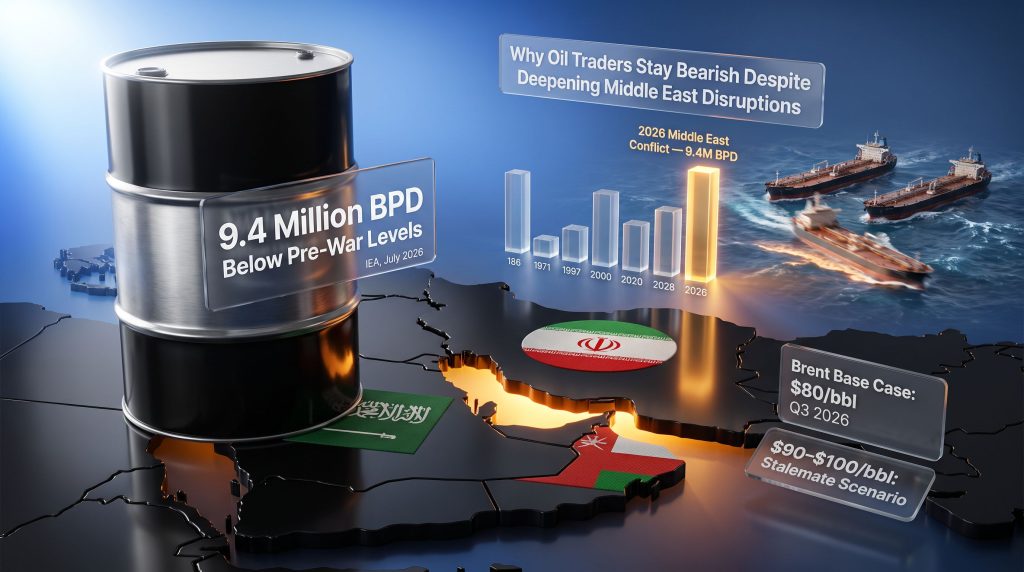
To understand why markets are behaving this way, it helps to first recognise what the data actually shows. According to the IEA's July 2026 Oil Market Report, global oil production remains approximately 9.4 million barrels per day (bpd) below pre-war levels. That figure represents the largest single supply disruption ever recorded in the history of global oil markets, dwarfing every previous shock including the 1973 Arab Oil Embargo and the 1979 Iranian Revolution.
Yet Brent crude has been trading around the $80 per barrel level, with WTI hovering near $75, levels that would appear entirely unremarkable in any normal supply environment. This is not a minor discrepancy between physical fundamentals and price signals. It is a structural divergence of historic proportions.
Key Data: The Scale of the Current Supply Disruption
| Metric | Figure | Source / Context |
|---|---|---|
| Global production deficit vs. pre-war | 9.4 million bpd | IEA Oil Market Report, July 2026 |
| Production rebound following June ceasefire | +4 million bpd | Temporary; ceasefire collapsed within one month |
| Regional refining capacity offline | ~3 million bpd | Attacks and disrupted export outlets |
| Gulf crude released post-ceasefire | ~70 million barrels | Kpler data, cited via Reuters |
| Gulf crude remaining in storage | ~80 million barrels | Effective regional buffer nearing depletion |
| Hormuz share of pre-war global oil and gas trade | ~20% | Historical Strait of Hormuz throughput benchmark |
The ceasefire negotiated in June 2026 briefly lifted production by more than 4 million bpd, and Gulf states responded by rapidly offloading stored crude, with approximately 70 million barrels exported in the weeks immediately following the agreement. However, that ceasefire collapsed within a month, leaving production deficits largely intact while simultaneously drawing down the regional storage buffer that markets had been implicitly relying upon as a safety valve.
The Three Forces Keeping Trader Sentiment Bearish
Despite the extraordinary scale of physical disruption, institutional sentiment in oil futures markets has remained tilted toward the downside. Three structural factors are driving this positioning:
-
Demand-side weakness – Subdued economic growth across major oil-importing economies, particularly in Europe and parts of Asia, has compressed consumption forecasts and reduced the urgency of any supply premium.
-
Non-OPEC+ supply expansion – Producers outside the OPEC+ alliance, including the United States, Brazil, and Guyana, continue to add output, providing a partial counterweight to Middle East supply losses in headline balances.
-
Perceived OPEC+ spare capacity – The assumption that idle production capacity within OPEC+ nations could absorb a supply shock has remained deeply embedded in market psychology, despite growing questions about the practical accessibility of that capacity.
Underpinning all three factors is a fourth and perhaps more powerful force: the memory of 2022. When Western sanctions targeted Russian crude exports following the invasion of Ukraine, markets initially priced a severe and sustained disruption. Russian barrels then redirected toward Asia, primarily India and China, and the feared supply collapse did not materialise. That episode embedded a deeply influential assumption in oil market psychology — that supply disruptions are inherently self-correcting, that oil always finds an alternative route.
Furthermore, as research into oil market dynamics has highlighted, the distinction between redirected and destroyed supply is frequently underweighted in futures positioning. The critical distinction that many traders appear to be underweighting is the difference between redirected supply and destroyed supply. Russian sanctions in 2022 rerouted barrels. The current Middle East conflict has physically eliminated production capacity and taken refining infrastructure offline through direct attacks. These are fundamentally different dynamics with fundamentally different timelines for resolution.
ING commodity analysts, writing in early August 2026, maintained a Brent average forecast of $80 per barrel for Q3 2026, contingent on flows beginning to normalise through the quarter. That forecast reflects an expectation of diplomatic progress translating into physical flow recovery, a view based on optimism rather than hard evidence from tanker traffic or production data.
The Strait of Hormuz: From Shipping Lane to Active Conflict Zone
Before the current conflict, the Strait of Hormuz facilitated roughly one-fifth of all global oil and gas trade, making it the single most consequential energy chokepoint on earth. The disruptions now occurring in and around this corridor are not merely logistical inconveniences. They represent a structural threat to the architecture of global crude and refined product flows. Indeed, crude oil market analysts have long flagged this corridor as the most vulnerable single point in the global energy system.
A cascade of escalation events has reshaped the risk environment around Hormuz in 2026:
-
Houthi forces have conducted ballistic missile strikes on Saudi oil tankers operating in the Red Sea, forcing a fundamental rerouting of Saudi crude exports away from the primary East-West pipeline corridor toward the Suez Canal and a Mediterranean-connected pipeline that operates at significantly lower throughput capacity.
-
ADNOC, the Abu Dhabi national oil company, has reported 15 vessel attacks across the broader Gulf region, signalling that operational risk for commercial shipping is sustained and serious, not episodic.
-
Iran's parliament has been actively reviewing legislation that would bar vessels from the United States, Israel, and designated hostile nations from Strait of Hormuz transit, a measure that would represent a formal legislative escalation with direct implications for freedom of navigation in the world's most critical energy corridor.
-
Iran and Oman have been engaged in negotiations over a framework to co-manage Strait of Hormuz access, with a draft agreement reportedly awaiting senior Iranian government approval as of early August 2026.
-
Hormuz tanker traffic has remained consistently subdued even during periods when peace talks were reported to be advancing, a signal that physical market participants are not yet convinced that diplomatic progress is translating into operational normalcy.
Saudi Arabia's Export Rerouting: A Capacity Problem Markets Are Underestimating
| Export Route | Current Status | Capacity Constraint |
|---|---|---|
| East-West Pipeline (Persian Gulf to Yanbu, Red Sea) | Disrupted / Under threat | Primary artery compromised by Houthi activity |
| Suez Canal routing | Active but strained | Lower throughput than primary pipeline corridor |
| Mediterranean pipeline connection | In use | Significantly reduced capacity relative to East-West pipeline |
The rerouting of Saudi crude through lower-capacity alternatives is not simply a logistical inconvenience. It creates a structural ceiling on the volume of Saudi oil that can reach global markets, regardless of how much production Saudi Aramco is capable of delivering. Consequently, Aramco has also been deepening its crude discounts to Asian buyers, a pricing signal that market observers typically interpret as an indicator that export normalisation is not imminent and that the seller is managing competitive pressure from constrained supply availability.
Why Physical Markets and Futures Prices Are Telling Different Stories
Energy market analysts noted early in the conflict that the transmission of physical supply constraints into spot and futures pricing typically requires several months to fully materialise through the supply chain. Production is destroyed, but inventories buffer the immediate impact. Refining capacity goes offline, but stored refined products create a short-term cushion. The lag between physical supply destruction and the point at which prices fully reflect that destruction is a well-understood feature of oil market dynamics, but it is also the window in which bearish positioning can persist long after the underlying fundamentals have shifted.
With the conflict now approaching the six-month mark, that lag period is narrowing rapidly. Several physical market indicators are flashing warnings that futures sentiment has not yet absorbed:
-
Gulf storage buffers are being drawn down toward levels that would eliminate the regional spare supply cushion. With approximately 80 million barrels remaining in Gulf storage after the post-ceasefire release, any further drawdown would leave markets without the inventory backstop that has allowed bearish positions to be maintained without a price shock.
-
Indian refiners, which historically sourced heavily from Middle East producers, have been pivoting toward West African crude grades, a behavioural shift that indicates physical supply chain disruption is real and ongoing, not merely a futures market abstraction.
-
Hormuz tanker traffic data continues to show suppression that has not recovered to pre-conflict levels despite multiple rounds of reported peace negotiations.
As noted by analysts tracking Middle East tensions, physical market participants are voting with their procurement decisions. When refiners start buying West African crude to replace Gulf grades, it is because Gulf supply is genuinely constrained, not because futures markets suggest it should be.
Comparing the 2026 Disruption to Historical Oil Supply Shocks
| Supply Shock Event | Estimated Disruption | Price Response | Duration |
|---|---|---|---|
| 1973 Arab Oil Embargo | ~4-5 million bpd | Prices quadrupled | ~6 months |
| 1979 Iranian Revolution | ~5-6 million bpd | Prices doubled | ~12-18 months |
| 1990 Gulf War (Iraq/Kuwait) | ~4-5 million bpd | Spike, then rapid reversal | ~6 months |
| 2022 Russia sanctions | ~2-3 million bpd (redirected, not destroyed) | Temporary spike, self-corrected | ~3-6 months |
| 2026 Middle East Conflict | ~9.4 million bpd (production deficit) | Muted; bearish positioning dominant | Ongoing (5+ months) |
The scale of the 2026 disruption exceeds every prior oil supply shock in recorded history by a significant margin. Yet the price response has been the most muted of any comparable crisis. This is the central paradox facing anyone attempting to understand current oil market dynamics.
The key differentiator from 2022 is the nature of the supply loss. Russian barrels in 2022 were redirected — they moved from European buyers to Asian buyers, but the barrels themselves continued to exist and flow. The current disruption involves the physical destruction of production infrastructure and refining capacity. Those barrels are not being redirected. In significant proportion, they are simply not being produced.
The next major ASX story will hit our subscribers first
Three Scenarios for Oil Prices From Here
Scenario 1: Diplomatic Breakthrough and Flow Normalisation
The Iran-Oman co-management framework is ratified. Saudi export rerouting pressure eases. Gulf storage inventory is released gradually, and Brent stabilises near the $80 per barrel level through Q3 2026. This scenario represents the base case embedded in current bearish positioning, but it requires Iranian parliamentary legislation on vessel access restrictions to fail, Houthi activity to de-escalate, and a diplomatic process between Washington and Tehran that has so far been characterised by mutual mistrust to reach a durable resolution.
Scenario 2: Prolonged Stalemate With Periodic Escalation
Hormuz access remains contested. Tanker traffic stays suppressed. Saudi rerouting constraints persist and refined product markets tighten further. The physical supply deficit of approximately 9.4 million bpd begins transmitting into spot prices as the lag period expires. Brent tests the $90 to $100 per barrel range, and bearish futures positioning faces a forced unwind that amplifies the price move. The trade war's impact on oil markets adds further complexity to this already volatile outlook.
Scenario 3: Structural Reconfiguration of Middle East Oil Flows
Post-conflict Hormuz operates under a new governance framework, potentially including tolls, co-management arrangements, or formalised access restrictions. Alternative pipeline infrastructure, including a proposed Iraq-Syria bypass corridor with an estimated revival timeline of approximately three years, begins development. Structural shifts in regional crude pricing persist regardless of when active hostilities end, and oil markets reprice on a new equilibrium basis above pre-war levels.
The Triggers That Could Force a Rapid Reversal of Bearish Positioning
Markets positioned for a diplomatic resolution that has not yet materialised are exposed to asymmetric risk. A single escalation event at this stage of physical market tightening could trigger a price spike substantially more severe than anything seen in the earlier phases of the conflict. The specific triggers to monitor include:
-
Passage of Iranian parliamentary legislation formally barring hostile vessel access to the Strait of Hormuz.
-
Aramco deepening Asia crude discounts further, signalling that export normalisation remains a distant prospect.
-
Hormuz tanker traffic data showing a sustained decline below current already-suppressed levels.
-
Gulf storage inventory falling below thresholds that would eliminate the regional buffer entirely, removing the principal cushion underpinning bearish sentiment.
Some analysts are beginning to conclude that even a successful diplomatic resolution may not restore pre-war oil flow dynamics. The combination of proposed Hormuz tolling or co-management arrangements, the need for alternative pipeline infrastructure development, and the physical destruction of regional refining capacity suggests that post-conflict Middle East oil flows will be structurally different — and structurally more expensive — than what existed before February 2026. In addition, OPEC's influence on global oil markets will be a critical variable in determining how quickly any new equilibrium can be established.
FAQ: Oil Traders, Middle East Disruptions, and What Comes Next
Why are oil traders staying bearish when supply disruptions are so severe?
Traders are effectively betting that a diplomatic resolution will materialise before the full weight of the physical supply deficit translates into market prices. They are also weighting structural bearish factors — including weak demand, non-OPEC supply growth, and OPEC+ spare capacity — against the disruption risk. The 2022 Russia precedent has reinforced a market assumption that supply disruptions self-correct, an assumption that may not hold when the disruption involves physical infrastructure destruction rather than trade route redirection.
What is the significance of the Strait of Hormuz to global oil markets?
Prior to the current conflict, the Strait of Hormuz facilitated approximately one-fifth of all global oil and gas trade. Any sustained restriction on tanker transit carries cascading consequences for crude supply, refined product availability, and shipping costs across Asia, Europe, and beyond.
How much refining capacity has been lost in the conflict?
The IEA has estimated that approximately 3 million bpd of regional refining capacity has been taken offline due to attacks and the loss of viable export outlets, creating tightness in refined product markets that goes beyond crude price signals alone.
What are the alternative routes if Hormuz access stays restricted?
Current alternatives include Suez Canal routing and Mediterranean pipeline connections, both operating at significantly lower throughput than primary Gulf export corridors. A proposed Iraq-Syria pipeline bypass has been identified as a potential longer-term solution, with an estimated revival timeline of approximately three years.
Could Hormuz governance be permanently restructured after the conflict?
Signals including Iran's parliamentary discussions on vessel access legislation and the Iran-Oman co-management negotiations suggest that post-conflict Hormuz governance may operate under a materially different framework than the pre-war status quo. Furthermore, oil traders stay bearish despite deepening Middle East disruptions in the near term, but the long-term structural implications for the region's energy pricing remain profound and largely unpriced by current markets.
Disclaimer: This article is for informational purposes only and does not constitute financial or investment advice. Oil price forecasts and scenario analyses involve significant uncertainty and may not reflect actual market outcomes. Readers should conduct their own due diligence before making any investment decisions. All figures cited are sourced from publicly available reports including the IEA Oil Market Report (July 2026) and Kpler data as referenced in contemporaneous Reuters reporting.
Want to Stay Ahead of Major Resource Discoveries Driven by Shifting Commodity Markets?
While geopolitical upheaval continues to reshape global energy supply chains, resource investors positioned early on significant mineral discoveries stand to benefit from the resulting commodity repricing — Discovery Alert's proprietary Discovery IQ model scans ASX announcements in real time, delivering instant alerts on high-potential discoveries across more than 30 commodities so subscribers can act before the broader market catches on. Explore historic examples of discovery-driven returns and begin your 14-day free trial to secure a market-leading edge.