August 8, 2026
When Trade Policy Becomes a Weapon: The Senate Bill Rewriting Global Energy Rules
The architecture of modern economic warfare has shifted decisively away from direct financial penalties and toward something more structurally disruptive: the weaponisation of trade access itself. Secondary sanctions, once a niche instrument used sparingly by the US Treasury Department, have evolved into a blunt geopolitical tool capable of forcing third-party nations to choose between energy economics and diplomatic alignment. The US Senate Russia sanctions bill 100% tariffs on India represents perhaps the most sweeping iteration of this doctrine yet seen, and its implications stretch far beyond Eastern Europe.
Understanding what this legislation actually does, and more importantly what it could do, requires separating the political theatre from the legal architecture buried inside the bill's text. Furthermore, the reciprocal tariffs impact of such legislation cannot be understated when examining how trade tools are reshaping geopolitical alliances.
When big ASX news breaks, our subscribers know first
The Secondary Sanctions Doctrine: How Energy Trade Became a Geopolitical Liability
Secondary sanctions operate on a fundamentally different logic than primary sanctions. Primary sanctions prohibit US persons and entities from engaging with a designated target. Secondary sanctions, by contrast, threaten to penalise third countries that continue doing business with that target, even when those countries have no legal obligation to observe US foreign policy objectives.
This distinction matters enormously for countries like India. When the US imposed primary sanctions on Russia following the 2022 invasion of Ukraine, Indian refiners were under no legal obligation to stop purchasing Russian crude. They responded rationally, scaling up purchases of discounted Russian oil that Western buyers had abandoned.
By 2024, Russia had become India's single largest crude supplier, accounting for roughly 35 to 40 percent of India's total crude oil imports, up from a negligible share before 2022. The US-China trade war impact provides a useful parallel here, illustrating how economic pressure cascades unpredictably across third-party nations.
The Senate bill now seeks to change the cost-benefit calculation for that decision, not by making the trade illegal, but by threatening to make it economically catastrophic through retaliatory tariffs on Indian exports to the US.
The shift from direct sanctions to third-country pressure mechanisms represents a structural escalation in how the United States uses its trade architecture as a foreign policy instrument, with consequences that extend well beyond the Russia-Ukraine conflict itself.
Precise Legal Mechanics: What the Bill Actually Authorises
Does the Bill Automatically Impose Tariffs?
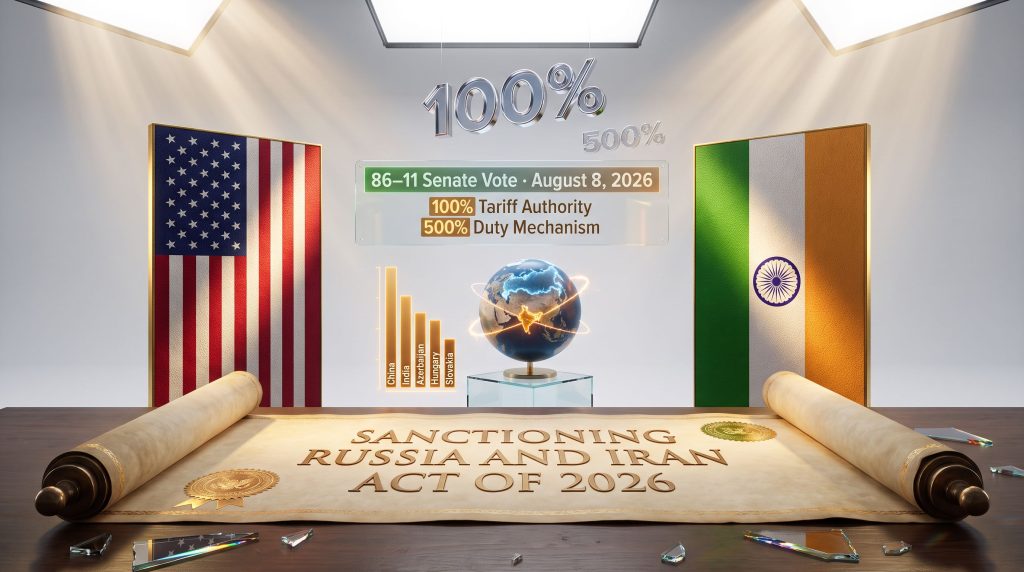
One of the most consequential misunderstandings surrounding this legislation involves the word "imposes." The bill does not automatically impose 100% tariffs on any country. What it does is grant the US President discretionary authority to levy tariffs of up to 100% on goods imported from nations classified among the top five purchasers of Russian oil or gas. This is a critical legal distinction.
The presidential discretion framing means that tariff imposition is a political act, not an automatic regulatory consequence. Any president would need to make a formal determination, issue the appropriate executive order or proclamation, and direct US Customs and Border Protection to apply the relevant tariff schedule. This process creates both diplomatic space and political risk at every stage.
Beyond the headline 100% tariff authority, the bill contains a separate and considerably more severe escalation mechanism: a 500% duty provision targeting entities that knowingly trade in Russian-origin energy products already subject to sanctions. This is not a country-level measure but a transaction-level one, with potentially broader reach across global commodity tariff effects involving sanctioned Russian energy.
| Provision | Threshold / Trigger | Who Is Affected | Exemption Available? |
|---|---|---|---|
| 100% Tariff Authority | Top 5 Russian oil/gas importers | China, India, Azerbaijan, Hungary, Slovakia | Yes, if importing under 15% gas from Russia and reducing |
| 500% Duty Mechanism | Trade in sanctioned Russian energy products | Broad third-country exposure | Limited |
| Iran Sanctions Extension | Investment in Iran's energy sector | Global energy companies | No |
| Iran Sanctions Act Renewal | Extended to 2031 from 1996 baseline | Energy sector investors | No |
A key exemption clause embedded within the legislation provides a potential off-ramp. Countries that source less than 15% of their natural gas from Russia and can demonstrate a downward trajectory in that dependency may qualify for relief. For India, which imports very limited volumes of Russian piped gas, this clause may carry more practical relevance than it initially appears, though India's dominant exposure is in crude oil rather than gas specifically, which complicates the exemption calculus.
The Five Countries in the Crosshairs: A Comparative Profile
The five nations currently classified as the top importers of Russian oil and gas present a strikingly diverse set of geopolitical profiles, and that diversity is itself a policy challenge for Washington. Indeed, the broader geopolitical mining landscape reflects how energy dependencies and resource trade have become inseparable from foreign policy risk.
China represents the largest single buyer of Russian energy by volume, with Russian crude and pipeline gas now forming a substantial pillar of Beijing's energy security strategy. Any tariff threat directed at China operates within an already-fraught bilateral trade relationship and would interact unpredictably with existing tariff structures.
India presents a different risk profile. Unlike China, India maintains a broadly cooperative relationship with Washington and has no formal strategic alignment with Moscow. Its pivot toward Russian crude was driven by economics, specifically the steep discounts, sometimes $10 to $15 per barrel below Brent, that Russian Urals crude commanded after Western buyers withdrew.
India's refining sector rapidly adapted to process higher volumes of Russian grades, creating a degree of infrastructural lock-in that cannot be quickly reversed. Azerbaijan, Hungary, and Slovakia represent the European dimension of this problem. Hungary and Slovakia in particular have maintained deep pipeline dependencies on Russian gas, and their continued Russian energy purchases reflect genuine infrastructure constraints rather than strategic preference.
India's Specific Exposure: What 100% Tariffs Would Mean in Practice
How Would Tariffs Actually Be Applied?
India's goods exports to the United States represent a substantial and growing trade corridor. In the 2023-24 financial year, India's merchandise exports to the US exceeded $77 billion, making the United States India's single largest export destination. Categories including pharmaceuticals, textiles, engineering goods, gems and jewellery, and IT-related hardware represent the most exposed segments under a 100% tariff scenario.
A doubling of effective import costs on Indian goods would devastate price competitiveness across virtually every major export category. Indian pharmaceutical exports, which supply a significant share of US generic drug requirements, would face particularly acute disruption, with downstream consequences for American consumers who depend on affordable generics.
The step-by-step process through which 100% tariffs would actually materialise on Indian goods is worth examining carefully:
- The President formally designates India as one of the top five Russian energy importers under the bill's authority
- An executive order or proclamation is issued invoking the tariff authority granted by the legislation
- US Customs and Border Protection receives updated tariff schedule instructions for affected Indian goods
- A 100% ad valorem duty is applied to designated Indian product categories at US ports of entry
- India's government is formally notified through diplomatic and trade representation channels
- India may invoke WTO dispute resolution mechanisms, though the timeline for such proceedings typically spans years
India's retaliatory options are constrained by the asymmetry of the trade relationship. While India could target US agricultural exports, defence procurement decisions, or market access for US digital services firms, none of these levers carries the same immediate economic weight as losing preferential access to the world's largest consumer market.
The 86 to 11 Senate Vote: What Bipartisan Momentum Actually Signals
The Senate passed the bill on August 8, 2026, by a margin of 86 votes to 11. In contemporary American legislative politics, an 86-vote majority is remarkable, crossing the two-thirds threshold that would be required to override a presidential veto. This supermajority status significantly reduces the political leverage any future executive might deploy to resist enactment.
The bill's bipartisan character owes much to its unusual backstory. Republican Senator Lindsey Graham, who died on July 11, 2026, following a visit to Kyiv, had championed the legislation alongside Democratic Senator Richard Blumenthal. His death transformed the bill into a symbolic vehicle for honouring a legislator whose commitment to Ukraine support spanned party lines.
Darline Graham, appointed to her late brother's Senate seat, became the bill's public face in its final passage phase, describing the legislation as a mechanism to force major Russian energy buyers to choose between American commerce and discounted Russian crude.
| Legislative Stage | Status | Expected Timeline |
|---|---|---|
| Senate Vote | Passed 86 to 11 | August 8, 2026 |
| House Review | Pending | From August 31, 2026 |
| Presidential Signature | Not yet reached | TBD |
| Full Enactment | Contingent on House | TBD |
The next major ASX story will hit our subscribers first
The Democratic Fault Line: Why Some Lawmakers Opposed a Russia Sanctions Bill
Opposition to the bill from within Democratic ranks reveals a substantive legislative concern that extends beyond the Russia-Ukraine context. Democratic Congressmen Gregory Meeks and Don Beyer publicly criticised the legislation for embedding sweeping new tariff authorities within a sanctions framework, arguing that such powers could be redirected toward entirely unrelated trade objectives by the executive branch.
Critics within the Democratic caucus raised a structural concern: that granting the presidency expansive tariff discretion through a sanctions bill creates a durable mechanism that could outlast its stated geopolitical purpose and be applied in ways Congress never intended.
This criticism targets the intersection of two distinct policy domains: sanctions enforcement and trade war mechanics. By coupling punitive tariff authority to a geopolitical rationale, the bill potentially normalises the use of tariff escalation as a foreign policy tool in a way that blurs the boundary between trade policy and national security law. Consequently, the tariff-driven supply chain risks associated with this kind of legislative precedent extend well beyond any single bilateral relationship.
The concern is not without historical foundation. Presidential trade authorities, once granted, have rarely been narrowly constrained in practice, and the Trump administration's prior use of tariff mechanisms across multiple unrelated trade disputes provides specific grounds for Democratic unease.
Iran Sanctions Extension: The Bill's Second Major Dimension
Receiving considerably less public attention than the Russia provisions is the bill's extension of the Iran Sanctions Act of 1996 through to 2031. Originally enacted to penalise foreign companies investing in Iran's energy sector, the ISA has been renewed multiple times since its original passage. This extension adds another five years of enforcement authority to a framework that has already reshaped global energy investment patterns for nearly three decades.
For international energy companies operating in or near sanctioned markets, the 2031 extension creates durable legal risk that will factor into investment planning across projects with multi-decade horizons. The combination of Iran and Russia provisions within a single legislative package signals a broader strategic intent: to use energy sector access as the primary lever of geopolitical compliance enforcement.
Three Scenarios for India: Economic Shock, Diplomatic Escape, or Presidential Waiver
How this legislation ultimately affects India depends heavily on which of three plausible scenarios plays out after House passage and presidential signature.
Scenario A: Full Tariff Imposition. The President designates India among the top five importers and issues tariff orders. Indian exports face 100% duties at US ports. Bilateral trade relationships deteriorate sharply, triggering retaliatory measures and WTO dispute proceedings. Indian refiners face intense government pressure to diversify away from Russian crude, though infrastructure constraints limit the speed of any transition.
Scenario B: Negotiated Exemption. India commits to a credible, measurable reduction in Russian energy dependency, potentially restructuring procurement toward Middle Eastern, African, or American suppliers. If India can restructure its natural gas import profile to fall below the 15% Russian sourcing threshold and demonstrate a downward trend, it may qualify for formal relief without requiring a presidential waiver.
Scenario C: Presidential Waiver. Given India's strategic importance to US foreign policy objectives in the Indo-Pacific, the executive branch exercises its discretionary authority not to designate India, or formally waives tariff imposition on diplomatic grounds. This outcome resolves India's immediate exposure without requiring structural energy policy changes, but leaves the underlying vulnerability intact.
Macro Implications: How This Bill Is Already Reshaping Global Energy Flows
The bill's influence on global energy markets extends beyond its actual enactment status. The credible threat of the US Senate Russia sanctions bill 100% tariffs on India and other major buyers is already functioning as a market signal, forcing refiners, sovereign energy buyers, and oil trading desks to model tariff risk into their procurement decisions.
If China and India, the two largest buyers of discounted Russian crude, were simultaneously to reduce purchases in response to tariff pressure, the downstream consequences for Russian export revenues would be severe. Russia currently depends on Asian demand to absorb the volumes Western buyers have withdrawn, and that dependency has deepened with each additional sanctions tranche imposed since 2022.
A sustained reduction in Asian demand for Russian crude would likely compress the discount at which Russian Urals trades against Brent, reducing Russia's effective oil revenues even without a price ceiling mechanism. Whether that compression would be sufficient to materially alter Russian military financing is a separate analytical question, but the direction of the pressure is clear.
This article is intended for informational purposes only and does not constitute financial, investment, or legal advice. Legislative status, tariff provisions, and trade flow data are subject to change. Readers should consult qualified professionals before making decisions based on legislative or geopolitical analysis.
Want to Stay Ahead of Market-Moving Geopolitical Shifts?
When trade policy reshapes global energy flows and commodity markets, the investors best positioned are those with the fastest, most actionable intelligence — Discovery Alert's proprietary Discovery IQ model scans ASX announcements in real time, instantly identifying significant mineral discoveries before the broader market reacts, so whether you're a short-term trader or long-term investor, you can begin your 14-day free trial today or explore historic discoveries and their exceptional returns to understand just how transformative early positioning can be.