July 21, 2026
The global crude oil marketplace operates within intricate supply networks where individual producing regions wield influence far beyond their statistical footprint. Mediterranean refining infrastructure represents a concentrated hub of processing capacity specifically configured for light sweet crude feedstock, creating vulnerabilities when supply chains experience disruptions. This dependency becomes particularly pronounced during periods when alternative crude sources face constraints, forcing refineries to compete for limited supplies of premium-quality feedstock.
Understanding these supply-demand dynamics requires analyzing both the technical specifications that drive crude value and the operational constraints that limit market flexibility. When production infrastructure experiences weather-related disruptions, the ripple effects extend throughout regional markets, creating pricing volatility and forcing strategic adaptations among downstream processors.
Algeria's Mediterranean Market Position
Algeria's crude export operations center on Saharan Blend, a light sweet crude that comprises the nation's entire export portfolio. This concentration creates both strategic advantages and operational vulnerabilities within Mediterranean crude markets. With production reaching 965,000 barrels per day in November 2025, Algeria achieved its highest output levels in two years, yet export capacity constraints have severely limited the country's ability to capitalise on this production momentum.
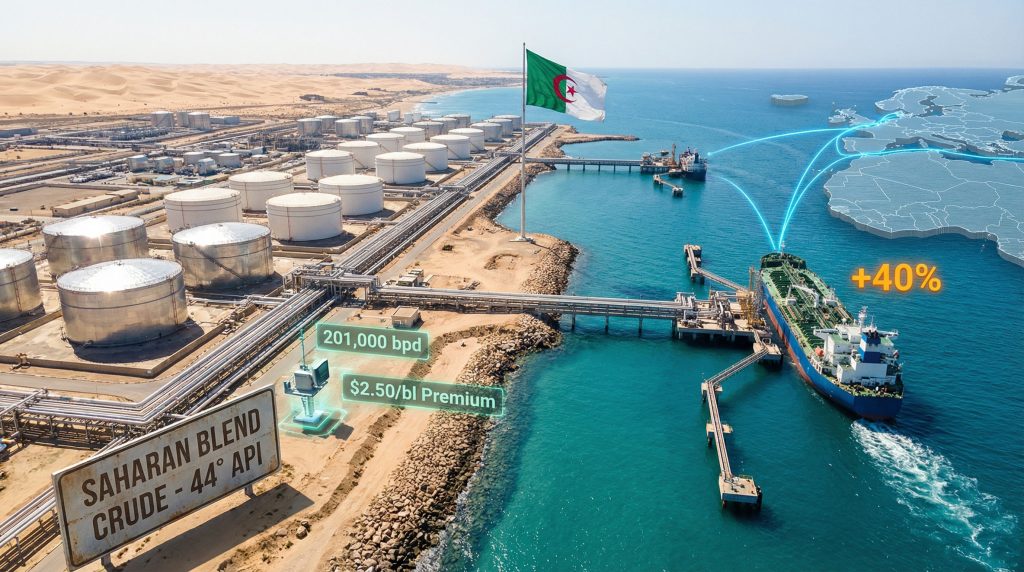
The disconnect between production capabilities and export performance reveals infrastructure bottlenecks that extend beyond simple operational challenges. Export volumes plummeted from 476,000 barrels per day in December 2025 to just 201,000 barrels per day in January 2026, representing a 58% month-over-month decline that highlights the vulnerability of concentrated export infrastructure.
Mediterranean refineries have historically relied on Algerian supplies due to favourable freight economics and crude quality specifications that align with regional processing configurations. This dependency creates a strategic chokepoint when weather conditions or infrastructure constraints disrupt normal export patterns, forcing refiners to seek alternative supplies at potentially higher costs.
Furthermore, the timing of these algeria saharan blend export disruptions becomes crucial for market impact assessment. Winter weather patterns affecting North African coastal regions can create extended periods of loading restrictions, while seasonal refinery maintenance schedules may provide demand relief that masks the severity of supply constraints.
When big ASX news breaks, our subscribers know first
Technical Specifications Driving Premium Valuations
Saharan Blend's market positioning stems from specific quality characteristics that optimise refinery processing economics. With API gravity ratings between 44-45 degrees and sulfur content below 0.1%, this crude grade falls squarely within the light sweet classification that Mediterranean refineries favour for their processing configurations.
These specifications translate directly into refinery yield advantages. Light sweet crudes require minimal desulfurisation processing and produce higher yields of valuable transportation fuels compared to heavier or higher-sulphur alternatives. Mediterranean refineries equipped with hydrotreating and catalytic cracking units specifically designed for light sweet feedstock cannot easily substitute heavy sour crude without accepting reduced product yields or implementing costly processing modifications.
Premium Pricing Evolution:
- Mid-January 2026: $2.00 per barrel premium to North Sea Dated Brent
- Early February 2026: $1.30 per barrel premium to Dated Brent
- 70-cent decline reflecting seasonal demand patterns and alternative supply availability
The premium commanded by Saharan Blend reflects both supply constraints and the limited availability of comparable light sweet crude grades in European markets. When refineries face feedstock shortages, they compete aggressively for available supplies, driving premiums to levels that reflect the economic value of optimised processing yields.
Refinery economics favour light sweet crude processing through multiple mechanisms. Moreover, our oil price rally analysis demonstrates how thermal cracking and catalytic conversion units operate more efficiently with lighter crude inputs, while reduced sulphur content minimises hydrotreating requirements. These operational advantages justify premium pricing even during periods of temporary supply constraints.
Processing Economics Analysis
| Crude Grade | API Gravity | Sulfur Content | Typical Premium | Processing Advantages |
|---|---|---|---|---|
| Saharan Blend | 44-45° | <0.1% | $1.30-2.00/bl | Optimal thermal cracking, minimal desulfurisation |
| North Sea Forties | 40-41° | 0.3-0.4% | Baseline | Moderate hydrotreating required |
| West African Bonny Light | 33-35° | 0.12-0.15% | Heavier processing, increased hydrotreating |
Infrastructure Vulnerability and Weather Impact
Algeria's export infrastructure demonstrates the risks associated with concentrated coastal loading facilities when facing adverse weather conditions. The country's export system relies on pipeline networks connecting inland production facilities to Mediterranean terminals, creating specific vulnerability points where weather disruptions can halt loading operations for extended periods.
Operational constraints affecting Algerian exports extend beyond simple weather delays. Offshore loading systems require specific sea state conditions to operate safely, while onshore terminals may face flooding, equipment damage, or pipeline operational restrictions during severe weather events. These factors combined to create the dramatic export reduction observed in January 2026.
The production-to-export ratio gap reveals the complexity of infrastructure constraints. Despite maintaining production at 965,000 barrels per day, exports fell to 201,000 barrels per day, creating a variance of approximately 764,000 barrels per day that reflects infrastructure bottlenecks, domestic consumption requirements, and inventory management challenges.
Consequently, the U.S. Energy Information Administration notes that weather-related disruptions affecting export terminals are anticipated as persistent operational challenges extending into spring 2026, rather than short-term anomalies that will resolve quickly.
Export scheduling becomes impossible during extended adverse weather periods, forcing refiners to activate alternative procurement strategies while waiting for operational resumption. The duration and severity of weather impacts determine whether market disruptions remain temporary inconveniences or evolve into strategic supply chain reconfigurations.
Market Substitution Dynamics
When algeria saharan blend export disruptions limit supply availability, European refineries implement substitution strategies that reveal both market flexibility and structural constraints. Mediterranean refiners typically pivot toward North Sea Forties, West African Bonny Light, and U.S. light tight oil as alternative feedstock sources, though each option carries distinct economic and operational implications.
The timing of supply disruptions significantly influences market impact severity. Spring refinery maintenance seasons, typically occurring from February through April, naturally reduce crude consumption across Mediterranean facilities. This seasonal demand reduction provided some market relief despite continued Saharan Blend constraints, preventing more severe price escalations.
Substitution Economics Comparison:
• North Sea Forties: Similar quality specifications with comparable freight costs, but limited incremental availability during peak demand periods
• West African Bonny Light: Heavier crude requiring processing adjustments, with extended shipping distances increasing landed costs
• U.S. Light Tight Oil: Variable quality profiles depending on field source, with transatlantic shipping creating substantial freight premiums
• CPC Blend Resumption: Alternative light sour supplies providing partial demand relief as exports resumed operations
However, market participants noted that each substitution option requires refineries to optimise processing parameters while accepting either higher costs or reduced yields compared to their preferred Saharan Blend feedstock. This optimisation challenge becomes more pronounced during periods when multiple crude grades face simultaneous supply constraints.
The 70-cent premium decline from mid-January to early February 2026 reflected both seasonal maintenance scheduling and increased availability of alternative crude supplies, demonstrating how market forces adjust to supply disruptions through multiple mechanisms simultaneously. In addition, our analysis of trade war oil price trends shows similar adaptation patterns during supply constraint periods.
Freight Market Complications
Rising transportation costs compound the economic challenges created by limited crude availability. Aframax tanker rates for Mediterranean crude movements increased approximately 40% during late January and early February 2026, reflecting broader shipping market constraints beyond Algeria-specific factors.
This freight inflation directly impacts netback economics for crude exports while simultaneously increasing landed costs for refineries seeking alternative supplies. The combination of reduced export volumes and elevated transportation costs creates a dual pressure mechanism affecting both producers and downstream buyers.
Sonatrach's Official Pricing Response:
- February 2026: $2.50 per barrel premium to Dated Brent
- January 2026: $1.00 per barrel premium to Dated Brent
- Monthly increase: $1.50 per barrel
- Historical significance: Highest premium since December 2022
The official pricing mechanism reflects Algeria's strategy to maintain revenue margins despite higher transportation costs. By implementing retroactive pricing adjustments after clearing existing supplies, Sonatrach transfers freight inflation costs to downstream buyers while protecting producer economics.
Freight rate escalation affects the broader Mediterranean crude market by altering the relative competitiveness of different supply sources. Furthermore, when transportation costs increase uniformly across shipping routes, crude grades with inherent quality advantages maintain their market position despite higher absolute costs.
The 40% freight rate increase represents a significant cost component that refinery procurement teams must incorporate into their feedstock optimisation models. For refineries operating on compressed margins, these transportation cost increases can determine whether specific crude purchases remain economically viable.
Strategic Market Implications
Extended algeria saharan blend export disruptions carry implications that extend beyond immediate supply-demand imbalances. Mediterranean refineries dependent on Algerian crude may accelerate long-term diversification strategies to reduce single-source supply risks, potentially altering regional crude demand patterns permanently.
The concentration of Algeria's crude exports in a single grade creates inherent vulnerability for both the producer and dependent refineries. This supply chain risk becomes more pronounced during operational disruptions, highlighting the strategic value of supply source diversification for energy security considerations.
Scenario Analysis Framework:
-
Extended Infrastructure Constraints: Persistent weather disruptions through Q2 2026 could drive permanent market share losses as refineries develop alternative supply relationships
-
Infrastructure Resilience Investment: Algeria may prioritise operational redundancy and weather-hardening investments to prevent future export disruptions
-
Regional Supply Reconfiguration: Mediterranean refineries might invest in processing flexibility to handle diverse crude grades, reducing dependency on specific suppliers
Investment implications emerge from supply chain reliability considerations. Market participants with strategic storage capacity near Mediterranean refineries may benefit from arbitrage opportunities during supply disruptions, while refineries with crude processing flexibility gain competitive advantages during constraint periods.
The premium pricing dynamics observed during January-February 2026 demonstrate how quickly crude markets respond to supply constraints, but also how seasonal factors and alternative supply developments can moderate extreme price movements. For instance, our oil price stagnation factors analysis reveals similar patterns during previous disruption periods.
Risk Management Considerations:
• Single-source dependency creates vulnerability to extended disruptions affecting critical feedstock supplies
• Infrastructure concentration limits operational flexibility during weather-related or maintenance disruptions
• Freight market volatility compounds supply constraint impacts through transportation cost escalation
• Seasonal demand patterns can either amplify or moderate the market impact of supply disruptions depending on timing
The next major ASX story will hit our subscribers first
Investment and Trading Perspectives
Market volatility created by algeria saharan blend export disruptions generates both risks and opportunities for different market participants. Crude oil storage economics become attractive during supply constraints, particularly for facilities located near Mediterranean refineries seeking assured feedstock availability.
Refineries with flexible crude processing capabilities may capture margin improvements from price differentials created by supply disruptions. Conversely, facilities dependent on specific crude grades face margin compression risks when preferred feedstock becomes unavailable or prohibitively expensive.
The $2.50 per barrel premium established by Sonatrach for February 2026 represents not only current market conditions but also expectations about supply constraint duration. This pricing signal provides market participants with insights into producer expectations about operational restoration timelines.
Trading strategies must account for the interconnected nature of crude supply disruptions, freight market dynamics, and seasonal refinery operations. The rapid premium adjustments observed between mid-January and early February 2026 demonstrate how quickly market conditions can shift when multiple factors change simultaneously.
Market Monitoring Priorities:
• Infrastructure investment announcements from Sonatrach regarding export capability enhancement
• Alternative crude supply development in competing regions, particularly North Sea and West African facilities
• European refinery configuration changes aimed at feedstock diversification and processing flexibility
• Freight market dynamics affecting crude oil transportation costs across Mediterranean and transatlantic routes
How Do Global Markets Respond to Supply Disruptions?
The ongoing situation illustrates fundamental principles of energy market risk management: supply concentration creates vulnerability, infrastructure resilience requires continuous investment, and market participants must maintain flexibility to adapt to changing conditions. These lessons extend beyond Algeria's specific circumstances to broader considerations affecting global crude oil supply chains.
Additionally, examining WTI and Brent outlook provides context for how international benchmarks respond to regional supply constraints. Meanwhile, broader geopolitical oil supply dynamics continue to influence market stability across multiple producing regions.
Understanding the technical, economic, and strategic factors driving these market dynamics provides essential context for evaluating similar situations affecting other crude producing regions and export infrastructure systems worldwide. However, as noted by the International Institute for Strategic Studies, Algeria's hydrocarbon sector continues to struggle with meeting both export expectations and domestic energy requirements, creating ongoing structural challenges that extend beyond weather-related disruptions.
Are You Positioned to Capitalise on Energy Market Volatility?
Discovery Alert's proprietary Discovery IQ model identifies actionable opportunities in ASX mineral discoveries, including critical energy transition commodities that drive market volatility during global supply disruptions. Explore how major discoveries can generate substantial returns and begin your 14-day free trial today to secure your market-leading advantage.