
July 21, 2026
When Energy Chokepoints Collide: A Strategic Analysis of the U.S.-Iran Escalation and Global Oil Markets
Energy markets are built on a foundational assumption: that at least one major transit corridor remains open during any given geopolitical shock. Trump vows Tehran will pay as U.S. strikes Iran, and historical conflicts in the Persian Gulf — from the Tanker War of the 1980s to the post-2019 drone strike episodes — always left global traders with a viable pressure-release valve. The current U.S.-Iran conflict, now entering its fifth month since hostilities first resumed in late February 2026, is systematically dismantling that assumption by threatening two critical export corridors simultaneously.
Understanding what that dual-chokepoint risk actually means for energy pricing, downstream consumers, and long-term supply strategy requires moving beyond headlines and into the structural mechanics of how oil moves, where it can be rerouted, and what happens when those alternatives are exhausted. Furthermore, monitoring crude oil price trends helps contextualise just how dramatically this conflict has reshaped market expectations.
When big ASX news breaks, our subscribers know first
The Pre-Escalation Fragility That Markets Ignored
Before the 10th consecutive night of U.S. strikes on Iranian command centres, missile infrastructure, and air defence installations, global oil supply chains had already absorbed five months of compounding stress. Spare capacity buffers, which typically provide a cushion against geopolitical disruption, entered this conflict cycle at historically thin levels. OPEC's market influence had been gradually depleted through a combination of production discipline, underinvestment in upstream assets, and demand recovery following the post-pandemic normalisation period.
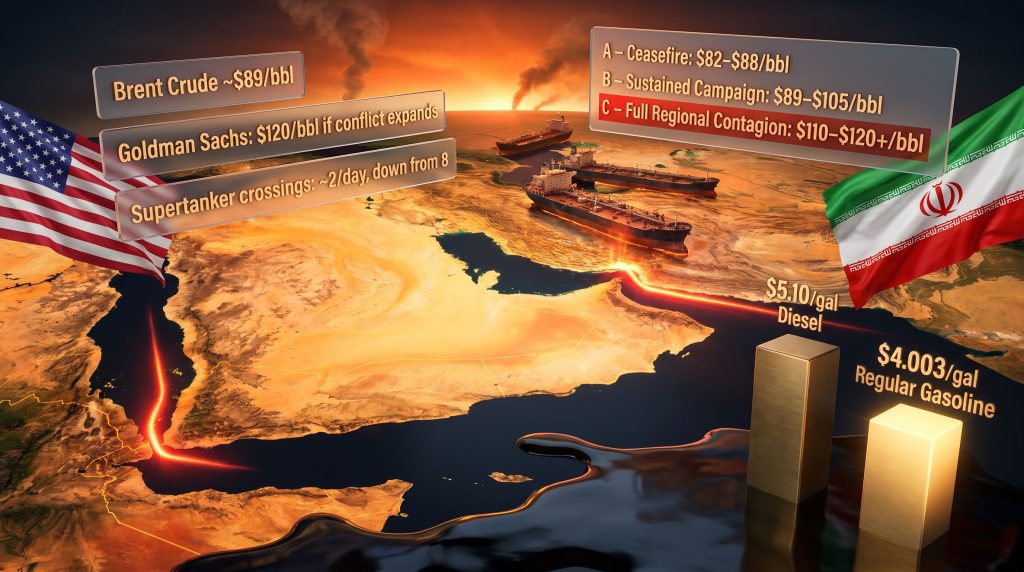
The Strait of Hormuz itself was already functioning well below its pre-conflict throughput by mid-July 2026. Satellite tracking data showed supertanker crossings collapsing from approximately eight per day in late June to roughly two per day by mid-July, a decline that represents a structural breakdown in normal commercial flow rather than a temporary disruption.
Ship-to-ship transfer activity outside the strait — a method tanker operators use to consolidate cargo and minimise exposure time in contested waters — had nearly ceased entirely. The U.S. Central Command-facilitated southern corridor through Omani waters was designed as a partial operational workaround, helping move approximately 900 commercial vessels and an estimated 450 million barrels of crude since early May 2026. However, this routing solution was never architecturally designed to absorb the full volume of pre-conflict Hormuz transit, and it came with its own vulnerability.
That vulnerability materialised on July 20, when two Dynacom-managed tankers were struck by projectiles while using the southern corridor. The Malta-flagged vessel sustained an engine room fire and required full crew evacuation. The Liberian-flagged supertanker, carrying capacity for approximately 2 million barrels of crude, was diverted to anchorage. When the corridor marketed as the safe alternative is no longer safe, the entire routing architecture collapses.
Three Scenarios, Three Oil Price Worlds
Energy traders are simultaneously pricing fundamentally incompatible outcomes, and the spread between those outcomes is unusually wide. The current conflict trajectory supports at least three analytically distinct scenarios, each with material implications for Brent crude pricing and global supply availability.
| Scenario | Trigger Condition | Brent Price Range | Global Supply Impact |
|---|---|---|---|
| A: Ceasefire | 10-day verified pause holds | $82 – $88/bbl | Minimal; Hormuz partially reopens |
| B: Sustained Campaign | Continued strikes, no resolution | $89 – $105/bbl | ~2-3% of global supply at risk |
| C: Regional Contagion | Houthi blockade plus Hormuz closure | $110 – $120+/bbl | ~7-10% of global supply disrupted |
Scenario A: Ceasefire and Price Relief
Scenario A hinges on the 10-day ceasefire framework that mediating nations floated in late July 2026. A historical precedent exists: an earlier ceasefire in mid-June briefly reopened Hormuz and pulled U.S. gasoline below $4 per gallon before the latest escalation reversed those gains. Brent retreating toward the $82 to $88 band under a verified pause is a plausible but fragile outcome, as the window between diplomatic signalling and operational reality remains wide.
Scenario B: Sustained Military Campaign
Scenario B reflects the trajectory as of July 21, 2026. As Trump vows Tehran will pay as U.S. strikes Iran, U.S. strikes targeting Iranian command centres and air defence systems signal a campaign with defined military objectives rather than a punitive one-off response. The Pentagon has confirmed nearly 100 U.S. troops injured since July 7, with 17 confirmed deaths by July 21. Casualty escalation historically deepens military commitment, making an early exit politically costly. Goldman Sachs has warned that Brent could approach $120 per barrel if the conflict expands without diplomatic resolution.
Scenario C: Regional Contagion and Tail Risk
Scenario C represents the tail risk that markets are beginning to price with increasing seriousness. The Houthi declaration of a naval blockade on Saudi Arabia via the Bab el-Mandeb Strait introduces a second major chokepoint into an already stressed system. Saudi Arabia had quietly been routing crude to its Yanbu Red Sea export terminal to compensate for reduced Hormuz transit volumes. A verified Bab el-Mandeb closure could remove an estimated 7% of globally traded oil supply from accessible markets simultaneously with Hormuz disruption — a combination with no modern precedent.
Hormuz as a Supply Chain System: What the Numbers Actually Mean
Under pre-conflict conditions, the Strait of Hormuz handled approximately 17 to 21 million barrels of crude per day, representing roughly 20% of globally traded oil. The collapse from eight supertanker crossings per day in late June to approximately two per day by mid-July is not simply a risk premium story. It reflects actual physical reduction in crude moving from production to consumption markets. Consequently, current crude oil prices have responded sharply to each new development in the conflict.
Alternative routing options exist but are structurally limited:
- The Saudi East-West Pipeline can move crude overland from the Eastern Province to Yanbu, but its capacity ceiling falls well short of Hormuz throughput volumes
- The Omani southern corridor, now compromised by the July 20 tanker attacks, was always a supplementary measure with capacity constraints and elevated insurance exposure
- Iraq's Khor Mor gas field has already been shut down amid regional security threats, adding a parallel supply uncertainty to the LNG market
The attack on the southern corridor is particularly strategically significant. Tanker operators and their insurers had begun treating the route as a lower-risk option. Its compromise eliminates the perceived hierarchy of risk that shipping markets depend on to allocate vessels and premium pricing. War risk insurance premiums have surged accordingly, cascading into shipping economics in ways that compound the physical supply reduction with financial friction.
How Conflict Costs Reach American Consumers
The transmission mechanism from Brent crude futures to U.S. retail gasoline prices operates through a reasonably predictable chain, though the speed and magnitude of pass-through varies by region and refinery configuration.
- Crude price movement sets the primary input cost for refinery operations
- Refinery margins reflect crack spreads, regional supply-demand balances, and maintenance schedules
- Wholesale distribution costs add pipeline, terminal, and blending expenses
- State-level tax structures create the geographic spread between high and low-cost markets
- Retail margin represents the final layer before the consumer price
| Fuel Type | National Average (July 21, 2026) | State High | State Low | Weekly Change |
|---|---|---|---|---|
| Regular Gasoline | $4.003/gallon | ~$5.49 (California) | ~$3.35 (Indiana) | +$0.13 |
| Diesel | $5.10/gallon | – | – | Rising |
| Brent Crude | ~$89/barrel | – | – | Near-term high |
The $4 gasoline threshold carries outsized political and economic significance in the U.S. context. Consumer sentiment surveys consistently show elevated energy price sensitivity at this level, and the inflationary read-through from $5.10 diesel affects freight logistics, agricultural input costs, and manufacturing margins across the economy. The IMF has flagged elevated oil prices as a key risk to emerging market GDP growth, with India's crude import bill reportedly surging approximately 60% as prices climb.
Iran's Asymmetric Response Architecture
Tehran's operational response to continued U.S. strikes draws on a multi-layered proxy escalation model that has been developed and refined over decades. The Islamic Revolutionary Guard Corps has claimed strikes on regional infrastructure in Bahrain, targeting of Patriot air defence installations, and drone hangar strikes in Kuwait, though none of these claims had been independently confirmed by U.S. or allied officials as of July 21, 2026.
The strategic logic of proxy escalation through Houthi forces in Yemen is analytically important. By directing attacks through non-state actors, Iran can expand the conflict's geographic theatre and economic costs without providing direct attribution that would formally justify a symmetrical U.S. response. The Houthi naval blockade declaration on Saudi Arabia is the clearest recent expression of this doctrine. In addition, this oil market disruption has compounded pre-existing structural vulnerabilities in global supply chains.
The human cost of the conflict has reached levels that historically influence ceasefire negotiation dynamics on both sides. With 17 U.S. service members confirmed dead and the Iranian Red Crescent reporting at least 201 killed and 747 injured from U.S. and Israeli strikes, the casualty picture is generating domestic political pressure in both countries. The U.S. administration's stated position that any Iranian retaliation will be met with disproportionate force signals that escalation dominance, rather than de-escalation, remains the operative framework.
The next major ASX story will hit our subscribers first
Asia-Pacific and European Exposure: The Downstream Ripple Effect
The geographic concentration of Hormuz dependency makes Asia-Pacific the most exposed regional energy consumer by a significant margin. India, South Korea, Japan, and China collectively account for a disproportionate share of crude moving through the strait under normal operating conditions.
Asia-Pacific pressure points:
- India's crude import bill has reportedly surged approximately 60% as conflict-driven price increases compound volume disruption
- India has continued purchasing Russian crude at near-record volumes despite expired sanction waivers, a structural hedging behaviour that reflects the absence of adequate alternative supply
- Asian LNG spot prices surged approximately 10% as Hormuz supply fears intensified, with Pakistan paying the highest spot LNG prices in four years
- China has pivoted toward securing long-term LNG supply agreements outside the strait's geographic reach, a strategic repositioning with multi-year implications
- South Korea is routing cargo via the Red Sea as Hormuz disruptions persist; Japan's LNG sector is weighing capital market strategies to accelerate supply diversification
European vulnerability:
- European diesel inventories are trending toward multi-year lows as Middle East supply routes tighten
- Ryanair's reported 36% profit decline, attributed to unhedged jet fuel costs doubling, illustrates how conflict costs transmit directly into corporate earnings across fuel-intensive sectors
- The EU's push to double electrification rates has taken on renewed urgency as fossil fuel supply risk becomes structurally acute rather than cyclically temporary
The Structural Argument for a Permanent Risk Premium
Commodity analysts have increasingly argued that the geopolitical risk premium embedded in oil pricing is no longer a transient feature that dissipates when conflicts resolve. Jeff Currie, the commodities analyst formerly at Goldman Sachs and now at Carlyle Group, has argued publicly that the era of abundant, accessible oil has fundamentally ended — a thesis that the current conflict appears to be validating in real time. Furthermore, broader geopolitical trade tensions have compounded investor uncertainty well beyond the immediate conflict zone.
The structural case rests on several compounding factors:
- Underinvestment in upstream oil and gas infrastructure during the 2015–2020 period reduced the global capacity cushion that previously absorbed geopolitical shocks
- The concentration of remaining spare capacity in the Gulf region means that Middle East instability directly threatens the only meaningful supply buffer available to markets
- Alternative routing infrastructure for Hormuz-dependent volumes has proven insufficient to handle sustained disruption at current conflict intensity
- ADNOC's approval of a $6.2 billion gas development project in Abu Dhabi signals producer-side confidence in long-term demand despite the disruption, suggesting supply investment will eventually respond, but with a multi-year lag
The illusion that geopolitical risk premiums are temporary has been progressively eroded by five months of conflict demonstrating that global supply chains have far less redundancy than markets previously assumed.
Frequently Asked Questions
Why Did Oil Prices Briefly Break Above $90 When a Kuwaiti Tanker Was Hit in the Strait of Hormuz?
Tanker attacks within the strait directly threaten the physical movement of approximately 20% of globally traded crude oil. When a vessel is struck, the market reprices the probability that additional tankers will be deterred from making the crossing, reducing near-term supply availability and triggering immediate geopolitical risk premium expansion across Brent and WTI benchmarks.
What Is the Bab el-Mandeb Strait and Why Does the Houthi Blockade of Saudi Arabia Matter?
The Bab el-Mandeb connects the Red Sea to the Gulf of Aden and serves as the transit route for Saudi Arabia's Yanbu terminal, which has been absorbing Hormuz pressure throughout the conflict. A verified closure of Bab el-Mandeb, combined with reduced Hormuz throughput, could theoretically remove approximately 7% of global oil supply from market-accessible routes simultaneously, representing an unprecedented dual-corridor disruption with no modern historical analogue.
Could Oil Reach $120 Per Barrel If the Conflict Escalates Further?
Goldman Sachs has issued analysis indicating that Brent crude could approach $120 per barrel if the Middle East conflict expands without diplomatic resolution, particularly under a scenario where both Hormuz and Bab el-Mandeb face simultaneous sustained disruption. This represents a tail risk scenario rather than a base case, but one whose probability has risen materially as Trump vows Tehran will pay as U.S. strikes Iran and the conflict has entered its second week of consecutive U.S. strike operations.
Disclaimer: This article contains forward-looking analysis, price projections, and scenario modelling based on publicly available information as of July 21, 2026. Oil price forecasts involve significant uncertainty and should not be construed as investment advice. Geopolitical situations can change rapidly and materially from the circumstances described above.
Want to Track the Commodity Opportunities Emerging From Global Energy Disruptions?
Discovery Alert's proprietary Discovery IQ model delivers real-time alerts on significant ASX mineral discoveries — including those in the energy and resources sectors being reshaped by geopolitical upheaval — empowering subscribers to identify actionable opportunities ahead of the broader market. Explore historic discoveries and their extraordinary returns, or begin your 14-day free trial today to position yourself ahead of the next major market move.