
July 21, 2026
The Quiet Revolution Beneath the Red Lagoons: Why Bauxite Residue Is Being Reimagined as a Strategic Resource
Across the global industrial landscape, few challenges carry the combination of scale, urgency, and untapped opportunity that bauxite residue does. For decades, the highly alkaline sludge generated during alumina refining has been treated primarily as a logistical burden, pumped into containment lakes and left to accumulate. However, the economics, the environmental pressures, and the materials science have all shifted. What was once an inert liability is now attracting serious attention as a dual-purpose feedstock capable of producing secondary iron and low-carbon construction materials simultaneously. The convergence of green metallurgy and circular economy policy is reframing the narrative around aluminium red mud iron recovery and low-carbon cement production — one of heavy industry's most persistent waste problems.
When big ASX news breaks, our subscribers know first
What Aluminium Red Mud Actually Contains and Why That Matters
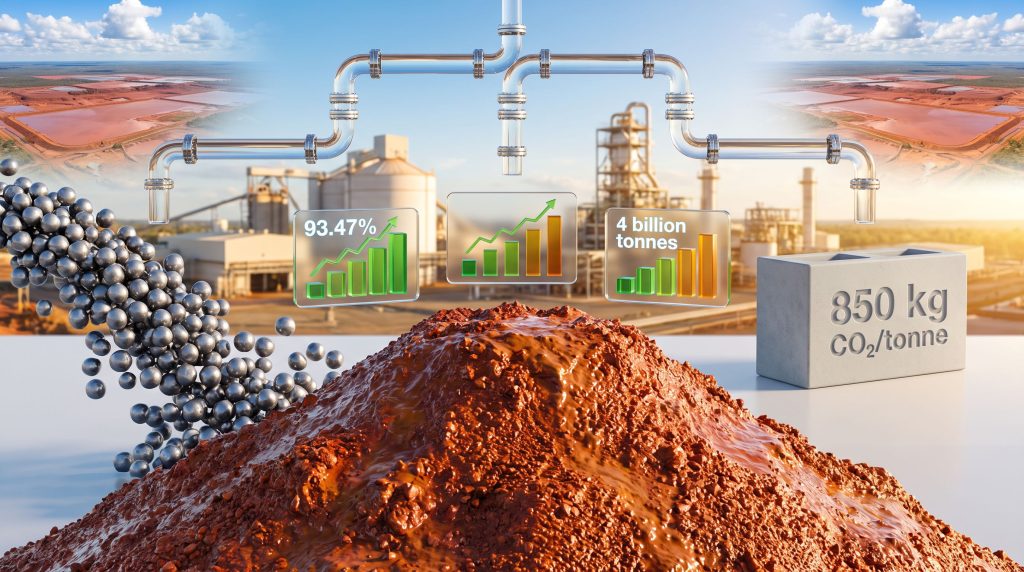
Bauxite residue, commonly referred to as red mud due to its distinctive iron-rich colouration, is an unavoidable output of the Bayer process used to extract alumina from bauxite ore. For every tonne of alumina produced, the refining process generates approximately one to two tonnes of this caustic slurry. Globally, accumulated stockpiles have now surpassed 4 billion tonnes, a figure that continues to climb as aluminium demand sustains output at refineries worldwide. Understanding global bauxite production trends is therefore essential context for grasping the scale of this challenge.
The composition of red mud varies by bauxite source and processing conditions, but its mineralogical profile consistently includes several components of industrial significance.
Red Mud Composition and Strategic Significance
| Component | Typical Concentration Range | Strategic Significance |
|---|---|---|
| Iron Oxide (Fe₂O₃) | 14–45% | Primary target for secondary iron recovery |
| Alumina (Al₂O₃) | 5–14% | Recoverable via hydrometallurgical routes |
| Reactive Silica and Alumina | Variable | Enables alkali-activated cementitious applications |
| Heavy Metals | Trace to moderate | Environmental liability requiring immobilisation |
The high iron oxide content in particular positions red mud as a candidate secondary iron resource in regions where ore imports represent a strategic and cost vulnerability. At iron oxide concentrations exceeding 30%, certain red mud stockpiles approach the grade of lower-quality natural iron ore deposits, making the case for recovery economically as well as environmentally compelling.
Beyond iron, the reactive silica and alumina fractions carry their own downstream value. These mineral phases are precisely what makes iron-extracted residue suitable for use in alkali-activated binders, a class of low-carbon cementitious materials that can partially or substantially replace Portland cement clinker in construction applications.
Why Passive Storage Is No Longer Defensible
The environmental profile of untreated red mud creates compounding liabilities over time. Its highly alkaline pH, fine particle size, and capacity for heavy metal leaching mean that containment failure — as demonstrated historically by the 2010 Ajka disaster in Hungary — can produce catastrophic consequences for surrounding soil and water systems. According to research published by ScienceDirect, the leaching characteristics of red mud pose significant long-term environmental risks that conventional storage cannot adequately mitigate.
Tightening environmental regulations across the European Union, China, and other major producing regions are progressively raising the cost and complexity of conventional disposal, pushing refiners to evaluate valorisation pathways more seriously than at any previous point in the industry's history.
China's Red Mud Mountain: The Numbers Behind the Opportunity
No country illustrates the scale of the red mud challenge more starkly than China. As the world's dominant alumina producer, China generates more than 107 million tonnes of red mud annually. Its total accumulated stockpile has exceeded 1.3 billion tonnes, concentrated primarily across the alumina-intensive provinces of Shandong, Shanxi, Henan, and Guangxi.
Within those stockpiles, researchers estimate that approximately 520 million tonnes qualify as high-iron red mud, with iron oxide concentrations above 30%. At that grade, the material represents a substantial domestic iron resource at a time when China's steel industry remains partly dependent on imported ore from Australia and Brazil.
The strategic framing here is significant. A domestic iron feedstock embedded within existing industrial waste streams could theoretically reduce import exposure while simultaneously addressing an environmental liability. Whether that potential is captured depends entirely on the economics and scalability of the recovery technologies deployed.
This dual motivation — resource security and environmental management — is accelerating research investment and pilot-scale development in Chinese metallurgical and materials science institutions at a pace that is difficult to match elsewhere.
The Technology Landscape for Iron Recovery from Red Mud
Extracting iron from red mud is technically achievable through multiple routes, each with distinct trade-offs across recovery efficiency, iron grade, energy intensity, and environmental profile. Recent advances have significantly improved on earlier benchmarks.
Comparative Performance of Leading Iron Extraction Methods
| Recovery Method | Core Process | Iron Recovery Rate | Iron Grade Achieved | Carbon Profile |
|---|---|---|---|---|
| Reductive Sintering | 1200°C sintering with controlled MgO/SiO₂ ratio followed by magnetic separation and NaOH digestion | 91.02% | 55.03% Fe | Moderate energy intensity |
| Carbothermic Roasting | Alkaline salt roasting at 1100°C to suppress fayalite formation | 85.43% | 79.32% Fe | High-temperature dependent |
| Hydrometallurgical Leaching | H₂SO₄ leaching followed by co-precipitation and calcination | 93.47% | 63.84% total Fe | Chemical-intensive |
| Soda and Magnetisation Roasting | Combined soda roasting with medium-temperature magnetisation conversion | 93.47% | High-purity magnetite | Lower-temperature potential |
| Vacuum Thermal Reduction | Vacuum reduction combined with alkali leaching and magnetic separation | Above 90% | High efficiency demonstrated | Emerging low-carbon pathway |
A particularly important development is the combined soda roasting and magnetisation roasting route. This integrated thermal approach has demonstrated iron recovery rates of 93.47% alongside alumina purity of 99.49% Al₂O₃ in a single process sequence — a dual-extraction efficiency that single-metal approaches cannot match. The ability to recover high-purity alumina as a co-product significantly improves the economics of the overall process and reduces the volume of residue requiring further management.
The Low-Carbon Frontier: Hydrogen and Biomass Reduction
Conventional pyrometallurgical routes are effective but carbon-intensive. Emerging alternatives are addressing this directly. Hydrogen-based direct reduction, hydrogen plasma processes, and biomass-assisted thermal reduction all aim to decouple iron recovery from fossil fuel consumption. The mining decarbonisation benefits associated with these technologies make their development a priority rather than an optional consideration.
One less widely understood dimension of this space involves the use of secondary aluminium dross as a substitute reducing agent in iron recovery processes. Aluminium dross, itself a waste product of aluminium smelting and recycling operations, contains sufficient metallic aluminium and aluminium nitride to function as a reductant. Research suggests that substituting conventional carbon-based reductants with secondary aluminium dross can reduce process-level carbon emissions by approximately 407 kilograms per tonne of dross utilised.
Physical separation methods — specifically magnetic and gravity-based techniques — are also being refined to improve fine-particle iron recovery without chemical inputs. These approaches are particularly relevant for lower-grade or more mineralogically complex red mud feedstocks where thermal processing alone may not achieve target grades economically.
Turning Iron-Depleted Tailings into Low-Carbon Cement
The conventional framing of iron recovery from red mud treats extraction as the end goal. The more transformative argument being advanced by materials researchers is that the residue remaining after iron extraction — far from being a secondary waste stream — is itself a valuable industrial raw material with specific application in low-carbon cement production.
Red mud contains reactive silica and alumina phases that provide the chemical basis for alkali-activated binder systems. These are cementitious materials that cure through an alkali-driven chemical reaction rather than the calcium silicate hydrate chemistry that governs ordinary Portland cement. When iron-depleted red mud tailings are blended with ground granulated blast furnace slag (GGBS) and fly ash, the resulting alkali-activated system can achieve 28-day compressive strengths of approximately 45 MPa, competitive with standard structural concrete applications.
A critical and often overlooked point is that removing reactive iron from red mud before using it as a supplementary cementitious material is not merely a processing step — it is a performance prerequisite. Iron removal activates the underlying aluminosilicate mineral structure, improving its reactivity and binding performance. It also enhances the immobilisation of residual heavy metals within the hardened cementitious matrix, addressing one of the key environmental objections to using red mud in construction materials. The International Aluminium Institute's guidance on bauxite residue use in Portland cement provides further technical context on this performance prerequisite.
Carbon Reduction: The Numbers That Define the Opportunity
Substituting Portland cement clinker with red mud-derived supplementary cementitious materials carries a CO₂ reduction potential of approximately 850 kilograms per tonne of cement replaced. For context, the global cement sector accounts for roughly 8% of annual CO₂ emissions, making any high-leverage substitution pathway a significant decarbonisation tool.
The table below contextualises this within the broader landscape of low-carbon cement technologies currently under development or deployment.
Comparative Carbon Performance of Low-Carbon Cement Technologies
| Cement Technology | Clinker Content | Key SCM Components | Estimated CO₂ Reduction |
|---|---|---|---|
| Red Mud Alkali-Activated Binder | Low and variable | Red mud tailings, GGBS, fly ash | Up to approximately 850 kg CO₂/tonne substituted |
| LC3 Limestone Calcined Clay Cement | Around 50% | 30% calcined clay, 15% limestone, 5% gypsum | Approximately 40% versus standard OPC |
| ECOPlanet-type Blended Cements | Around 70% | Industrial by-product blends | Approximately 30% versus standard OPC |
| Paris Alignment Clinker Target | 0.60 ratio by 2050 | Broad SCM integration | Sector-wide decarbonisation pathway |
The Paris Agreement's construction sector decarbonisation roadmap requires a global clinker-to-cement ratio reduction to 0.60 by 2050, down from the current average of approximately 0.72. Achieving this requires a substantial increase in supplementary cementitious material availability and performance. Red mud-derived SCMs, particularly when produced as a co-product of iron recovery, could contribute meaningfully to this supply gap, which makes them part of a broader set of critical raw materials transition solutions.
The Integrated Processing Pathway: How Full-Component Valorisation Works
The most compelling argument in the literature on aluminium red mud iron recovery and low-carbon cement production is the integrated systems case. Treating iron extraction and cement production as separate industrial objectives leaves value unrealised and undermines the economics of each individual process. Combining them, furthermore, creates a circular flow that supports both.
The full-component utilisation pathway proceeds through the following stages:
- Feedstock characterisation — Red mud stockpiles are sorted and assessed for iron oxide concentration, mineralogical profile, and moisture content to determine the optimal processing route.
- Iron and aluminium extraction — The appropriate thermal or hydrometallurgical recovery method is selected based on feedstock composition, with dual-extraction processes prioritised where alumina co-recovery is economically viable.
- Tailing stream conditioning — Iron-depleted residue is processed to optimise the reactivity of its aluminosilicate content for downstream cementitious applications.
- SCM formulation and blending — Conditioned tailings are combined with GGBS, fly ash, or calcined clay to engineer alkali-activated binders meeting specific compressive strength and durability targets.
- Life Cycle Assessment validation — Net carbon savings, waste reduction volumes, and resource efficiency metrics are quantified across the integrated value chain to substantiate environmental claims and support regulatory compliance.
- Industrial deployment — Material flows are connected across alumina refining, steel production, and cement manufacturing, establishing a cross-sector circular economy architecture with defined offtake relationships and logistics.
Life Cycle Assessment results from integrated processing models indicate that this approach reduces waste generation, improves resource recovery ratios, and supports measurably lower carbon outcomes compared to operating any single step of the chain in isolation. The connecting mechanism is industrial symbiosis: the output of one sector's waste stream becomes the input of another's production process.
The next major ASX story will hit our subscribers first
Barriers to Commercialisation and What It Will Take to Overcome Them
Despite the technical credibility of integrated red mud valorisation, the pathway to commercial scale faces meaningful obstacles that research alone cannot resolve.
Technical Complexity at the Mineralogical Level
Red mud is not a uniform material. Its composition shifts significantly based on the origin of the bauxite ore, the specific Bayer process parameters employed, and the age and storage conditions of the stockpile. Mineralogical variability creates processing uncertainty, particularly for high-temperature roasting methods that depend on consistent feed chemistry. Fine particle sizes also complicate magnetic and gravity separation at scale, requiring equipment engineering that goes beyond laboratory demonstrations.
Economic Viability Thresholds
The commercial case for iron recovery from red mud strengthens considerably when the following conditions are met:
- Iron concentrate grades exceed 55% Fe, enabling direct use in steelmaking without expensive upgrading steps.
- Carbon pricing mechanisms place a cost on conventional iron ore processing that narrows the gap with secondary recovery routes.
- SCM co-production generates a second revenue stream that subsidises the iron extraction process and improves overall project returns.
- Hydrogen reduction technology matures sufficiently to reduce energy costs and compete with established pyrometallurgical methods on a total cost basis.
None of these conditions is universally met today, but the trajectory of carbon pricing, critical materials policy, and energy technology development is moving in a direction that progressively improves the financial case.
Regulatory Frameworks and Industrial Policy
Industrial circularity frameworks in the European Union, China, and several other jurisdictions are establishing increasingly defined pathways for classifying processed industrial residues as secondary raw materials rather than wastes. This reclassification has practical consequences: it affects permitting timelines, liability structures, and the eligibility of projects for green finance instruments. Consequently, the regulatory environment's evolution will materially influence the pace at which red mud valorisation moves from research to industrial deployment.
Frequently Asked Questions: Aluminium Red Mud Iron Recovery and Low-Carbon Cement
What percentage of iron can be recovered from red mud?
Depending on the extraction method and feedstock quality, iron recovery rates range from approximately 85% to over 93%. Hydrometallurgical leaching and combined soda-magnetisation roasting routes consistently achieve the higher end of this range, with iron concentrate grades between roughly 55% and 79% Fe.
Is red mud safe to use in cement and construction materials?
Safety is conditional on processing. Iron-extracted red mud tailings incorporated into alkali-activated binders show improved heavy metal immobilisation compared to raw red mud. The hardened cementitious matrix physically and chemically binds residual contaminants, reducing leachability to levels compatible with construction application standards in most regulatory frameworks.
How does red mud-based cement compare in strength to conventional concrete?
Alkali-activated binders incorporating red mud tailings, GGBS, and fly ash have demonstrated 28-day compressive strengths of approximately 45 MPa, comparable to standard structural concrete grades used in civil engineering applications.
Which countries are leading in red mud valorisation research and deployment?
China leads by volume of research output and pilot-scale activity, driven by the scale of its accumulation problem and strategic interest in domestic iron resources. European research institutions, particularly in the context of the EU's critical raw materials framework, are also active. In addition, Australian and Indian groups linked to major bauxite-producing operations are contributing significantly — a trend consistent with Australia's broader green metals leadership ambitions.
What is the difference between alkali-activated binders and standard Portland cement?
Portland cement cures through the hydration of calcium silicate compounds, producing calcium silicate hydrate as the primary binding phase. Alkali-activated binders instead use an alkaline activator to dissolve and reorganise aluminosilicate precursors, producing a geopolymeric binding structure with a fundamentally different chemistry. The process typically requires less energy and generates significantly lower CO₂ emissions than clinker production.
How does red mud processing align with net-zero industrial targets?
The integrated pathway addresses three overlapping net-zero imperatives: reducing industrial waste volumes, displacing virgin iron ore extraction, and substituting clinker in cement production with lower-carbon alternatives. Each step contributes independently; combined, they represent a cross-sector decarbonisation mechanism with compound environmental leverage.
The Strategic Outlook: Red Mud at the Intersection of Waste, Iron, and Decarbonisation
The transformation of aluminium red mud into a dual-purpose feedstock for green iron and low-carbon cement represents one of the more structurally coherent circular economy opportunities in heavy industry. The chemistry is established, the recovery rates are competitive, and the downstream application in supplementary cementitious materials addresses a genuine supply gap in the low-carbon construction materials market. The aluminium industry leaders best positioned to capitalise on this shift are those already investing in integrated valorisation infrastructure.
What the sector now requires is not further validation of the concept but investment in scale-up infrastructure, standardisation of LCA methodologies across the value chain, and cross-industry commercial frameworks that allow alumina refiners, steel producers, and cement manufacturers to share both material flows and economic returns.
The key takeaways for anyone tracking this space can be summarised as follows:
- Global red mud stockpiles exceeding 4 billion tonnes represent an accumulated secondary resource, not merely a waste management problem.
- Iron recovery rates above 93% are now achievable through advanced thermal and hydrometallurgical routes.
- Post-extraction tailings can achieve 45 MPa compressive strength in alkali-activated binder formulations, meeting structural application requirements.
- CO₂ savings of up to 850 kg per tonne of cement substituted position red mud SCMs among the highest-leverage decarbonisation options available to the construction sector.
- The use of secondary aluminium dross as a reducing agent adds a 407 kg/tonne carbon reduction benefit while addressing a second industrial waste stream.
- Commercial viability improves materially when iron extraction and cement production are integrated rather than pursued independently.
The convergence of green iron recovery technologies and low-carbon cement production creates a dual-value pathway from red mud that simultaneously addresses industrial waste management, carbon reduction, and critical material supply — positioning bauxite residue valorisation as a structural priority for the aluminium sector's decarbonisation agenda.
For investors, policymakers, and industrial strategists, the signal is becoming clearer: the aluminium industry's largest waste stream may yet prove to be its most strategically valuable secondary resource. The question is no longer whether the technology works, but whether the commercial architecture to deploy it at scale can be built quickly enough to matter.
Want to Stay Ahead of the Next Major Mineral Discovery Reshaping the Green Metals Landscape?
Discovery Alert's proprietary Discovery IQ model delivers real-time alerts on significant ASX mineral discoveries — including those tied to the commodities driving green metallurgy and circular economy transitions — instantly turning complex data into actionable investment insights. Explore historic discoveries and the returns they generated, then begin your 14-day free trial to position yourself ahead of the market.