July 21, 2026
The Architecture of Preferential Trade and Why It Is Breaking Down
For decades, the relationship between the United States and African economies was shaped by a foundational premise: that extending preferential market access to developing nations would serve both humanitarian and strategic American interests. That premise is now being tested in ways the architects of those frameworks never anticipated. Trump tariffs on African exports to the U.S. do not simply raise the cost of doing business — they challenge the entire logic of asymmetric trade arrangements that African export industries were built around.
Understanding the full weight of what is unfolding requires looking beyond the headline tariff rates. The structural exposure of African economies to U.S. trade policy shifts is a function of decades of deliberate export concentration, investment decisions made in anticipation of stable preferential access, and the absence of any continent-wide mechanism capable of presenting a unified negotiating front to Washington.
When big ASX news breaks, our subscribers know first
The Numbers Defining the Relationship
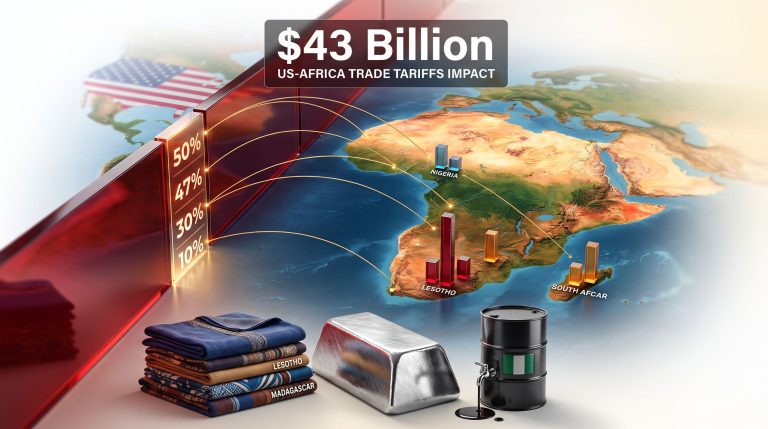
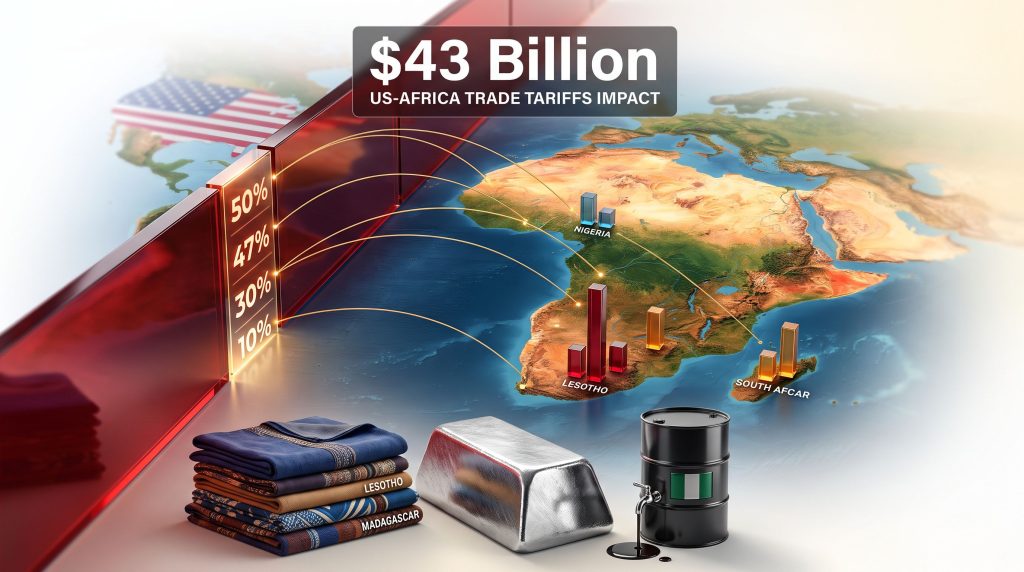
According to data from the Office of the United States Trade Representative (USTR), total U.S.-Africa goods trade reached an estimated $83.4 billion in 2025. Within that figure, the United States imported $43.0 billion worth of goods from African nations while exporting $40.4 billion in return — producing a trade surplus on Africa's side of approximately $2.6 billion.
While that surplus is modest by global standards, understanding how tariffs work helps explain why the administration's framework treats bilateral trade deficits as policy grievances regardless of their scale relative to total trade volumes. This methodology disproportionately penalises smaller economies whose trade surpluses with the U.S. reflect export concentration rather than protectionist barriers — a distinction Washington's current policy apparatus does not formally recognise.
The reciprocal tariff formula used by the administration calculates rates based on trade deficit ratios rather than the absolute dollar value of imbalances, which explains why Lesotho — a country with a fraction of South Africa's trade volume — carries a higher tariff rate than the continent's largest exporter.
The Legal Mechanism Behind the Tariff Agenda
April 2 and the Reciprocal Tariff Announcement
On April 2, 2025, the Trump administration unveiled country-specific tariff schedules targeting dozens of trading partners simultaneously. The policy rationale centred on reducing America's aggregate trade deficit and applying import cost pressure to incentivise domestic manufacturing. Unlike conventional anti-dumping measures, which require demonstrated injury to specific U.S. industries, the reciprocal tariff structure operates as a broad-based trade leverage instrument.
One week later, on April 9, the White House suspended most elevated tariff rates for 90 days while maintaining a universal 10% baseline duty. The suspension was designed to open bilateral negotiation windows rather than provide permanent relief. That window was subsequently extended to July 31, 2025, giving governments a second opportunity to reach arrangements with Washington before the higher country-specific rates could be reimposed.
Section 338: The Escalation Instrument
The legal architecture behind the administration's enforcement posture relies heavily on Section 338 of the Tariff Act of 1930, a seldom-invoked provision that authorises the president to impose unilateral tariffs on nations deemed to engage in discriminatory trade practices against U.S. commerce. The administration demonstrated its willingness to use this instrument by imposing an additional 50% tariff on certain Canadian goods, with a 30-day implementation window — bypassing extended negotiation in favour of direct enforcement action.
For African policymakers, the Canada precedent carries a specific message: the July 31 deadline is not a procedural formality. It represents a genuine enforcement threshold backed by established legal authority and demonstrated executive willingness to act unilaterally.
Country-by-Country Tariff Rates Across Africa
The tariff rates applied to African nations vary substantially based on the administration's trade deficit weighting methodology. The table below captures the current landscape:
| Country | Tariff Rate | Effective Date | Primary Exposure |
|---|---|---|---|
| Lesotho | 50% | April 9, 2025 | Apparel and textiles |
| Madagascar | 47% | April 9, 2025 | Garment manufacturing |
| Mauritius | 40% | April 9, 2025 | Trade imbalance |
| Botswana | 37% | April 9, 2025 | Diamonds and minerals |
| South Africa | 30% | August 7, 2025 | Vehicles, PGMs, manufactured goods |
| Algeria | 30% | August 7, 2025 | Hydrocarbons and trade deficit |
| Libya | 30% | August 7, 2025 | Energy exports |
| Tunisia | 25% | August 7, 2025 | Trade imbalance |
| Nigeria | 14-15% | April 9, 2025 | Energy export surplus |
| Ghana | 10% baseline | April 5, 2025 | Agriculture and minerals |
| Kenya | 10% baseline | April 5, 2025 | Apparel and agriculture |
| Ethiopia | 10% baseline | April 5, 2025 | Garments and coffee |
Why Lesotho Carries the Heaviest Burden
Lesotho's 50% tariff rate is one of the highest imposed on any country globally under this framework. The figure reflects the administration's deficit ratio calculation rather than bilateral trade volume — Lesotho's total goods trade with the U.S. is a fraction of South Africa's, yet it carries a higher penalty rate. The country's export economy is heavily concentrated in apparel and textiles, a sector the Trump administration has explicitly targeted as part of its domestic manufacturing revival agenda. For a nation where garment factories represent a primary formal employment sector, a 50% tariff does not simply reduce competitiveness — it structurally threatens the viability of the entire industry.
The Proposed Forced Labor Surcharge
Separately from the reciprocal tariff framework, a 12.5% forced labor surcharge is under active policy consideration, targeting eight African nations: Algeria, Angola, Egypt, Libya, Mauritania, Morocco, Nigeria, and South Africa. The measure is focused on supply chain concerns involving goods originating from China's Xinjiang region being processed or relabelled within these countries before export to the United States. The surcharge has not yet been formally approved, but its potential enactment would create a compounding tariff burden on top of existing reciprocal rates.
If the forced labor surcharge is enacted alongside existing reciprocal tariffs, some product categories from Nigeria and South Africa could face combined import duty rates exceeding 40%, fundamentally altering the economics of U.S.-bound trade for affected exporters.
AGOA: A Framework Under Functional Erosion
The African Growth and Opportunity Act has, since its enactment in 2000, provided eligible sub-Saharan African nations with duty-free access across more than 1,800 product categories. It was explicitly designed to deepen U.S.-Africa commercial integration and offer an alternative to Chinese economic influence on the continent. The Trump administration extended AGOA through December 31, 2026, but that extension now operates in direct tension with the reciprocal tariff schedules.
In practical terms, where a reciprocal tariff rate is higher than the duty-free preference AGOA provides, the tariff rate takes precedence. AGOA has not been formally revoked, but its real-world benefit has been significantly compressed for the countries facing the highest tariff rates. Furthermore, the absence of any confirmed renewal pathway past 2026 compounds the uncertainty facing exporters who built entire investment cases around stable preferential access.
Industries that attracted foreign direct investment specifically because of AGOA's guarantees — particularly garment manufacturing in East and Southern Africa — now face a dual threat: near-term cost increases and medium-term access uncertainty.
Sector-by-Sector Exposure Assessment
The impact of Trump tariffs on African exports to the U.S. is not uniform across sectors. Energy and critical mineral exporters benefit from significant exemptions, while labour-intensive manufacturing faces the most severe structural disruption.
| Sector | Key Countries | Headline Tariff | Exemption Status |
|---|---|---|---|
| Automotive manufacturing | South Africa | 30% | No exemption |
| Apparel and textiles | Lesotho, Madagascar, Kenya, Ethiopia | 10-50% | No exemption |
| Crude oil and LNG | Nigeria, Algeria | 14-30% headline | Largely exempt |
| Platinum group metals and critical minerals | South Africa, Botswana | 30-37% headline | Largely exempt |
| Agriculture and agri-processing | Ghana, Kenya, Côte d'Ivoire, Ethiopia | 10% baseline | No exemption |
Automotive Manufacturing: South Africa's Structural Vulnerability
South Africa is the continent's largest exporter to the American market, shipping vehicles, platinum group metals, gold, iron and steel products, and agricultural goods. The 30% tariff on selected goods falls heavily on the automotive sector, which is integrated into global just-in-time tariffs and supply chains where cost increases cannot be easily absorbed through operational adjustments. The South African Reserve Bank has projected that the tariff could result in up to 100,000 job losses, a figure that underscores the disproportionate social consequence of tariff policy in economies with high existing unemployment rates.
Energy Exports: Nigeria's Partial Buffer
Nigeria's export profile is dominated by crude petroleum and liquefied natural gas. Critically, oil, gas, and many critical minerals are largely exempt from the reciprocal tariff schedules, reflecting Washington's strategic interest in maintaining access to energy commodities and materials essential for defence and clean energy supply chains. This exemption provides Nigeria with a meaningful buffer against the headline 14-15% tariff rate, as the country's primary export revenues remain largely insulated from the new cost structure.
Critical Minerals: The Strategic Exemption Logic
The exemption of critical minerals from tariff schedules is not coincidental — it reflects a deliberate policy calculation. The surge in critical minerals demand globally has made Washington's interest in securing reliable access to platinum group metals, cobalt, manganese, and other strategic materials central to domestic industrial and defence applications, creating a natural tension with the punitive tariff agenda. For South Africa and Botswana, this creates a bifurcated impact: manufactured exports face full tariff exposure while strategic mineral exports retain preferential treatment.
This asymmetry has a less-discussed implication for African industrial policy. Nations pursuing downstream beneficiation — processing raw minerals into higher-value manufactured inputs — may find that the finished products they produce face tariffs their unprocessed mineral exports would not. The tariff framework inadvertently creates a perverse incentive to reduce rather than increase value-added processing in some commodity categories.
The next major ASX story will hit our subscribers first
The Geopolitical Stakes Beyond Trade Economics
China's Strategic Positioning
Trade economists and geopolitical analysts have consistently flagged the risk that punitive U.S. tariff policy could accelerate Africa's commercial pivot toward China. The ongoing US-China trade war has already reshaped global supply chains, and Beijing has steadily expanded its economic footprint across the continent through infrastructure financing, bilateral trade frameworks, and direct investment in extractive industries. If U.S. market access becomes structurally more expensive for African exporters, the commercial logic of deepening trade relationships with China intensifies — an outcome that runs directly counter to Washington's stated objective of limiting Chinese economic influence in the region.
The Negotiating Asymmetry Problem
African nations face a structural disadvantage in bilateral trade negotiations with Washington that goes beyond diplomatic leverage. The continent lacks a unified trade negotiation mechanism equivalent to the European Union's trade mandate. Each country must engage the United States independently, fragmenting what could be a collective bargaining position into dozens of isolated bilateral conversations. Africa's response to these tariff policies has consequently been fragmented, with smaller economies such as Lesotho and Madagascar having virtually no leverage to secure meaningful exemptions or carve-outs in this environment.
South Africa represents the notable exception. Following the imposition of 30% tariffs on selected goods, Pretoria mounted a formal diplomatic and trade defence effort — the most organised pushback from any African government. The outcome of South Africa's negotiations with Washington may establish a template, or at minimum a reference point, for how other African nations approach their own bilateral discussions.
Strategic Responses for Exporters and Policymakers
Immediate Operational Priorities
- Harmonised System code audits: Exporters should conduct detailed HS code classification reviews to identify whether specific product lines qualify for energy or critical mineral exemption categories
- Market diversification: Reducing dependence on U.S. market access by developing export channels to the EU, Gulf states, China, and intra-African markets through the African Continental Free Trade Area (AfCFTA)
- Value-chain reassessment: Evaluating whether adjustments to processing stages could shift certain product categories into exempted classifications without triggering other compliance thresholds
- Supply chain compliance documentation: For the eight countries under forced labor surcharge review, establishing robust chain-of-custody documentation may become a critical trade defence tool
Policy-Level Options for Governments
- Engage Washington directly before the July 31 deadline with concrete trade concession offers aligned with U.S. policy priorities, including critical mineral supply agreements and forced labor compliance certification frameworks
- Accelerate AfCFTA implementation as a structural hedge against external market volatility, deepening intra-African trade flows that reduce dependence on any single export destination
- Coordinate through the African Union to develop a collective position on AGOA renewal and tariff exemption requests — recognising that bilateral fragmentation systematically weakens each nation's negotiating position
- Deploy development finance institutions to buffer employment impacts in the most exposed labour-intensive sectors while industrial policy frameworks are reassessed
Frequently Asked Questions: Trump Tariffs on African Exports
What is the highest tariff rate currently imposed on any African country?
Lesotho faces the highest rate at 50%, effective April 9, 2025. The rate is derived from the administration's trade deficit ratio methodology rather than the volume of bilateral trade between the two countries.
Are Nigerian crude oil exports affected by the new tariff framework?
Crude petroleum and liquefied natural gas are largely exempt from the reciprocal tariff schedules. Nigeria's headline tariff rate of 14-15% primarily affects non-energy goods, while its dominant export commodities remain substantially insulated.
Does AGOA still provide meaningful duty-free access under the current tariff environment?
AGOA has been extended through December 31, 2026, but reciprocal tariff rates functionally override its duty-free provisions for many product categories. No formal revocation has occurred, however the practical trade benefit has been substantially reduced for nations facing elevated tariff rates.
What is the proposed forced labor surcharge and which countries are affected?
A 12.5% additional tariff surcharge under consideration targets Algeria, Angola, Egypt, Libya, Mauritania, Morocco, Nigeria, and South Africa over supply chain concerns related to goods from China's Xinjiang region being processed within those countries. The measure has not yet been formally approved.
What happens after July 31, 2025, if no bilateral agreements are reached?
Countries without negotiated arrangements face potential reimposition of the elevated tariff rates that were suspended from their April 2 levels. The administration's use of Section 338 against Canada demonstrates both the legal capacity and political willingness to enforce these measures unilaterally. Analysts at the Center for Strategic and International Studies have outlined several strategic options African governments might consider ahead of this deadline.
Which African export sectors face the most severe disruption?
Apparel and textile manufacturers in Lesotho, Madagascar, Ethiopia, and Kenya face the most acute structural disruption. South Africa's automotive sector carries significant exposure, with projected employment consequences of up to 100,000 jobs according to South African Reserve Bank analysis.
Key Takeaways
- Africa's $43 billion annual export market to the U.S. is operating under a fundamentally altered policy environment, with tariff rates ranging from 10% to 50% depending on country and product category
- The AGOA preferential access framework has been functionally undermined for high-tariff nations, even as its formal extension through 2026 remains nominally in place
- Energy and critical mineral exports retain significant exemptions, creating an uneven impact distribution across the continent's export economy
- The July 31 deadline carries genuine enforcement risk given the administration's demonstrated willingness to impose unilateral tariff measures under Section 338 authority
- A potential 12.5% forced labor surcharge targeting eight African nations remains under consideration and has not yet been formally enacted
- The risk of accelerating Africa's commercial realignment toward China represents a strategic consequence that runs counter to Washington's own geopolitical objectives in the region
This article is intended for informational purposes only and does not constitute financial, legal, or trade advice. Tariff rates, policy frameworks, and negotiation outcomes are subject to change. Readers are encouraged to consult qualified trade law professionals for guidance specific to their circumstances.
Want to Stay Ahead of the Commodity Opportunities Emerging From Global Trade Disruptions?
As tariff pressures reshape African mineral and resource export flows, new investment opportunities on the ASX are emerging in real time — Discovery Alert's proprietary Discovery IQ model instantly identifies significant mineral discoveries as they are announced, transforming complex data across 30+ commodities into clear, actionable insights for both traders and long-term investors. Explore historic discovery returns on Discovery Alert's discoveries page and begin a 14-day free trial to position yourself ahead of the market.