July 21, 2026
The Chokepoint Trap: How Saudi Arabia's Export Strategy Created a New Vulnerability
Global oil markets have spent decades managing single-point risks. The Strait of Hormuz has long occupied the top position in energy security threat assessments, with contingency planners, tanker insurers, and crude traders all building frameworks around its potential disruption. What those frameworks rarely modelled in full was the simultaneous closure of a second major maritime chokepoint, compressing the world's remaining export options into a corridor barely 29 kilometres wide at its narrowest reach.
That is the scenario now unfolding in the southern Red Sea, where the Houthi naval blockade threat to Saudi oil exports has transformed the Bab el-Mandeb Strait from a background risk into the central variable in global oil supply calculations.
When big ASX news breaks, our subscribers know first
Why Saudi Arabia's Red Sea Pivot Created Concentrated Exposure
Understanding the current risk requires tracing a strategic decision made in response to Hormuz disruptions. Saudi Arabia operates two primary crude export corridors: the Persian Gulf route through the Strait of Hormuz, and the Red Sea route fed by the East-West Pipeline terminating at Yanbu. When Hormuz shipping fell to near standstill conditions, Riyadh logically maximised the Yanbu channel, ramping exports from that terminal to approximately 4 million barrels per day (bpd).
The decision was operationally sound. The East-West Pipeline insulates crude from Gulf shipping lanes entirely, delivering oil overland to the Red Sea coast for onward maritime shipment. What the strategy could not eliminate was the final maritime passage that Red Sea-bound crude must clear before reaching Asian markets: Bab el-Mandeb. This pipeline disruption risk dynamic underscores how even well-designed infrastructure can carry residual geographic vulnerabilities.
The Geography That Cannot Be Engineered Around
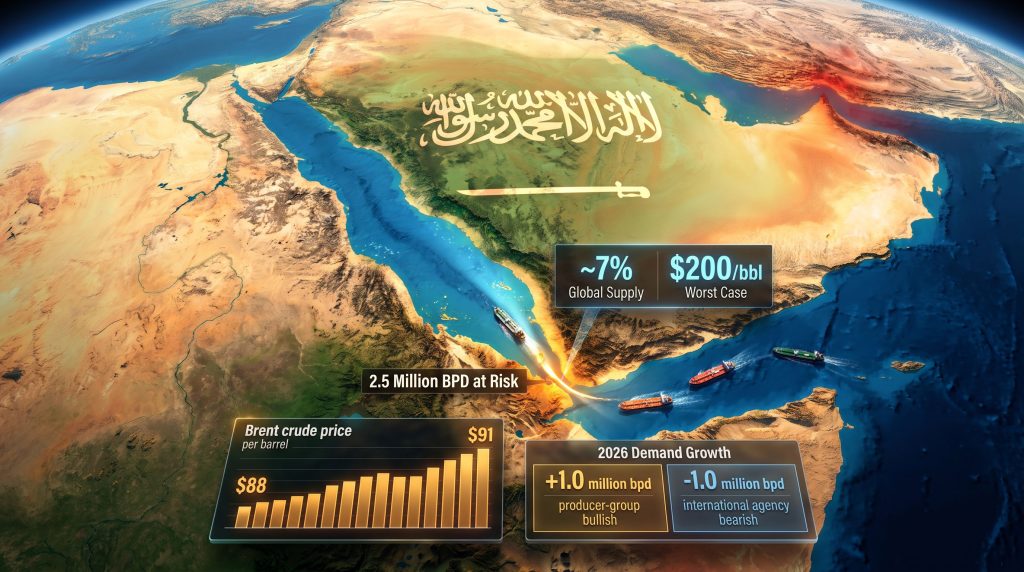
Bab el-Mandeb sits at the southern entrance to the Red Sea, separating Yemen's coast from Djibouti across a channel that narrows to roughly 29 kilometres. Every southbound tanker carrying Saudi crude toward Asian destinations must pass through this corridor. Vessel-tracking data from Rystad Energy indicates that approximately 2.5 million bpd of Saudi crude departing Yanbu currently moves through this passage on southbound trajectories, per reporting by Rigzone published July 21, 2026.
The strait also handles an estimated quarter of global container trade flows and serves as the primary transit pathway for crude moving from the Persian Gulf toward European markets via the Suez Canal, underscoring just how much of the world's physical trade depends on this single narrow waterway remaining open.
The Houthi Blockade Declaration: From Harassment to Strategic Interdiction
The Houthi anti-shipping campaign that began escalating through 2023 and 2024 was characterised largely as opportunistic disruption: commercial vessels targeted to create political pressure, rerouting costs imposed on global shipping, and insurance war-risk premiums driven sharply higher. Disruptive, certainly, but not structured as a deliberate supply chokepoint strategy.
The current blockade declaration represents a fundamentally different posture. The Houthis have announced formal intent to impose a naval blockade specifically targeting Saudi Arabia, framing the action as retaliation for what they characterise as an unjust siege on Yemen, including strikes on Houthi-controlled ports and Sanaa airport. The shift from opportunistic harassment to declared strategic interdiction is a qualitative escalation that markets are only beginning to price.
The Houthi movement's prior campaign against commercial vessels established both the operational capability and the demonstrated willingness to target Red Sea shipping. The current declaration converts that demonstrated capability into explicit strategic intent directed at a specific nation's export infrastructure.
Critically, the Houthi naval blockade threat to Saudi oil exports as of late July 2026 remains a declared intent rather than a fully enforced physical interdiction. Tanker movements through Bab el-Mandeb continue under elevated risk conditions. However, Rystad Energy's analysis, as reported by Rigzone, makes clear that the market is correctly pricing the threat probability rather than waiting for confirmed disruption, because by the time enforcement is confirmed, the supply shock will already be underway.
Mapping the Dual-Chokepoint Supply Shock
The severity of the current situation is best understood through the lens of simultaneous disruption rather than isolated incidents.
| Export Route | Estimated Volume | Current Operational Status |
|---|---|---|
| Strait of Hormuz (Persian Gulf) | Near standstill | Severely disrupted, sporadic movements only |
| Yanbu Total Exports (Red Sea) | ~4 million bpd | Operational but directly threatened |
| Yanbu southbound via Bab el-Mandeb | ~2.5 million bpd | Exposed to Houthi interdiction |
| Yanbu northbound via Suez Canal | Remainder of ~4 million bpd | Partially insulated, capacity-constrained |
Existing Hormuz disruptions have already reduced accessible Gulf export capacity by an estimated 10%. A sustained closure of Bab el-Mandeb would strip a further approximately 7% from global oil supply, producing a combined supply shock approaching 17% of global seaborne crude flows. No modern oil market equivalent exists for this scenario. The broader oil market impact of such a dual disruption would ripple far beyond the immediate region.
Why Rerouting Cannot Solve the Volume Problem
The instinctive response to a blocked maritime corridor is rerouting, but the arithmetic of available alternatives does not support a full substitution:
- Suez Canal northbound: Capacity-constrained and cannot absorb the full southbound volume currently transiting Bab el-Mandeb. Canal congestion risk increases materially under a surge scenario.
- Cape of Good Hope: Physically viable but adds 10 to 14 days per voyage, dramatically reducing the effective annual carrying capacity of the global tanker fleet even without any production loss. Fuel and war-risk insurance costs escalate significantly.
- East-West Pipeline: Already operating near capacity. Fixed infrastructure throughput cannot be rapidly scaled, and this route terminates at Yanbu, which still faces the same Bab el-Mandeb exposure for southbound cargo.
The Cape of Good Hope reroute introduces an important but underappreciated market dynamic: tanker supply tightening without any reduction in physical crude production. When vessels spend more days per voyage, fewer cargoes complete per year, reducing effective delivered supply even if wellhead output remains constant. This mechanism quietly amplifies the price impact beyond what production figures alone would suggest.
How Markets Are Reading the Threat Right Now
Oil prices retreated from approximately $91 per barrel to around the $88 per barrel range as Qatar's proposed ten-day ceasefire framework temporarily dampened the geopolitical risk premium embedded in crude. Rystad Energy's analysis, reported by Rigzone, characterises this price decline as reflecting diplomatic optimism rather than any genuine improvement in the physical supply picture, noting that the Strait of Hormuz remains almost at a standstill.
Furthermore, the asymmetry of the current price risk is worth examining carefully:
- Ceasefire materialisation: Provides moderate downside relief on the risk premium, but physical supply conditions remain structurally constrained
- Blockade enforcement at Bab el-Mandeb: Could rapidly push Brent back above $90 per barrel and, in a worst-case dual-chokepoint scenario, toward levels above $200 per barrel according to analyst modelling
- US military strikes on Iranian energy infrastructure: Introduces a separate second-order supply disruption risk entirely independent of Houthi action
Naeem Aslam, CIO of Zaye Capital Markets, described the current market condition as one caught between diplomacy-driven selling and conflict-driven supply protection, with insurance costs, freight rates, and replacement-supply expenses all capable of pushing Brent higher if any physical disruption confirms the threatened supply loss, per Rigzone reporting from July 21, 2026. This scenario echoes broader concerns around oil prices and geopolitics that analysts have been tracking closely throughout 2025 and 2026.
The Demand Side Is Not Helping Price Support Either
Supply-side risks are occurring against a softening demand backdrop. The US Leading Economic Index declined 0.2% in June to a reading of 99.1, against a forecast of -0.1%, reversing the marginal improvement recorded in May. This weaker-than-expected forward-growth signal caps demand optimism, as slower business activity and reduced industrial momentum would compress future fuel consumption.
Counterbalancing this softness, tighter US crude and gasoline inventory positions are providing near-term physical market support, creating a disconnect between macro economic signals pointing downward and spot market conditions pointing toward price stability.
The broader supply-demand forecasting landscape reflects a similarly divided picture:
| Forecast Source | 2026 Demand Projection | 2027 Projection |
|---|---|---|
| Producer-group assessment (bullish) | +1.0 million bpd growth | Not specified |
| International agency assessment (bearish) | -1.0 million bpd decline | +2.0 million bpd rebound |
The divergence between these projections matters because geopolitical risk can sustain elevated prices in the near term, but a sustained breakout beyond current levels requires either confirmed physical supply disruption or stronger-than-expected demand evidence. As Aslam's analysis makes clear, neither condition is yet firmly established.
The Geopolitical Architecture Underneath the Crisis
The Houthi naval capability did not emerge independently. Iranian technical and material support has underpinned the evolution of Houthi maritime operations from improvised attacks to organised blockade declarations. This creates a layered risk structure where the immediate Houthi threat and the broader US-Iran confrontation are interconnected variables.
US President Donald Trump's publicly stated warnings regarding potential strikes on Iranian energy infrastructure, including export terminals and maritime assets, introduce a second-order supply disruption scenario that operates entirely independently of Houthi decisions. A strike affecting Iranian production or export facilities would tighten global supply further, elevating freight rates and insurance costs across the entire Gulf corridor. Such an escalation would also constitute a significant oil price shock for energy producers globally.
Additional US trade policy actions, including a 50% tariff on selected Canadian products, are creating broader macroeconomic friction. The exclusion of energy from these tariffs limits the direct effect on crude flows, however the broader trade war oil risks continue to compound the macro environment in which oil markets are operating.
The Yemen Conflict as a Structural Enabler
The deeper strategic reality is that the unresolved Yemen conflict provides the Houthis with both the motivation and the operational geography to threaten global shipping indefinitely. International pressure to avoid civilian harm constrains military response options available to Saudi Arabia and its coalition partners, while the Houthis retain the geographic advantage of controlling coastline directly adjacent to the Bab el-Mandeb corridor.
This raises a long-term structural question that markets have not yet fully priced: whether Saudi Arabia's Red Sea export architecture carries a permanent vulnerability given the geography of Bab el-Mandeb, or whether the conflict can be resolved in a manner that removes the operational threat. Saudi Arabia has formally condemned the blockade announcement, but the answer to that underlying question may ultimately shape the kingdom's longer-term infrastructure investment decisions around export diversification.
The next major ASX story will hit our subscribers first
Key Risk Variables to Monitor
For energy market participants tracking the evolution of the Houthi naval blockade threat to Saudi oil exports, the following variables carry the highest forward signal value:
- Ceasefire framework progress: Whether Qatar's proposed ten-day ceasefire materialises and whether it includes enforceable provisions covering Houthi maritime operations
- Vessel-tracking data at Bab el-Mandeb: Any confirmed interdiction of tankers departing Yanbu would shift the scenario from declared threat to active disruption
- Hormuz shipping resumption: A partial reopening of Hormuz traffic would reduce Saudi dependence on the Yanbu-Bab el-Mandeb corridor and lower the strategic value of the Houthi blockade threat
- US-Iran diplomatic trajectory: Escalation or de-escalation in the direct US-Iran confrontation determines the probability of second-order energy infrastructure strikes
- Inventory drawdown pace: If tighter US crude and gasoline stocks accelerate, physical market conditions could outpace diplomatic optimism in setting the price floor
Disclaimer: This article contains forward-looking projections, price forecasts, and geopolitical scenario analysis sourced from third-party energy analysts and market commentators. These projections represent analytical estimates under specific assumptions and should not be construed as investment advice. Energy market conditions can change rapidly, and actual outcomes may differ materially from modelled scenarios. Readers should conduct their own due diligence before making any investment or trading decisions.
Want to Stay Ahead of the Next Major Commodity Shift?
When geopolitical flashpoints compress global supply corridors, the flow-on effects reach every corner of the commodities market — including ASX-listed energy and resources stocks. Discovery Alert's proprietary Discovery IQ model delivers real-time alerts on significant ASX mineral discoveries, translating complex market dynamics into actionable investment insights for both short-term traders and long-term investors. Begin your 14-day free trial today and explore historic discoveries and their returns to understand how early positioning can make all the difference.