July 21, 2026
The Geography of Energy Vulnerability: When Two Chokepoints Face Simultaneous Threat
U.S. strikes Iran and Houthi threat to Saudi Arabia shipping have combined to create what energy security analysts have long dreaded: the concurrent disruption of both the Strait of Hormuz and the Bab el-Mandeb Strait. For decades, this was treated as an abstract stress-test, a theoretical worst case used to pressure-check global supply resilience. As of July 2026, that theoretical scenario has become operational reality.
The world's two most strategically significant maritime energy corridors are now under simultaneous, active threat for the first time in modern history. Understanding why this matters requires moving beyond headline oil prices and examining the underlying architecture of how Persian Gulf oil actually reaches global markets. The crude oil price trends emerging from this crisis reflect unprecedented structural pressure across the entire global supply chain.
When big ASX news breaks, our subscribers know first
Why Maritime Chokepoints Create Structural Energy Fragility
A maritime chokepoint is a narrow navigable passage where the physical geography of ocean transit compresses an enormous volume of commercial traffic into a single, easily disrupted lane. Unlike overland pipelines or distributed land-based infrastructure, a maritime chokepoint cannot be quickly rerouted, expanded, or replaced when threatened.
The global oil supply chain contains several such passages, but two dominate all others in strategic consequence:
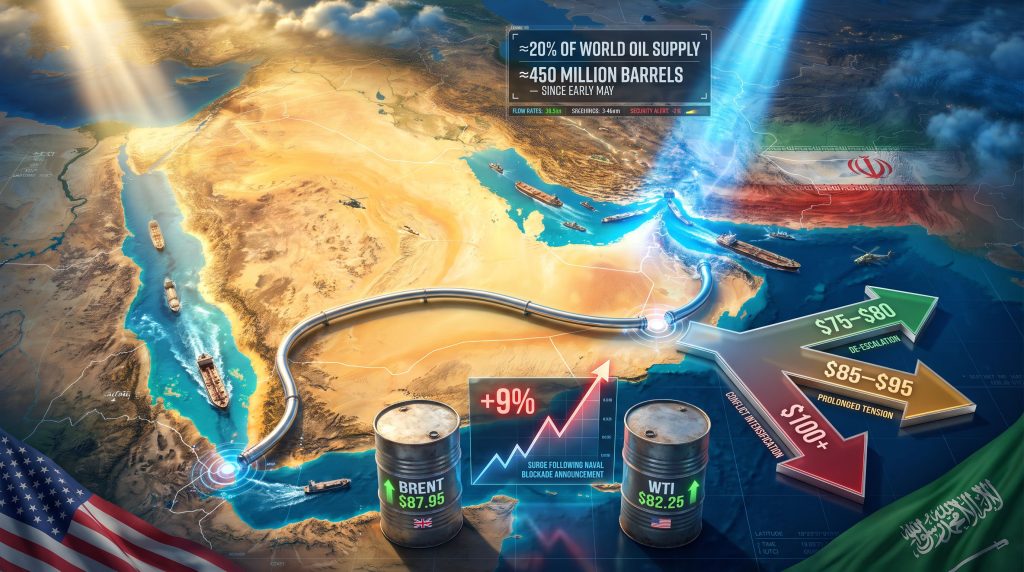
- The Strait of Hormuz, a roughly 21-mile-wide navigable channel between Iran and Oman, through which approximately 20% of the world's entire oil supply passes every day.
- The Bab el-Mandeb Strait, connecting the Red Sea to the Gulf of Aden, which serves as the primary maritime exit point for oil exported from Saudi Arabia's Red Sea coast terminals.
What makes the current situation categorically different from every prior Middle East energy disruption is the simultaneity of the threat. Previous conflicts, including the 1980s Tanker War and the 2019 Abqaiq drone strikes, targeted one node of the system at a time. The current configuration places both nodes under active pressure concurrently, eliminating the redundancy that global markets have historically relied upon.
The Strait of Hormuz: Scale, Vulnerability, and the Logic of Degraded Transit
Volume and Strategic Weight
The raw numbers explain why the Strait of Hormuz commands such disproportionate geopolitical attention:
| Metric | Data Point |
|---|---|
| Share of global oil traffic | ~20% of world supply |
| Commercial vessels transited (since early May 2026) | ~900 vessels |
| Crude oil transited (since early May 2026) | ~450 million barrels |
| Iranian tanker attack location | Strait of Hormuz, early July 2026 |
| U.S. consecutive strike nights completed | 10 |
These figures, reported by U.S. Central Command (CENTCOM), represent the volume of traffic that military operations have facilitated. However, they also reveal an important analytical distinction that markets are still processing: facilitated transit is not the same as normal transit. The friction costs of operating under active military protection, with war risk insurance premiums surging and crew safety conditions deteriorating, accumulate in ways that headline throughput figures do not capture.
The Difference Between Closure and Degradation
Much of the public debate around Hormuz focuses on the dramatic scenario of full closure. In practice, energy market analysts have identified sustained traffic degradation as potentially more damaging over time than an outright blockade, precisely because it creates prolonged uncertainty without triggering the immediate emergency response mechanisms that a full closure would activate.
A degraded transit environment produces cascading economic effects:
- War risk insurance premiums spike, adding cost to every barrel transiting the strait.
- Shipping operators impose route risk surcharges, compressing refinery margins globally.
- Vessel operators begin rerouting via the Cape of Good Hope, adding approximately two weeks of transit time and significant fuel costs per voyage.
- Crew unions and maritime labour organisations begin restricting member participation in high-risk transits.
- Cargo financiers demand enhanced risk documentation, slowing deal execution across the entire supply chain.
Each of these effects compounds the others, creating a cumulative economic drag that far exceeds what simple throughput statistics suggest. Furthermore, the market volatility reset triggered by these conditions is reverberating well beyond energy sectors into bond and equity markets globally.
Energy market analysts have consistently noted that even a partial, sustained reduction in Hormuz traffic produces outsized price volatility, because markets price in forward uncertainty rather than confirmed present-day supply loss. The expectation of disruption can be as economically damaging as disruption itself.
Iran's strategy of attacking commercial tankers, including two UAE-flagged vessels in Omani waters, reflects a deliberate calculation: maximum market and diplomatic pressure without the full international response that a formal strait closure would trigger. According to Reuters, Iran has even signalled to the Houthis that they should close the Red Sea gateway if the U.S. hits its power network — a contingency that underscores the coordinated nature of the threat. An Iranian tanker attack in the early hours of Tuesday, July 22, 2026, forcing the crew to abandon the vessel, demonstrates that this strategy remains active.
U.S. Military Operations: Objectives, Tempo, and the Escalation Paradox
What CENTCOM Is Targeting and Why
U.S. Central Command completed its tenth consecutive evening of airstrikes against Iran on Monday, July 21, 2026. The strikes were explicitly framed around maritime security objectives rather than broader regime-change or nuclear programme goals.
Confirmed CENTCOM strike categories:
- Iranian military command and control infrastructure
- Maritime capability installations and naval assets
- Missile and drone launch facilities
- Air defence systems
The operational logic is specific: by targeting maritime capabilities rather than civilian or nuclear infrastructure, the U.S. aims to degrade Iran's ability to threaten commercial shipping without escalating to a confrontation that would trigger broader regional or international responses.
CENTCOM's metric of success, approximately 900 commercial vessels and 450 million barrels of crude oil transited since early May, reflects this narrow objective. By that measure, the waterway has not been fully closed.
The Escalation Paradox at the Heart of U.S. Strategy
However, the gap between operational claims and market reality exposes a fundamental strategic tension. Oil prices surged more than 9% following the U.S. naval blockade announcement, signalling that markets remain deeply unconvinced about the durability of current transit conditions. Each successive night of U.S. strikes has been met with Iranian retaliatory action, including the early Tuesday tanker attack, creating a cycle where military operations intended to stabilise shipping conditions are simultaneously generating the incidents that destabilise them.
A second escalation trigger compounds this paradox. U.S. Secretary of State Marco Rubio has consistently framed the strikes as a narrowly scoped response to Iranian aggression against commercial shipping. However, President Trump's public directive, communicated via Truth Social, that the United States would make Iran pay many times over for every American soldier killed, introduces an open-ended retaliation commitment that extends well beyond maritime security parameters.
ING strategists Warren Patterson and Ewa Manthey characterised the path to de-escalation as difficult, noting that large divisions remain between Washington and Tehran. Consequently, the American troop casualties issue creates an additional, unpredictable escalation trigger that any ceasefire architecture must account for.
The Houthi Maritime Embargo: A New Front With Specific Infrastructure Consequences
Why the Houthi Declaration Against Saudi Arabia Is Structurally Different
The Houthi movement's declaration of an immediate maritime embargo against Saudi Arabia, announced Monday July 21, 2026, represents a qualitatively different escalation from prior Houthi Red Sea operations. Previous Houthi attacks on commercial shipping targeted vessels broadly associated with Israeli or Western interests. The new embargo specifically targets Saudi Arabian shipping, citing Riyadh's alleged strikes on Sanaa International Airport as justification.
The Saudi-led coalition characterised the embargo declaration as a blatant violation of international law and pledged a forceful response. The geopolitical significance of the Houthi move, however, extends beyond the diplomatic dimension into hard infrastructure vulnerability.
The Bab el-Mandeb as Saudi Arabia's Backup Export Route
| Metric | Data Point |
|---|---|
| Geographic function | Connects Red Sea to Gulf of Aden |
| Saudi oil at risk from Houthi threat | ~2.5 million barrels per day |
| Potential global oil supply impact (full closure) | ~7% of global supply |
| Saudi Petroline (East-West Pipeline) length | ~750 miles |
| Petroline route | Abqaiq (eastern Gulf coast) to Yanbu (Red Sea) |
The timing of the Houthi embargo is what elevates it from a routine escalation to a potential supply shock. With Hormuz traffic severely constrained by the U.S.-Iran conflict, Saudi Arabia's Yanbu terminals on the Red Sea have become one of the few remaining functioning export corridors for Persian Gulf crude. The Bab el-Mandeb Strait is the gateway through which that Red Sea export capacity reaches global markets.
Rystad Energy's senior vice president of geopolitical analysis Jorge León identified precisely this vulnerability, noting that with the Gulf's primary maritime outlet largely closed, global markets had become increasingly dependent on Saudi Arabia's East-West pipeline and Red Sea terminal infrastructure to maintain export flows. León further assessed that approximately 2.5 million barrels per day of Saudi Arabian oil now faces direct exposure to the Houthi embargo threat. This oil market disruption is compounding pre-existing supply chain fragilities that were already under stress before the current escalation began.
Saudi Arabia's Petroline: The Last Export Corridor and Its Limits
Understanding the East-West Pipeline's Role and Vulnerability
The Petroline, formally designated as Saudi Arabia's East-West Crude Oil Pipeline, is a roughly 750-mile infrastructure system connecting Abqaiq in the oil-rich Eastern Province to the port of Yanbu on the Red Sea coast. It was originally designed as a Hormuz bypass route, providing Saudi Arabia with an export pathway that did not depend on Persian Gulf maritime access.
In the current crisis, the Petroline is functioning as intended: as an alternative to Hormuz-dependent export routes. However, the system now faces a second-order threat that its designers did not originally architect against. The pipeline terminates at Red Sea port facilities that are entirely dependent on Bab el-Mandeb access to reach global markets. A Houthi interdiction of Bab el-Mandeb would effectively negate the Petroline's bypass function, converting Saudi Arabia's backup export system into a stranded asset.
Historical precedent adds weight to this concern. The Petroline has been the target of previous attacks, including a 2019 Houthi drone strike that temporarily disrupted operations, demonstrating that the system is not immune to the type of precision strikes that the Houthi movement has demonstrated capacity to execute.
The next major ASX story will hit our subscribers first
Three Scenarios for Dual Chokepoint Disruption
Mapping the Risk Landscape Across Probability Tiers
Scenario A: Partial Disruption (Base Case)
Hormuz traffic continues at reduced capacity under U.S. military protection. The Houthi embargo is declared but only partially enforced, with Saudi tankers experiencing harassment rather than systematic interdiction. Oil prices stabilise in the $90 to $100 per barrel range. Diplomatic pressure from Asian importing nations, particularly China, India, Japan, and South Korea, accelerates ceasefire negotiations. Cape of Good Hope rerouting absorbs partial volume loss at elevated cost.
Scenario B: Extended Dual Disruption (Elevated Risk)
The 10-day ceasefire proposal fails to gain formal acceptance. U.S.-Iran strikes continue through August. Houthi forces begin active interdiction of Saudi tankers in the Red Sea. Saudi Yanbu export capacity falls below operational thresholds. The Petroline continues pumping, but with nowhere viable to ship output from Yanbu. Oil prices breach $100 per barrel. Global inflation pressures re-emerge, complicating central bank policy in Europe, Asia, and North America.
Scenario C: Full Dual Chokepoint Closure (Tail Risk)
Iran escalates to full Hormuz denial following additional American military casualties, triggering Trump's stated retaliation directive. Houthi forces enforce a complete Bab el-Mandeb blockade. Approximately 2.5 million barrels per day of Saudi oil is removed from reachable export markets. Global supply falls by an estimated 7% relative to current consumption. IEA member nations initiate emergency strategic reserve releases. Global recession risk moves from theoretical to operational. Triple-digit oil prices become the base expectation rather than the tail risk.
The 10-Day Ceasefire Proposal: Anatomy of a Fragile Diplomatic Window
What Regional Mediators Are Working With
Regional intermediaries have presented both Washington and Tehran with a proposal for a 10-day ceasefire, structured as a short-horizon confidence-building measure designed to revive the June 2026 Memorandum of Understanding between the two governments. The 10-day timeframe is deliberate: it is short enough to be acceptable as a non-committal pause rather than a formal agreement, while long enough to allow diplomatic channels to re-establish functional communication.
The involvement of regional mediators signals that back-channel diplomacy has not collapsed entirely, a meaningful data point in itself. However, three structural obstacles stand between the current conflict state and meaningful de-escalation:
- Ideological and structural divisions: Deep disagreements between Washington and Tehran persist on nuclear programme parameters, sanctions relief sequencing, and acceptable regional influence boundaries for Iran.
- The American troop casualties trigger: President Trump's public retaliation commitment creates a hair-trigger escalation condition. Any ceasefire that does not account for this variable is structurally fragile, because a single American military death could nullify the entire diplomatic architecture.
- The Houthi autonomy factor: The Houthi movement operates with significant strategic independence. A U.S.-Iran ceasefire agreement does not automatically translate into Houthi de-escalation against Saudi Arabia, meaning the Bab el-Mandeb threat could persist even if Hormuz tensions subside.
The single most important variable in determining which scenario materialises over the next 30 days is whether the 10-day ceasefire proposal gains formal acceptance from both Washington and Tehran, and whether the Houthi movement chooses to honour or exploit that diplomatic window.
How Oil Markets Are Pricing the Risk Right Now
Benchmark Prices and the Signals They Send
| Benchmark | Price | Movement |
|---|---|---|
| Brent Crude (September delivery) | $87.95/barrel | -1.5% (session); previously surpassed $90 |
| WTI (August delivery) | $82.25/barrel | -1.2% (session) |
| Oil price surge post-blockade announcement | +9% | Following U.S. naval blockade declaration |
The intraday price action on July 22 reveals an important market psychology dynamic. Prices rose briefly on the Houthi embargo announcement, then pared gains as the prospect of a ceasefire proposal circulated. This pattern reflects what traders describe as the ceasefire premium: a temporary suppression of prices that would otherwise reflect the full cumulative geopolitical risk embedded in the current situation.
The WTI and Brent futures markets are currently pricing in significant forward uncertainty, with options skew heavily weighted toward upside hedging — a structural signal that institutional energy consumers are not convinced the diplomatic window will hold. The asymmetric risk profile for energy investors is notable. If the ceasefire succeeds and both Hormuz and Bab el-Mandeb threats recede, the downside for oil prices is meaningful but bounded, with prices likely retreating toward the $75 to $80 range. If the dual disruption escalates toward Scenario C, the upside for oil prices has no reliable historical precedent as a ceiling.
Rystad Energy's León explicitly identified the combination of Hormuz closure and Houthi Red Sea disruption as the conditions required for a substantial oil price rebound. The historical analogies available, the 1973 oil embargo, the 1980 Tanker War, and the 2019 Abqaiq strikes, each involved single-node disruptions. The simultaneous dual-chokepoint configuration the market currently faces has no direct historical parallel from which to extrapolate a reliable price ceiling.
Second-Order Consequences: Shipping, Trade, and Asian Import Dependency
Who Else Bears the Cost of Chokepoint Disruption
The consequences of sustained dual chokepoint pressure extend well beyond oil prices. Global shipping insurance markets have already experienced significant war risk premium escalation, and those premiums affect non-energy cargo as much as crude oil tankers. Any vessel transiting waters adjacent to active conflict zones faces elevated insurance costs regardless of what it carries.
The rerouting of global trade via the Cape of Good Hope, already underway in response to prior Houthi Red Sea disruptions beginning in late 2023, adds approximately 10 to 14 days of transit time to voyages between Asia and Europe. That additional transit time translates directly into higher inventory carrying costs, supply chain delays, and inflationary pressure on consumer goods that have no direct connection to energy markets. In addition, the broader geopolitical trade tensions generated by this conflict are accelerating supply chain diversification decisions that will reshape global trade patterns for years to come.
The nations with the most at stake beyond the immediate conflict parties are the large Asian energy importers:
- China, the world's largest crude oil importer, sourcing a substantial share of its supply from Persian Gulf producers.
- India, which has rapidly expanded Persian Gulf crude imports and has limited alternative supply flexibility at short notice.
- Japan and South Korea, which are almost entirely dependent on imported energy and have minimal strategic reserve capacity relative to their consumption levels.
For these nations, the dual chokepoint scenario represents not merely an oil price problem but a genuine energy security emergency that could cascade into broader economic disruption.
Frequently Asked Questions
What Is the Strait of Hormuz and Why Does It Matter for Oil Markets?
The Strait of Hormuz is a narrow maritime passage between Iran and Oman that handles approximately 20% of the world's entire oil supply. It is the primary exit point for crude oil produced by Saudi Arabia, Iraq, Kuwait, the UAE, and Iran itself. Any sustained disruption to traffic through this waterway creates immediate and material consequences for global energy prices and supply security.
What Is the Bab el-Mandeb Strait and Why Is the Houthi Threat Significant?
The Bab el-Mandeb connects the Red Sea to the Gulf of Aden and serves as the maritime exit route for oil shipped from Saudi Arabia's Red Sea coast terminals. Because Hormuz traffic is already severely constrained by the U.S.-Iran conflict, Bab el-Mandeb has become one of Saudi Arabia's last viable export corridors. The Guardian's live coverage of the unfolding crisis illustrates just how rapidly the situation is evolving. A Houthi blockade of this waterway would consequently create a dual chokepoint crisis with no modern historical parallel.
How Much Saudi Arabian Oil Is at Risk From the Houthi Maritime Embargo?
Rystad Energy estimates that approximately 2.5 million barrels per day of Saudi Arabian oil exports are now exposed to the Houthi maritime embargo threat, given current dependence on Red Sea terminals as an alternative to the Hormuz route.
What Has U.S. CENTCOM Done to Protect Commercial Shipping?
CENTCOM conducted ten consecutive nights of airstrikes targeting Iranian military command centres, maritime capabilities, missile and drone launch facilities, and air defence systems. CENTCOM reported facilitating the transit of approximately 900 commercial vessels and 450 million barrels of crude oil through the Strait of Hormuz since early May 2026.
What Is the Proposed 10-Day Ceasefire and What Are Its Prospects?
Regional mediators have presented Washington and Tehran with a proposal for a 10-day ceasefire intended as a confidence-building measure to revive the June 2026 Memorandum of Understanding. ING strategists have characterised the path to agreement as difficult, citing deep structural divisions between the two governments, the American troop casualties retaliation commitment, and the Houthi movement's operational independence from Iranian command authority.
Could Oil Prices Reach Triple Digits If the Conflict Escalates?
Energy market analysts have identified a scenario in which sustained Hormuz disruption combined with active Houthi interdiction of Red Sea shipping could produce a substantial oil price rebound. A full dual chokepoint closure, classified as a tail risk rather than the base case, could theoretically remove sufficient global supply volume to push prices well above $100 per barrel. This scenario has no direct historical precedent. This represents forward-looking analysis and should not be construed as investment advice.
The 30-Day Horizon: Three Pathways for Global Energy Markets
Resolution, Stalemate, and Escalation
- Resolution pathway: The ceasefire proposal gains formal acceptance. Houthi forces stand down their Saudi embargo under diplomatic pressure from regional actors. Oil prices retreat toward the $75 to $80 range as the accumulated geopolitical risk premium deflates. Shipping insurance markets normalise over a 60 to 90-day period.
- Stalemate pathway: Intermittent strikes continue at reduced tempo. The Houthi embargo is partially enforced with occasional incidents but no systematic interdiction campaign. Diplomatic talks continue without resolution. Oil prices remain elevated in the $85 to $95 range with high directional volatility, making hedging expensive and supply planning difficult for importers.
- Escalation pathway: Additional American military casualties trigger the retaliation directive publicly committed to by President Trump. The U.S.-Iran conflict widens beyond maritime containment objectives. Houthi forces enforce a full Bab el-Mandeb blockade. Oil prices breach $100 per barrel and global energy security frameworks face stress-testing at a scale not seen since the 1970s oil shocks.
The variables that will determine which of these pathways materialises are not primarily military. They are diplomatic, psychological, and political: whether Washington and Tehran can find enough common ground to accept a 10-day pause, whether the Houthi movement calculates that its interests are better served by restraint or escalation, and whether a single triggering event, another American soldier killed, another tanker attacked, another airport bombed, tips the entire system toward the escalation scenario before diplomacy can establish a foothold.
U.S. strikes Iran and Houthi threat to Saudi Arabia shipping ultimately represent a convergence of military, geopolitical, and energy market pressures that have no clean historical template. The 30-day window ahead is, in every meaningful sense, uncharted territory for global energy security.
This article contains forward-looking analysis, scenario modelling, and market projections. These represent analytical assessments based on publicly available information and should not be interpreted as investment advice or financial recommendations. Energy markets are subject to rapid change, and outcomes may differ materially from scenarios described.
Want to Stay Ahead of the Mineral Discoveries That Could Reshape Investment Portfolios?
While geopolitical disruptions reshape global energy markets, commodity-driven volatility creates powerful opportunities across the ASX mining and exploration sector — and Discovery Alert's proprietary Discovery IQ model delivers real-time alerts the moment significant mineral discoveries are announced, ensuring subscribers can act before the broader market reacts. Explore historic discoveries and their extraordinary returns, then begin your 14-day free trial at Discovery Alert to position yourself ahead of the next major find.