July 21, 2026
The Hidden Architecture of China's Wartime Fuel Controls
When major crude transit routes face disruption, the nations most exposed are rarely those making headlines. China, which processes and re-exports refined petroleum products at a scale that quietly underpins energy availability across Asia-Pacific, sits at a structural crossroads that most market participants underestimate. The mechanics of China fuel export restrictions amid Iran war pressures reveal far more about modern energy geopolitics than any single policy announcement.
The outbreak of the US-Israeli war on Iran in early 2026 set in motion a chain of supply-side decisions in Beijing that have since reshaped refined product flows across the region. Understanding the architecture of those decisions, and how they may evolve, matters enormously for traders, importers, and analysts watching Asian energy markets.
When big ASX news breaks, our subscribers know first
Why China's Role in Refined Fuel Supply Is Routinely Underestimated
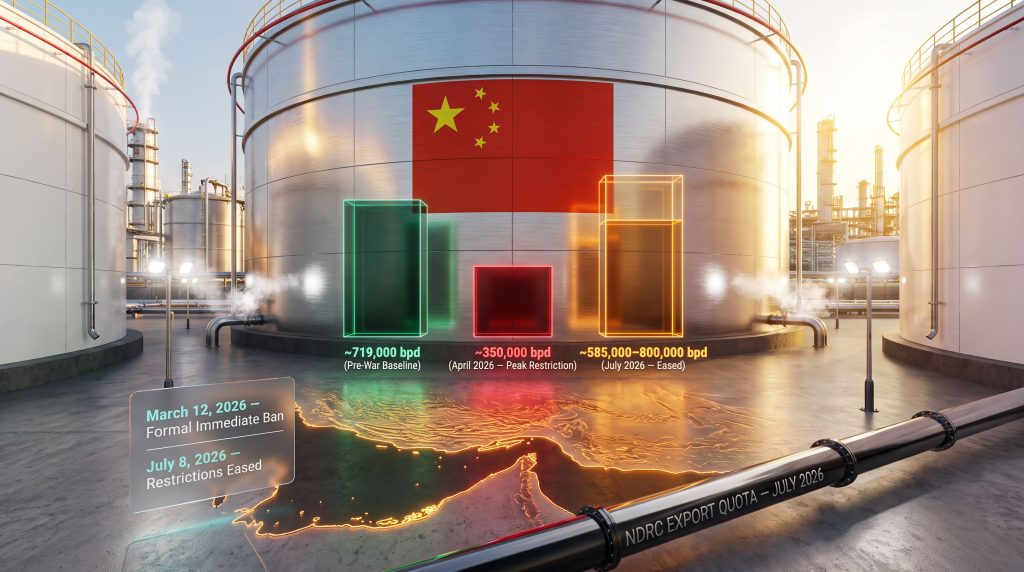
Most analysis of global oil markets focuses on crude production and OPEC+ quota adjustments. Far less attention falls on the refined product layer, where China has quietly become a significant swing supplier for Asian neighbours. Prior to the 2026 disruptions, China was exporting approximately 719,000 barrels per day (bpd) of refined fuels including petrol, diesel, and jet fuel, providing meaningful supply coverage for markets from the Philippines to Pakistan.
This export volume was not incidental. China's large-scale refining infrastructure, combined with relatively modest domestic consumption growth in certain fuel categories, created consistent export surpluses that regional importers came to rely upon. The assumption that this supply was stable proved fragile the moment Beijing's own crude import supply chains came under threat. Furthermore, China commodity demand trends had already been reshaping regional supply dynamics well before the conflict began.
How Domestic Energy Security Doctrine Shapes Export Decisions
China's energy governance is structured around a foundational principle: domestic consumption security takes precedence over commercial export activity. This is not simply policy rhetoric. It is operationalised through the dual-agency oversight of the National Development and Reform Commission (NDRC) and the Ministry of Commerce, which jointly regulate refined oil export authorisations.
Since Q2 2026, this dual-agency framework has operated under significantly elevated scrutiny. Compliance requirements are now formally attached to every export authorisation issued, representing a structural departure from the lighter-touch administrative approach that governed refined product exports before the Iran war began. The result is a system where commercial refining decisions are subordinated to national reserve management priorities in real time.
A Chronology of Restriction, Collapse, and Cautious Recovery
The speed at which China's fuel export volumes compressed after March 2026 illustrates how quickly Beijing can activate its domestic-first doctrine when supply security is threatened. According to reporting from Energy Connects, the sequence of policy actions unfolded as follows:
| Date | Policy Action | Scope |
|---|---|---|
| March 5, 2026 | Informal directive to halt new export contracts | Gasoline, diesel, non-mandatory |
| March 12, 2026 | NDRC issues formal immediate ban | Petrol, diesel, aviation fuel for uncustoms-cleared cargoes |
| April 2026 | Export volumes fall to 350,000 bpd | Lowest level in nearly five years |
| May 2026 | Partial recovery to approximately 417,000 bpd | Roughly half of pre-war baseline |
| July 8, 2026 | Restrictions eased; private refiners partially re-authorised | Diesel, jet fuel, gasoline |
The informal directive in early March was notable precisely because Beijing did not formally acknowledge the restrictions at the time. The policy was operational before it was documented, a characteristic of Chinese energy governance during acute supply stress events.
Critically, two categories were carved out from the original March ban: international aviation bunkering fuel and fuel supplies designated for Hong Kong and Macau. These exclusions were not arbitrary. They reflect the political and logistical realities of maintaining civil aviation functionality and cross-border obligations during periods of domestic supply tightening.
The Iranian Supply Gap and the Russian Pivot
At the core of Beijing's caution lies a crude import crisis of significant scale. China's oil imports from Iran fell by an estimated 1 to 1.4 million barrels per day following the outbreak of hostilities, a supply gap that cannot be absorbed quietly. These developments are closely connected to broader geopolitical trade disruptions that have been reshaping energy flows across multiple regions simultaneously.
China's accelerated pivot toward Russian crude to compensate for lost Iranian volumes introduces new structural dependencies that extend well beyond the current conflict timeline.
Russia has become the structural substitute supplier, but this transition carries its own risks. Greater dependency on a single alternative crude source concentrates geopolitical exposure rather than dispersing it. Simultaneously, Chinese refiners have been drawing down commercial stockpiles to bridge the gap, a process that is sustainable in the short term but creates inventory fragility if the conflict extends into late 2026.
The drawdown of commercial reserves is precisely why the July 2026 easing of export restrictions came with a non-negotiable condition: domestic inventory levels must remain above the benchmarks recorded at the end of February 2026. This floor is not a guideline. It functions as a hard operational boundary within the current compliance framework.
What the July 2026 Easing Actually Means
The resumption of fuel exports in July 2026 has been widely characterised as a relaxation of restrictions. That framing requires qualification. What Beijing authorised was a conditional, monitored resumption, not a return to pre-war export normalcy.
| Metric | Pre-War Baseline | April 2026 Peak Restriction | July 2026 Eased Regime |
|---|---|---|---|
| Export Volume | ~719,000 bpd | ~350,000 bpd | Est. 585,000 to 800,000 bpd |
| Monthly Volume Target | Unrestricted | Collapsed | ~3 million metric tons |
| Volume vs. Pre-War | 100% | ~49% | ~81% to 111% |
Export allocations issued in July went predominantly to state-owned domestic refiners, with at least one private refiner granted limited authorisation. The preference for state-owned entities reflects Beijing's need for direct administrative control over compliance with inventory floor conditions. Private teapot refineries, which operate with greater commercial flexibility, carry higher policy execution risk in this environment.
The collapse of the interim truce between Washington and Tehran has reinforced Beijing's cautious posture. The easing is explicitly contingent on supply conditions remaining stable enough to prevent further drawdowns of domestic reserves below February benchmarks. In addition, the US-China trade war impacts continue to create layered complexity for Beijing's export policy decisions.
Three Scenarios for August 2026 and Beyond
Whether China maintains, tightens, or expands its export authorisations in the coming weeks depends on a set of observable triggers that energy market participants should track closely.
Scenario 1: Sustained Ceasefire and Gradual Normalisation
- The Strait of Hormuz returns to full commercial transit capacity
- Iranian crude flows to China begin recovering toward pre-war levels
- Beijing maintains the current quota framework but progressively raises monthly allocations
- Exports trend back toward or above the 719,000 bpd pre-war baseline
Scenario 2: Renewed Gulf Conflict with Partial Reimposition
- Hostilities resume in the Gulf and Hormuz disruptions persist intermittently
- NDRC tightens export quotas in response to inventory floor pressure
- Private refiner authorisations are suspended as a precautionary measure
- Exports fall back toward the 400,000 to 450,000 bpd range
Scenario 3: Full Escalation and Export Suspension
- A major Hormuz closure or direct regional escalation triggers an acute supply shock
- Beijing reimposing the March-style formal ban on refined product exports
- Global refined product prices spike sharply across Asian import markets
- Southeast Asian economies reliant on Chinese diesel and jet fuel face acute shortages
Key Indicators to Watch
- Weekly Chinese commercial crude inventory data relative to February 2026 benchmarks
- NDRC monthly export quota announcements and refiner allocation disclosures
- Strait of Hormuz transit volume reports from shipping intelligence providers
- Russian crude delivery volumes to Chinese ports as a proxy for import diversification progress
The next major ASX story will hit our subscribers first
How China's Approach Compares to Other Major Refining Nations
China's fuel export management strategy during the Iran war is not without precedent elsewhere, but its scale and administrative sophistication distinguish it from comparable measures in other refining nations. Moreover, oil trade geopolitics have increasingly influenced how governments across the globe are rethinking domestic energy security priorities.
| Country | Export Policy Stance (2026) | Primary Driver | Market Impact |
|---|---|---|---|
| China | Conditional quotas with inventory floors | Domestic security and war risk | Reduced Asian supply availability |
| India | Selective restrictions on diesel | Domestic inflation management | Regional price volatility |
| Russia | Periodic export bans on petrol | Internal supply management | Limited global impact |
| Saudi Arabia | Maintained export volumes | Revenue maximisation | Partial offset to Asian shortfalls |
Saudi Arabia's decision to maintain export volumes has provided some buffer for Asian importers, however it cannot fully substitute for Chinese refined product volumes given product-type mismatches and logistical routing differences. Saudi Arabia primarily exports crude, not finished refined products, meaning the displacement effect on Asian diesel and jet fuel markets is only partial. OPEC's market influence remains a significant factor in how these supply gaps are ultimately managed at the global level.
The Structural Legacy of the Iran War on China's Export Framework
Beyond the immediate supply dynamics, the Iran war has triggered something more consequential: the formal transformation of China's refined product export framework from a commercially driven activity into an instrument of national energy security management.
This shift has long-term implications for how Asian importers approach supply diversification. Economies that built procurement strategies around consistent Chinese refined product availability now face a structural risk premium that did not exist at the same scale before 2026. Investment in alternative refining capacity across Southeast Asia and the Middle East is likely to accelerate as a result.
As Reuters analysis highlights, the weaponisation of refined product export controls as a geopolitical instrument is no longer a theoretical risk scenario. It is an operational reality that regional energy planners must now price into long-term supply strategies.
For energy market participants, the China fuel export restrictions amid Iran war dynamics represent a fundamentally new baseline for Asian refined product risk assessment. The question is no longer whether Beijing will use export controls as a domestic buffer mechanism. It is how frequently, how deeply, and under what trigger conditions it will do so going forward.
Frequently Asked Questions
What triggered China's fuel export restrictions in 2026?
The outbreak of the US-Israeli war on Iran in March 2026 threatened the Strait of Hormuz, a critical transit route for a substantial portion of China's crude oil imports. Beijing responded with informal guidance followed by formal export restrictions to protect domestic fuel reserves.
Has China fully lifted its fuel export ban?
No. As of July 2026, Beijing has eased rather than eliminated restrictions. Refiners must operate within allocated export quotas while maintaining domestic inventory above end-February 2026 benchmarks.
Which fuel types are covered by China's export restrictions?
Petrol, diesel, and seaborne jet fuel are covered. International aviation bunkering fuel and supplies for Hong Kong and Macau were explicitly excluded from the original March 2026 ban.
How far did China's fuel exports fall during the restriction period?
From approximately 719,000 bpd pre-war to around 350,000 bpd in April 2026, the lowest level recorded in nearly five years.
How has the Iran war affected China's crude oil imports?
Imports from Iran fell by an estimated 1 to 1.4 million barrels per day, forcing an accelerated shift toward Russian crude and drawdowns from commercial stockpile reserves.
Disclaimer: This article contains forward-looking scenarios and market analysis based on publicly available information as of July 2026. Energy policy conditions and geopolitical developments can change rapidly. Nothing in this article constitutes financial or investment advice.
Want to Track the ASX Stocks Most Exposed to Shifting Energy and Commodity Flows?
Discovery Alert's proprietary Discovery IQ model delivers real-time alerts on significant ASX mineral discoveries, instantly translating complex commodity data into actionable investment insights — precisely the kind of edge that matters when geopolitical disruptions are reshaping global supply chains. Explore historic discoveries and their market returns on Discovery Alert's dedicated discoveries page, or begin your 14-day free trial today to position yourself ahead of the next major market move.