July 21, 2026
The World's Most Dangerous Shipping Lane Is Getting More Dangerous
Few mechanisms in the global economy carry more concentrated risk than a narrow stretch of water measuring just 21 miles at its tightest point. The Strait of Hormuz has long functioned as the jugular vein of global energy supply, but the events of 2026 have transformed it from a theoretical vulnerability into an active crisis with measurable, accelerating consequences for oil prices, Asian economies, and geopolitical stability alike.
Understanding why the Iran war Strait of Hormuz oil prices relationship is so explosive requires examining not just the conflict itself, but the structural architecture of global energy dependency that makes this waterway so irreplaceable.
When big ASX news breaks, our subscribers know first
Why Hormuz Cannot Simply Be Replaced
The Arithmetic of 20.3 Million Barrels
The scale of energy flow through the Strait of Hormuz defies easy comprehension. According to the U.S. Energy Information Administration, approximately 20.3 million barrels of petroleum and crude oil transit the strait daily, representing roughly 25% of all seaborne oil trade on the planet. To put that in context, no other single infrastructure point, pipeline network, or maritime corridor concentrates this much of the world's energy supply into such a geographically constrained passage.
The destination profile of those barrels compounds the strategic sensitivity further. Nearly 90% of Hormuz oil exports flow eastward toward Asian markets, with China and India absorbing the dominant share. This geographic orientation means disruption at Hormuz does not affect all economies equally. It lands hardest on the world's most populous nations, which also happen to be its fastest-growing energy consumers.
The Chokepoint Vulnerability Index: A Comparative View
| Chokepoint | Daily Oil Volume | Bypass Availability | Disruption Risk Rating |
|---|---|---|---|
| Strait of Hormuz | ~20.3M bbl/day | Limited (Saudi pipeline) | Critical |
| Strait of Malacca | ~16M bbl/day | Minimal | High |
| Bab el-Mandeb | ~6-7M bbl/day | Partial (Suez alternative) | High |
| Suez Canal | ~5.5M bbl/day | Cape of Good Hope | Moderate |
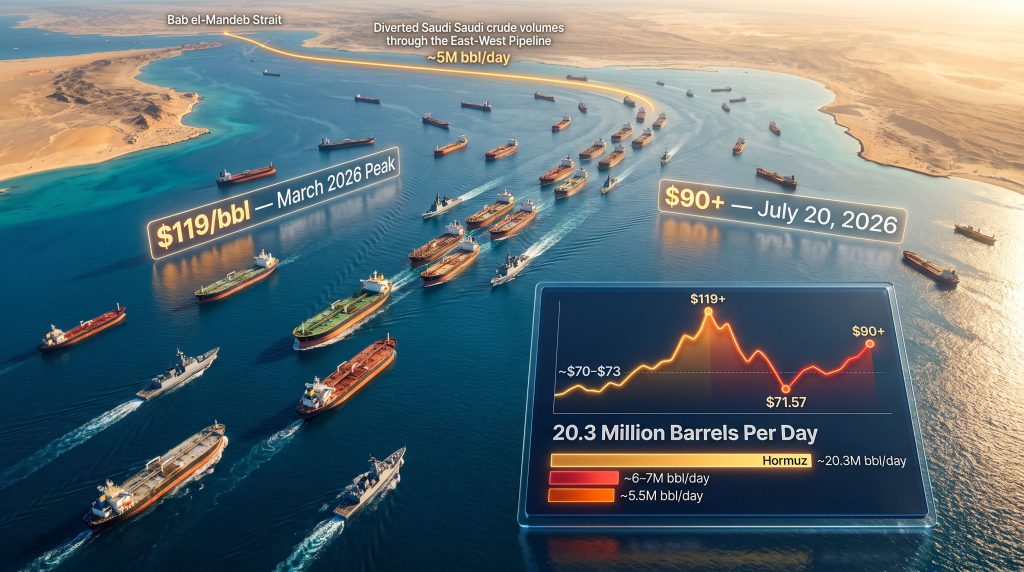
Unlike the Suez Canal, where vessels can reroute around the Cape of Good Hope at the cost of additional voyage time, Hormuz has no functional bypass capable of absorbing its full daily volume. Saudi Arabia's East-West Pipeline connects Gulf production to a Red Sea export terminal, but its maximum throughput of approximately 5 million barrels per day falls well short of replacing total strait capacity. That gap is not a temporary engineering limitation. It is a structural feature of Middle Eastern energy infrastructure that has existed for decades without resolution.
How the 2026 Conflict Has Transformed the Risk Landscape
From Theoretical Vulnerability to Active Crisis
The hostilities that began in early 2026 converted what energy analysts had long modelled as a tail risk into a lived market reality. When U.S. and Israeli forces struck Iran on February 28, 2026, the cascade of consequences through global oil markets was both rapid and severe. Reporting from The Guardian confirmed the immediate and dramatic market response to those initial strikes.
The price trajectory tells the story with brutal clarity:
| Period | Brent Crude Price | Key Catalyst |
|---|---|---|
| Pre-conflict baseline | ~$70-$73/barrel | Stable Hormuz transit |
| March 2026 peak | $119+/barrel | Effective strait closure |
| June 2026 ceasefire dip | $71.57/barrel | Ceasefire reopens transit |
| July 20, 2026 | Above $90/barrel | Hostilities resume; tanker strikes |
| Near-term analyst range | Upper $70s-$90s | Persistent geopolitical uncertainty |
The March 2026 spike above $119 per barrel accompanied an effective closure of the strait, with initial supply losses estimated at 4.5 to 5 million barrels per day. That figure alone represented roughly 5% of total global oil supply, a disruption level that historically triggers coordinated emergency responses from International Energy Agency member nations.
The Ceasefire Window Was Too Narrow to Matter
A critical and underappreciated dynamic from the June 2026 ceasefire period is that the price relief it generated did not translate into meaningful inventory rebuilding. When Brent fell back to $71.57 per barrel following the ceasefire declaration, market participants may have interpreted this as a signal that supply security had been restored. In reality, the window was too brief to replenish the petroleum inventory buffers that had been drawn down during the conflict's first phase.
Amrita Sen, founder and director of market intelligence at Energy Aspects, noted in commentary to CNBC that with inventory buffers heavily depleted, sustained disruption into August 2026 could force Gulf production lower and push crude prices back into triple-digit territory. This inventory depletion dynamic is arguably more consequential than the headline price moves themselves. It means the market enters any renewed disruption phase with reduced shock-absorption capacity, amplifying the price impact of each incremental escalation.
The Current Operational Picture: July 2026
Traffic Collapse in Real Numbers
The scale of shipping disruption since the resumption of hostilities is striking. Data from trade intelligence firm Kpler indicates that just 30 ships transited the Strait of Hormuz over the weekend following the ceasefire breakdown. Before hostilities began, the strait handled more than 100 ship transits daily.
Compounding the visibility problem, analysts at Lloyd's noted that vessels transiting the strait have increasingly been doing so with their Automatic Identification System (AIS) transponders switched off. This blackout behaviour, while understandable from a vessel security perspective, creates significant complications for downstream supply chain management. Refiners and commodity traders depend on real-time cargo tracking to plan intake schedules, and transponder blackouts introduce uncertainty that the market prices as additional risk.
The Trump administration has maintained that the strait remains open, stating that millions of barrels continue to flow daily under U.S. naval protection. The gap between the administration's characterisation and the Kpler ship count data illustrates the complexity of assessing operational reality during an active conflict. As CBS News reported, the question of whether the Strait of Hormuz is genuinely open remains deeply contested, with the Iran war Strait of Hormuz oil prices dynamic continuing to drive significant market volatility.
Iran's Retained Asymmetric Capability
One of the more strategically significant realities of the 2026 conflict is that sustained U.S. military operations have not eliminated Iran's capacity to threaten commercial shipping. U.S. Central Command has conducted 10 consecutive nights of strikes against Iranian targets since the ceasefire was declared finished, with the stated objective of degrading capabilities used to attack vessels in the Strait of Hormuz.
Despite this campaign, Iran has continued to launch missiles and drone attacks against U.S. assets and the bases of allied nations, with Iranian strikes killing an additional three U.S. servicemen as of mid-July 2026. A vessel operated by Greek shipping firm Dynacom was reportedly struck by an unknown projectile inside the strait, catching fire, demonstrating that interdiction capabilities remain operational.
Senior geopolitical analysts have described Iran's Hormuz leverage as functioning somewhat like a pressure valve that can be adjusted up or down to calibrate economic pain on adversaries without requiring direct conventional military engagement. This asymmetric architecture means that air strikes, however sustained, may degrade but are unlikely to fully eliminate Iran's ability to threaten transit.
The Dual-Chokepoint Risk: Why Bab el-Mandeb Changes Everything
Saudi Arabia's Relief Valve Is Now Under Direct Threat
Since Hormuz disruption began, Saudi Arabia has been redirecting crude exports through the East-West Pipeline to an export terminal on the Red Sea coast. This routing has functioned as the global oil market's primary pressure release mechanism during the conflict, helping to partially offset supply losses and moderate price spikes.
That relief mechanism is now directly threatened. In late July 2026, Houthi militants declared a maritime embargo against Saudi Arabia, targeting the Red Sea export route that Riyadh has been using to bypass Hormuz. The Houthis have repeatedly threatened to close the Bab el-Mandeb Strait, the narrow passage connecting the Red Sea to the Gulf of Aden through which Saudi Red Sea exports must pass to reach global markets.
The consequence matrix here is stark:
| Pipeline Route | Capacity | Current Status |
|---|---|---|
| Saudi East-West Pipeline (Petroline) | ~5 million bbl/day | Active, routing oil to Red Sea terminal |
| Bab el-Mandeb transit (Red Sea exit) | ~6-7M bbl/day total corridor | Under active Houthi threat |
| Net relief capacity if Bab el-Mandeb closes | ~0 effective bypass | Critical scenario |
Analytical Warning: A simultaneous closure of both Hormuz and Bab el-Mandeb would not merely compound disruption linearly. It would eliminate the market's primary and secondary routing options simultaneously, creating a supply shock with no adequate offset mechanism currently available in global energy infrastructure.
Senior geopolitical analysts have described this dual-closure scenario as potentially catastrophic for the global economy, a characterisation that reflects not hyperbole but a sober assessment of what the absence of workable alternative routing would mean for Asian refiners operating on 30 to 60-day crude inventory cycles.
The Diplomatic Off-Ramp: Three Unpalatable Options
Why Resolution Remains Elusive
Qatar and Pakistan have jointly proposed a 10-day ceasefire framework as of late July 2026, offering a potential pause in hostilities. Washington is simultaneously preparing contingency plans for diplomatic failure, and Israel has been reported to be readying for a possible expansion into a full-scale coordinated military campaign within days.
The structural challenge facing any diplomatic effort is that all three available U.S. strategic options carry significant costs:
-
Attrition Endurance – Accept continued Iranian harassment of commercial shipping without major escalation, accepting prolonged market disruption and the political cost of appearing unable to protect allied maritime interests.
-
Escalation Dominance – Expand military operations to the point where Iranian interdiction capability is genuinely neutralised, accepting the risk of broader regional conflict, coalition fracture, and potentially uncontrollable escalation dynamics.
-
Concession Diplomacy – Offer Iran terms that provide a face-saving exit, potentially at the cost of undermining broader deterrence credibility and signalling that sustained pressure can extract political concessions from Washington.
None of these options resolves cleanly, which is precisely why the situation has been characterised by analysts as a contained but widening escalatory cycle with no obvious exit pathway.
The next major ASX story will hit our subscribers first
The Asian Exposure Problem: Who Bears the Most Risk
Disproportionate Dependency on Hormuz-Routed Crude
The geographic concentration of Hormuz oil exports creates a deeply asymmetric risk distribution across the global economy. While Western economies face higher energy costs and inflationary pressure from any supply disruption, Asian economies face something qualitatively more serious: the potential for physical supply shortfalls rather than merely price-driven demand destruction.
-
India imports approximately 85% of its total crude requirements. For New Delhi, sustained Hormuz disruption is not an abstract commodity market event but a direct threat to refinery operations and downstream economic activity.
-
China, as the world's largest crude importer, has built substantial strategic reserve capacity, but those reserves were partially drawn down during the conflict's first phase, reducing available buffer.
-
South Korea and Japan, with negligible domestic production, face refinery input shortages if disruption extends beyond 30 to 60 days, a timeline now well within the range of plausible scenarios.
Strategic Petroleum Reserve releases by IEA member nations represent the primary short-term buffer mechanism, but the inventory drawdown during the first conflict phase has materially reduced the firepower available for any coordinated emergency response.
Macro-Economic Transmission: Beyond the Oil Price
How Energy Shocks Spread Through the Broader Economy
Oil price spikes into the $90 to $100+ per barrel range do not remain contained within energy markets. The transmission channels through the broader economy are well-documented and operate with a lag of weeks to months:
- Transportation costs rise across all freight modes, lifting the landed cost of virtually every traded good.
- Agricultural input costs increase as fertiliser and machinery fuel prices climb.
- Manufacturing margins compress as energy-intensive production becomes more costly.
- Consumer goods inflation follows as cost pressures accumulate through supply chains.
For central banks already navigating the aftermath of the 2022-2024 inflationary cycle, an energy-driven price shock creates a genuine policy dilemma. Tightening monetary policy to contain inflation risks choking growth in economies still operating below potential. Holding rates risks allowing energy-driven inflation to become entrenched in consumer expectations.
Emerging market economies face a compounded version of this challenge. Those with dollar-denominated energy import bills confront both higher commodity prices and potential currency depreciation as capital flows toward perceived safe-haven assets during periods of geopolitical stress.
War Risk Insurance and the Hidden Cost of Uncertainty
Beyond the commodity price itself, the conflict has generated significant costs that do not appear directly in crude price charts. War risk insurance premiums for vessels transiting Hormuz have surged sharply since hostilities resumed, adding per-voyage cost burdens that are ultimately passed through to refiners and end consumers.
The AIS transponder blackout phenomenon creates an additional layer of cost and complexity. Vessels navigating without tracking create cargo visibility gaps that force commodity traders and refiners to maintain larger precautionary inventory buffers, tying up capital and reducing operational flexibility precisely when supply uncertainty is highest.
Rerouting around the Arabian Peninsula, should shipping lanes become fully untenable, adds approximately 10 to 15 days to typical voyage times. Even without a complete closure, this routing elongation effectively reduces available tanker capacity in the market, since the same fleet of vessels can complete fewer voyages per quarter. The implication is that physical supply shortfalls can emerge even when crude is technically being produced, simply because the logistics capacity to deliver it has been compressed.
Frequently Asked Questions: Hormuz, Iran, and Global Oil Markets
What is driving oil prices higher in July 2026?
The primary driver is the resumption of active hostilities between the U.S.-led coalition and Iran, which has triggered a sharp reduction in Strait of Hormuz tanker traffic. With only 30 ships transiting over a recent weekend versus more than 100 daily before the conflict, supply concerns have pushed Brent crude above $90 per barrel for the first time in over a month. Depleted global inventory buffers mean the market has limited capacity to absorb further disruption.
Why can't the market simply route around the Strait of Hormuz?
Saudi Arabia's East-West Pipeline provides a partial bypass, but its capacity of roughly 5 million barrels per day represents only a fraction of the approximately 20.3 million barrels that typically transit Hormuz daily. Furthermore, that pipeline routes oil to a Red Sea terminal that must exit via the Bab el-Mandeb Strait, which is itself now under active threat from Houthi militant action. There is currently no scalable alternative route capable of absorbing full Hormuz displacement.
What would a simultaneous Hormuz and Bab el-Mandeb closure mean for prices?
This dual-closure scenario would remove both the primary and secondary export pathways for Persian Gulf oil simultaneously. Analyst assessments suggest this scenario would push prices well above $100 per barrel and potentially into territory without historical precedent in modern energy markets, as the market would face both physical supply shortfalls and the absence of any viable relief valve. The Iran war Strait of Hormuz oil prices feedback loop in this scenario would be unlike anything previously modelled.
How are Asian economies most at risk?
With approximately 90% of Hormuz exports directed at Asian markets, nations including India, China, South Korea, and Japan face disproportionate exposure. India, which imports roughly 85% of its crude requirements, faces the most acute vulnerability to physical supply shortfalls rather than merely higher prices. South Korea and Japan, with minimal domestic production, could face refinery operational constraints within 30 to 60 days of sustained disruption.
Key Risk Factors Investors and Analysts Should Monitor
-
Bab el-Mandeb transit data: Any confirmed Houthi action to physically obstruct Red Sea shipping would eliminate the market's last functional relief valve
-
AIS transponder activity: Rising transponder blackout rates signal escalating risk perception among vessel operators and presage insurance premium spikes
-
IEA emergency meeting indicators: A coordinated SPR release announcement would confirm that supply stress has reached threshold levels
-
Diplomatic channel signals: Qatar and Pakistan's proposed 10-day ceasefire framework represents the most plausible near-term de-escalation pathway
-
Israeli operational signals: Reporting suggests Israel may be preparing for a significant expansion of military operations, which would represent a qualitative escalation beyond the current framework
-
Crude inventory reports: Weekly EIA and IEA inventory data will indicate how rapidly remaining buffer capacity is being consumed
Disclaimer: This article contains forward-looking assessments, scenario projections, and analyst commentary that reflect conditions as understood at the time of writing. Oil markets are subject to rapid change based on geopolitical developments, military actions, and diplomatic outcomes. Nothing in this article constitutes financial or investment advice. Readers should conduct their own research and consult qualified advisors before making investment decisions.
Want to Stay Ahead of the Resource Opportunities Emerging From Global Energy Volatility?
Geopolitical shocks like the Strait of Hormuz crisis ripple directly into commodity markets and ASX-listed resource stocks — and Discovery Alert's proprietary Discovery IQ model delivers real-time alerts the moment significant mineral discoveries hit the ASX, transforming complex market signals into actionable opportunities for traders and investors alike. Explore how major discoveries have historically generated exceptional returns on Discovery Alert's dedicated discoveries page, and begin your 14-day free trial today to ensure you're positioned ahead of the market.