
July 29, 2026
When Mega-Deals Meet Geopolitical Reality: The Architecture of Modern Mining M&A Failure
Cross-border mining acquisitions have always carried a unique set of execution risks that pure domestic transactions do not. When sovereign interests, capital controls, foreign investment screening regimes, and commodity nationalism converge around a single transaction, even the most commercially compelling deals can quietly unravel at the regulatory checkpoint. The Allied Gold sale to Zijin collapses as a case study in exactly this dynamic, and it carries implications that extend far beyond the two companies involved. Furthermore, understanding this outcome requires examining both the structure of what was originally proposed and why it ultimately failed.
When big ASX news breaks, our subscribers know first
Understanding the Scale of What Was Originally Proposed
When Zijin Gold, the international acquisition arm of China's Zijin Mining Group, announced its intention to acquire Allied Gold in January 2026, the deal immediately registered as one of the most significant cross-border gold transactions attempted in recent memory. Zijin's geopolitical expansion ambitions were central to this deal, reflecting a broader pattern of resource-sector outreach that has defined the company's strategy in recent years.
The terms were straightforward and richly priced:
- Transaction price: C$44.00 per share, all-cash
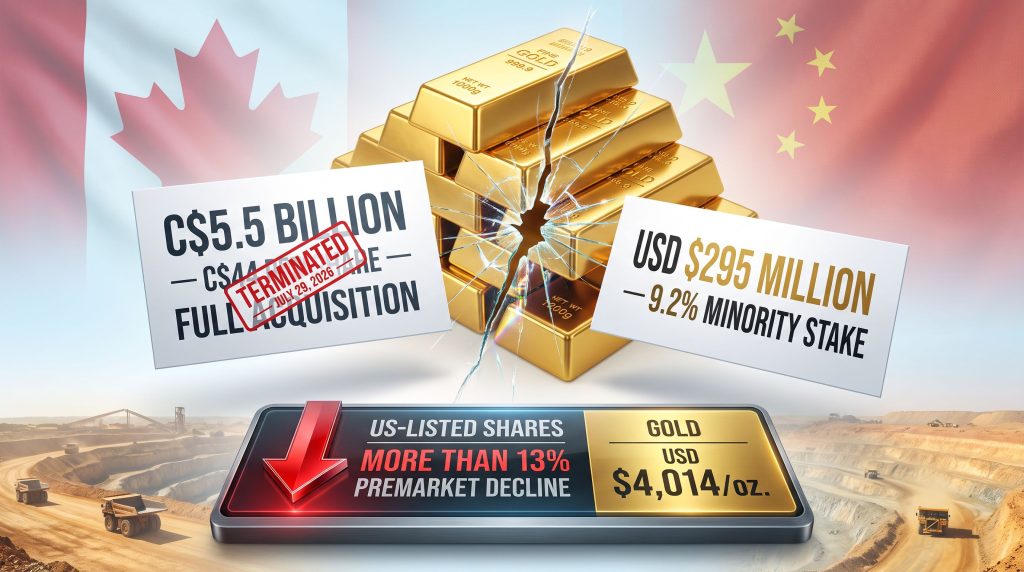
- Implied equity value: approximately C$5.5 billion (roughly USD $3.90 billion)
- Transaction structure: 100% acquisition, full change of control
- Target: Allied Gold, a Canadian-listed gold producer with core African operations including the Sadiola mine in Mali
Zijin Mining Group is one of the world's largest gold and copper producers by output volume, with a long track record of acquiring international assets. The Allied Gold acquisition announcement would have been transformative, adding a significant African gold production base to Zijin's existing portfolio of global mines.
For Allied Gold shareholders, the C$44 offer represented a substantial premium over the stock's pre-announcement trading levels, which is typical for full change-of-control transactions. Once such a premium is officially on the table, the market tends to price shares close to the acquisition price, effectively treating the stock as a synthetic cash instrument rather than an equity position.
This repricing dynamic is a critical and often underappreciated risk in deal-priced stocks. Investors holding Allied Gold at or near C$44 were not holding a gold company. They were holding a binary bet on regulatory clearance, and that bet failed to pay off.
Why the Allied Gold Sale to Zijin Collapses: The Regulatory Mechanism
The formal termination of the Allied Gold sale to Zijin was reported on July 29, 2026. Both companies agreed not to extend the contractual outside date, which had been set as the final deadline by which all closing conditions needed to be satisfied.
The language used in the termination announcement was precise: the parties concluded there was no reasonable likelihood that the remaining conditions could be met within any reasonable additional timeframe. This is legally significant phrasing. It does not allege breach by either party. It describes a shared recognition of factual impossibility.
What Closing Conditions Remained Unsatisfied?
In large cross-border mining transactions, the closing condition matrix typically includes several categories of approval:
| Condition Type | Description | Status in Allied-Zijin Deal |
|---|---|---|
| Target shareholder vote | Allied Gold shareholders approve the transaction | Likely satisfied |
| Chinese regulatory clearance | MOFCOM and related approvals from Chinese authorities | Not satisfied by deadline |
| Foreign investment screening | Investment Canada Act review | Status not publicly confirmed |
| Stock exchange compliance | TSX and NYSE listing requirements | Pending revised structure |
| Material adverse change clause | No significant deterioration in asset quality or financials | Not triggered |
The outstanding Chinese regulatory approvals were identified as the primary obstacle. This reflects a well-documented pattern in Chinese outbound M&A: while the acquirer may be highly motivated, Chinese government approval processes for large-scale outbound capital deployment can be lengthy, opaque, and subject to broader macroeconomic and political considerations that have nothing to do with the merits of the individual transaction. In addition, the geopolitical mining risks associated with Chinese-linked acquisitions of Western-listed assets have grown considerably more complex since 2020.
The Termination Fee Question
Original transaction documentation referenced a potential C$220 million termination fee applicable under certain defined breach circumstances. However, because the termination was structured as a consensual wind-down rather than a unilateral exit or default by either side, market commentary following the announcement indicated that no termination fees are payable under the revised outcome.
The absence of a C$220 million fee in a deal of this magnitude is notable. It suggests both parties accepted the regulatory failure as a shared outcome rather than one attributable to either side's conduct, which is consistent with the force majeure-like nature of regulatory non-completion.
How Markets Responded: Pricing the Removal of a Premium
Allied Gold's US-listed shares fell more than 13% in premarket trading on July 29, 2026. Understanding why this magnitude of decline occurred requires a brief examination of how deal premiums become embedded in share prices.
When a company trades at or near the announced acquisition price for an extended period, several things happen simultaneously:
- Fundamental investors rotate out of the stock, since the acquisition price caps upside
- Arbitrage-focused investors rotate in, seeking to capture the spread between the current price and the deal consideration
- The stock's price action becomes correlated with deal probability rather than underlying asset performance
- Sell-side analysts often suspend or revise price targets, deferring to the announced deal price as the implied value ceiling
When the deal disappears, so does the entire synthetic support structure. The stock must immediately re-price on standalone fundamentals, and that re-pricing is rarely gentle. A 13% decline on the first day of trading after a termination announcement is consistent with typical gold M&A activity outcomes following deal collapse in the mining sector.
Investor note: This dynamic illustrates a fundamental asymmetry in deal-priced stocks. The upside is capped at the acquisition premium, while the downside on deal failure can be severe and immediate. Investors holding these positions should always maintain a clear view of what the company is worth on a standalone basis.
What Replaced the Acquisition: The USD $295 Million Minority Stake
Rather than walking away entirely, Zijin Gold agreed to invest approximately USD $295 million in Allied Gold in exchange for a 9.2% equity stake. This transaction remains subject to stock exchange approvals at the time of reporting.
Comparing the Two Structures Side by Side
| Metric | Original Acquisition | Revised Minority Investment |
|---|---|---|
| Transaction type | Full takeover | Strategic equity investment |
| Consideration | C$44/share all-cash | ~USD $295 million cash injection |
| Zijin post-transaction ownership | 100% | ~9.2% |
| Regulatory complexity | High (full change of control) | Substantially lower |
| Allied Gold independence | Eliminated | Fully preserved |
| Allied Gold board and management control | Transferred to Zijin | Unchanged |
| Market reaction on announcement | Premium priced in | 13%+ share price decline on collapse |
The strategic logic for Zijin is reasonably clear. A 9.2% position preserves meaningful exposure to Allied Gold's African gold production base, including the Sadiola mine, without requiring the full change-of-control regulatory clearances that sank the original deal. Minority investments of this size generally attract less scrutiny under both Chinese outbound capital frameworks and Canadian foreign investment review mechanisms.
For Allied Gold, the USD $295 million injection strengthens the balance sheet and provides capital for operational continuity and potential growth initiatives, while leaving management and strategic direction intact.
The Sadiola Mine and African Gold Asset Risk: What Standalone Valuation Means Now
With the acquisition premium stripped away, Allied Gold must re-establish itself as a standalone investment proposition. This requires investors to assess the company's African asset base on its own merits, which introduces a distinct risk profile.
Key Risk Factors for Allied Gold's Standalone Valuation
-
Gold price sensitivity: Allied Gold's revenue and margin profile is directly tied to spot gold prices. At the time of reporting, gold was trading near USD $4,014 per ounce, a level that provides strong operational margins for most African gold producers. However, gold prices are inherently volatile.
-
Mali sovereign risk: The Sadiola mine operates within Mali, a jurisdiction that has experienced significant political instability in recent years. Mali has seen multiple coups since 2020 and has implemented policies affecting foreign mining operations, including renegotiating terms with international producers.
-
African operational complexity: Environmental permitting, artisanal mining conflicts, infrastructure constraints, and community relations represent ongoing operational risk factors across Allied Gold's African portfolio.
-
Minority shareholder dynamics: A 9.2% Zijin stake introduces a large but non-controlling shareholder. While this does not give Zijin board control, significant minority holders can influence corporate decisions and may have strategic interests that diverge from those of other shareholders.
-
Re-rating timeline: It typically takes several quarters after a failed acquisition for a company to fully re-establish its standalone investment narrative and attract a new shareholder base.
The next major ASX story will hit our subscribers first
The Broader Pattern: Chinese Mining M&A and the Minority Stake Pivot
The Allied Gold outcome is not an isolated incident. It reflects a structural tension that has been building across Chinese outbound resource investment for several years. Consequently, mining consolidation trends globally are being reshaped as large Chinese acquirers adapt their approach in response to heightened regulatory friction.
Chinese mining groups face a dual regulatory challenge when pursuing large Western-listed targets:
- Chinese outbound capital controls have tightened, particularly for large acquisitions in sectors deemed non-strategic by Chinese authorities
- Western foreign investment screening has become more rigorous, with Canada's Investment Canada Act increasingly applied to resource sector transactions involving Chinese state-linked entities
When both regulatory vectors apply simultaneously to a single transaction, the probability of satisfying all closing conditions within a standard contractual timeframe decreases substantially. Furthermore, Zijin's global expansion strategy has had to adapt accordingly, with the company increasingly exploring structures that avoid triggering full change-of-control reviews.
The pivot to minority stakes as an alternative strategy is becoming more visible across the sector. Rather than triggering full change-of-control reviews, Chinese mining groups are increasingly deploying capital through strategic equity positions that preserve commodity exposure and build long-term relationships with target companies, without crossing the regulatory thresholds that invite intensive scrutiny.
The Allied Gold-Zijin outcome may function as a reference architecture for how future China-linked mining transactions are structured when full acquisition proves unworkable. The minority stake model sacrifices control but preserves optionality, and in an environment of heightened geopolitical scrutiny, optionality has real value.
Frequently Asked Questions: Allied Gold Sale to Zijin Collapses
Why did the Allied Gold sale to Zijin collapse?
The deal terminated because both parties concluded that the outstanding closing conditions, primarily approvals from Chinese regulatory authorities, could not be satisfied before the contractual July 29, 2026 deadline. Rather than seek an extension, both companies agreed to a mutual termination.
What does Allied Gold do now that the Zijin acquisition is terminated?
Allied Gold continues operating as an independent publicly listed company. Zijin Gold will instead hold a 9.2% equity stake through a USD $295 million minority investment, subject to stock exchange approvals.
Was a termination fee paid after the deal collapsed?
Original documentation referenced a potential C$220 million termination fee under certain circumstances. However, because the termination was consensual rather than breach-triggered, no termination fees appear to be payable under the structure announced on July 29, 2026.
How much did Allied Gold shares fall on the news?
Allied Gold's US-listed shares declined more than 13% in premarket trading on July 29, 2026, reflecting the immediate removal of the C$44 per share acquisition premium from the stock's implied value.
What is Zijin's new stake in Allied Gold worth?
Zijin Gold agreed to invest approximately USD $295 million in Allied Gold, acquiring a 9.2% equity position, subject to applicable stock exchange approvals.
Key Takeaways: The Allied Gold-Zijin Situation at a Glance
-
The original C$5.5 billion all-cash acquisition at C$44 per share was terminated on July 29, 2026 after Chinese regulatory approvals could not be secured before the contractual deadline
-
Allied Gold's US-listed shares fell more than 13% in premarket trading as the acquisition premium was unwound
-
Zijin Gold transitioned from would-be full owner to strategic minority investor, committing approximately USD $295 million for a 9.2% equity stake
-
No termination fees appear to be payable under the consensual wind-down structure, despite C$220 million being referenced in original documentation
-
Allied Gold must now rebuild its standalone investment case with gold trading near USD $4,014/oz and material sovereign risk factors in Mali
-
The outcome reflects a growing structural pattern in Chinese mining M&A, where regulatory friction is redirecting large-scale acquisition ambitions toward strategic minority positions
-
The minority stake model is emerging as a pragmatic alternative that preserves commodity exposure and supply chain influence while avoiding the regulatory complexity of full change-of-control transactions
This article contains analysis and commentary based on publicly available information. Certain forward-looking observations regarding regulatory trends, valuation dynamics, and deal structuring represent analytical perspectives and should not be construed as financial advice. Investors should conduct independent due diligence before making investment decisions.
Want to Stay Ahead of Major ASX Mineral Discoveries Before the Broader Market?
Discovery Alert's proprietary Discovery IQ model delivers real-time alerts on significant ASX mineral discoveries, transforming complex mineral data into clear, actionable insights for both short-term traders and long-term investors — visit the Discovery Alert discoveries page to explore historic examples of exceptional returns, and begin your 14-day free trial today to secure a genuine market-leading advantage.