
July 29, 2026
The Geology Was Never the Problem
Spend enough time studying commodity cycles and one pattern becomes unmistakable: the resources that power civilisational shifts are rarely scarce in the ground. What fails, repeatedly, is the institutional architecture needed to convert identified deposits into producing assets. The global energy transition is now exposing this structural weakness at precisely the moment when the cost of getting it wrong is highest, and critical minerals demand continues to accelerate.
The Western world is not short of critical mineral deposits. Substantial resources of lithium, copper, nickel, graphite, and rare earth elements have been identified across Australia, Canada, the United States, and Europe. Project pipelines are extensive. Feasibility studies have been completed. Environmental assessments are underway. And yet production timelines continue to slip, processing capacity remains concentrated in a single jurisdiction, and supply chain diversification remains more aspiration than reality.
The bottleneck, in almost every case, is not geology. It is capital.
When big ASX news breaks, our subscribers know first
Understanding the Critical Minerals Financing Problem
The critical minerals financing problem is not a simple funding shortfall. It is a structural mismatch between the risk profile of mining and processing projects and the return expectations built into mainstream private capital markets.
Mining projects are capital-intensive, long-duration, and exposed to a layered stack of risks that conventional investors are poorly equipped to absorb. A project might require a decade or more before it generates its first dollar of revenue. Permitting processes can stretch across years without any guarantee of approval. Commodity prices move in cycles that can render even well-scoped projects uneconomic within the window a private equity firm needs to deliver a return.
Offtakers want certainty the project will be built before they commit; lenders want committed offtake before they will finance construction. This circular dependency is one of the most underappreciated dynamics trapping developers in the pre-production phase.
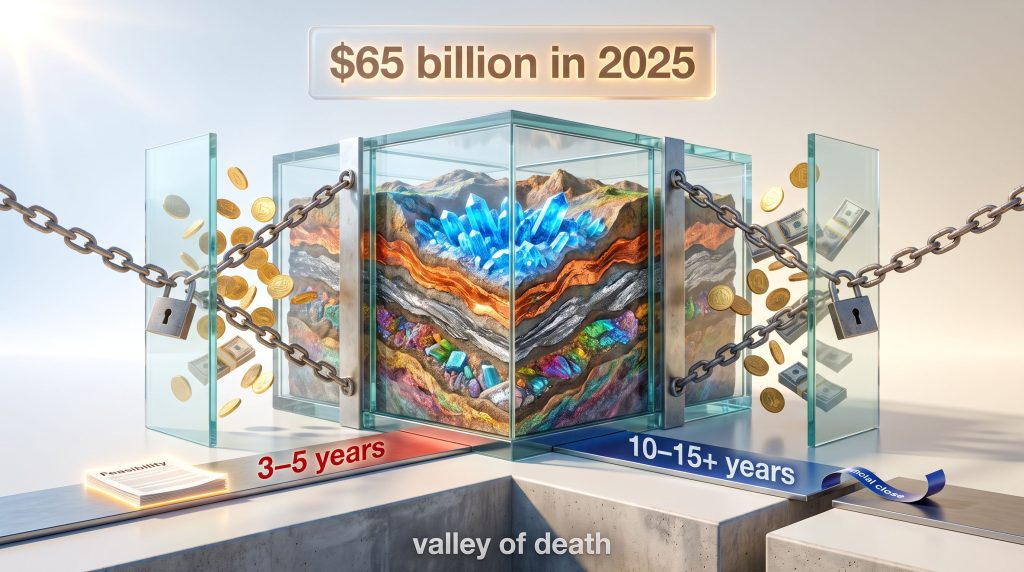
This structural void between feasibility and financial close is sometimes called the valley of death, and it claims a disproportionate share of projects that, on purely geological terms, should proceed.
| Risk Category | How It Manifests | Impact on Bankability |
|---|---|---|
| Long lead times | 10-15+ year development horizons | Mismatches with 3-5 year private equity exit windows |
| High upfront capex | Billions required before first revenue | Limits debt serviceability at early stages |
| Permitting uncertainty | Multi-year regulatory processes | Reduces lender confidence, delays financial close |
| Price volatility | Cyclical commodity markets | Pushes project economics below bankable thresholds |
| Offtake dependency | Circular lender/offtaker commitment problem | Traps developers at pre-financial close |
| ESG requirements | Institutional capital increasingly ESG-conditional | Adds compliance burden, but can unlock new capital pools |
Private capital markets are not failing when they decline to fund critical minerals projects. They are functioning precisely as designed. The problem is that the risk profile of strategic mining assets was never engineered to fit commercial return parameters.
Why the IEA's $65 Billion Figure Tells Only Half the Story
The headline numbers around public finance commitments are striking. According to the International Energy Agency, public finance commitments for critical minerals in advanced economies reached approximately $65 billion in 2025, representing roughly a fourfold increase over the prior two years. That figure reflects a genuine shift in political awareness across Western governments.
However, the IEA simultaneously flagged a deeply uncomfortable reality: those commitments are not translating into deployed capital at anything close to the required pace.
The gap between announced funding and actual disbursements is not primarily a budget problem. It reflects something more fundamental: institutional cultures within public finance bodies that are structured to avoid losses rather than mobilise capital strategically. Many agencies possess authorities including guarantees, subordinated debt, equity co-investment, and political risk insurance that they exercise rarely or at insufficient scale. Consequently, the result is a paradox in which governments announce record financing commitments while the projects those commitments were designed to support remain stalled.
Furthermore, reliable financing frameworks remain a persistent challenge across the sector, with analysts noting that the absence of coordinated institutional architecture consistently undermines even well-funded government programmes.
China's Capital Deployment Model and What the West Is Missing
State-Directed Finance as Industrial Strategy
China's dominance across critical minerals processing is not primarily a consequence of geological advantage. China holds significant domestic reserves of certain minerals, but its control over global processing for rare earths, graphite, and battery precursor materials extends far beyond its own resource base. The explanation lies in how capital has been deployed over decades.
Chinese state-owned banks, policy lenders, and industrial conglomerates evaluate mining and processing investments through a strategic lens that incorporates manufacturing competitiveness, export positioning, technology supply chain control, and geopolitical leverage. Financial return is one variable in a broader calculation, not the primary constraint.
This model enables the absorption of risks — early-stage development risk, long permitting timelines, commodity price downturns — that commercial Western investors are structurally unable to accept.
| Dimension | China's Model | Western Market-Led Model |
|---|---|---|
| Capital source | State banks, policy lenders, SOEs | Commercial banks, private equity, capital markets |
| Investment rationale | Strategic industrial policy | Risk-adjusted financial return |
| Risk tolerance | High – absorbs early-stage and geopolitical risk | Low – requires de-risked, bankable projects |
| Time horizon | Decades | 3-10 years depending on instrument |
| Coordination | Centralised, policy-directed | Fragmented across agencies and investors |
| Track record | Dominant processing market share | Persistent project delays and financing gaps |
The Architecture Gap in Western Finance
Western governments have historically delegated the financing of supply chains, including strategically critical ones, to commercial capital markets. The assumption is that market signals will direct capital toward critical minerals when demand fundamentals are strong enough. However, commodity price cycles, permitting risk, and policy uncertainty systematically distort those signals.
Even when long-term demand fundamentals are compelling, near-term risk profiles routinely deter private capital. Political rhetoric around supply chain resilience does not alter the underlying risk-reward equation. It is an architectural problem, not an ideological one: the institutions, incentives, and instruments required to mobilise capital at scale for strategic purposes remain underdeveloped across most Western economies.
In this context, critical minerals policy support at the federal level has become an increasingly important signal to private investors, even where direct capital deployment remains limited.
Public Finance Instruments That Can Change the Equation
The most effective interventions do not replace private capital. They restructure project risk profiles so that private capital is willing to follow. The toolkit available to governments is considerably broader than most public communications suggest:
- Blended finance structures combine concessional public capital with commercial private capital, improving risk-adjusted returns for private investors without fully displacing market discipline
- Guarantees and political risk insurance reduce lender exposure to permitting reversals, regulatory changes, and sovereign risk across emerging market jurisdictions
- Concessional and subordinated debt absorbs first-loss positions, making senior debt more attractive to commercial lenders who would otherwise decline
- Government offtake agreements and price floor mechanisms create revenue certainty that underpins bankability calculations for project finance
- Equity co-investment signals institutional commitment while reducing the capital burden on private project sponsors
- ESG-linked financing frameworks structure capital around community and environmental outcomes, reducing social licence risk and unlocking institutional mandates with sustainability requirements
The strategic logic here is catalytic deployment, not substitution. Public finance budgets are finite. Institutional capital pools — pension funds, sovereign wealth funds, and infrastructure asset managers collectively managing trillions of dollars in long-duration assets — are not. The objective is to use public de-risking instruments to bring those pools into play.
Where the Model Has Already Been Validated
Lynas, MP Materials, and Nouveau Monde Graphite
A small number of projects demonstrate that the catalytic model works in practice. Lynas Rare Earths has benefited over multiple years from public finance support channelled through both Japanese institutions, including mechanisms associated with the Japan Organization for Metals and Energy Security (JOGMEC), and Australian government bodies. That support has sustained a rare earth supply chain through periods of severe price volatility that purely commercial investors would not have navigated.
In the United States, MP Materials secured a multi-instrument partnership with the Department of Defense that incorporated equity, loan facilities, price protection mechanisms, and long-term offtake commitments simultaneously. The breadth of that structure, rather than any single instrument, is what made it transformative. It addressed capital access, revenue certainty, and demand visibility in a single coordinated package.
Canada's approach, illustrated by federal and Quebec provincial support for Nouveau Monde Graphite's integrated mine-to-processing graphite project, demonstrates how sub-national government coordination can catalyse private investment by signalling institutional confidence.
These examples are not the norm. The majority of critical minerals developers, particularly those working on graphite, rare earths, and specialty metals, continue to face severe financing constraints without comparable access to multi-instrument public support.
The Harder Cases: Copper and Junior Developers
If large copper projects — among the most commercially attractive mining investments globally — are experiencing financing difficulties against rising capital costs and permitting uncertainty, the challenge facing junior developers in graphite or rare earths is considerably steeper. The junior mining investment landscape reflects this acutely, with developers at the pre-production stage facing the most acute capital access constraints of any cohort in the sector.
Investors in these markets are acutely aware that demand forecasts depend heavily on electric vehicle adoption trajectories, battery manufacturing policy, and energy transition frameworks that have themselves become politically contested across major economies. Every policy reversal, every subsidy reduction, and every shift in trade architecture adds a layer of perceived risk that conventional project finance models struggle to price.
The next major ASX story will hit our subscribers first
The Institutional Capital Opportunity
The scale of capital that could ultimately flow into the critical minerals sector — given the right de-risking conditions — is orders of magnitude larger than public finance budgets alone. Infrastructure and pension fund managers have demonstrated growing appetite for real assets providing inflation protection and structural demand growth exposure.
Critical minerals assets, in principle, align well with those mandates: long-duration, inflation-linked, and exposed to secular demand growth from electric vehicles, grid-scale storage, and defence applications. Furthermore, the connection between critical minerals and energy security is increasingly shaping how institutional allocators frame these investments within broader portfolio strategy.
The conditions required to unlock that capital at scale are well understood:
- Early-stage construction and permitting risk must be absorbed by public finance before infrastructure-style capital can enter
- Revenue certainty mechanisms such as government offtake or price floor guarantees are often a prerequisite for pension fund allocation
- ESG and community outcome frameworks increasingly determine whether institutional mandates can accommodate mining assets
- Blended finance vehicles that pool public de-risking with institutional capital at the fund level provide the most scalable deployment pathway
Signs of Progress and the Tests Ahead
Western governments are not standing still. The US has expanded the mandates of the Export-Import Bank, the International Development Finance Corporation, and the Department of Energy's Loan Programs Office. The European critical raw materials facility has established a framework for identifying projects eligible for coordinated support and streamlined permitting processes, though implementation and capital translation remain the key tests.
Canada and Australia are increasingly coordinating financing approaches with allied nations through multilateral mechanisms rather than acting in isolation. This reflects a recognition that no single Western economy can replicate China's state-directed capital scale independently.
Japan's approach through JOGMEC — deploying equity, loans, and guarantees to support Japanese companies securing overseas mineral supply — has operated for decades and is increasingly studied as a reference model by governments that previously dismissed it as incompatible with market-economy principles. Analysts at the World Economic Forum have similarly highlighted targeted de-risking as the most viable pathway for mobilising private capital into strategic mineral supply chains.
The ultimate measure of progress will not be the size of the next financing announcement. It will be the number of projects that reach financial close, begin construction, and enter production within the decade. That outcome depends less on budget availability than on whether public finance institutions develop the speed, inter-agency coordination, and cultural willingness to take calculated risks that strategic capital deployment requires.
The critical minerals financing problem, at its core, is not a resource problem or even a budget problem. It is an institutional design problem — and that is something governments have the demonstrated capacity to change.
The minerals are in the ground. The capital exists in institutional portfolios. The distance between those two facts is institutional architecture.
This article is for informational purposes only and does not constitute financial advice. Forecasts, projections, and references to market trends involve inherent uncertainty. Readers should conduct independent research before making any investment decisions.
Ready to Spot the Next Major Discovery?
Discovery Alert’s proprietary Discovery IQ model delivers real-time alerts on significant ASX mineral discoveries, helping investors cut through complexity and identify actionable opportunities as the market reacts. See how major discoveries have historically driven exceptional returns on the Discovery Alert discoveries page and start a 14-day free trial at the Discovery Alert home page.