
July 17, 2026
Why Uranium Project Execution Is Becoming the Market's Ultimate Differentiator
Investor sentiment in the uranium sector has historically been captured by two forces: spot price movements and headline resource announcements. Yet as the global nuclear expansion cycle matures, a quieter but more durable variable is gaining traction among sophisticated capital allocators. The ability of a junior uranium developer to actually execute, to move a project from resource definition through feasibility and into production on schedule, is increasingly separating genuine value creation from speculative noise.
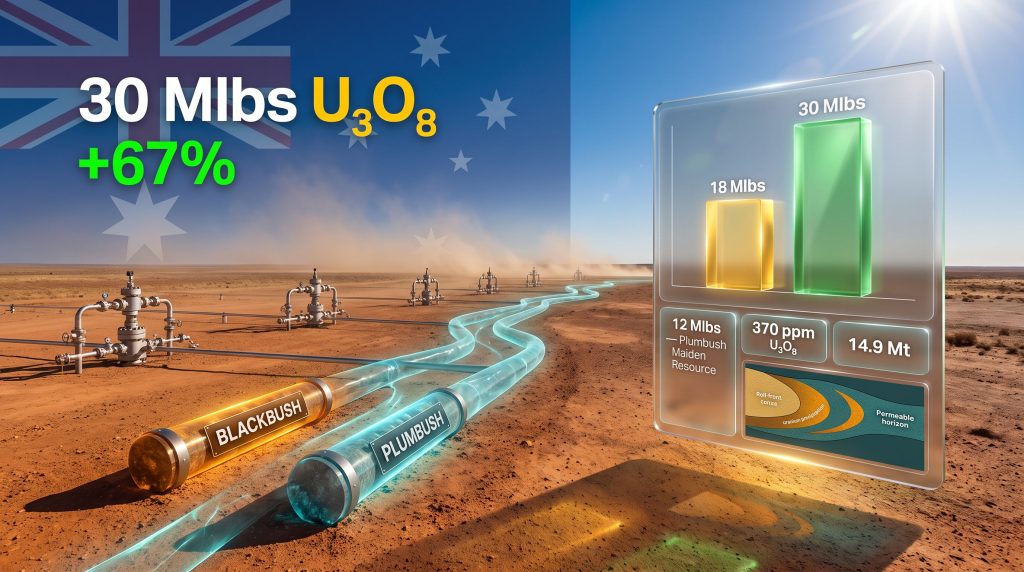
This shift in market psychology matters because it reframes how individual milestones should be interpreted. A resource upgrade is no longer just a volumetric signal. It is a composite indicator of geological model confidence, technical discipline, and development readiness. When viewed through this lens, the 67% increase in the Alligator Energy Samphire uranium project resource, lifting the total mineral inventory from 18 million pounds to 30 million pounds of U₃O₈, carries considerably more strategic weight than the headline figure alone suggests.
When big ASX news breaks, our subscribers know first
The Samphire Resource Upgrade: What the Numbers Actually Communicate
A Disciplined Resource Philosophy, Not Just a Tonnage Increase
The composition of the updated Mineral Resource Estimate (MRE) reveals a technical philosophy that sets this upgrade apart from typical headline-chasing announcements. The 12 million pound maiden resource at the Plumbush deposit, defined at 14.9 million tonnes grading 370 ppm U₃O₈, was deliberately held back from public reporting until the company secured unconditional access to the Mulga Rock Crown Lease, the land parcel on which Plumbush sits.
This sequencing reflects a production-first approach that is worth noting. Management had spent approximately three years negotiating access to this ground before announcing the resource, ensuring that the reported pounds were genuinely developable rather than geologically theoretical. Furthermore, the Samphire uranium project represents one of the most methodically developed ISR uranium opportunities in South Australia.
Equally notable is what was intentionally excluded. There are approximately 20 million additional pounds of uranium sitting at shallower levels above the optimal in-situ recovery (ISR) extraction horizon that were consciously omitted from the MRE. Rather than inflating the headline number, the technical team opted to restrict the reported inventory to material that can be practically and economically extracted by ISR methods.
This deliberate exclusion of non-ISR-amenable pounds reflects a resource classification philosophy where every reported pound is intended to be producible. It is a meaningful differentiator in a sector where headline inflation is common.
Key Resource Metrics at a Glance
| Metric | Previous Position | Updated Position | Change |
|---|---|---|---|
| Total MRE (Mlbs U₃O₈) | 18 Mlbs | 30 Mlbs | +67% |
| Primary Deposit | Blackbush only | Blackbush + Plumbush | Multi-deposit |
| Plumbush Contribution | Nil | 12 Mlbs (Inferred) | Maiden resource |
| Plumbush Grade | N/A | 370 ppm U₃O₈ | 14.9Mt @ 370 ppm |
| Deposit Separation | N/A | 5 km corridor | Connected system |
| ISR Amenability | ISR-targeted | 100% ISR-amenable | No change |
| Implied Mine Life Base | 12 years | Extendable beyond 12 years | Expansion potential |
How the Plumbush Discovery Transforms the Geological Risk Profile
From Concentration Risk to District-Scale Diversification
When a uranium project's entire resource sits within a single ore body, any structural complexity or grade variability at that deposit can materially impair the development case. The confirmation of Plumbush as a satellite deposit fundamentally changes this risk dynamic for the Alligator Energy Samphire uranium project.
Both Blackbush and Plumbush share comparable geological characteristics. Uranium mineralisation at both deposits occurs at equivalent stratigraphic levels, suggesting the same roll-front mechanisms that formed Blackbush were also active further south along the same paleo-channel system. The two deposits are now understood to sit within what geologists are characterising as the Blackbush-Plumbush corridor, a continuous roll-front system spanning approximately 5 kilometres.
The geological model is reinforced by airborne geophysics, which has traced the continuity of the paleo-channel system across the region. Critically, only 30% of the total regional paleo-channel system secured by the company has been tested by any drill holes, and the majority of that historical drilling has been focused near the two known deposits. This means the current 30 million pound figure likely represents an early inventory floor rather than a ceiling.
The exploration target range published by the company in late 2023 has an upper bound of approximately 75 million pounds, implying a potential resource multiplication factor of 2.5 times from the current base if the geological model continues to perform. The Plumbush maiden resource was originally expected to deliver around 5 million pounds internally. The actual outcome of 12 million pounds exceeded those internal expectations, providing early validation that the district-scale model is behaving better than anticipated.
Understanding Roll-Front Uranium Systems and ISR Compatibility
A roll-front uranium deposit forms when uranium-bearing groundwater migrates through permeable sandstone and encounters a geochemical boundary, typically a transition between oxidising and reducing conditions. Uranium precipitates at this boundary in a crescent or roll-shaped front along the permeable horizon. Over geological time, these fronts can extend along paleo-channel systems for tens of kilometres.
The reason roll-front systems are prized for ISR development comes down to host rock characteristics. The same permeable sandstone that allowed uranium-bearing fluids to migrate and concentrate is the ideal medium for circulating ISR leach solutions. There is no need to physically excavate the ore. Instead, an acidic or alkaline solution is injected through a wellfield network, dissolves the uranium in place, and the uranium-bearing solution is pumped to surface for processing. The in-situ leaching benefits at Samphire are consequently well-aligned with modern environmental and cost expectations.
Why roll-front ISR systems attract investor attention:
-
Capital expenditure is significantly lower than open-pit or underground mining because there is no conventional mining infrastructure required
-
Development timelines from resource definition to first production are shorter, typically measured in years rather than decades
-
Environmental surface disturbance is minimal, which supports permitting in politically sensitive or ecologically sensitive jurisdictions
-
Production rates can be modulated by adjusting the wellfield configuration, providing operational flexibility that conventional mines lack
ISR vs. Conventional Uranium Mining: Why Not All Pounds Are Equal
| Factor | ISR Uranium Projects | Conventional Uranium Mining |
|---|---|---|
| Capital Intensity | Low to Moderate | High |
| Environmental Disturbance | Minimal surface footprint | Significant earthworks |
| Permitting Complexity | Moderate | High |
| Reagent Requirements | Acid or alkaline leach solution | Milling and chemical processing |
| Production Scalability | High via wellfield expansion | Limited by pit or shaft design |
| Applicable Deposits | Permeable sandstone-hosted | Hardrock, breccia, unconformity |
The Four Critical ISR Performance Metrics Every Investor Should Understand
Regardless of whether ISR is being applied to uranium or copper, four technical parameters determine whether a project is economically viable at the wellfield level. These are sometimes referred to in the industry as the big four ISR factors:
-
Permeability: The ability of leach solutions to flow freely through the host rock. Without adequate permeability, reagent distribution across the ore zone is uneven and recovery rates suffer.
-
Grade recovery: The concentration of uranium extracted per unit of fluid pumped to surface. This directly determines operating revenue per unit of reagent consumed.
-
Reagent consumption: The volume and cost of acid or alkaline solution required to mobilise uranium from the rock. Minimising reagent use is the primary operating cost lever in ISR operations.
-
Reagent-rock interaction: How efficiently the leach solution mobilises uranium without excessive consumption by non-target minerals in the host rock. Poor reagent-rock interaction dramatically increases operating costs.
These four parameters apply equally when ISR is used to extract oxide copper from permeable fractured rock, which is directly relevant to the company's strategic investment in EnviroCopper.
The Field Recovery Trial: The Pivotal De-Risking Milestone
Why a Field-Scale Test Changes the Development Equation
Laboratory metallurgical testing can indicate whether ISR is theoretically viable, but it cannot replicate the spatial variability, natural groundwater chemistry, and geological heterogeneity encountered at field scale. A Field Recovery Trial (FRT) addresses this gap by applying the actual ISR process within the ore zone under real in-ground conditions.
The recently completed six-month FRT at Samphire delivered results that met or exceeded peer industry benchmarks across all key ISR performance metrics. This outcome is particularly significant because it validates that the laboratory-derived parameters used to build the scoping study economics translate faithfully to field conditions. The FRT results are expected to be released in the coming weeks, with management indicating that a more detailed technical disclosure will accompany the formal announcement.
Why the FRT outcome matters for BFS credibility:
-
Validates that ISR performance metrics translate from laboratory to field scale
-
Provides direct input data for operating cost modelling in the Bankable Feasibility Study
-
Confirms wellfield spacing, reagent mix ratios, and recovery efficiency assumptions
-
Substantially reduces technical risk for project financiers and potential offtake counterparties
-
Effectively reclassifies the project from exploration-stage to early development, a transition that can materially influence institutional valuation frameworks
The completion of a successful FRT is one of the most under-discussed de-risking events in the ISR development lifecycle. It is the moment at which the geological and metallurgical hypothesis is tested against geological reality at a scale that financiers and offtake counterparties can rely upon.
Management also noted that reagent optimisation work continues alongside the FRT analysis, with the goal of further reducing operating expenditure even beyond the already favourable results achieved during the trial. In ISR, the margin between a competitive and uncompetitive operation often comes down to incremental improvements in reagent efficiency, making this ongoing work commercially material rather than merely academic.
Samphire's Development Milestone Roadmap
| Milestone | Target Timeline | Strategic Significance |
|---|---|---|
| Field Recovery Trial results release | Coming weeks | Validates ISR opex assumptions for BFS |
| Updated MRE incorporating new drilling | Late 2025 to Early 2026 | Lifts resource base ahead of BFS |
| Bankable Feasibility Study delivery | Mid to Q3 2026 | Financing and offtake trigger |
| Mining Lease Application submission | End of 2028 | Regulatory pathway confirmation |
| Production rate under review | Ongoing | Potential modest upward revision in mine plan |
The 300-Hole Drilling Campaign: Strategic Logic Behind the November Cut-Off
Resource-Definition Drilling with a Commercial Deadline
The current 300-hole drilling program is not conventional exploratory drilling. It is a targeted resource-definition campaign with a specific commercial deadline: maximising the number of pounds that can be incorporated into the BFS before the November data cut-off date. After this cut-off, the company will have sufficient time to complete an updated MRE and integrate it into the BFS before the mid-2026 delivery target.
Key drilling objectives broken down by strategic purpose:
-
Blackbush southern extensions: Testing open mineralisation immediately south of the existing Blackbush deposit boundary on the newly secured Mulga Rock Crown Lease, where drilling to the northern boundary of the former lease had already confirmed mineralisation at the fence line
-
Plumbush extensions: Investigating the open ground surrounding the maiden Plumbush resource in all directions, as the deposit remains open on all sides
-
Corridor infill: Testing approximately 5 kilometres of largely undrilled ground within the Blackbush-Plumbush corridor, where the continuous paleo-channel geophysics indicate high prospectivity
-
Production rate optionality: Generating sufficient resource confidence to support evaluation of a modest increase to the current 1.2 million pounds per year production rate considered in the scoping study, particularly in the back-end of the mine plan
Drilling results are expected to be released approximately every six to eight weeks, creating a sustained cadence of news flow through the remainder of 2025 and into early 2026. Investors focused on interpreting drill results will find this regular disclosure cadence particularly valuable for tracking development progress.
The next major ASX story will hit our subscribers first
Uranium Market Dynamics: The Three Structural Trends That Drive Long-Term Value
Beyond Spot Price: What Actually Moves Uranium Company Valuations
The uranium spot price dominates media coverage but is frequently the least reliable guide to long-term company value in the uranium development sector. Three structural forces are more likely to drive valuation outcomes for developers positioned to deliver into the mid-decade supply window. Understanding broader uranium market dynamics helps contextualise why execution-focused developers are attracting increased institutional attention.
1. Nuclear utility contracting cycles
Long-term supply contracts rather than spot transactions are the primary driver of cash flow security for uranium producers. Utilities securing supply for the 2029 to 2033 window are increasingly approaching projects that can demonstrate credible development timelines. Projects capable of delivering material into this window should attract increasing offtake interest as forward contracting activity intensifies.
2. Geopolitical supply chain premiums
Uranium sourced from low-sovereign-risk jurisdictions, including Australia, Canada, the United States, and Namibia, commands a structural premium as utilities and governments prioritise supply chain security. The recent Australia-India uranium export agreement is one indicator of how bilateral energy security arrangements are broadening the addressable market for Australian uranium producers.
3. Project execution differentiation
The market is increasingly distinguishing between announced projects, permitted projects, financed projects, and projects that will actually produce uranium on schedule. Many announced uranium projects are unlikely to reach production within their stated timeframes. Investors who can identify developers with demonstrated execution track records are likely to capture disproportionate value as the production window narrows.
Uranium market fundamentals remain constructive. The spot price is now supported above the threshold needed by low-cost ISR producers, meaning projects with competitive operating cost structures are economically viable at current price levels. Price growth is unlikely to follow a straight-line trajectory, with periods of sharp strength expected to alternate with corrections driven by spot market liquidity and financial flows. The structural trends rather than day-to-day price movements are the more reliable guide for investors with multi-year horizons.
However, investors should also remain mindful of uranium market volatility, which can influence short-term sentiment even when the underlying project fundamentals remain sound. In addition, staying across evolving uranium market trends provides useful context when assessing how near-term news flow from projects like Samphire may be received by the market.
Global Reactor Demand Context
| Demand Category | Current Status |
|---|---|
| Reactors in operation | Approximately 440 globally |
| Reactors under construction | Approximately 80 |
| Reactors in planning stage | Approximately 120+ |
| Key utility contracting window | 2029 to 2033 |
South Australia's Sulfuric Acid Advantage: An Underappreciated Supply Chain Edge
One supply chain risk that receives limited attention in most uranium project analyses is the availability and cost of sulfuric acid, the primary reagent used in acid-based ISR operations. Global sulfuric acid supply has periodically tightened due to geopolitical disruptions affecting key production and shipping corridors.
For the Samphire project in South Australia, this risk is effectively neutralised. Local sulfuric acid production facilities are located within 100 kilometres of the project, providing access to a reliable domestic reagent supply that is insulated from international shipping disruptions. This geographic advantage is not replicated by ISR uranium projects in many other global jurisdictions, representing a meaningful but frequently overlooked operating cost and supply chain differentiator. Consequently, the South Australian government's support for the project as a developing major resource further reinforces the favourable operating environment.
The Big Lake Project: South Australia's Next Uranium Province?
Kazakhstan-Scale Geological Analogues in an Underexplored Basin
While the Samphire project commands the near-term development focus, the Big Lake project in South Australia represents a longer-duration optionality position. The geological rationale for Big Lake draws on analogies with the large-scale ISR uranium systems found in South Kazakhstan, where uranium mineralisation is associated with extensive hydrocarbon basin architecture rather than discrete structural controls.
Big Lake sits in a region historically dominated by oil and gas exploration, making the company the first mineral explorer to test for uranium in the area. After approximately three years of access negotiations, an initial drilling program was completed, confirming favourable sand thicknesses and anomalous uranium grades. These early results support the hypothesis that the area could host a new uranium province in South Australia, though the project remains at a greenfields exploration stage with no existing resource estimate.
A follow-up drilling program at Big Lake is currently underway, building on the August 2024 discovery. Results are expected to contribute to the company's news flow cadence over the coming months.
EnviroCopper: ISR Technology as a Cross-Commodity Platform
How a 16% Equity Stake Builds Transferable Operational Intelligence
The company holds a 16% equity stake in EnviroCopper Pty Ltd, a company applying ISR technology to stranded oxide copper assets across South Australia. The strategic logic is directly tied to ISR expertise. The same four technical parameters that govern ISR uranium performance, permeability, grade recovery, reagent consumption, and reagent-rock interaction, apply without modification to oxide copper extraction.
EnviroCopper is currently conducting a field recovery trial at the Kapunda copper mine, a historical oxide copper operation located north of Adelaide. This live ISR copper extraction program provides a real-time technical learning environment that informs reagent optimisation and wellfield design decisions with direct applicability to the Samphire uranium operation.
South Australia hosts numerous historical oxide copper mines with no active conventional development plans, representing a large addressable inventory of stranded assets that could potentially be unlocked through ISR techniques. For Alligator Energy, the EnviroCopper investment functions simultaneously as a commodity diversification position and as an operational intelligence asset that accelerates ISR expertise development.
Key Risks to Weigh Against the Resource Upgrade
| Risk Category | Specific Consideration | Mitigating Factor |
|---|---|---|
| Resource classification | Plumbush resource is Inferred, reflecting lower geological confidence | Active drilling program targeting upgrade to Indicated category |
| BFS delivery | Mid-2026 target depends on drilling results and technical inputs | November data cut-off provides structured data pipeline |
| Uranium price volatility | Spot price corrections can dampen market sentiment | Long-term contract pricing insulates project economics |
| Permitting timeline | Mining lease application targeted for end of 2028 | South Australia maintains an active uranium-supportive regulatory framework |
| Reagent supply | Sulfuric acid availability is critical for ISR operations | Local South Australian production within 100 km of project |
| Execution risk | FRT results, resource expansion drilling, and BFS all running concurrently | Management has demonstrated milestone delivery across multiple workstreams |
Frequently Asked Questions: Alligator Energy Samphire Uranium Project
What Is the Current Total Mineral Resource at the Samphire Uranium Project?
The combined Samphire mineral resource stands at 30 million pounds of U₃O₈, comprising the established Blackbush deposit and the newly defined maiden Plumbush resource of 12 million pounds at 14.9 million tonnes grading 370 ppm U₃O₈.
Why Is the 100% ISR-Amenable Classification Commercially Important?
ISR-amenable means every reported pound of uranium can be extracted without physical excavation, using leach solutions circulated through permeable host rock. This translates directly to lower capital costs, a smaller environmental footprint, faster development timelines, and more competitive operating economics compared to conventional uranium mining.
What Is the Exploration Upside Beyond the Current 30 Million Pound Resource?
Approximately 70% of the total regional paleo-channel system remains untested by drilling. The company's published exploration target range has an upper bound of approximately 75 million pounds, suggesting a potential resource multiplication factor of 2.5 times from the current base if ongoing drilling continues to validate the geological model.
When Is the Bankable Feasibility Study Expected?
The BFS is targeted for delivery in the mid to Q3 2026 timeframe, incorporating updated resource estimates from the current drilling program and the full dataset from the field recovery trial.
How Does South Australia's Regulatory Environment Affect the Project?
South Australia maintains an active framework supporting uranium exploration and mining. The proximity of local sulfuric acid production within 100 kilometres of the project also addresses a reagent supply risk that affects ISR uranium projects in many other jurisdictions.
Key Takeaways: What the Resource Upgrade Signals for the Development Trajectory
-
The 67% MRE increase to 30 million pounds is a structural milestone that validates the district-scale geological model and expands mine life optionality beyond the current 12-year base case
-
The deliberate exclusion of approximately 20 million non-ISR-amenable pounds reflects a production-first resource philosophy that prioritises bankable economics over headline tonnage inflation
-
The FRT results, expected in the coming weeks, represent the most significant near-term de-risking event, as they will determine how the project's operating cost assumptions are incorporated into the BFS
-
The convergence of three simultaneous workstreams, FRT disclosure, active 300-hole drilling, and BFS advancement, creates a dense near-term news flow cadence that investors should monitor as a proxy for project de-risking velocity
-
The Blackbush-Plumbush corridor, with 70% of the paleo-channel system untested, represents the most material near-term exploration upside and the clearest pathway to further Alligator Energy Samphire uranium project resource increases
-
Geopolitical supply chain premiums for Australian uranium, combined with the 2029 to 2033 utility contracting window, provide a structural demand backdrop that supports long-term project value independent of near-term spot price movements
This article is intended for informational purposes only and does not constitute financial advice or a recommendation to buy or sell any securities. Readers should conduct their own due diligence and consult a qualified financial advisor before making any investment decisions. Forward-looking statements, exploration targets, and development timelines involve inherent uncertainty and may not be achieved.
Want to Track the Next Major Uranium Discovery the Moment It Hits the ASX?
Discovery Alert's proprietary Discovery IQ model delivers real-time alerts on significant ASX mineral discoveries — instantly transforming complex geological data into actionable insights for investors at every level. Explore why historic mineral discoveries have generated extraordinary returns on Discovery Alert's dedicated discoveries page, and begin your 14-day free trial today to position yourself ahead of the broader market.