July 16, 2026
The Ocean as a Nuclear Fuel Reserve: Understanding Uranium from Seawater
Nuclear energy has always been defined by one unavoidable constraint: the fuel that powers it must be dug from the ground. For decades, that geological dependency shaped everything from geopolitical alliances to utility procurement strategies. But a growing body of materials science research is beginning to question whether the earth beneath our feet is truly the only viable source of uranium from seawater — or whether the ocean covering 71% of our planet's surface might hold the answer to long-term nuclear fuel security.
The concept of extracting uranium from seawater is not new. Japanese researchers were exploring marine uranium adsorption as far back as the 1960s. What has changed dramatically is the urgency driving the field forward, the sophistication of the extraction materials being developed, and the commercial infrastructure beginning to form around what was previously considered a scientific curiosity with no near-term industrial relevance.
When big ASX news breaks, our subscribers know first
Why Uranium Supply Security Is Becoming a Strategic Priority
The global uranium market is structurally tighter than headline spot prices often suggest. While the spot price of uranium fluctuates with sentiment and short-term contract cycles, the deeper supply picture reveals a fuel cycle under compounding pressure. Understanding uranium supply-demand volatility is increasingly essential for anyone tracking nuclear energy trends.
U.S. domestic uranium concentrate (U₃O₈) production reached approximately 1.04 million pounds in the first quarter of 2026, according to U.S. Energy Information Administration data — a figure that, while reflecting a recovery from historic lows, still falls well short of domestic reactor demand. The United States continues to import the majority of its reactor fuel, with significant volumes originating from Kazakhstan, Canada, and Namibia.
This geographic concentration creates supply chain vulnerabilities that are difficult to hedge through market mechanisms alone. Furthermore, the pressure extends beyond raw uranium production into every downstream stage of the nuclear fuel cycle:
- Conversion — transforming uranium oxide into uranium hexafluoride for enrichment
- Enrichment — increasing the concentration of the U-235 isotope to reactor-grade levels
- HALEU production — High-Assay Low-Enriched Uranium enriched between 5% and 20% U-235, required by most advanced reactor designs, faces acute supply constraints that are independent of raw uranium availability
- Fuel fabrication — manufacturing fuel assemblies to the precise specifications of individual reactor designs
The combined effect of these bottlenecks has elevated seawater uranium extraction from a long-range research concept to an active area of commercial development. Consequently, Austin-based SuperCritical Materials secured an exclusive licence from the U.S. Department of Energy in mid-2026 to commercialise extraction technology developed at Pacific Northwest National Laboratory (PNNL).
Additionally, recent uranium supply challenges have intensified the search for alternative fuel sources beyond conventional terrestrial mining.
The challenge facing nuclear energy is not simply a uranium mining problem. It is a full-spectrum fuel cycle problem that requires unconventional thinking about where nuclear fuel can come from in the first place.
How Much Uranium Does the Ocean Actually Contain?
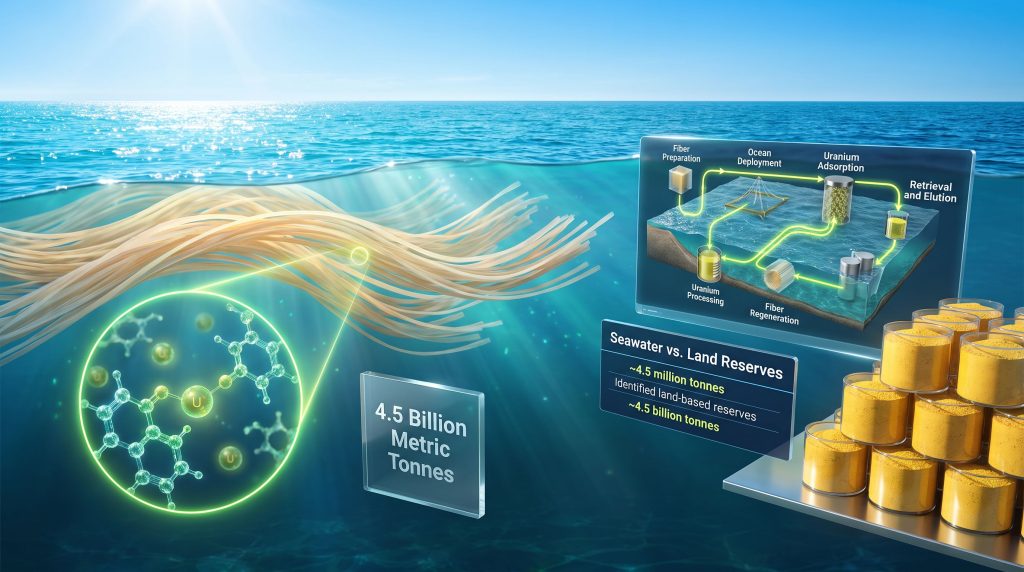
The scale of the ocean's dissolved uranium resource is genuinely difficult to contextualise. Earth's oceans contain an estimated 4.5 billion metric tonnes of dissolved uranium — a figure that exceeds all known terrestrial uranium reserves by a factor of more than 1,000. The average concentration is approximately 3.3 micrograms per litre, or roughly 3.3 parts per billion by mass.
To put that in perspective:
| Resource Category | Estimated Volume | Key Constraint |
|---|---|---|
| Identified land-based uranium reserves | ~4.5 million tonnes | Geographically concentrated and finite |
| Seawater dissolved uranium | ~4.5 billion tonnes | Ultra-low concentration, high extraction cost |
| Annual global uranium consumption | ~65,000 tonnes | Growing with reactor deployment |
At current global consumption rates, the ocean's dissolved uranium could theoretically sustain nuclear power generation for tens of thousands of years if extraction were to become economically viable. That single fact explains why governments and research institutions continue investing in the field despite the formidable technical and economic barriers that remain.
Importantly, the ocean's uranium reservoir is not static. Rivers continuously deliver dissolved uranium from weathered geological formations into the sea, meaning the ocean functions not just as a reservoir but as an actively replenishing resource — a characteristic that land-based mining cannot match.
The Adsorption Process: How Uranium from Seawater Is Actually Captured
The dominant extraction methodology relies on a process called selective adsorption, where chemically engineered materials are immersed in seawater and allowed to capture dissolved uranium ions through highly specific chemical reactions.
The most widely studied adsorbent material uses amidoxime functional groups — a class of chemical structures with a strong and selective affinity for dissolved uranyl ions (UO₂²⁺), which are the predominant form of uranium in seawater. These groups are typically grafted onto polymer fibre substrates, most commonly acrylic-based materials, creating a deployable structure with high surface area relative to its mass.
Step-by-Step: The Full Extraction Cycle
- Fibre Preparation — Polymer fibres are chemically functionalised with amidoxime or related groups that selectively coordinate with uranyl ions
- Ocean Deployment — Fibre assemblies are positioned within natural current flows to maximise contact with seawater volumes without the energy cost of active pumping
- Uranium Adsorption — Dissolved uranium ions bind progressively to the fibre surface over a deployment period typically measured in weeks
- Retrieval — Saturated fibre assemblies are recovered from the ocean
- Elution — Fibres are placed in an acidic or alkaline stripping solution that releases the captured uranium into concentrated liquid form
- Processing — The uranium-rich eluate is refined into uranium concentrate (yellowcake, U₃O₈), which enters the conventional nuclear fuel cycle
- Fibre Regeneration — Chemically stripped fibres are treated and redeployed for subsequent cycles, with adsorbent materials typically capable of approximately six regeneration cycles before performance degrades meaningfully
A typical yield under current technology is approximately 2 grams of uranium per kilogram of adsorbent after roughly one month of ocean deployment — a modest figure that underscores both the dilute nature of the resource and the performance gap that materials science research is working to close.
Recent Materials Science Breakthroughs
The performance envelope of seawater uranium adsorbents has expanded significantly in recent research cycles. Researchers at institutions such as Oak Ridge National Laboratory have reported notable advances in adsorbent efficiency and selectivity. Some of the most notable advances include:
| Technology Approach | Reported Uptake Capacity | Timeframe | Development Stage |
|---|---|---|---|
| Studtite nanodot adsorbent strategy | ~154.5 mg/g | 12 days | Research phase (2024) |
| Micro-redox adsorbent design | 962.4 mg/g (controlled); 14.62 mg/g in natural seawater | 56 days | Research phase (2024) |
| Electrochemical amidoxime capsule electrode | 12.6 mg/g in natural seawater | 24 days | Early development (2024) |
| Sulfonic-group polymer adsorbent | Enhanced selectivity metrics | Ongoing | Laboratory scale (2025) |
The gap between controlled-environment performance figures and real-world seawater results is itself an important piece of information for anyone evaluating this field. The micro-redox adsorbent's capacity drops from over 900 mg/g in optimised laboratory conditions to approximately 14.62 mg/g in actual seawater — reflecting the impact of competing dissolved ions, biofouling, and the thermodynamic realities of operating at parts-per-billion concentration levels.
Research leadership in this area is currently concentrated at Pacific Northwest National Laboratory and Oak Ridge National Laboratory in the United States, alongside multiple Japanese academic research groups that have been active in the field for several decades.
The Economics: Where the Technology Stands Today
The single most significant barrier to commercial uranium from seawater is cost, not scientific feasibility. Current extraction costs are estimated at approximately $300 per kilogram under best-case conditions — representing a premium of roughly 3 to 10 times the prevailing market price for conventionally mined uranium.
Japanese research programmes, which have produced the most detailed techno-economic modelling in the public domain, have placed the theoretical minimum extraction cost at approximately 25,000 yen per kilogram under highly optimised conditions. Even at this theoretical minimum, seawater uranium remains significantly more expensive than its terrestrial equivalent.
Why Scaling Remains Deeply Challenging
Several compounding factors make cost reduction difficult:
- The Energy Balance Problem — Actively pumping seawater through extraction systems consumes more energy than the recovered uranium could generate. Passive deployment in natural ocean currents is the only energetically rational approach, which constrains where and how systems can be deployed.
- Volume Requirements — Meeting global annual uranium demand of approximately 65,000 tonnes would require processing seawater volumes equivalent to the entire North Sea on an ongoing basis.
- Biofouling Degradation — Marine organisms colonise adsorbent fibres in open-ocean environments within weeks of deployment, reducing chemical binding efficiency and shortening operational lifespan.
- Competing Ion Interference — Seawater contains elevated concentrations of vanadium, copper, iron, and other dissolved metals that compete with uranium for binding sites on amidoxime-functionalised materials, reducing both selectivity and yield.
- Infrastructure Gap — No commercial-scale seawater uranium extraction facility currently exists anywhere in the world. All operations to date remain at laboratory or small pilot scale.
⚠ Important Caveat: Seawater uranium extraction is not currently an economically competitive uranium supply pathway. It is best understood as a long-term research priority and strategic contingency resource, not an imminent commercial solution.
The Critical Mineral Co-Recovery Thesis
One of the most strategically interesting aspects of seawater uranium extraction is the possibility of recovering multiple dissolved metals simultaneously from the same adsorbent platform. SuperCritical Materials has indicated that its DOE-licensed process could potentially recover up to 23 important metals dissolved in seawater alongside uranium — a claim that, if validated at industrial scale, could fundamentally reshape the economics of the entire approach.
The United States government currently designates approximately 50 minerals and elements as critical to national security and economic competitiveness. In addition, critical minerals demand is accelerating across defence, energy technology, and advanced manufacturing sectors, with China currently dominating global rare earth production and creating substantial supply chain vulnerability.
A seawater extraction platform capable of recovering uranium alongside lithium, rare earth elements, vanadium, and other strategically important dissolved metals could distribute extraction costs across multiple high-value commodity revenue streams. Under this multi-mineral model, uranium becomes a co-product of a broader ocean mineral recovery operation rather than a standalone commodity that must bear the full cost burden of the extraction system.
This is arguably the most significant speculative dimension of the field. If the co-recovery thesis holds at industrial scale, the cost-per-kilogram of uranium recovered from seawater could decline substantially — not through improvements in uranium-specific extraction efficiency alone, but through the blended economics of a multi-commodity platform.
The next major ASX story will hit our subscribers first
Regulatory and Environmental Considerations
Uranium from seawater occupies an ambiguous position within existing regulatory frameworks. It is not conventional mining, not offshore drilling, and not aquaculture — and existing permitting structures do not map cleanly onto what commercial ocean uranium extraction would actually involve.
In a U.S. context, regulatory jurisdiction could plausibly overlap across multiple federal agencies:
- Nuclear Regulatory Commission (NRC) — oversight of materials producing uranium concentrate
- Environmental Protection Agency (EPA) — monitoring of marine environmental impacts
- National Oceanic and Atmospheric Administration (NOAA) — potential jurisdiction over large-scale marine deployments in U.S. exclusive economic zones
From an environmental standpoint, proponents argue that passive adsorbent systems have a substantially lower footprint than offshore oil and gas infrastructure. The absence of drilling, blasting, tailings management, or groundwater interaction represents genuine advantages over conventional uranium mining. However, large-scale deployment of adsorbent arrays in active marine current zones raises legitimate questions about ecosystem disruption that independent scientific assessment has not yet addressed at commercial scale.
SuperCritical Materials has noted that the environmental profile of its process is more straightforward than offshore hydrocarbon extraction, which could reduce permitting complexity. For early commercial operations, the company has indicated that recovered yellowcake could be processed through existing uranium handling facilities in Texas, avoiding the capital requirement of constructing entirely new processing infrastructure.
Scenario Pathways: When Could Seawater Uranium Become Competitive?
The commercialisation timeline depends on which combination of conditions materialises. Three broad scenarios frame the range of plausible outcomes:
Scenario A: Uranium Price Surge
If geopolitical disruption — such as the consequences flowing from the Russian uranium import ban — caused uranium spot prices to rise above $200 per pound U₃O₈, seawater extraction costs could approach competitive parity under optimised conditions. This would make ocean-sourced uranium a credible emergency supply pathway rather than a fringe alternative.
Scenario B: Technology Cost Reduction
If continued materials science research reduces adsorbent production costs by 70–80% and extends fibre operational lifespan significantly beyond the current six-cycle benchmark, seawater uranium economics could shift toward viability even without dramatic changes in uranium market pricing.
Scenario C: Multi-Mineral Revenue Model
If commercial extraction platforms demonstrate reliable co-recovery of lithium, rare earths, and other critical minerals at economically meaningful concentrations, the blended revenue model could effectively subsidise uranium extraction costs. Under this model, uranium becomes economically viable as a co-product.
Most analysts working in this space consider Scenario C the most plausible near-term pathway to commercial relevance. It does not require either a uranium market shock or a step-change breakthrough in adsorbent performance — it requires demonstration of multi-mineral recovery at pilot scale, which is a more tractable near-term milestone.
Where Seawater Uranium Fits in the Nuclear Fuel Hierarchy
Understanding broader uranium market dynamics is essential context for positioning seawater extraction within the wider fuel supply landscape.
| Supply Tier | Source Type | Current Role | Long-Term Potential |
|---|---|---|---|
| Primary | Conventional mining (Kazakhstan, Canada, Namibia) | Dominant global supply | Geopolitically concentrated |
| Secondary | U.S. domestic in-situ recovery and open-pit mining | Growing from historic lows | Strategically important |
| Tertiary | Uranium recycling and secondary market sources | Niche contribution | Expanding with SMR deployment |
| Emerging | Seawater extraction | Pre-commercial research | Long-term strategic backstop |
The framing that SuperCritical Materials and others working in this space employ positions seawater uranium not as a replacement for conventional mining but as a long-term strategic layer — an essentially inexhaustible backstop that becomes increasingly valuable as terrestrial reserves become more geographically contested.
The Intelligence Economy framing is particularly notable. Just as access to coal defined industrial-era economic competitiveness, and access to semiconductor supply chains defines technology-era competitiveness today, access to reliable nuclear fuel supply chains is increasingly framed as a prerequisite for leadership in the AI and advanced computing era. Within that framing, seawater uranium is less a niche technology and more a strategic insurance policy for civilisational-scale energy security.
Key Takeaways
- Earth's oceans contain an estimated 4.5 billion metric tonnes of dissolved uranium, more than 1,000 times all known land-based reserves, at a concentration of approximately 3.3 micrograms per litre
- Current adsorption-based extraction using amidoxime-coated polymer fibres is technically proven at laboratory scale but costs 3 to 10 times more than conventionally mined uranium
- Recent adsorbent designs have achieved uptake capacities exceeding 900 mg/g in controlled conditions, though real-world seawater performance is substantially lower
- The primary barrier to commercialisation is economic, not scientific — the cost gap, not the chemistry, is what separates seawater uranium from market relevance
- Co-recovery of up to 23 critical minerals alongside uranium could transform the economics of ocean extraction by distributing costs across multiple commodity revenue streams
- Seawater uranium is best understood as a long-term strategic backstop and civilisational-scale energy security asset, not a near-term commercial uranium supply solution
This article is intended for informational and educational purposes only. It does not constitute financial, investment, or legal advice. The commercialisation of seawater uranium extraction technology involves significant technical, regulatory, and economic uncertainties. Readers should conduct independent research and consult qualified professionals before making investment decisions related to uranium, nuclear energy, or related sectors. Forecasts and scenario projections discussed in this article are speculative and should not be interpreted as predictions of actual outcomes.
For ongoing coverage of uranium market dynamics, nuclear energy policy, and energy transition trends, explore the resources available at CarbonCredits.com, including live uranium price tracking and nuclear energy education.
Want to Stay Ahead of the Next Major Uranium Discovery on the ASX?
Discovery Alert's proprietary Discovery IQ model delivers real-time alerts on significant ASX mineral discoveries — including uranium and critical minerals — instantly translating complex data into actionable investment insights for both short-term traders and long-term investors. Explore how historic ASX discoveries have generated extraordinary returns on Discovery Alert's dedicated discoveries page, and begin your 14-day free trial today to position yourself ahead of the broader market.