June 5, 2026
What Alphamin’s first-quarter earnings say about the tin market in 2026
Tin is one of the smallest major metals markets, which is exactly why quarterly results from a single producer can reveal so much about price formation, margin expansion, and investor sentiment. In compact commodity markets, even modest changes in supply, transport flow, or concentrate availability can produce outsized pricing reactions. That dynamic matters in 2026, because the latest Alphamin first-quarter earnings tin prices discussion is really about how a relatively stable production base interacted with a sharply stronger tin market.
Rather than signalling a volume-led breakout, Alphamin’s latest quarter points to a classic mining-market lesson: when realised prices rise much faster than operating costs, earnings can accelerate at a disproportionate rate. The company’s reported numbers for the three months ended March 31, 2026 show exactly that pattern, while also highlighting the operational and geopolitical risks that could complicate the next quarter.
Important context: This article discusses reported results and scenario analysis, not investment advice or a formal earnings forecast. Commodity prices, logistics conditions, and jurisdictional risk can change quickly, especially in frontier mining regions.
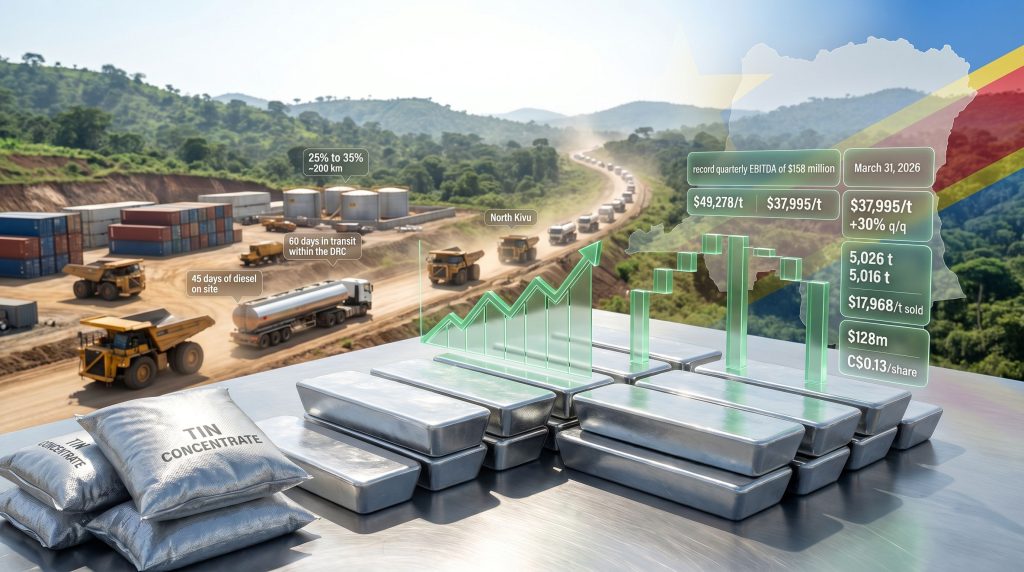
Alphamin reported record quarterly EBITDA of $158 million in Q1 2026, with the biggest swing factor being price rather than output. Its average realised tin price climbed to $49,278 per tonne, up 30% quarter on quarter from $37,995/t. Meanwhile, contained tin production reached 5,026 t and sales totalled 5,016 t, both broadly steady.
That combination matters because it strips away some of the noise. If tonnage had jumped sharply, analysts would have had to separate operational improvement from market effect. Here, the reading is cleaner: the earnings surge was predominantly a tin-price story.
Featured takeaway
The simplest answer to the Alphamin first-quarter earnings tin prices question is this:
- EBITDA hit $158 million in Q1 2026
- The average tin price rose 30% q/q to $49,278/t
- Production and sales were broadly flat, showing the earnings jump was not driven by a volume surprise
- AISC increased to $17,968/t sold, but that rise was far smaller than the price increase
- Investors still need to weigh fuel inflation risk, transport dependencies, and eastern DRC exposure, including security risks at Bisie
The broader implication is that the tin market remained tight enough in early 2026 for pricing to overwhelm cost inflation, at least for that quarter.
Which Q1 2026 numbers matter most?
Not every line in a quarterly release carries the same analytical weight. For this result, the most important figures are the ones that explain margin conversion, not just top-line optics.
Key metrics at a glance
| Metric | Q1 2026 | Comparison | Why it matters |
|---|---|---|---|
| EBITDA | $158m | +46% q/q | Shows strong earnings leverage |
| Average tin price | $49,278/t | $37,995/t prior quarter | Main driver of the result |
| Tin price change | +30% q/q | n/a | Indicates commodity-led upside |
| Contained tin production | 5,026 t | broadly steady | Confirms operating consistency |
| Tin sales | 5,016 t | 5,045 t prior quarter | Suggests sales execution remained intact |
| Net cash increase | $128m | n/a | Demonstrates powerful cash conversion |
| AISC | $17,968/t sold | +7% q/q | Costs rose, but much less than price |
| Final FY2025 dividend | C$0.13/share | n/a | Points to confidence in cash generation |
| Diesel on site | ~45 days | n/a | Operational resilience marker |
| Diesel in transit in DRC | ~60 days | n/a | Supports near-term fuel continuity |
| Fuel sourcing premium | 25% to 35% | since early March | Possible Q2 cost headwind |
| Distance from referenced conflict events | ~200 km | n/a | Relevant for jurisdictional risk assessment |
Why these figures deserve attention
Several metrics reinforce one another. For instance:
- Production was stable
- Sales were also stable
- Realised pricing moved sharply higher
- Cash increased by $128 million
- Dividend capacity remained intact
That sequence tells investors the quarter was not just profitable on paper. It converted into balance-sheet strength as well. In addition, recent coverage from Mining Weekly on strong tin prices supports the view that pricing did the heavy lifting.
Why higher tin prices had such a large impact on earnings
Mining investors often talk about operating leverage, and this quarter is a straightforward example. When a mine’s throughput and sales volumes stay relatively similar but the selling price jumps, a large share of that price improvement can flow through to earnings.
A simple margin bridge
| Earnings driver | Q1 2026 effect | Interpretation |
|---|---|---|
| Production | Stable at 5,026 t | No major volume shock |
| Sales | Stable at 5,016 t | Revenue impact from tonnage was limited |
| Tin price | Up to $49,278/t | Dominant positive factor |
| AISC | Up to $17,968/t sold | Negative, but manageable |
| EBITDA | Up to $158m | Strong operating leverage |
Why rising AISC was not necessarily bearish
AISC rose 7% quarter on quarter to $17,968/t sold, but the components behind that increase are important. The company indicated that higher royalties, export duties, marketing commissions, and net smelter return-related payments were key contributors. Those items are linked, directly or indirectly, to stronger realised prices.
So a higher AISC number did not automatically mean the mine became structurally less efficient. Part of the increase reflected a more profitable pricing environment. Furthermore, broader sector efforts around tin recovery improvements show how margin quality can depend on both price and processing performance.
Investor nuance: AISC can rise in a strong quarter without undermining the bull case if the increase is largely price-linked rather than caused by operational slippage, grade decline, or severe input-cost blowouts.
How sensitive are earnings to tin prices?
Because the quarter was so clearly price-driven, the next question is obvious: what happens if tin moves lower or higher from here?
Scenario framework for investors
This is a scenario tool, not a company forecast.
| Tin price assumption | Margin outlook | Likely earnings effect | What to watch |
|---|---|---|---|
| Below $40,000/t | More compressed | Cash build slows materially | Security and logistics risks matter more to valuation |
| $40,000/t to $50,000/t | Strong | Healthy operating cash flow | Cost discipline and shipment continuity |
| Above $50,000/t | Very strong | Potential for outsized EBITDA | Volatility, higher linked charges, possible fiscal pressure |
At the reported Q1 average of $49,278/t, and with AISC at $17,968/t sold, the implied operating margin per tonne remained substantial. That spread is why EBITDA could expand faster than production or sales.
Why tin can move so sharply
Tin behaves differently from larger base metals for several reasons:
- The global market is relatively small
- Supply is geographically concentrated
- Electronics demand, especially solder demand, remains important
- Small disruptions at individual mines or along export routes can affect available supply faster than many investors expect
Because of that structure, a tight physical market can create fast price adjustments, which then feed directly into producer margins. However, investors also need to account for Bisie mine volatility when modelling how quickly sentiment can shift.
Is production stable enough to support the earnings story?
The reported 5,026 t of contained tin production implies a quarterly run rate that aligns with the company’s 20,000 t per year guidance. That is significant because it supports the idea that Q1 was not flattered by a one-off production spike.
Production versus sales
Sales of 5,016 t compared with 5,045 t in the prior quarter and sat very close to production. That narrow gap suggests:
- no major offtake disruption
- no severe inventory mismatch
- relatively effective movement of product despite regional complexity
From an analytical standpoint, this improves confidence in earnings quality. Strong quarters built on volatile shipment timing are harder to trust. By contrast, strong quarters built on steady operations plus higher prices are easier to model, even if future prices remain uncertain.
Logistics remain a hidden earnings variable
The company cited improved road conditions as one factor behind the $128 million net cash increase. In mining, road access does more than influence transport costs. It can also change:
- shipment timing
- working capital release
- inventory levels
- receivables timing
- effective cash conversion from reported earnings
That is especially important in remote operations, where logistics can become as financially relevant as mining performance itself.
What operational risks could affect the next quarter?
The clearest near-term margin risk appears to be fuel. The company stated that increased fuel prices did not materially affect Q1, but could begin to show up in Q2. Additional diesel has reportedly been sourced at premiums of 25% to 35% since early March.
Diesel coverage offers a short-term buffer
Fuel inventory and supply visibility are therefore critical:
- About 45 days of diesel was held on site
- A further 60 days of consumption was in transit within the DRC
That does not eliminate risk, but it does provide near-term insulation against immediate supply disruption. Consequently, the issue is less about immediate stoppage and more about margin pressure.
Operational risk checklist
Investors should monitor the following items closely:
- diesel availability and delivered cost
- road access and seasonal transport conditions
- concentrate export flow continuity
- contractor and workforce stability
- cost pass-through from linked fees and logistics
- any slippage between production and sales volumes
If Q1 was the quarter where price strength dominated the story, Q2 may be the quarter where cost lag effects become more visible. Company commentary in the record Q1 EBITDA guidance update also points to this balance between earnings strength and operational vigilance.
How important is the DRC security backdrop to valuation?
A strong quarter does not erase jurisdictional discounting. The company said the security situation in North Kivu had remained relatively stable since October 2025, but also warned that the operating risk profile remained elevated. Its mine was described as being in a remote area about 200 km from the referenced events.
Three ways to think about jurisdictional risk
1. Operational lens
Can the mine continue producing within guidance parameters?
2. Logistics lens
Can diesel, supplies, and tin concentrate move reliably to and from site?
3. Market lens
Will investors still apply a lower valuation multiple because of location, even if quarterly operations remain stable?
Key valuation point: A mining company can post excellent quarterly earnings and still trade below what its cash generation alone might suggest if the market believes disruption risk remains structurally elevated.
Distance from conflict matters, but it is not a perfect shield. In resource investing, tail risk often affects the valuation multiple long before it affects reported production. In the same way, the path to any future Alphamin mine reopening narrative can influence sentiment well before fundamentals fully settle.
What strong tin prices mean for dividends and capital allocation
The final FY2025 cash dividend of C$0.13 per share is more than a shareholder-return headline. It signals that management judged the balance sheet and near-term cash outlook to be robust enough to support distributions even in a higher-risk operating environment.
Capital allocation options in a strong pricing cycle
| Option | Potential benefit | Main trade-off |
|---|---|---|
| Higher dividends | Immediate return to shareholders | Less protection against shocks |
| Cash retention | Stronger buffer for risk and volatility | Lower near-term yield appeal |
| Reinvestment | Supports future output or resilience | Execution risk and slower payoff |
For a producer operating in the DRC, holding extra liquidity can be strategically valuable. Cash can function as a buffer against supply-chain disruption, higher fuel procurement costs, security-related contingencies, and working-capital swings. That means investors should not automatically treat retained cash as inefficient capital management.
What this quarter implies for the broader tin market
The larger takeaway from Alphamin first-quarter earnings tin prices is that price strength is currently overpowering cost inflation for profitable producers with stable output. That does not mean every tin miner is equally positioned, but it does reinforce several structural points about the market.
Why tin remains strategically important
Tin has a distinct demand profile, with major use in:
- solder for electronics manufacturing
- industrial alloys and chemicals
- applications tied to broader manufacturing activity
This creates a market that is sensitive both to industrial demand cycles and to concentrated mine supply. It is also one reason tin prices can react strongly when supply disruptions emerge, even if global demand is not booming across every sector simultaneously. Meanwhile, projects such as the Oropesa tin project highlight how the market is watching future supply sources closely.
Momentum or peak?
There are two reasonable interpretations of the quarter:
Bullish view
- stable output supported the result
- higher prices drove exceptional earnings leverage
- net cash increased by $128 million
- dividend capacity adds confidence
Cautious view
- Q1 may prove difficult to repeat if tin prices cool
- fuel premiums may pressure Q2 margins
- logistics can still disrupt cash conversion
- security conditions remain an ongoing valuation overhang
The most balanced reading is that Q1 2026 demonstrated how powerful Alphamin first-quarter earnings tin prices can be as a market signal, but not that every benefit will persist unchanged.
FAQ: Alphamin first-quarter earnings tin prices
What was Alphamin’s EBITDA in Q1 2026?
Alphamin reported $158 million in EBITDA for the quarter ended March 31, 2026.
How much did tin prices rise quarter on quarter?
The average tin price increased 30% q/q, from $37,995/t to $49,278/t.
Did Alphamin increase production in Q1 2026?
Production was broadly steady at 5,026 t, consistent with a roughly 20,000 t/y run rate.
What were tin sales in the quarter?
Tin sales were 5,016 t, compared with 5,045 t in the prior quarter.
Why did costs rise even though earnings improved?
AISC rose 7% to $17,968/t sold, mainly because royalties, export duties, commissions, and related payments increased alongside higher tin prices.
What are the main risks after the quarter?
The main issues to watch are:
- fuel sourcing premiums of 25% to 35%
- security conditions in eastern DRC
- transport corridor and road reliability
- continued tin price volatility
Final takeaway
Alphamin’s Q1 2026 result was primarily a price-led earnings expansion, not a production-led surprise. A 30% rise in the average tin price helped drive record EBITDA of $158 million, while steady production, near-flat sales, and improved logistics supported strong cash generation.
For investors, the core issue now is durability. If tin prices remain elevated and operations continue within guidance, earnings can remain highly attractive. However, if fuel costs rise further, logistics tighten, or security risk worsens, the market may reassess how much of Q1 represented sustainable momentum versus a cyclical high point.
Could Tin Discoveries Drive The Next Big ASX Opportunity?
Investors tracking tight tin markets and price-driven margin expansion can use Discovery Alert’s proprietary Discovery IQ model to spot significant ASX mineral discoveries in real time, turning complex market signals into actionable opportunities. Explore how major discoveries have historically delivered exceptional returns on Discovery Alert’s discoveries page and start a 14-day free trial today.