Altitude Minerals Ltd
Altitude Minerals Locks In Drill Targets on Australia's Premier Copper-Gold Belt — Rigs Ready for June
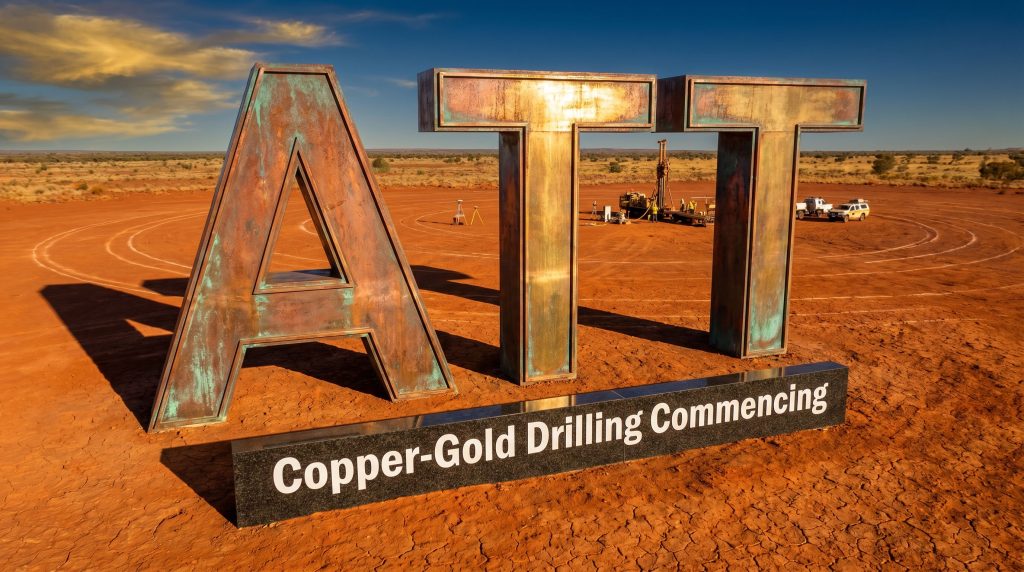
Altitude Minerals Ltd (ASX: ATT) has confirmed final RC drill collar locations for a 2,300-metre drilling campaign at its Byrock Project in New South Wales, targeting concealed copper-gold porphyry systems along what the company interprets as a north-west extension of the Macquarie Arc — Australia's most productive porphyry copper-gold province. Altitude Minerals Byrock copper gold drilling in June 2026 is now the central near-term catalyst for this explorer, with permits expected in late May 2026 and an RC rig confirmed for June.
This is the kind of catalyst investors in early-stage explorers wait for: a drill program backed by multiple converging geophysical datasets, validated by shallow aircore results, and modelled against economic deposits already operating on the same geological trend.
When big ASX news breaks, our subscribers know first
What Is the Byrock Project and Why Does the Macquarie Arc Matter?
The Macquarie Arc is arguably the most important copper-gold address in Australia. It hosts some of the country's most profitable mines, including:
- Newcrest Mining's Cadia mine — one of the world's largest gold-copper mines
- Evolution Mining's North Parkes operation — a cluster of high-value "pencil" porphyry deposits that have been in continuous production since 1983
- Evolution Mining's Cowal mine — another major gold producer on the Arc
The Byrock Project sits 80km northeast of Bourke, NSW, 3km from the Mitchell Highway, in what Altitude Minerals interprets as the north-west extension of the Macquarie Arc's Junee-Narromine Volcanic Belt. This segment of the Arc has seen far less systematic modern exploration than the southern portions hosting Cadia and North Parkes.
The scale of industry interest in this corridor is significant. Third-party exploration commitments along the ground between North Parkes and Byrock include a multi-year $195 million exploration agreement between AngloGold Ashanti and Kincora Copper (announced June 2023), as well as a further earn-in arrangement involving Inflection Resources (announced May 2024). These are serious operators deploying serious capital on the same geological trend.
From Pixels to Drill Collars: How Altitude Built These Targets
The drill program is the product of a disciplined, multi-stage exploration workflow that has progressively narrowed a broad area of prospectivity down to six specific drill holes across three priority targets.
The targeting process integrated:
- 2025 fixed-wing airborne magnetics — 12,824 line kilometres at 100-metre spacing, identifying pipe-like magnetic anomalies interpreted as porphyry cores
- Ground gravity surveys — 375 stations at 100-metre spacing, identifying gravity lows interpreted as hydrothermal alteration and breccia halos surrounding the magnetic cores
- Passive seismic surveys — 52 line kilometres of data, used to determine depth to bedrock and refine drill collar positioning
- 2025 aircore drilling — 22 holes for 2,198 metres, which returned pathfinder element geochemistry and hydrothermal alteration mineral assemblages consistent with proximity to a porphyry system
- FTIR and spectral mineralogy — laboratory analysis of aircore chips to map alteration zonation
The result is a geophysical and geochemical picture where gravity lows form halos around discrete magnetic pipe-like anomalies — a geometry directly analogous to the structure of economic deposits at North Parkes.
Managing Director Duncan Chessell said: "These targets reflect disciplined screening of multiple prospects using geophysics, air-core drilling and alteration studies, narrowing our focus to the most compelling opportunities along an interpreted extension of the Macquarie Arc. This drilling represents a decisive step in testing for concealed porphyry systems under shallow cover; exactly the type of generative exploration that drives new discoveries on the margins of proven world-class mineralised belts."
The Drill Program: Six Holes, Three Targets, 2,300 Metres
The 2026 RC campaign comprises six planned holes across three targets — P02, P01, P38, and T47 — with depths to anomaly ranging from 150 metres to 400 metres and total hole depths between 300 metres and 500 metres.
| Hole ID | Target | Depth to Anomaly (m) | Total Depth (m) |
|---|---|---|---|
| 26PL01 | P02 | 225 | 350 |
| 26PL02 | P01 | 150 | 300 |
| 26PL03 | P38 | 280 | 400 |
| 26PL04 | P38 | 200 | 350 |
| 26PL05 | P38 | 350 | 400 |
| 26PL06 | T47 | 400 | 500 |
| Total | 2,300 |
The P38 target receives the most attention in the current program, with three holes planned. The strategy at P38 begins with a vertical hole to confirm the geometry of the magnetic anomaly, followed by angled holes to test the margins of the system — a logical approach for intersecting the mineralised shell around a pipe-like porphyry core.
At all targets, the RC holes are designed to drill beneath the shallow 2025 aircore program, which tested only the near-surface expression of the geophysical anomalies. Furthermore, the RC program will reach the depths at which the geophysical modelling predicts the core of each system sits.
Understanding "Pencil Porphyry" Deposits: A Primer for Investors
What Is a Pencil or Pipe Porphyry?
Most investors are familiar with the concept of a porphyry copper-gold deposit as a large, bulk-tonnage system. What is less commonly understood is that porphyry systems can occur in clusters of narrow, cylindrical (pipe-like) intrusions rather than as a single large body. These are informally called "pencil porphyries" because of their elongated, roughly cylindrical geometry when viewed in cross-section or three dimensions.
Why Does the Geometry Matter?
A pipe-like geometry means the surface footprint of the mineralised system can be quite small — potentially as little as a few hundred metres across — while still hosting economically significant copper and gold grades at depth. This has important implications for exploration: a small surface footprint makes these systems easy to miss with conventional wide-spaced drilling, but modern geophysics can detect the magnetic and density contrasts created by the altered and mineralised rock column.
The North Parkes Analogy
Evolution Mining's E26 deposit at North Parkes — one of the original pencil porphyries in the Arc and still being mined by block cave method today — has a mineralised plan-view footprint of approximately 170 metres by 400 metres. That is a remarkably small surface expression for a deposit of economic significance. The North Parkes operation as a whole is a cluster of similar deposits.
Altitude Minerals interprets the geophysical anomalies at Byrock as potentially analogous in scale and geometry to the North Parkes deposits, based on the comparable dimensions of the magnetic and gravity features.
| Feature | North Parkes E26 (Analogue) | Byrock Pipe Targets (Interpreted) |
|---|---|---|
| Deposit style | Pencil/pipe porphyry Cu-Au | Pencil/pipe porphyry Cu-Au (interpreted) |
| Plan footprint | ~170m x 400m | Comparable dimensions |
| Geophysical expression | Magnetic core + gravity low halo | Magnetic pipe anomalies + gravity low halos |
| Discovery method | Historical drilling | RC drilling — June 2026 |
| Production status | Operating (since 1983) | Pre-discovery |
Glossary of Key Terms
- RC drilling (Reverse Circulation): A drilling method that uses compressed air to blow rock chips to the surface, allowing rapid sampling of subsurface geology
- Porphyry deposit: A large, low-to-moderate grade copper and/or gold deposit formed by hydrothermal fluids associated with igneous intrusions
- Hydrothermal alteration: Chemical changes in rock caused by hot, mineralising fluids — often a key indicator of proximity to an ore-forming system
- mGal: Milligal, a unit of gravitational acceleration used in gravity surveys
- 1VD gravity: First vertical derivative of gravity data, used to enhance near-surface anomaly definition
- FTIR-MIN: Fourier Transform Infrared Spectroscopy applied to identify alteration minerals in drill samples
- Pathfinder elements: Elements such as arsenic, bismuth, tellurium, and molybdenum that, while not necessarily economic themselves, are commonly associated with copper-gold mineralisation and indicate proximity to a deposit
Timeline to First Results
The program is well-advanced logistically, with a clear near-term schedule.
| Milestone | Expected Timing |
|---|---|
| Drill permits received | Late May 2026 |
| RC rig mobilisation | June 2026 |
| Drilling commences | June 2026 |
| First assay results | Following drilling completion |
The 2,300-metre campaign is a focused program. With six holes and rig availability confirmed, the company should be in a position to report initial results within weeks of the rig spudding. Consequently, the Altitude Minerals Byrock copper gold drilling in June 2026 timetable leaves little room for delay, reinforcing how imminent this exploration milestone truly is.
The Investment Thesis in Context
Several elements combine to make this a program worth tracking closely.
The geological setting is proven. The Macquarie Arc has produced multiple world-class mines. The economic case for porphyry exploration in this province is not speculative — it is demonstrated by decades of production at Cadia and North Parkes. The question for Altitude is whether the Arc extends to the northwest and hosts analogous systems under shallow cover.
The targeting is rigorous. This is not speculative first-pass drilling. The company has run airborne magnetics, ground gravity, passive seismic, and aircore drilling across the project, and used the integrated results to design holes that directly test the geophysically defined anomalies. In addition, the 2025 aircore program already returned encouraging pathfinder chemistry and alteration assemblages, providing direct geochemical support for the geophysical interpretation.
The analogues are tangible. The comparison to North Parkes is grounded in the observable geophysical similarities between the Byrock targets and the pipe anomalies associated with the E26 and surrounding deposits. The E26 deposit's small footprint — and its ongoing economic productivity since 1983 — illustrates that pipe porphyry systems can carry significant value within a compact, drill-testable geometry.
The scale of nearby industry activity adds context. The multi-year, multi-hundred-million-dollar exploration commitments by major and mid-tier operators on the same geological trend between North Parkes and Byrock reflect a shared view among technically sophisticated explorers that this corridor warrants sustained attention.
The program is fully defined and imminent. Collar locations are set, permits are in the submission process, and a rig is confirmed. There is no further preparatory work standing between the current stage and results.
The next major ASX story will hit our subscribers first
Why Investors Should Watch ATT Closely
Altitude Minerals enters June 2026 with a well-prepared, geophysically justified drill program targeting a style of mineralisation that has proven economic in the same geological province. The company's systematic approach — moving from regional airborne surveys through ground geophysics, shallow aircore validation, and now deep RC testing — reflects a methodical exploration philosophy rather than speculative punting.
The near-term binary event is straightforward: six holes will test whether the geophysical and geochemical signals detected at Byrock reflect genuine porphyry Cu-Au systems at depth. Indeed, the significance of Altitude Minerals Byrock copper gold drilling in June 2026 cannot be overstated for investors monitoring early-stage exploration on Australia's most celebrated copper-gold belt.
Key Takeaway: Altitude Minerals (ASX: ATT) is weeks away from drilling its highest-priority copper-gold porphyry targets at Byrock, NSW — on an interpreted extension of the same Macquarie Arc that hosts the Cadia and North Parkes mines. With six RC holes across three geophysically defined pipe targets, permits expected in late May, and a rig confirmed for June 2026, the next major inflection point for this exploration story is imminent.
Ready to Follow Altitude Minerals' Drilling Campaign at Byrock?
With RC rigs confirmed for June 2026 and drill collars locked in across three priority copper-gold porphyry targets on an interpreted extension of Australia's most celebrated mining belt, Altitude Minerals (ASX: ATT) is entering one of its most significant exploration milestones to date. Investors looking to understand the full scope of the Byrock Project, the company's exploration strategy, and how to stay across upcoming results should head directly to the Altitude Minerals Investor Centre for the latest announcements, project updates, and corporate information.