July 22, 2026
The Thermal Energy Problem That Makes Alumina One of Industry's Toughest Decarbonisation Challenges
Across the global mining and metals sector, few industrial processes present a more stubborn emissions challenge than alumina refining. Unlike many manufacturing operations that can pivot toward electrification, alumina refineries rely on sustained, high-temperature combustion to drive the Bayer Process, the dominant method for extracting alumina from bauxite ore. This thermal dependency has kept coal-fired boilers at the operational core of refineries worldwide for decades, and replacing that energy source at industrial scale is considerably more complex than simply switching fuels.
It is within this challenging context that the Rio Tinto bio pellet deal with SuperChar takes on its full significance. Signed in July 2026, this five-year commercial supply agreement between Rio Tinto and Australian bioenergy firm SuperChar represents a carefully structured attempt to introduce lower-carbon fuel into one of the most thermally demanding industrial settings on Earth.
When big ASX news breaks, our subscribers know first
Understanding the Bayer Process and Why It Resists Decarbonisation
The Combustion Imperative at the Heart of Alumina Production
The Bayer Process, developed in the late nineteenth century and still the foundation of global alumina production, works by dissolving bauxite in caustic soda at elevated temperatures and pressures, then precipitating aluminium hydroxide from the resulting solution before calcining it into alumina. That calcination step, along with the digestion phase, requires continuous, high-grade thermal energy measured in hundreds of degrees Celsius.
This is fundamentally different from aluminium smelting, where electricity drives the electrolytic reduction of alumina into metal. Smelting can be decarbonised by connecting to renewable power grids. Refinery boilers, by contrast, need combustion. That combustion requirement places alumina refining in the same "hard-to-abate" industrial category as cement clinker production and primary steelmaking, sectors where carbon-free alternatives remain either prohibitively expensive, technically immature, or both.
The energy intensity is not trivial. Alumina refineries are among the largest industrial consumers of steam and process heat globally, and the fuels powering that heat have historically been coal and natural gas, both with substantial Scope 1 emissions footprints. Furthermore, the growing role of renewable energy in mining is beginning to reshape expectations for what is commercially achievable across even the most thermally demanding operations.
Rio Tinto's Gladstone Operations: Scale and Emissions Context
Rio Tinto operates two alumina refineries in Gladstone, Queensland: the Yarwun refinery, which it operates and owns outright, and Queensland Alumina Limited (QAL), in which it holds a significant equity stake. These two facilities sit at the centre of one of Australia's largest industrial clusters and form a critical part of Rio Tinto's aluminium value chain. The Gladstone aluminium operations produce smelter-grade alumina destined for both internal smelting operations and external customers.
According to Rio Tinto's annual report, the company's 2025 gross Scope 1 and 2 greenhouse gas emissions totalled 31.5 million tonnes of CO₂-equivalent. Aluminium and alumina operations account for a meaningful share of that figure, making the Gladstone refineries a natural focal point for emissions reduction efforts. Regulatory scrutiny from Australian climate disclosure frameworks, combined with growing pressure from institutional investors prioritising climate-aligned portfolios, has accelerated the urgency of finding practical solutions.
The core challenge facing Rio Tinto's Gladstone operations is not a lack of ambition but a lack of mature, commercially viable alternatives to fossil-fuel combustion at refinery scale. That reality is shaping the technology pathway the company is now pursuing.
What Bio Pellets Actually Are, and Why They Matter for Industrial Boilers
Composition, Energy Density, and Combustion Properties
Bio pellets are densified biomass materials, typically produced by compressing agricultural residues, wood waste, or purpose-grown energy crops into uniform cylindrical forms. The pelletisation process is critical because raw biomass has low bulk density, variable moisture content, and inconsistent combustion characteristics that make it difficult to handle and burn efficiently in industrial boilers designed for coal.
By contrast, processed bio pellets offer:
- Significantly reduced moisture content compared to raw biomass, typically below 10%
- Bulk densities approaching that of lower-grade thermal coal, improving conveying and storage compatibility
- Reasonably consistent calorific values, generally in the range of 16 to 19 megajoules per kilogram, compared to thermal coal at approximately 24 to 28 MJ/kg
- Lower ash yields than many coal grades, reducing handling and disposal requirements
- Near-zero net CO₂ emissions under biomass accounting methodologies, provided the feedstock is sourced from sustainably managed or waste biomass streams
The energy density gap relative to coal means that substituting bio pellets on a tonne-for-tonne basis results in lower thermal output. Consequently, co-firing strategies — blending bio pellets with coal to maintain boiler performance — are the standard starting point for large industrial facilities making the transition.
SuperChar's Production Model and Its Strategic Location
SuperChar's planned production facility in Gladstone is not an incidental choice. Locating the plant within close proximity to Rio Tinto's two refinery sites eliminates a major logistical cost and emissions burden that would arise from transporting biomass feedstock over long distances. Industrial biomass supply chains have historically struggled with the economics of long-haul transport, which can erode the carbon and cost advantages of the fuel itself.
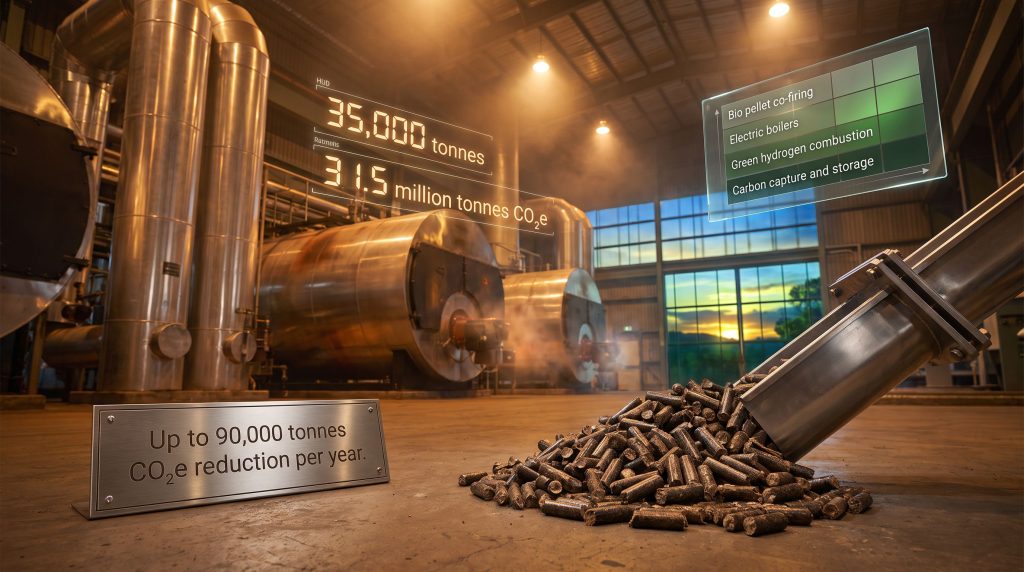
The facility is designed with an initial nameplate production capacity of 35,000 tonnes of bio pellets per year, calibrated specifically to the near-term offtake volumes that Rio Tinto has committed to assess under the agreement. If operational performance validates the co-firing model, there is a credible pathway toward capacity expansion, though no formal commitment to increased volumes has been disclosed. As reported by MarketScreener, the deal marks a significant step in Rio Tinto's approach to cutting alumina refinery emissions through locally sourced bioenergy.
Inside the Rio Tinto Bio Pellet Deal With SuperChar: Structure and Mechanics
Agreement Parameters at a Glance
| Parameter | Detail |
|---|---|
| Agreement Type | Five-year bio pellet supply (offtake) agreement |
| Supplier | SuperChar Limited |
| Buyer | Rio Tinto |
| Target Sites | Yarwun and Queensland Alumina refineries, Gladstone |
| First Supply Target | 2028 |
| Initial Annual Volume | 35,000 tonnes of bio pellets |
| Projected Scope 1 Reduction | Up to 90,000 tonnes of CO₂-equivalent per year |
The Validation Work That Preceded Commercial Commitment
The five-year supply agreement did not emerge in isolation. Rio Tinto conducted operational trials at its Gladstone facilities during 2024 and 2025, testing bio pellet combustion performance in existing boiler infrastructure and evaluating the practicalities of fuel handling, feed system compatibility, and ash management. The transition from trial to offtake agreement signals that those assessments generated sufficient confidence to justify a commercial commitment, though the deal structure preserves Rio Tinto's ability to conduct further assessments before the first delivery in 2028.
This staged validation approach is increasingly common in hard-to-abate sector decarbonisation, where the cost of operational failure at an active industrial facility is high enough to justify extended pre-commercial testing periods. The gap between agreement signing and first delivery — roughly two years — reflects both the time needed to construct SuperChar's Gladstone facility and the completion of outstanding boiler compatibility assessments Rio Tinto has flagged.
Emissions Arithmetic: The 90,000-Tonne Reduction in Context
The projected reduction of up to 90,000 tonnes of CO₂-equivalent per year from consuming 35,000 tonnes of bio pellets is explained by the carbon accounting methodology applied to biomass combustion. Under internationally accepted greenhouse gas accounting frameworks, biomass combustion is treated as carbon-neutral at the point of combustion when the feedstock is derived from sustainably managed or waste sources. This is fundamentally different from fossil fuel combustion, which releases carbon that has been sequestered underground for millions of years.
The ratio of CO₂e reduction to bio pellet volume — approximately 2.57 tonnes of CO₂e avoided per tonne of bio pellets consumed — reflects the combination of combustion carbon neutrality and the displacement of coal, which carries a high carbon intensity per unit of energy delivered.
Scale reality check: A 90,000-tonne annual Scope 1 reduction represents approximately 0.29% of Rio Tinto's 2025 gross Scope 1 and 2 emissions base of 31.5 million tonnes CO₂e. This figure underscores the magnitude of the decarbonisation challenge facing the broader aluminium value chain, and why Rio Tinto's leadership has explicitly framed bio pellets as one component within a broader, multi-technology portfolio rather than a standalone solution.
How Bio Pellet Co-Firing Compares to Other Decarbonisation Pathways
Comparative Technology Assessment for Alumina Refinery Decarbonisation
| Technology Pathway | Capital Intensity | Operational Readiness | Emissions Reduction Potential | Key Limitation |
|---|---|---|---|---|
| Bio pellet co-firing | Low to Medium | Near-term (2028) | Moderate | Biomass supply chain scale |
| Electric boilers (renewable-powered) | High | Medium-term | High | Grid reliability and energy cost |
| Green hydrogen combustion | Very High | Long-term | Very High | Hydrogen cost and availability |
| Carbon capture and storage | Very High | Long-term | High | Infrastructure and permanence risk |
| Full process heat electrification | High | Medium-term | High | Technology maturity at refinery scale |
Why the Bridge Technology Framing Matters
Bio pellet co-firing occupies a specific and deliberate position in the decarbonisation technology stack. It requires no boiler replacement, minimal capital expenditure on feed system modifications relative to more transformative alternatives, and leverages existing combustion infrastructure. For a company managing the operational continuity of two active industrial refineries, these characteristics are not trivial.
The risk of "technology lock-in" deserves acknowledgment. If bio pellet co-firing becomes embedded in refinery operations without a clear transition plan toward deeper decarbonisation pathways, the incremental capital invested in biomass handling infrastructure could create inertia against more transformative changes. Rio Tinto's Pacific Operations leadership has been explicit in framing the bio pellet strategy within a multi-technology approach, signalling awareness of this risk and a deliberate intent to avoid treating co-firing as an endpoint rather than a waypoint.
European power generation offers a relevant precedent. Several major European utilities adopted bio pellet co-firing in coal plants during the 2010s as a transitional measure under renewable energy obligations. Those programmes generated operational expertise in biomass fuel handling and supply chain management that subsequently informed more ambitious conversions. The same institutional learning dynamic may benefit Rio Tinto's Gladstone operations over the term of the SuperChar agreement. In addition, broader mining decarbonisation pathways increasingly demonstrate that bridge technologies play an economically rational role in staged transitions.
What This Agreement Means for Queensland's Industrial Bioenergy Ecosystem
SuperChar's Gladstone Facility as Bioenergy Infrastructure Catalyst
Beyond its immediate emissions impact on Rio Tinto's operations, the SuperChar agreement serves a structural function in Queensland's nascent industrial bioenergy sector. A creditworthy, five-year offtake commitment from a major global miner provides the kind of revenue certainty that bioenergy project developers need to access project finance. Without that anchor contract, the commercial risk profile of a purpose-built industrial bio pellet facility in regional Queensland would be difficult to de-risk for lenders.
This mirrors the project finance dynamics well established in the renewable energy sector, where power purchase agreements with investment-grade counterparties have consistently enabled projects to access debt on commercially viable terms. The parallel is instructive for understanding how the bioenergy sector in Australia may scale — not through government mandates alone, but through commercial offtake structures that create bankable revenue streams for producers.
Capacity Expansion Potential and Replicability
If the first phase of the SuperChar supply arrangement demonstrates reliable pellet quality, consistent combustion performance, and an acceptable cost per tonne of CO₂e avoided, the commercial logic for scaling volumes becomes compelling. SuperChar's Gladstone facility could in principle expand output to supply a larger share of Rio Tinto's total boiler fuel requirements across both Yarwun and QAL, though any such expansion would represent a separate commercial decision beyond the current agreement scope.
The replicability of this model across Rio Tinto's other alumina operations is also worth considering. A successful Gladstone implementation creates an operational blueprint and institutional knowledge base that could be adapted to other refinery contexts, subject to local feedstock availability and regulatory frameworks. This dynamic also supports Australia's green metals push, which increasingly depends on scalable, commercially proven decarbonisation models across major industrial sites.
The next major ASX story will hit our subscribers first
Frequently Asked Questions
What is the Rio Tinto bio pellet deal with SuperChar?
Rio Tinto has entered a five-year commercial supply agreement with SuperChar, an Australian bioenergy company, to deliver locally produced bio pellets to its Yarwun and Queensland Alumina refineries in Gladstone. The pellets will be co-fired with coal in refinery boilers as part of a broader strategy to reduce Scope 1 greenhouse gas emissions, with first deliveries targeted for 2028.
How large is the projected emissions reduction from bio pellet use?
Consuming 35,000 tonnes of bio pellets annually is projected to reduce Rio Tinto's reported Scope 1 emissions by up to 90,000 tonnes of CO₂-equivalent per year, based on biomass carbon accounting methodologies that treat sustainably sourced biomass combustion as carbon-neutral at the point of emission.
When does the bio pellet supply to Gladstone refineries begin?
First supply is targeted for 2028, subject to the completion of boiler compatibility assessments by Rio Tinto, regulatory approvals for SuperChar's production facility, and construction and commissioning of the Gladstone pellet plant.
Are bio pellets a permanent solution to alumina refinery emissions?
Industry analysis and Rio Tinto's own strategic framing position bio pellets as a near-term, lower-capital bridge measure within a broader multi-technology decarbonisation programme. Longer-term pathways including process electrification, green hydrogen, and carbon capture are likely to carry a greater share of the emissions reduction burden over time. Furthermore, comparable alumina decarbonisation efforts by other industry participants suggest that no single technology will resolve the sector's emissions challenge in isolation.
What is SuperChar's planned production capacity?
SuperChar's Gladstone facility is initially designed to produce 35,000 tonnes of bio pellets per year, scaled to match Rio Tinto's near-term offtake commitment. Expansion beyond this initial capacity would depend on demonstrated operational performance and commercial outcomes under the current agreement.
Strategic Implications for Investors and Industry Observers
Reading the Deal Within Rio Tinto's Broader Emissions Architecture
For investors tracking Rio Tinto's progress toward its long-term climate commitments, the SuperChar agreement provides a tangible near-term data point rather than a transformative milestone. The deal is best understood as evidence of operational pragmatism: a major mining company choosing the lowest-capital, lowest-risk entry point into biomass fuel substitution while preserving optionality on more capital-intensive pathways.
The partnership model itself is noteworthy. Rather than attempting to develop in-house bioenergy production capability, Rio Tinto has engaged a specialist bioenergy firm and structured a supply agreement that transfers feedstock sourcing and pellet production risk to SuperChar. This asset-light approach to decarbonisation supply chain development may become a template for how large miners engage with emerging clean energy technology providers. The Australian Financial Review has previously noted Rio Tinto's preference for biofuels ahead of batteries in its carbon credit strategy, making the SuperChar arrangement consistent with a well-established directional bias across its operations.
Key Takeaways
- Proportionality matters: 90,000 tonnes CO₂e against a 31.5 million tonne emissions base is a 0.29% reduction, meaningful at the project level but illustrative of the scale of work ahead across the aluminium sector
- Operational de-risking is central: co-firing preserves boiler infrastructure and avoids the capital and operational risks of full fuel switching in active refinery settings
- Offtake agreements as bioenergy enablers: the five-year commercial commitment gives SuperChar a bankability anchor critical for project financing of its Gladstone facility
- Partnership over vertical integration: Rio Tinto's preferred model appears to be specialist supplier engagement rather than developing proprietary bioenergy capability
- Replication potential: a successful Gladstone implementation creates a transferable operational model applicable to other Rio Tinto refinery sites globally
This article contains analysis of publicly reported commercial agreements and emissions data. Forward-looking statements, projected emissions reductions, and supply timeline targets are subject to operational, regulatory, and commercial variables. Nothing in this article constitutes financial advice. Readers should conduct independent research before making investment decisions.
Want to Track the Next Major ASX Discovery Before the Market Moves?
Discovery Alert's proprietary Discovery IQ model scans ASX announcements in real time, instantly identifying high-potential mineral discoveries across more than 30 commodities and delivering actionable insights to subscribers ahead of the broader market — explore historic discovery returns on the Discovery Alert discoveries page to see what early positioning can mean, then begin your 14-day free trial at discoveryalert.com.au.