July 22, 2026
The Hidden Complexity Behind Iron Ore Production Milestones
Global iron ore markets operate on a rhythm that most investors only partially understand. When a major producer reports quarterly output figures, the headline number captures attention, but the real analytical value lies beneath the surface: which assets drove the result, how inventory dynamics shaped sales volumes, what pricing mechanisms created divergence from spot benchmarks, and whether base metals operations are quietly becoming a more material earnings variable. Vale's Q2 2026 production report, which confirmed the strongest vale second-quarter iron ore output since 2018, offers a rare opportunity to examine all of these layers simultaneously.
When big ASX news breaks, our subscribers know first
Understanding Vale's Q2 2026 Iron Ore Output in Historical Context
How Does 84.3 Million Tonnes Compare to Vale's Recent Q2 History?
Vale's Q2 2026 iron ore production of 84.3 million tonnes did not arrive in isolation. It represents a measured but meaningful continuation of a multi-year recovery trajectory that has been shaped as much by operational discipline as by geological advantage.
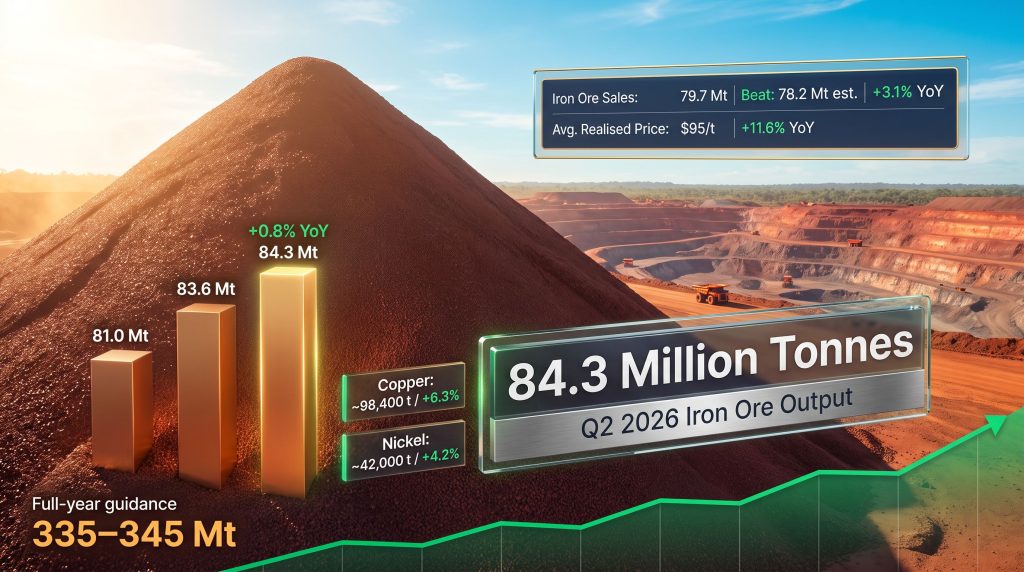
| Year | Q2 Iron Ore Output (Mt) | Year-on-Year Change |
|---|---|---|
| 2024 | ~81.0 Mt | N/A |
| 2025 | ~83.6 Mt | +3.2% |
| 2026 | 84.3 Mt | +0.8% |
The year-on-year growth rate of +0.8% may appear modest relative to prior periods, but context is essential. Vale is no longer rebuilding from a low base; it is pushing against the structural ceiling of its permitted and operational capacity across its Brazilian iron ore system, which makes each incremental tonne meaningfully harder to add.
Why 2018 Remains the Historical Reference Point
The significance of the 2018 reference point is frequently mentioned but rarely explained with precision. Prior to the Brumadinho tailings dam disaster in January 2019, Vale was operating its full portfolio of Brazilian iron ore assets, including higher-volume operations in Minas Gerais that were subsequently curtailed or placed under heightened regulatory scrutiny. The aftermath of Brumadinho triggered mandatory operational suspensions, licence reviews, and a fundamental recalibration of how Vale manages tailings storage across its entire system.
The consequence was a suppressed output ceiling that persisted for years. Achieving Q2 volumes that now eclipse most of that post-2018 period signals that Vale has largely navigated its way through the regulatory and operational constraints imposed by the disaster, though the industry-wide lessons about tailings governance remain permanently embedded in how large miners approach production planning. Understanding iron ore demand prospects is equally critical when contextualising why these production milestones matter to the broader market.
How Vale Exceeded Analyst Estimates in Q2 2026
Breaking Down the Visible Alpha Consensus Miss
The gap between analyst expectations and reported output deserves scrutiny. Visible Alpha's consensus estimate of 82.2 million tonnes was surpassed by 2.1 million tonnes, a variance of approximately 2.6%. In iron ore terms, that is not a rounding error; it is equivalent to roughly a week of continuous production from a mid-tier operation.
Three specific Brazilian projects drove this outperformance:
S11D Complex: A Record Second-Quarter Performance
The S11D complex in Pará state, in Brazil's north, is Vale's most technologically advanced iron ore operation. Unlike traditional open-cut iron ore mines that rely on truck-and-shovel fleets, S11D employs a truckless mining system using conveyor belts and in-pit crushing equipment, dramatically reducing diesel consumption and operating costs per tonne.
S11D's ore body contains iron grades typically in the range of 66-67% Fe in concentrate form, positioning it at the high end of the global iron ore quality spectrum. High-grade Brazilian ore commands meaningful premiums from Chinese steel mills seeking to reduce coke consumption per tonne of steel produced, an increasingly relevant consideration given China's ongoing pressure on steel mills to reduce carbon intensity.
Achieving a record Q2 output at S11D signals that the asset is not yet at its operational ceiling. The complex has a long-term production capacity expansion pathway through incremental equipment additions and continued ramp-up of its licensed extraction volumes.
Capanema Project: Incremental Volume Contribution
Capanema represents Vale's effort to bring previously idle or under-utilised capacity in Minas Gerais back into production. The project's ramp-up is proceeding on schedule, contributing incremental tonnes to the quarterly result without requiring greenfield capital expenditure at the scale that S11D demanded.
VGR1 Project: Deepening Minas Gerais Production
VGR1 operates within Vale's established Minas Gerais infrastructure network, meaning its volumes can be processed and exported through existing logistics corridors. This integration lowers the marginal cost of each tonne produced and demonstrates how brownfield expansions within a mature mining district can add meaningful output without proportionate capital risk.
What Vale's Iron Ore Sales Figures Reveal About Market Demand
Sales Volume vs. Production Volume: A Structural Divergence
Vale's Q2 2026 iron ore sales reached 79.7 million tonnes, a 3.1% year-on-year increase, surpassing analyst expectations of 78.2 million tonnes. The 4.6 million tonne gap between production and sales reflects inventory drawdown dynamics and logistics timing rather than any structural demand weakness.
A critical but underappreciated aspect of iron ore sales reporting is the distinction between production volume and sales volume. The 3.1% sales growth outpacing 0.8% production growth indicates that Vale was actively drawing down previously accumulated inventory during Q2. This inventory liquidation dynamic can reflect multiple factors simultaneously:
- Opportunistic selling into periods of firmer spot pricing
- Logistics throughput optimisation at Brazilian ports
- Customer demand pull from Chinese steel mills seeking to rebuild stockpiles
- Seasonal patterns in Pará and Minas Gerais that create natural inventory accumulation in certain quarters
Fines, Pellets, and Run-of-Mine: Understanding Vale's Product Mix
Vale's sales figures aggregate across three distinct product categories. Iron ore fines are the dominant volume category and are sold into the seaborne spot and term contract market. Pellets command a significant premium over fines, reflecting the value-added processing required to produce a product that steel mills can charge directly into direct reduction or blast furnace systems without sintering. Run-of-mine material represents lower-grade, less processed product typically sold at a discount to the benchmark.
The average realised price for iron ore fines of $95 per tonne incorporates the pricing mechanics of Vale's contract portfolio, which blends spot-indexed and lagged pricing mechanisms. The 11.6% year-on-year increase in realised fines pricing reflects a more favourable iron ore price environment in Q2 2026 relative to the same quarter in 2025. Furthermore, the iron ore market types and deposit classifications play a meaningful role in how these pricing differentials emerge across product categories.
How Iron Ore Prices Are Responding to Vale's Output Surge
Average Realised Price Analysis: The $95/t Signal
The 0.8% sequential decline from Q1 2026 to Q2 2026 in realised fines pricing warrants careful interpretation. Vale's reference to negative pricing mechanism impacts points to a specific feature of how large iron ore producers manage their contract books.
Many of Vale's long-term supply agreements with Asian steel mills contain pricing formulas that reference an average of index prices over a preceding period, often one to three months prior to the delivery quarter. When spot prices decline between the reference period and the delivery period, the realised contract price lags the current spot market, creating a downward pricing mechanism impact even if spot prices have subsequently stabilised or recovered.
The divergence between year-on-year price gains of +11.6% and quarter-on-quarter softness of -0.8% illustrates precisely how pricing lag mechanisms embedded in long-term iron ore supply contracts can generate short-term earnings volatility that is structurally independent of underlying demand conditions. Investors modelling Vale's EBITDA trajectory need to account for this contractual timing effect rather than extrapolating spot price movements directly into realised price forecasts.
Chinese Steel Demand and Iron Ore Price Floors in 2026
China accounts for approximately 70% of global seaborne iron ore trade, which makes Chinese steel production policy the single most important external variable for iron ore price formation. In 2026, Chinese steel output has been subject to ongoing administrative guidance targeting both capacity utilisation and carbon intensity reduction. Consequently, this creates a complex dynamic: output restrictions can depress iron ore demand volumes, but simultaneously incentivise a quality upgrade toward high-grade Brazilian fines and pellets to improve steel mill efficiency metrics.
The China steel-iron ore market continues to face structural headwinds that make quality differentiation increasingly decisive for producers like Vale. Vale's high-grade product portfolio is structurally positioned to benefit from quality-driven demand shifts even in a volume-constrained Chinese steel market.
Beyond Iron Ore: Vale's Copper and Nickel Output as Emerging Value Drivers
Copper Production Reaches 98,400 Tonnes
Vale's copper segment produced approximately 98,400 tonnes in Q2 2026, a 6.3% year-on-year increase driven primarily by record Q2 output at the Salobo complex in Pará, Brazil, with supporting contributions from Sossego in Brazil and Voisey's Bay in Canada.
Salobo is a large-scale copper-gold porphyry deposit, a geological formation characterised by disseminated copper sulphide mineralisation over very large volumes of rock. Porphyry deposits typically carry relatively low head grades, often below 1% copper, but their scale and consistent mineralogy make them amenable to bulk processing at very low unit costs. Salobo's record Q2 performance reflects the benefit of continued throughput optimisation rather than any grade improvement.
Nickel Output at ~42,000 Tonnes: Up 4.2%
Vale's nickel production reached approximately 42,000 tonnes, up 4.2% year-on-year, with two specific assets delivering standout performances:
- Long Harbour Refinery (Canada): Set a Canadian production record, reflecting successful ramp-up of its hydromet processing technology
- Onça Puma (Brazil): Delivered improved ferronickel output from its Pará operations
- Sudbury (Canada): Experienced planned biennial maintenance, a predictable headwind that created output drag offset by the gains elsewhere
The Long Harbour facility is notable because it uses a direct hydrometallurgical process to produce finished nickel, cobalt, and copper products from Voisey's Bay concentrate without smelting. This technology pathway reduces energy intensity and produces battery-grade nickel sulphate more directly than conventional pyrometallurgical routes, positioning Long Harbour as a strategically differentiated asset in the context of electric vehicle battery supply chains.
| Metal | Q2 2026 Output | YoY Change | Key Driver |
|---|---|---|---|
| Iron Ore | 84.3 Mt | +0.8% | S11D record, Capanema, VGR1 |
| Copper | ~98,400 t | +6.3% | Salobo record Q2 |
| Nickel | ~42,000 t | +4.2% | Long Harbour record, Onça Puma |
The next major ASX story will hit our subscribers first
What Analysts Are Saying About Vale's Q2 2026 Results
Jefferies' Assessment and the Unit Cost Variable
Jefferies characterised Vale's Q2 production report as a solid result driven by better-than-expected iron ore volumes. However, the firm identified unit cost performance as the primary unresolved variable heading into Vale's Q2 earnings release on July 30. This is a critical distinction that separates production reporting from earnings quality assessment.
Volume beats confirm operational execution, but they do not guarantee margin expansion. If inflationary cost pressures across labour, energy, and consumables have risen proportionately with output, the earnings uplift from higher volumes can be substantially eroded. Unit cost per tonne is the metric that will ultimately determine whether Q2 2026 represents a genuine earnings catalyst or a volume-without-margin event.
Citi's EBITDA Upgrade Signal
Citi analyst Alexander Hacking indicated that consensus estimates for Vale's Q2 EBITDA are likely to shift upward by 1% to 2% following the production report, with the copper and nickel segments identified as particularly constructive contributors to the overall result. The framing of these results as a continued strong start to the year specifically highlights the base metals division as an increasingly material earnings variable, a shift in analytical emphasis that reflects how Vale's diversification story is gaining traction with institutional investors.
Vale's Full-Year 2026 Production Guidance: 335-345 Million Tonnes
Interpreting Unchanged Annual Guidance After a Strong Q2
Vale's decision to maintain its full-year guidance range of 335 to 345 million tonnes despite a strong Q2 performance is analytically informative. Rather than revising guidance upward, which would signal management confidence, the unchanged guidance suggests either deliberate conservatism around H2 operational variables or a considered view that Q2 outperformance will not be fully replicated across the remaining two quarters.
A step-by-step tracking framework for investors monitoring guidance delivery:
- Establish H1 2026 cumulative output by combining confirmed Q1 and Q2 totals
- Calculate the implied H2 production requirement against the 335-345 Mt guidance range
- Assess whether S11D's ramp-up trajectory supports the upper or lower guidance boundary
- Factor in Brazilian seasonal weather patterns, which typically introduce logistics variability in H2
- Monitor Oman pellet plant resumption progress as an incremental volume upside variable
Risks to Full-Year Guidance
Several variables could disrupt H2 delivery against the guidance range:
- Weather and logistics: Seasonal rainfall in Pará and port congestion at Ponta da Madeira and Tubarão terminals represent recurring operational risks
- Regulatory evolution: Post-Brumadinho tailings dam compliance requirements continue to evolve and can impose unexpected operational pauses
- Geopolitical supply chain disruption: The Oman episode demonstrated that risks to pellet processing infrastructure extend well beyond traditional Brazilian mining risks
In addition, the iron ore price decline driven by surplus conditions and shifting Chinese demand presents a further layer of risk that management must factor into its H2 planning assumptions.
The Oman Pellet Plant Restart: A Geopolitical Supply Chain Case Study
Vale's Oman pellet plants were halted earlier in 2026 due to conflict-related disruptions in the Middle East and the associated logistics constraints that made continued operation impractical. A partial resumption in late June 2026 represents a meaningful development for pellet supply volumes in H2.
Vale's Oman operations illustrate an underappreciated dimension of modern mining supply chain risk: for major producers with geographically diversified processing infrastructure, geopolitical instability is no longer confined to traditional mining jurisdictions. Pellet plants, shipping corridors, and downstream processing nodes across the Middle East, Southeast Asia, and beyond are now legitimate components of a comprehensive supply chain risk assessment for any large iron ore producer.
The Oman facilities serve a strategic purpose beyond pure volume. Locating pellet production closer to Asian end markets reduces shipping costs relative to pellets produced in Brazil and shipped across the Atlantic and Indian Oceans, while also providing Vale with processing optionality outside its concentrated Brazilian production base.
How Vale Compares to Global Iron Ore Peers
Vale vs. BHP and Rio Tinto: A Structural Framework
| Metric | Vale (Q2 2026) | BHP (Pilbara) | Rio Tinto (Pilbara) |
|---|---|---|---|
| Q2 Output | 84.3 Mt | TBC Q2 2026 | TBC Q2 2026 |
| Primary Geography | Brazil | Australia | Australia |
| Primary Asset | S11D | Newman/Jimblebar | Gudai-Darri |
| Key Differentiator | High-grade fines | Scale/logistics | Grade consistency |
The Brazilian versus Australian origin distinction carries more analytical weight than is commonly appreciated. Brazilian iron ore from Carajás (S11D's host province) typically assays at 65-67% Fe, compared to Pilbara hematite blends from BHP and Rio Tinto that commonly average in the 61-62% Fe range. This grade differential translates directly into steel mill productivity: higher-grade ore requires less coke per tonne of hot metal produced and generates less slag, reducing both input costs and environmental intensity per unit of steel output.
However, Australia's iron ore advantages in freight efficiency remain significant, with Pilbara-to-China voyages running approximately 7-10 days compared to Brazil-to-China routes requiring roughly 30-35 days. This freight cost differential partially offsets the grade premium commanded by Brazilian material, and its magnitude fluctuates with global bulk carrier freight rates. Furthermore, Vale's annual output figures have already demonstrated the competitive threat that Brazilian producers pose to Australian dominance of the seaborne iron ore trade.
Frequently Asked Questions: Vale's Iron Ore Output and Market Position
What was Vale's Q2 2026 iron ore output?
Vale produced 84.3 million tonnes of iron ore in Q2 2026, representing the highest vale second-quarter iron ore output since 2018 and surpassing the Visible Alpha analyst consensus of 82.2 million tonnes.
What drove Vale's production beat against analyst estimates in Q2 2026?
Three Brazilian projects delivered the outperformance: a record Q2 at the S11D complex in Pará, incremental volumes from the Capanema project, and additional output from the VGR1 project in Minas Gerais.
What is Vale's full-year 2026 iron ore production guidance?
Vale maintained its annual guidance range of 335 to 345 million tonnes, with all other commodity guidance also left unchanged.
How did Vale's copper and nickel output perform in Q2 2026?
Copper production rose 6.3% year-on-year to approximately 98,400 tonnes, while nickel output increased 4.2% to approximately 42,000 tonnes, with record performances at Salobo and Long Harbour respectively.
When will Vale release its Q2 2026 earnings results?
Vale is scheduled to release its Q2 2026 earnings on July 30, 2026.
What happened to Vale's Oman pellet operations in 2026?
Vale suspended its Oman pellet plants due to Middle Eastern conflict conditions and associated logistics constraints, with a partial resumption beginning in late June 2026.
Key Takeaways: Vale's Q2 2026 Production Report at a Glance
| Metric | Q2 2026 Result | vs. Consensus | YoY Change |
|---|---|---|---|
| Iron Ore Production | 84.3 Mt | Beat (82.2 Mt est.) | +0.8% |
| Iron Ore Sales | 79.7 Mt | Beat (78.2 Mt est.) | +3.1% |
| Avg. Realised Price (Fines) | $95/t | N/A | +11.6% YoY / -0.8% QoQ |
| Copper Output | ~98,400 t | N/A | +6.3% |
| Nickel Output | ~42,000 t | N/A | +4.2% |
| Full-Year Guidance | 335-345 Mt | Unchanged | N/A |
Three Forward-Looking Signals Investors Should Monitor Heading Into Vale's Q2 Earnings
- Unit cost per tonne of iron ore: The variable that will determine whether volume outperformance translates into margin expansion or is absorbed by inflationary cost pressures
- Oman pellet plant resumption trajectory: Any acceleration in restart progress would add meaningful pellet volume and premium revenue to H2 2026 guidance delivery
- S11D ramp-up rate: Continued throughput improvements at Vale's flagship asset represent the clearest pathway to guidance upper-end delivery and potential positive revisions in subsequent quarters
This article contains forward-looking statements and analysis based on publicly available production reporting and analyst commentary. It does not constitute financial advice. Commodity markets, production forecasts, and earnings estimates carry inherent uncertainty. Investors should conduct independent due diligence before making investment decisions.
Want to Identify the Next Major Mineral Discovery Before the Market Does?
While Vale's production milestones reflect years of operational development, Discovery Alert's proprietary Discovery IQ model scans ASX announcements in real time, instantly identifying significant mineral discoveries across iron ore, copper, nickel, and more than 30 other commodities — delivering actionable alerts to subscribers before the broader market reacts. Explore historic discoveries and their returns to understand the scale of opportunity, then begin your 14-day free trial at Discovery Alert to position yourself ahead of the next major find.