June 21, 2026
Manufacturing advanced materials requires precision engineering capabilities far beyond traditional industrial processes. The semiconductor revolution has created unprecedented demand for ultra-pure materials that meet exacting specifications, fundamentally reshaping how chemical processing facilities approach production planning and quality control systems. This transformation represents more than incremental improvement; it signals a complete reimagining of industrial manufacturing priorities where purity levels previously considered impossible have become essential market requirements for the world's largest alumina production facility.
What Defines the World's Largest Alumina Production Facilities?
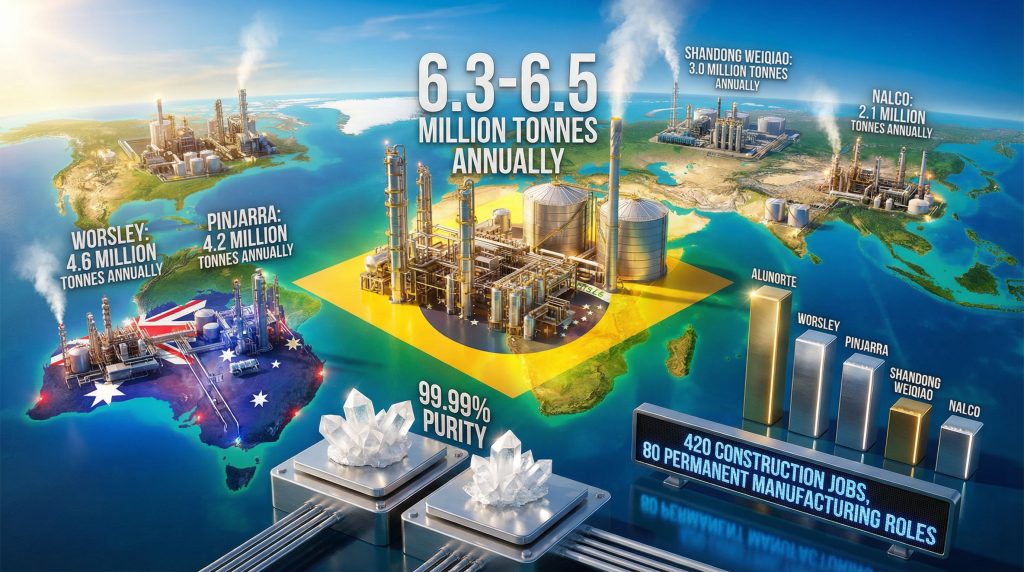
Production Capacity Benchmarks Across Global Refineries
Global alumina refining operates at massive industrial scales, with individual facilities processing millions of tonnes annually through sophisticated chemical processing systems. Furthermore, the world's largest facilities represent decades of industrial engineering advancement and strategic resource development.
Global Alumina Refinery Capacity Rankings:
| Facility | Location | Capacity (Million Tonnes/Year) |
|---|---|---|
| Hydro Alunorte | Brazil | 6.3-6.5 |
| Worsley Alumina | Australia | 5.3 |
| Alcoa Pinjarra | Australia | 4.2 |
| Queensland Alumina Limited | Australia | 3.95 |
| Rio Tinto Yarwun | Australia | 3.4 |
These production volumes represent the culmination of integrated bauxite mining operations, sophisticated chemical processing infrastructure, and decades of operational optimization. Each facility employs hundreds of specialized workers and operates continuous processing cycles to maintain consistent output volumes.
High Purity Alumina vs. Standard Alumina Production
The distinction between commodity alumina and high purity alumina (HPA) represents one of the most significant technological gaps in modern chemical processing. Standard alumina refining focuses on bulk production efficiency, typically achieving 98-99% purity levels suitable for primary aluminum smelting operations.
Critical Manufacturing Distinction: HPA requires 99.99% purity specifications for semiconductor applications, representing approximately 100 times greater purity than commodity-grade alumina used in traditional aluminum production.
This purity differential necessitates fundamentally different processing methodologies. While standard alumina refining utilizes the established Bayer Process for bulk efficiency, HPA production demands additional purification stages, specialized crystallization processes, and intensive quality control protocols operating continuously.
Technical Manufacturing Requirements:
- Fractional crystallization equipment for ultra-pure material isolation
- Advanced filtration systems removing trace contaminants
- Analytical instrumentation capable of detecting parts-per-million impurities
- 24/7 laboratory testing capabilities with real-time process monitoring
- Automated quality gates preventing off-specification material advancement
When big ASX news breaks, our subscribers know first
How Do Regional Manufacturing Hubs Compare in Scale and Capability?
Brazil's Dominance in Raw Alumina Production
Brazil's Hydro Alunorte facility maintains its position as the world's largest single-site alumina production operation, leveraging integrated bauxite mining operations in Pará State. This facility benefits from direct proximity to high-grade bauxite deposits, reducing transportation costs and supply chain complexity through vertical integration within the Hydro organizational structure.
The Brazilian advantage extends beyond raw material access. Environmental regulatory frameworks in Brazil have evolved to accommodate large-scale industrial operations while maintaining oversight through the Brazilian mining authority (DNPM) and environmental agency IBAMA requirements.
Australia's Strategic Position in Alumina Refining
Australia has established itself as a global alumina refining powerhouse through strategic geographic distribution across Western Australia and Queensland. This positioning leverages domestic bauxite sources while maintaining export capability through established port facilities.
Top Australian Alumina Facilities by Capacity:
- Worsley Alumina (Western Australia) – 5.3 million tonnes capacity
- Alcoa Pinjarra (Western Australia) – 4.2 million tonnes capacity
- Queensland Alumina Limited – 3.95 million tonnes capacity
- Rio Tinto Yarwun – 3.4 million tonnes capacity
- Alcoa Kwinana – 2.1 million tonnes capacity
Queensland's Gladstone region has emerged as a particularly significant industrial hub, hosting multiple major refineries alongside supporting chemical processing infrastructure. This industrial clustering creates synergistic benefits through shared logistics, skilled workforce development, and integrated supply chain optimization.
Emerging Asian Production Centers
Chinese government industrial policy has prioritized domestic alumina refining capacity expansion as part of broader strategic mineral security initiatives. State-owned enterprises have invested heavily in new refinery construction and technological capability enhancement, fundamentally altering global market share distribution patterns.
Indonesian smelting complex developments represent another significant shift in regional production capability. However, Indonesia's abundance of bauxite resources, combined with government policies encouraging domestic value-added processing, has attracted substantial international investment in integrated mining and refining operations.
What Makes High Purity Alumina Production Strategically Different?
Technical Manufacturing Requirements
HPA manufacturing demands processing capabilities that extend far beyond traditional alumina refining methodologies. The 99.99% purity specification requires elimination of virtually all trace elements, necessitating sophisticated analytical chemistry capabilities and process control systems.
HPA vs Standard Alumina Specifications:
| Parameter | Standard Alumina | High Purity Alumina |
|---|---|---|
| Purity Level | 98-99% | 99.99% |
| Primary Application | Aluminum Smelting | Semiconductors |
| Processing Stages | 3-4 Major Steps | 8-12 Purification Steps |
| Quality Control | Batch Testing | Continuous Monitoring |
| Energy Intensity | Moderate | Very High |
The Alpha HPA facility in Gladstone exemplifies these advanced manufacturing requirements through its integration of state-of-the-art testing laboratory capabilities operating continuously. This 24/7 operational model reflects the critical nature of maintaining consistent purity levels throughout the production process.
End-Market Applications Driving Demand Growth
Semiconductor chip manufacturing represents the primary driver of HPA demand growth, with global digitalization creating exponential increases in processing requirements. Data centers alone consume vast quantities of semiconductors, each requiring ultra-pure alumina components for thermal management and electrical insulation applications.
Key HPA Application Sectors:
- Semiconductor Manufacturing: Substrate materials and chip cooling systems
- LED Lighting Components: High-efficiency lighting system elements
- Lithium-ion Battery Separators: Advanced battery technology components
- Data Center Infrastructure: Computer chip cooling and thermal management
- Sapphire Glass Production: High-strength transparent materials
The accelerating demand from data centers has become particularly significant, as cloud computing expansion and artificial intelligence applications require ever-increasing processing capabilities. Each advancement in computing power translates directly into increased HPA consumption requirements.
Supply Chain Integration Strategies
The Alpha HPA facility demonstrates advanced industrial symbiosis through its integrated approach to supply chain management. Located in Gladstone's established industrial precinct, the facility sources key inputs from local operations while returning by-products for use as industrial feedstock by neighboring companies.
Industrial Integration Benefits:
- Orica Partnership: Specialized chemical inputs and processing expertise
- Rio Tinto Yarwun Integration: Adjacent alumina refinery enabling efficient material sourcing
- Closed-loop Material Flow: By-product utilization reducing waste streams
- Shared Infrastructure: Common port facilities and logistics networks
- Renewable Energy Integration: 100% clean electricity operation reducing carbon footprint
How Do Investment Patterns Shape Global HPA Manufacturing Capacity?
Government Funding Models and Strategic Support
The Australian Federal Government's $75 million commitment through the National Reconstruction Fund represents a strategic approach to catalyzing private investment in advanced manufacturing capabilities. Minister for Industry and Innovation Tim Ayres emphasized that this public investment demonstrates how regional projects can grow into major employers when supported by reliable, long-term investment that crowds in private capital.
This funding model recognizes the inherent risks in establishing first-of-kind manufacturing facilities for emerging technology applications. Government support provides essential de-risking for private investors while ensuring domestic capability development in strategically important materials.
Strategic Employment Impact: The Alpha HPA project will support 420 construction phase jobs and create 80 permanent advanced manufacturing and chemical processing positions, diversifying Gladstone's industrial base and opening new career pathways for local workers.
Private Capital Allocation in HPA Projects
Private investment in HPA facilities requires sophisticated risk assessment frameworks given the emerging nature of the technology and evolving market demand patterns. Investors must evaluate technology licensing arrangements, intellectual property considerations, and long-term demand forecasting challenges.
The Alpha HPA investment structure demonstrates how public sector funding can serve as catalytic capital, providing confidence for private investors to commit substantial additional resources. This public-private partnership model has become increasingly important for high-technology manufacturing projects requiring significant upfront capital investment.
Competitive Positioning Analysis
First-mover advantages in commercial-scale HPA production create significant competitive positioning benefits. The Alpha HPA facility's designation as Australia's first commercial-scale operation provides strategic market access advantages and establishes technological capabilities that subsequent competitors must match or exceed.
Geographic proximity to end-user markets presents another critical competitive factor. Australia's position in the Asia-Pacific region provides logistics advantages for serving growing semiconductor manufacturing hubs in South Korea, Taiwan, and expanding operations in Southeast Asia.
What Are the Long-term Implications for Global Alumina Market Structure?
Demand Trajectory Modeling Through 2030
Global HPA demand acceleration reflects underlying technological trends that show no signs of deceleration. The convergence of artificial intelligence, electric vehicle adoption, renewable energy infrastructure, and expanding data center requirements creates multiple reinforcing demand drivers.
HPA Demand Growth by Application Sector:
| Application | 2024 Demand | 2030 Projected | Growth Rate |
|---|---|---|---|
| Semiconductors | 45% | 52% | 8.2% annually |
| LED Lighting | 25% | 22% | 2.1% annually |
| Lithium Batteries | 20% | 18% | 1.8% annually |
| Data Centers | 10% | 8% | 15.3% annually |
These projections indicate that while semiconductor applications will remain the dominant market segment, data center cooling applications represent the fastest-growing demand category as computing infrastructure expands globally.
Supply Security and Geopolitical Considerations
HPA's classification as a critical mineral has elevated supply chain security considerations for technology-dependent economies. Regional self-sufficiency initiatives reflect concerns about supply route vulnerability and strategic material access during geopolitical tensions.
Australia's domestic HPA production capability positions the country advantageously within global technology supply chains. The ability to produce high-purity materials domestically reduces dependence on international suppliers and provides strategic flexibility during supply chain disruptions.
Technology Evolution and Production Efficiency
Ongoing process innovation continues reducing HPA manufacturing costs while improving product quality consistency. Automation integration in quality control systems enables real-time process adjustment, reducing material waste and improving production efficiency.
Environmental sustainability transformation improvements represent another significant advancement area. The Alpha HPA facility's commitment to 100% renewable electricity operation demonstrates alignment with semiconductor industry environmental, social, and governance (ESG) requirements, as many chipmakers now require renewable-powered supply chains.
How Will New Facilities Reshape Regional Economic Development?
Gladstone Industrial Hub Transformation
Gladstone's evolution into an advanced manufacturing hub represents a fundamental transformation from traditional resource processing toward high-technology industrial capabilities. The addition of HPA manufacturing capacity creates knowledge spillover effects throughout the regional economy.
The facility's advanced chemical processing requirements demand highly skilled technical personnel, creating career advancement opportunities for local workers and attracting specialized professionals to the region. These employment effects extend beyond direct facility operations to supporting service industries and infrastructure development.
Advanced Manufacturing Career Pathways:
- Chemical Process Engineering: Advanced degree requirements with specialization in purification technologies
- Quality Control Analytics: Laboratory science expertise with real-time monitoring capabilities
- Process Automation: Industrial control systems and automated manufacturing technologies
- Materials Science: Advanced understanding of crystal structure and purity specifications
- Environmental Compliance: Specialized knowledge of chemical processing environmental requirements
Supply Chain Localization Benefits
Domestic HPA production reduces transportation costs and carbon footprint associated with international material sourcing. The elimination of complex international logistics chains provides supply security benefits for downstream manufacturers while supporting local economic development.
Export market development potential creates additional economic benefits through foreign currency earnings and international market positioning. Australia's reputation for high-quality mineral processing translates into competitive advantages in global HPA markets.
Innovation Ecosystem Development
Research and development facility integration provides opportunities for ongoing process improvement and technology advancement. University partnership opportunities enable knowledge transfer between academic research capabilities and commercial manufacturing applications.
Technology commercialization pathways create potential for intellectual property development and licensing revenue streams. The establishment of advanced manufacturing capabilities often generates spin-off innovations applicable to related industrial processes.
The next major ASX story will hit our subscribers first
Understanding Global Alumina Production Leadership
Which facility currently holds the world's largest alumina production capacity?
Hydro Alunorte in Brazil maintains the world's largest single-site alumina production capacity, processing between 6.3-6.5 million tonnes annually. Located in Pará State, this facility benefits from integrated bauxite mining operations and established chemical processing infrastructure developed over decades of industrial operation.
The facility's scale advantage derives from its vertical integration with bauxite mining operations, reducing raw material transportation costs and enabling efficient supply chain coordination. This integrated approach has allowed Hydro Alunorte to achieve production volumes that remain unmatched by other single-site operations globally.
How does high purity alumina differ from standard alumina production?
HPA production requires 99.99% purity specifications compared to 98-99% purity levels typical in standard alumina manufacturing. This seemingly small difference represents approximately 100 times greater purity requirements, necessitating fundamentally different processing methodologies and quality control systems.
Standard alumina refining focuses on bulk production efficiency through the established Bayer Process, while HPA manufacturing demands additional purification stages, specialized crystallization processes, and continuous analytical monitoring. The pricing differential reflects these complexity differences, with HPA commanding significantly higher market prices than commodity alumina.
What factors determine optimal locations for HPA manufacturing?
Energy availability and renewable integration requirements represent critical location factors for HPA manufacturing facilities. The energy-intensive nature of purification processes makes reliable, cost-effective power supply essential for economic viability.
Proximity to raw materials and end-user markets provides logistics advantages that influence overall cost structure. Regulatory environment and government support frameworks increasingly influence location decisions, particularly for emerging technology applications requiring significant capital investment and technical expertise development.
Investment Considerations and Risk Factors
The information presented regarding HPA demand projections and production capacity figures represents industry analysis based on available public information. Investors should conduct independent research and consider multiple factors including market volatility, technology evolution, and competitive dynamics when evaluating opportunities in advanced materials manufacturing. Production capacity figures require verification through official company reports and regulatory filings.
Regional industrial development initiatives continue evolving as governments recognize the strategic importance of advanced manufacturing capabilities for long-term economic competitiveness. The intersection of technology demand growth, supply chain security considerations, and environmental sustainability requirements creates complex decision-making frameworks. Furthermore, mining industry innovation combined with data-driven operations and growing critical minerals demand will shape future facility development patterns across global markets for the world's largest alumina production facility.
Looking to Capitalise on High-Tech Materials Manufacturing Opportunities?
Discovery Alert's proprietary Discovery IQ model delivers real-time alerts on significant ASX mineral discoveries, instantly empowering subscribers to identify actionable opportunities in advanced materials and mining sectors ahead of the broader market. Explore why major mineral discoveries can lead to substantial returns through Discovery Alert's comprehensive historical analysis, then begin your 14-day free trial today to secure your market-leading advantage.