June 15, 2026
When Local Law Meets a Global Atmosphere: The Legal Architecture Being Tested
Planning law has always struggled with boundaries. It was built around tangible, locatable impacts: noise from a nearby factory, dust from a quarry, traffic from a new subdivision. The further an effect travels from its source, the harder it becomes for traditional planning frameworks to capture it in legal obligations. Greenhouse gas emissions, however, do not respect those conceptual limits. They accumulate in a shared atmosphere, warming a shared planet, but landing with disproportionate force on specific places and specific communities.
That tension has been building in Australian courts for years, and in May 2026 it arrived at its highest possible address. The Mount Pleasant coal mine extension High Court case, heard in Canberra on 12 May 2026, asks Australia's most authoritative legal body to settle a question that planning regulators have so far been permitted to sidestep: must a local planning authority account for downstream greenhouse gas emissions from exported coal when determining whether a mining project's environmental impacts are acceptable in its locality?
The answer, whenever it comes, will reshape how every future fossil fuel project in this country is assessed.
When big ASX news breaks, our subscribers know first
Understanding the Mount Pleasant Mine and Its Proposed Extension
Scale, Location, and Ownership
The Mount Pleasant operation sits in the Upper Hunter Valley of New South Wales, one of Australia's most productive and historically significant coal-producing regions. The original development consent for the site dates to 1999, but active open-cut mining did not commence until 2018 under the ownership and operation of MACH Energy Australia.
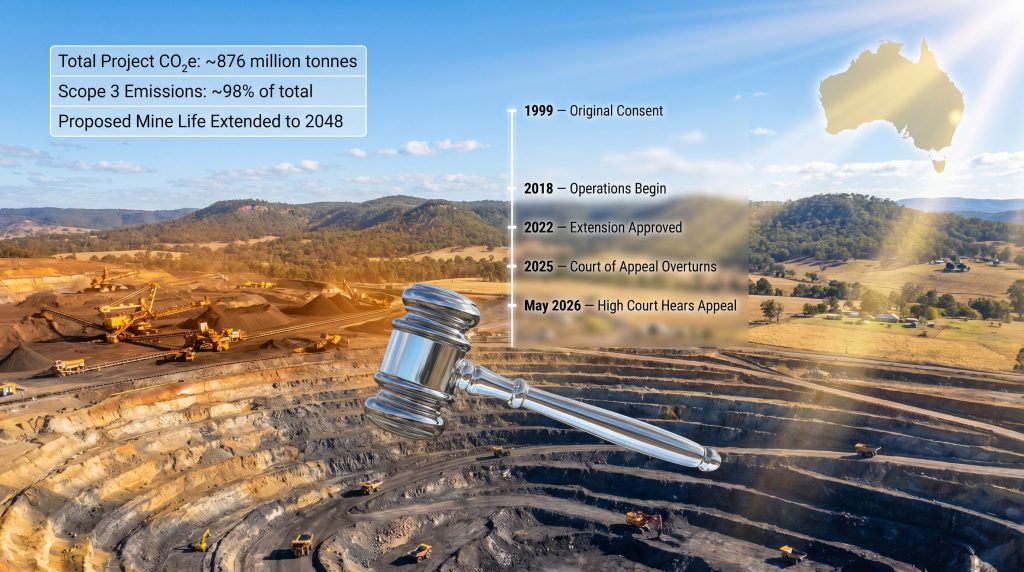
The mine's proposed extension is not a modest incremental adjustment. The application seeks to add 22 years of operational life, pushing the mine's closure date to 2048 and designating the project as State Significant Development under NSW planning law.
Key Project Metrics at a Glance
| Metric | Detail |
|---|---|
| Mine Type | Open-cut coal |
| Location | Upper Hunter Valley, NSW |
| Original Consent Granted | 1999 |
| Mining Operations Commenced | 2018 |
| Proposed Extended Life | To 2048 (22-year extension) |
| Proposed Annual Output | Up to 21 million tonnes |
| Additional Coal to Be Extracted | ~247 million tonnes |
| Total Project CO₂e (all scopes combined) | ~876 million tonnes |
How the 2022 Approval Was Reached
MACH Energy lodged its extension application with the NSW Independent Planning Commission (IPC) in 2021. The process included the preparation and public exhibition of a detailed environmental statement by the NSW Department of Planning and Environment, which attracted a significant volume of public submissions. A formal public hearing was also conducted.
At the conclusion of that process, the Department of Planning and Environment concluded that, on balance, the project's benefits outweighed its costs, and that greenhouse gas emissions associated with the project had been adequately accounted for through the NSW government's Net Zero Plan. The IPC accepted the position that greenhouse gas emissions are felt globally, are addressed through broad international frameworks including the Paris Agreement, and did not require a specific causal analysis linking the mine's outputs to local climate harm.
The IPC approved the 22-year extension in 2022. That approval did not survive legal scrutiny.
What Modification 8 Adds to an Already Complex Picture
Layered beneath the primary High Court proceedings is a further application known as Modification 8, which introduces additional complexity to the regulatory and legal picture surrounding the mine. This modification seeks further changes to the project parameters and sits in a state of uncertainty while the fundamental question of the extension's validity remains unresolved by Australia's highest court.
The Legal Journey to the High Court
From Approval to Challenge
The Denman Aberdeen Muswellbrook Scone Healthy Environment Group, known as DAMSHEG, is a community-based environmental body representing residents and interest groups across the Hunter Valley towns named in its title. Following the IPC's 2022 approval, DAMSHEG mounted a legal challenge that ultimately reached the NSW Court of Appeal.
Legal Milestone Timeline
| Year | Event |
|---|---|
| 1999 | Original mining consent granted |
| 2018 | Open-cut mining operations begin |
| 2021 | Extension application lodged with NSW IPC |
| 2022 | IPC approves 22-year extension to 2048 |
| 2025 | NSW Court of Appeal unanimously overturns approval |
| May 2026 | High Court of Australia hears appeal |
The NSW Court of Appeal's Unanimous 2025 Ruling
The NSW Court of Appeal issued a unanimous decision overturning the IPC's approval. The finding was specific and consequential: the IPC had failed to take into account a mandatory statutory consideration by not properly addressing environmental impacts in relation to climate change, and in particular the downstream greenhouse gas emissions generated when the mine's exported coal is combusted overseas.
The court's reasoning, articulated through Justice Christine Adamson, identified a critical evidential gap. The evidence before the IPC had established that global warming produces particular impacts in NSW and, disproportionately, in the specific locality surrounding the Mount Pleasant mine. A general, planetary-scale acknowledgment of emissions was found to be an insufficient discharge of the statutory obligation to assess environmental impacts on the locality.
MACH Energy's High Court Appeal
MACH Energy challenged the Court of Appeal ruling, and the High Court agreed to hear the matter. The case was heard in a single day, with the court's judgment to follow at a later date. This compressed hearing schedule reflects the relatively contained nature of the legal question, which turns primarily on statutory interpretation rather than contested factual evidence. Broader policy shifts in mining globally have, furthermore, amplified industry interest in how this ruling might reframe regulatory obligations for resource projects worldwide.
The Core Legal Dispute: What Does "Locality" Actually Mean?
The Interpretive Contest at the Centre of the Case
The Mount Pleasant coal mine extension High Court case hinges on interpreting a single phrase within the NSW Environmental Planning and Assessment Act. The legislation requires planning assessments to evaluate likely impacts on the natural and built environments, as well as social and economic impacts on the locality.
The central interpretive contest turns on whether the phrase "environmental impact on the locality" can encompass downstream greenhouse gas emissions generated when exported coal is combusted overseas, or whether such impacts are inherently global in character and therefore outside the scope of mandatory local planning consideration.
MACH Energy's Legal Position
MACH Energy's lawyers argue that climate change, by its very nature, cannot be characterised as an environmental impact of a development in the locality as that phrase is used in the Act. Their position holds that there was no specific legal obligation on the IPC to conduct a causal inquiry linking the mine's contribution to global emissions with any identifiable impact in the Muswellbrook area or surrounding localities. Climate change, on this reading, is a planetary phenomenon addressed through national policy and international agreements, not a localised planning consideration.
DAMSHEG's Counter-Position
DAMSHEG's lawyers argue that the Court of Appeal correctly identified an obligation to consider climate change impacts as they manifest locally. Their position is grounded in specific scientific evidence that global warming does not produce uniform impacts across all geographies. Certain regions experience disproportionate warming, more frequent extreme weather events, and compounded agricultural and ecological disruption. The Hunter Valley, they argue, falls into that category. This argument also resonates with wider debates about green transition pressures reshaping how resource-dependent regions must adapt to evolving environmental standards.
Scope 3 Emissions: The Science Driving the Legal Argument
Breaking Down the Three Scopes of Greenhouse Gas Emissions
Understanding why this case turns on emissions accounting requires familiarity with how greenhouse gases are categorised in corporate and regulatory frameworks:
- Scope 1 emissions originate directly from sources owned or controlled by the operator, including on-site machinery, diesel combustion in vehicles, and blasting operations.
- Scope 2 emissions are indirect emissions resulting from the consumption of purchased electricity or heat. For a mining operation, this is typically a relatively minor category.
- Scope 3 emissions encompass all other indirect emissions across the full value chain, including those that occur after the product leaves the operation entirely. For an export coal mine, this category includes every tonne of CO2 produced when coal is burned by overseas purchasers in power stations, steel mills, or industrial facilities.
Emissions Breakdown: Mount Pleasant Mine
| Emission Scope | Description | Estimated Share of Total |
|---|---|---|
| Scope 1 | Direct operational emissions (vehicles, machinery) | ~2% |
| Scope 2 | Indirect emissions from purchased energy | Minimal |
| Scope 3 | Downstream combustion of exported coal | ~98% |
| Total Project CO₂e | All scopes combined | ~876 million tonnes |
Why Scope 3 Dominates This Case
The emissions profile of an export coal mine is fundamentally unlike that of, say, a cement plant or a steel mill. When coal is extracted and shipped overseas, the vast majority of its atmospheric impact occurs outside Australian territory and outside the operational control of the miner. The coal is purchased by foreign utilities or industrial operators who combust it to generate energy, releasing CO2 into a shared atmosphere.
For the Mount Pleasant mine, Scope 3 emissions are estimated to represent 98% of total emissions across the project's lifetime. The combined Scope 3 contribution over the extension period is embedded within the total project estimate of approximately 876 million tonnes of CO2-equivalent. The mine's annual contribution is estimated at 0.065% of global anthropogenic emissions, a figure DAMSHEG presented as a meaningful and attributable share rather than an insignificantly diffuse one.
The IPCC Evidence on Cumulative CO2 and Warming
DAMSHEG's submissions to the High Court drew on findings from the Intergovernmental Panel on Climate Change establishing that every tonne of CO2 added to the atmosphere contributes to global warming through a near-linear cumulative relationship. This scientific framing matters for the legal argument because it transforms emissions from an abstract aggregated phenomenon into individually attributable contributions.
If each tonne matters, then the 876 million tonnes attributable to the Mount Pleasant extension represent a specific and quantifiable addition to the global warming burden, with downstream consequences for localities that can be identified through regional climate modelling.
Other courts internationally have recognised this causal logic, accepting a link between specific emission sources and particular climate change impacts. DAMSHEG's submissions noted this developing body of international jurisprudence to support the position that Australian courts are not breaking new ground by accepting the causal chain, but rather aligning with an emerging global standard.
The Parties and Their Supporters
MACH Energy Australia
As the consent holder and mine operator, MACH Energy bears the commercial risk of the legal proceedings most directly. A ruling upholding the Court of Appeal would leave the extension approval invalid, potentially stranding the capital investment already committed to expanding operations and foreclosing the production of approximately 247 million additional tonnes of coal through to 2048.
DAMSHEG: A Grassroots Group in the Nation's Highest Court
What began as a community coalition in small Hunter Valley towns has navigated one of the most technically complex areas of Australian environmental law to reach the nation's highest court. DAMSHEG's trajectory from local objector to High Court respondent illustrates how community legal challenges to resource projects have matured in sophistication over the past decade. The geopolitical mining landscape has, furthermore, made such community-driven legal actions increasingly consequential far beyond their originating jurisdictions.
The Institutions Supporting the Environmental Case
DAMSHEG's submissions are backed by expert bodies with significant scientific and legal credibility in climate and environmental fields:
- University of Cambridge
- Columbia University
- University of Melbourne
- Union of Concerned Scientists (US-based)
- Sabin Centre for Climate Change Law (UK-based)
The involvement of institutions of this calibre signals that the case is being watched not just domestically but by international climate law scholars and environmental scientists who view the outcome as potentially instructive for similar challenges in other jurisdictions.
The next major ASX story will hit our subscribers first
NSW Government Policy and Its Intersection With the Legal Battle
The Net Zero Plan as a Planning Shield
The NSW government's Net Zero Plan was invoked during the original IPC approval process as the basis for concluding that the mine's emissions had been adequately accounted for. This framing treated emissions as a macro-level policy matter absorbed into overarching government frameworks, rather than as site-specific impacts requiring individual analysis in each planning decision.
The Court of Appeal rejected this approach as insufficient. The existence of a government emissions plan does not discharge the obligation on a planning authority to assess the specific environmental impacts of a specific project on a specific locality. These are distinct obligations operating at different levels of the regulatory hierarchy. Questions of government intervention in mining approvals more broadly have, however, become increasingly prominent across multiple jurisdictions facing similar tensions.
The NSW Net Zero Commission's December 2025 Finding
Adding further complexity to the regulatory backdrop, the NSW Net Zero Commission issued findings in December 2025 regarding coal mine extensions that sit in tension with the continued acceptance of new coal expansion applications by planning authorities. This internal policy contradiction reflects the unresolved political and regulatory pressures facing government as it navigates commitments to emissions reduction alongside the economic dependencies of coal-producing regions.
The Paris Agreement's Role: Referenced but Contested
The Paris Agreement was cited during the original planning process as part of the framework within which the mine's emissions were considered managed. However, the Paris Agreement is a framework of national commitments and does not itself function as a project-level assessment tool. Its invocation in the planning context was one of the elements the Court of Appeal found inadequate as a substitute for specific impact analysis.
What the High Court's Ruling Could Mean: Three Scenarios
Strategic Scenario Comparison
| Ruling Outcome | Immediate Effect | Long-Term Implication |
|---|---|---|
| Court of Appeal Upheld | Mount Pleasant extension remains blocked | All future mining EIS documents must address localised Scope 3 climate impacts individually |
| High Court Overturns | Extension approval potentially reinstated | Planning authorities retain discretion to treat climate impacts as globally diffuse |
| Partial Ruling / Remittal | Matter returned to IPC for reassessment | Procedural reform without definitive precedent on the Scope 3 obligation |
Scenario A: The Court of Appeal Is Upheld
If the High Court affirms the unanimous Court of Appeal finding, every future environmental impact statement for a fossil fuel project in NSW, and potentially across Australia, would face a new mandatory obligation. Proponents could no longer rely on references to global agreements or whole-of-government emissions plans as substitutes for project-specific analysis of localised climate impacts. The evidentiary bar for approval would rise materially.
For communities in mining regions, this outcome would represent a significant expansion of their capacity to challenge projects through planning law, using scientific evidence of regional climate impacts as a legally cognisable ground.
Scenario B: The High Court Overturns the Ruling
A reversal would reinstate MACH Energy's position and potentially restore the pathway to approval for the extension. More broadly, it would confirm that planning authorities retain the discretion to treat greenhouse gas emissions from exported products as global phenomena outside the mandatory scope of localised impact assessment. Future project approvals could rely on policy frameworks rather than site-specific causal analysis.
This outcome would not eliminate climate litigation risk for resource projects, but it would confine that risk to different legal avenues and push the locus of climate accountability further toward legislative reform rather than planning law interpretation.
Why This Is Described as Australia's First Climate Case at the High Court Level
While climate-related planning challenges have been litigated in state courts and tribunals for years, the Mount Pleasant coal mine extension High Court case represents the first time Australia's apex court has been asked to determine the mandatory scope of climate impact assessment in the planning context. The ruling will carry binding precedential weight across all Australian jurisdictions.
The Hunter Valley Stakes: Industry, Economy, and Community
NSW Coal Industry Plans and the 2040s Operating Horizon
The broader NSW coal industry has existing plans to continue operating mines well into the 2040s. The Mount Pleasant extension, reaching to 2048, is consistent with that trajectory. A ruling that invalidates the planning basis for such extensions would create immediate regulatory uncertainty for multiple projects currently in various stages of approval or operation. Ongoing debates about coal revival policies in other jurisdictions have, furthermore, intensified scrutiny of how courts elsewhere draw the boundary between economic interest and climate obligation.
Economic Arguments and Regional Dependencies
The Hunter Valley's relationship with coal is deep and multigenerational. Royalty streams, direct employment, contractor networks, and regional service industries are all materially connected to the ongoing operation of coal mines in the region. Towns like Muswellbrook and Singleton have economic structures shaped around coal production over decades, and transitions away from that base involve genuine social and economic costs that planning authorities are required to weigh.
These economic considerations were part of the original IPC assessment in 2022, where the benefits were found to outweigh costs on balance. The legal challenge does not dispute that economic factors are relevant, but argues that a material mandatory consideration relating to environmental impact was omitted from the balance.
Community Health and Environmental Concerns
Residents in Muswellbrook and surrounding areas face a dual exposure that is rarely acknowledged in policy discussions: they experience the air quality, noise, and land use impacts of active open-cut mining, and they stand to bear disproportionate consequences from regional climate changes driven partly by the cumulative emissions of local coal extraction. The DAMSHEG coalition was formed around exactly this intersection of proximate operational impacts and longer-term climate exposure. Local community groups have been instrumental in driving this litigation from its earliest stages.
Frequently Asked Questions: Mount Pleasant Coal Mine High Court Case
What is the Mount Pleasant coal mine High Court case about?
The case concerns whether the NSW Independent Planning Commission was legally obligated to assess localised climate change impacts, including Scope 3 greenhouse gas emissions from exported coal combusted overseas, when it approved a 22-year extension of the Mount Pleasant coal mine in 2022. The NSW Court of Appeal unanimously overturned that approval in 2025, finding the IPC had failed to address a mandatory consideration. MACH Energy is appealing that ruling to the High Court of Australia.
Who is DAMSHEG and what role do they play?
DAMSHEG is the Denman Aberdeen Muswellbrook Scone Healthy Environment Group, a community and environmental body representing residents in towns near the mine. They successfully challenged the IPC's approval in the NSW Court of Appeal and are now the respondent in MACH Energy's High Court appeal. They are supported by international academic institutions and scientific organisations.
What are Scope 3 emissions and why are they legally significant here?
Scope 3 emissions are all indirect greenhouse gas emissions along the full value chain of a product, including those from combustion of coal by overseas buyers after export. For the Mount Pleasant mine, Scope 3 represents an estimated 98% of total emissions over the project's life. Their legal significance lies in whether these offshore, downstream emissions can constitute an environmental impact on the local NSW area under the terms of the Environmental Planning and Assessment Act.
Has Australia ever had a climate case reach the High Court before?
The Mount Pleasant coal mine extension High Court case is understood to be the first occasion on which Australia's High Court has been asked to rule on the mandatory scope of climate impact assessment within planning law. While climate considerations have featured in lower court proceedings and planning tribunal decisions, this represents the apex court's first direct engagement with the question.
What happens to the mine while the High Court case is being decided?
The mine continues its existing approved operations during the proceedings. The extension approval remains invalid as a result of the Court of Appeal ruling until and unless the High Court reverses that decision. Mining under the original consented parameters is not affected by the litigation.
Could this ruling affect other coal mines in NSW and across Australia?
Yes, significantly. A ruling upholding the Court of Appeal would establish binding precedent requiring all future fossil fuel project assessments to address Scope 3 localised climate impacts as a mandatory consideration. This would affect every major coal, gas, and potentially oil project seeking approval or modification in NSW and would influence how courts in other states interpret equivalent planning legislation.
What is Modification 8 and how does it relate to the High Court appeal?
Modification 8 is a separate application to modify project parameters at the Mount Pleasant mine. It sits in regulatory limbo while the fundamental question of the extension's legal validity is resolved by the High Court. Its outcome will depend materially on whether the core extension approval is ultimately sustained.
Key Takeaways: Why This Ruling Will Be a Landmark
The Three Legal Principles Being Tested
- The geographic scope of planning obligations: Can statutory obligations to assess local environmental impacts extend to emissions that physically occur overseas when the combustion of an exported product is the direct cause of measurable local harm?
- The adequacy of policy-level emissions accounting: Does inclusion of a project's emissions within a government's national or state net zero framework constitute a sufficient discharge of the duty to assess specific project-level environmental impacts on a locality?
- The causal chain between individual emission sources and local climate outcomes: Is scientific evidence of a near-linear relationship between cumulative CO2 and warming sufficient to establish the causal link necessary to make Scope 3 emissions a mandatory planning consideration?
What Planners, Operators, and Communities Need to Prepare For
Regardless of the High Court's ultimate decision, the fact that the question has reached this level signals a durable shift in the legal risk landscape for fossil fuel projects in Australia. Several practical implications flow from this:
- Environmental impact statements for new or extended coal and gas projects should anticipate more rigorous scrutiny of Scope 3 emissions accounting, even if the current ruling does not ultimately mandate it.
- Community groups now have a clear template for challenging planning approvals on climate grounds, with DAMSHEG's pathway from local objectors to High Court respondent providing a procedural roadmap.
- Planning authorities operating under statutory frameworks containing the concept of a protected locality need to develop clearer internal guidance on how climate evidence should be addressed in assessments, particularly given the accumulating international jurisprudence on causal links between specific emission sources and particular impacts.
The Broader Signal: When Local Planning Law Meets Global Climate Accountability
The Mount Pleasant coal mine extension High Court case is, at its core, about whether the legal architecture of local planning law is capable of holding a single project accountable for its share of a planetary-scale problem. The traditional tools of planning law were not designed for this task. However, the legal argument in this case does not ask planning law to solve climate change. It asks only that a mandatory consideration be honestly discharged — that the specific climate consequences for a specific community be identified and weighed, rather than dissolved into global averages and policy frameworks that do not require anyone to look at the Hunter Valley directly.
The High Court's answer to that question will define the boundaries of environmental accountability in Australian resource law for a generation.
Further Exploration: Readers seeking additional context on the legal and environmental dimensions of this case can explore related reporting from ABC News, which has covered the progression of the Mount Pleasant coal mine dispute from the original 2022 approval through to the High Court hearing: abc.net.au
Want to Stay Ahead of Significant ASX Mineral Discoveries Before the Market Catches On?
Discovery Alert's proprietary Discovery IQ model delivers real-time alerts the moment significant ASX mineral discoveries are announced, transforming complex data across more than 30 commodities into clear, actionable insights for both short-term traders and long-term investors. Start your 14-day free trial today and see why historic discoveries have generated extraordinary returns for those positioned early.