May 12, 2026
The Hidden Cost of Water in African Base Metal Mining
Across the arid mining corridors of southern Africa, water has quietly become one of the most consequential variables in determining whether a mining project succeeds or fails. Unlike ore grade or commodity price, water access rarely features in headline project metrics, yet it shapes operational continuity, community relations, environmental compliance, and long-term mine viability in ways that are increasingly difficult to ignore. For underground zinc and lead operations situated in some of the driest terrain on the continent, this reality is not theoretical. It is a daily engineering and governance challenge that demands sophisticated solutions.
The commissioning of the Rosh Pinah Zinc water treatment plant in May 2026 represents exactly this kind of solution, and it tells a broader story about how modern mining operations in frontier African jurisdictions are reengineering their relationship with scarce natural resources. Furthermore, it reflects a broader pattern of mining's transformation across the continent, where environmental accountability is reshaping capital deployment decisions.
When big ASX news breaks, our subscribers know first
What the RP2.0 Expansion Is Actually Building
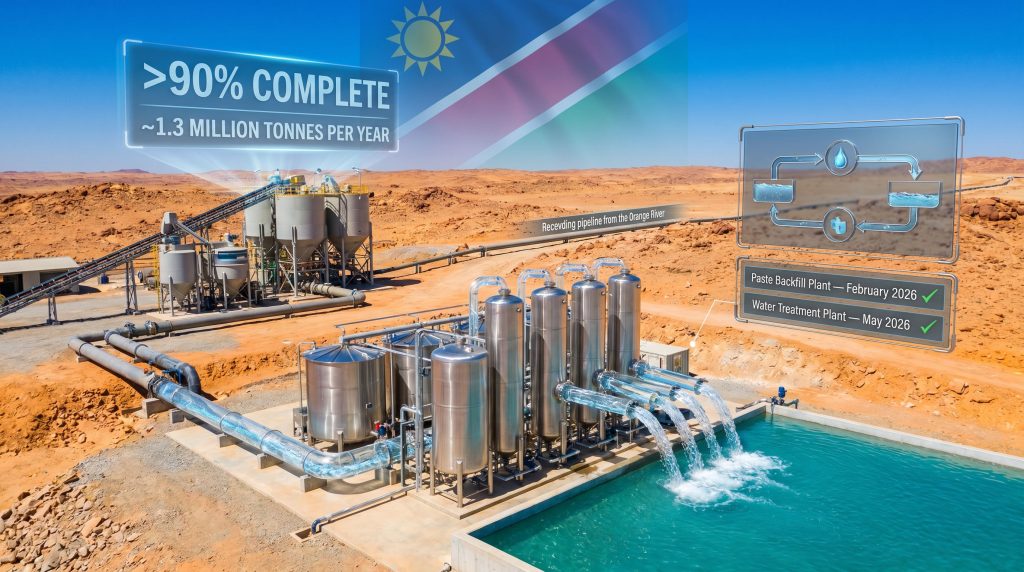
Rosh Pinah Zinc (RPZ) operates an underground zinc and lead mine in southwestern Namibia, one of the driest regions in sub-Saharan Africa. The mine sits within a landscape shaped by geological extremes, and its ore body has long been recognised as one of the more significant base metal deposits in the region. The RP2.0 expansion project is a comprehensive programme designed to scale the operation's processing capacity to approximately 1.3 million tonnes per year, which represents nearly double the mine's prior throughput capacity.
This is not a simple equipment upgrade. RP2.0 encompasses a suite of interconnected infrastructure investments:
- Underground development and stope expansion to access deeper, higher-volume ore zones
- Installation of a new SAG (semi-autogenous grinding) mill to handle increased ore volumes
- Construction of Namibia's first paste backfill plant, commissioned in February 2026
- Development of a dedicated water treatment plant (WTP), successfully commissioned in May 2026
Appian Capital Advisory, a private capital investment firm focused on long-term value creation in the mining sector, acquired RPZ in 2023. The RP2.0 expansion reflects Appian's thesis that disciplined capital deployment in operationally credible African mining assets can generate durable returns while meeting increasingly stringent ESG requirements from institutional co-investors and offtake partners.
As of May 2026, the RP2.0 project is more than 90% complete, tracking on schedule and within budget, with full project delivery expected before the end of 2026. For a large-scale underground mining expansion in a frontier jurisdiction, this level of execution discipline is notably uncommon and carries significant weight in investor perception.
| RP2.0 Milestone | Status (May 2026) | Target Completion |
|---|---|---|
| Underground Development | Advanced and ongoing | Q3 2026 |
| SAG Mill Installation | Substantially complete | Q3 2026 |
| Paste Backfill Plant | Commissioned | February 2026 |
| Water Treatment Plant | Successfully commissioned | May 2026 |
| Overall RP2.0 Expansion | Over 90% complete | End of 2026 |
How the Rosh Pinah Zinc Water Treatment Plant Works
The Rosh Pinah Zinc water treatment plant commissioning marks a meaningful shift in how the operation manages one of its most critical inputs. At a functional level, the WTP captures water generated from two primary sources: underground dewatering operations and the paste backfill plant. This water, rather than being discharged or wasted, is retreated and reintroduced into the processing circuit.
Understanding why this matters requires a basic grasp of underground mine hydrology. As mining progresses deeper underground, natural groundwater and process water accumulate in the workings. Managing this water is both an operational necessity and an environmental obligation. Traditionally, mines have either pumped this water to surface for disposal or drawn heavily on external freshwater sources to compensate for water lost in processing. Neither approach is optimal in an arid environment with shared water resources.
The step-by-step flow of water through the RPZ treatment system works broadly as follows:
- Underground accumulation – water collects in underground workings from natural inflow and process operations
- Surface transfer – water is pumped to surface-level treatment infrastructure
- Treatment processing – physical and chemical treatment stages remove contaminants, suspended solids, and process reagents
- Quality verification – treated water is assessed against operational and environmental parameters before reuse
- Circuit reintroduction – treated water is directed back into milling, flotation, and paste backfill operations
- Residual management – any water that cannot be recycled is managed under Namibian environmental compliance requirements
The critical point is what this cycle displaces: withdrawals from the Orange River via a 20-kilometre pipeline that serves as the mine's primary external freshwater supply artery. By substituting recycled process water for Orange River withdrawals, RPZ reduces both its environmental footprint and its operational exposure to external water supply constraints. In an era of increasing regional water governance pressure, reducing dependency on a shared transboundary river is not merely an environmental gesture. It is a material risk management decision. Indeed, considering natural capital in mining operations more broadly, this approach reflects a growing recognition that water is a finite shared asset, not a free industrial input.
Why Paste Backfill and Water Treatment Are Operationally Inseparable
One of the less widely understood aspects of the RPZ sustainability strategy is the operational interdependence between the paste backfill plant and the water treatment plant. Paste backfill involves mixing processed tailings with binder material and water to create a paste that is pumped back underground to fill mined-out voids. This technique improves ground stability, reduces surface tailings volumes, and significantly decreases the geotechnical risk associated with subsidence.
The critical link is that the paste backfill process requires treated water as a primary input. The consistency and chemistry of the water used directly affects paste quality, which in turn determines underground fill stability. This means the WTP is not simply a standalone environmental measure. It is a process-critical input supplier to the paste backfill plant, which itself is foundational to the underground expansion's geotechnical strategy.
Together, these two systems create what engineers would describe as a closed-loop or semi-closed-loop water and waste management architecture. Tailings that would previously have accumulated on surface are returned underground as fill, and the water used to make that fill possible is itself recovered, treated, and recycled. This represents systems-level environmental engineering rather than compliance-driven box-ticking.
Environmental and Operational Consequences of the WTP Commissioning
The environmental benefits of the Rosh Pinah Zinc water treatment plant commissioning operate across several dimensions simultaneously:
- Reduced freshwater extraction from the Orange River, protecting downstream communities and riparian ecosystems that depend on its flow
- Lower surface tailings accumulation, as paste backfill consumes processed material that would otherwise require surface storage
- Improved ore grade control underground, since unplanned water ingress can dilute ore before it reaches the mill, reducing recoverable metal content
- Reduced contamination risk, as closed-loop water systems contain process chemicals within the circuit rather than allowing them to interact with the broader environment
The operational efficiency gains are equally tangible. Water sourced externally over a 20-kilometre pipeline carries energy costs associated with pumping, as well as risks of supply disruption. Substituting recycled water reduces these costs and improves supply reliability. Additionally, when water chemistry is controlled through recycling and treatment, reagent consumption in flotation circuits tends to stabilise, as process reagents are not constantly diluted or contaminated by inconsistent input water quality.
Ignacio Bustamante, Base Metals Head at Appian Capital Advisory, described the commissioning as an important step in delivering on the company's environmental commitments as the operation scales under RP2.0, noting that responsible water management is critical to both operations and ESG standards, and that the milestone demonstrates a commitment to building a sustainable, long-term operation with high environmental stewardship. (Mining Weekly, May 12, 2026)
This framing is significant. The language of long-term stewardship is not accidental. Mining operations with extended reserve lives require a fundamentally different approach to environmental management than shorter-duration projects. RPZ's expansion is underpinned by a 19-year mine life extension, meaning infrastructure decisions made today will define the mine's environmental performance across two decades of operation. In this context, mine reclamation planning and resource stewardship must be considered from the earliest stages of project development, not as afterthoughts.
What On-Schedule Delivery in a Frontier Jurisdiction Actually Signals
Institutional investors in private capital mining funds apply rigorous scrutiny to execution risk in frontier African jurisdictions. Schedule slippage and budget overruns are endemic to large underground mining projects globally, but the challenge is compounded in regions with logistics constraints, regulatory complexity, and skills availability pressures.
The fact that RP2.0 has reached more than 90% completion on schedule and on budget is therefore a data point that carries weight beyond the project itself. It communicates something about Appian's project management capability, about the quality of engineering and construction partners engaged, and about Namibia's capacity to host and support sophisticated capital-intensive mining infrastructure. For investors evaluating follow-on opportunities in the region, this track record matters. Broader African mining finance trends suggest that demonstrated execution discipline is increasingly a prerequisite for accessing institutional capital in these markets.
Capital discipline in frontier mining environments is routinely cited as a key risk by institutional allocators, making on-budget, on-schedule project delivery a material differentiator when assessing private mining fund performance.
Zinc's Structural Demand Context and RPZ's Market Position
Zinc's primary industrial function is as a coating for galvanised steel, which accounts for roughly half of global zinc consumption. Galvanised steel underpins construction activity, infrastructure development, and increasingly, hardware associated with the energy transition. Wind turbine towers, offshore foundation structures, electrical grid infrastructure, and EV charging network hardware all incorporate galvanised steel components. As electrification investment accelerates globally, zinc demand from these end-use segments is growing alongside conventional construction demand.
On the supply side, global zinc mine production has faced structural constraints from ageing assets, declining ore grades at mature operations, and limited new project development due to the extended capital cycle following the commodity downturn of the mid-2010s. New or expanded low-cost producers entering the market during periods of constrained supply carry disproportionate strategic value. This dynamic is closely tied to critical minerals demand trends, where energy transition hardware continues to drive structural consumption growth across multiple base metal categories.
RPZ's positioning within this context deserves examination. As a low-cost underground producer scaling to approximately 1.3 million tonnes per year of processing capacity, it is not a marginal contributor to global supply. The combination of expanded throughput, improved water management, reduced operating costs, and a long reserve life positions RPZ competitively within the global zinc cost curve.
Namibia as a Mining Jurisdiction: Beyond the Headlines
Namibia is often discussed in the context of uranium mining, given the presence of significant deposits in the Erongo region. However, the country's geological endowment extends well beyond uranium. Zinc, lead, copper, and emerging lithium assets make Namibia increasingly relevant as a multi-commodity critical minerals jurisdiction. Its stable governance framework, established mining regulatory environment, and infrastructure connectivity relative to many sub-Saharan African peers contribute to its attractiveness for long-term capital deployment.
Flagship projects that execute with the discipline demonstrated by RP2.0 do more than create value for their direct investors. They serve as demonstration assets that inform how institutional capital perceives sovereign risk in the jurisdiction more broadly. A successful expansion at RPZ contributes to Namibia's profile as a viable destination for serious mining capital, potentially catalysing interest in complementary projects across the country's mineral portfolio.
The next major ASX story will hit our subscribers first
Three Structural Shifts This Milestone Represents
The Rosh Pinah Zinc water treatment plant commissioning is most usefully understood not as a single infrastructure event, but as an indicator of three broader structural shifts reshaping how responsible mining operations are built and evaluated:
1. From linear to circular water use. The expectation that mines treat water as a recyclable process input rather than a consumable resource is becoming a baseline requirement in ESG-sensitive capital markets. RPZ's WTP exemplifies this transition in a high-stress arid environment.
2. From single-asset to systems-level sustainability. The integration of paste backfill and water treatment into an operationally interdependent closed-loop system reflects a more sophisticated approach to environmental engineering than discrete compliance measures. This kind of integration creates compounding benefits across water, waste, and geotechnical performance simultaneously.
3. From frontier risk to investment-grade execution. RP2.0's track record reframes the narrative around African underground mining projects. Execution risk remains real, but demonstrated capital discipline in completing a complex multi-component expansion on schedule and within budget strengthens the credibility of Namibia as a jurisdiction and Appian as an operator.
This article is intended for informational purposes only and does not constitute financial or investment advice. Forecasts, projections, and mine life estimates referenced herein are based on publicly available company disclosures and industry reporting and are subject to change. Investors should conduct independent due diligence before making any investment decisions related to companies or projects mentioned in this article.
Want to Stay Ahead of the Next Major Base Metal Discovery?
Discovery Alert's proprietary Discovery IQ model delivers real-time alerts on significant ASX mineral discoveries — including zinc, lead, and copper — instantly transforming complex data into actionable investment insights for traders and long-term investors alike; explore historic examples of exceptional discovery returns or start your 14-day free trial today to secure your market-leading advantage.