May 12, 2026
The Hidden Cost of Fuel Dependency: Why Nations Without Reserves Pay the Highest Price
Energy security is rarely front of mind until it fails. The history of modern industrial economies is punctuated by moments when fuel supply disruptions rippled outward into economic crisis, defence paralysis, and social instability. The 1973 OPEC oil embargo, the supply shocks following Iraq's invasion of Kuwait in 1990, and the extraordinary energy market dislocations of 2022 each demonstrated a consistent pattern: nations without strategically managed fuel buffers absorb the full force of external shocks, while those with government-controlled reserves retain the ability to stabilise critical systems during the most acute phases of disruption.
Australia has, for decades, sat in the more exposed category. Despite being one of the world's most resource-rich nations, its structural dependence on imported refined petroleum products has left it unusually vulnerable to supply chain events originating thousands of kilometres away. That structural vulnerability is now being addressed through one of the largest energy security commitments in Australian federal budget history, and the Australia permanent fuel reserve is central to that effort.
When big ASX news breaks, our subscribers know first
Australia's Fuel Supply Problem: More Exposed Than Most Realise
Approximately 80% of Australia's national fuel consumption is sourced from overseas. This is not a recent development but a deepening structural reality, accelerated significantly by the closure of Australia's domestic refining sector over the past decade. The country's last major refinery closures left the nation almost entirely reliant on imported refined products, primarily arriving via long maritime supply chains from Singapore, South Korea, and the Middle East.
This geographic reality creates an exposure that is qualitatively different from most comparable developed economies. Australia's nearest significant refining hubs are between five and ten days of shipping time away under normal conditions. In a scenario involving contested sea lanes, regional conflict, or sustained tanker route disruption, that gap becomes a critical vulnerability window. Furthermore, Australia's resource and energy exports remain heavily intertwined with the same supply chains that underpin fuel imports, compounding the nation's overall exposure.
The specific fuel categories that carry the greatest strategic risk are diesel and aviation fuel. Diesel is the lifeblood of Australia's physical economy. It powers the heavy vehicle freight network, the mining equipment fleets of the Pilbara and Bowen Basin, agricultural machinery across the country's vast farming regions, and emergency service generators. Aviation fuel underpins both commercial air connectivity across a continent where distances make air travel essential, and the operational mobility of Australia's defence forces.
The IEA Compliance Gap That Defined Australia's Strategic Weakness
The International Energy Agency sets a 90-day minimum stockholding obligation as the benchmark for member nations. This figure is not arbitrary. It reflects historical analysis of how long supply disruptions typically persist before alternative sources can be established, and how much buffer is required to prevent critical systems from failing in the interim.
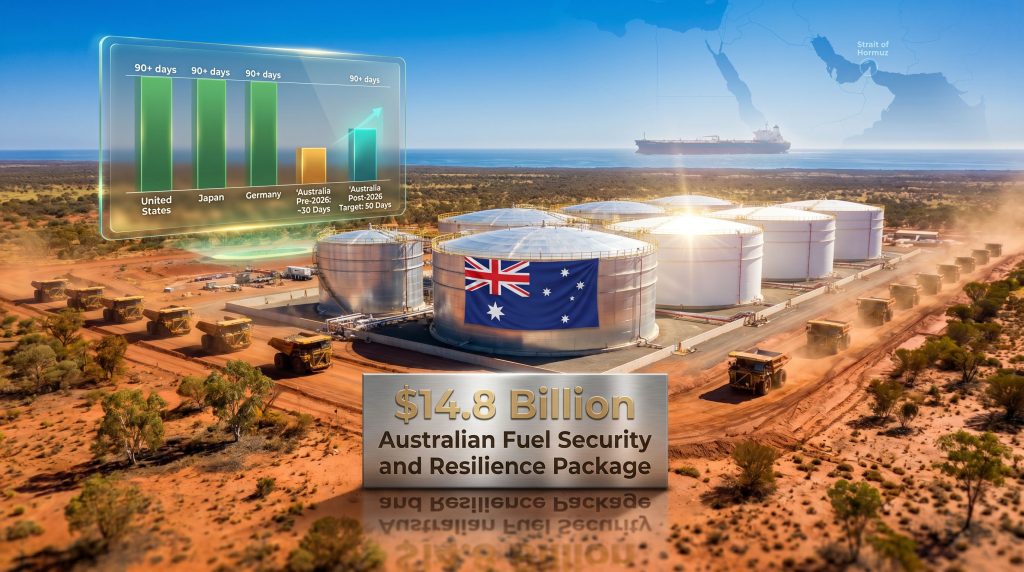
Prior to the 2026 policy announcement, Australia's position relative to this benchmark was striking. Private sector importers and refineries were required to maintain onshore minimum stockholding obligations of approximately 30 days per fuel type, yet even this threshold was largely unverified and unenforced against a government-managed reserve. Australia was among the only IEA member nations operating without a government-administered strategic fuel reserve of any kind.
Key Context: Prior to the 2026 announcement, Australia held fewer than 30 days of onshore fuel stocks across private sector holdings, well below the IEA's recommended 90-day threshold and among the lowest of any developed IEA member nation.
This compliance gap was well understood within energy policy circles but had not translated into corrective action at the scale required. The combination of escalating Middle East tensions and the trade war impact on oil price trajectory scenarios now entering formal government risk modelling appears to have shifted the calculus decisively.
What Is Australia's Permanent Fuel Reserve? A Full Policy Breakdown
On 6 May 2026, the Australian Federal Government announced the Australian Fuel Security and Resilience Package, a multi-instrument commitment totalling A$14.8 billion that represents a fundamental restructuring of how Australia manages its fuel supply security. The announcement was timed ahead of the federal budget the following week.
The Australian Fuel Security and Resilience Package: Core Architecture
The package operates across several distinct but complementary mechanisms:
| Package Component | Allocated Funding | Primary Purpose |
|---|---|---|
| Australian Fuel Security Reserve (AFSR) | A$3.2 billion | Government-owned physical reserve (~1 billion litres) |
| Fuel and Fertilizer Security Facility | A$7.5 billion | Loans, equity, guarantees, insurance, price support |
| MSO Uplift Storage Support | A$34.7 million | New and refurbished private sector storage infrastructure |
| Broader Package Envelope | A$14.8 billion total | Combined fuel and national supply chain resilience |
The Australian Fuel Security Reserve (AFSR) is the centrepiece of the commitment. It establishes Australia's first permanent, government-owned physical fuel stockpile — the Australia permanent fuel reserve — targeting approximately one billion litres of stored fuel with a primary focus on diesel and aviation fuel. This reserve will be built and managed directly by the government, creating a sovereign buffer that does not depend on private sector commercial incentives.
What Is the Minimum Stockholding Obligation Uplift?
Parallel to the government reserve, the package uplifts the private sector Minimum Stockholding Obligation (MSO) framework. The MSO is the regulatory requirement for fuel importers and refiners to hold minimum onshore stocks. Under the new framework, this obligation increases from 30 days to 40 days per fuel type, phased in across a four-year implementation period.
To support the infrastructure investment required by this uplift, the package allocates A$34.7 million in transitional support for new and refurbished private sector storage capacity. The government reserve and the uplifted private sector MSO are designed to function as layered complementary systems rather than alternatives. Together, they are projected to deliver a combined onshore fuel supply buffer of at least 50 days across critical fuel categories.
How the Fuel and Fertilizer Security Facility Works
The A$7.5 billion Fuel and Fertilizer Security Facility operates as a financial instrument toolkit rather than a direct expenditure programme. Its mechanisms include concessional loans, equity injections, government guarantees, insurance products, and price support interventions. This structure is significant because it means a portion of the facility's deployed capital may generate financial returns, distinguishing it from pure budgetary expenditure.
The facility's dual mandate covering both fuel supply resilience and agricultural fertilizer security is a less-discussed but strategically important dimension of the package. Australia's agricultural export sector, which generates tens of billions of dollars annually, depends on uninterrupted fertilizer imports. Many of these fertilizer supply chains transit precisely the same shipping routes that are most exposed to geopolitical disruption, creating a parallel vulnerability that this facility is designed to address alongside fuel.
What Does 50 Days of Onshore Fuel Supply Mean in Practice?
The gap between a 30-day and a 50-day onshore fuel reserve is not merely statistical. In a real-world disruption scenario, it represents the difference between managed continuity and critical system failure.
Consider a hypothetical but realistic scenario: a sustained conflict event disrupts tanker movements through the Strait of Hormuz for a period of 45 days. Under Australia's previous framework, with only approximately 30 days of private sector stockholdings and no government reserve, the nation would exhaust its onshore fuel supply before the disruption resolved. Under the post-2026 framework, a 50-day combined buffer would maintain critical supply continuity across the entire disruption event.
Scenario Modelling: If oil prices were to reach US$200 per barrel, a scenario flagged by government advisors amid escalating Middle East tensions, Australia's fuel import bill would increase dramatically in a single year. A domestic reserve buffer would insulate essential services, agriculture, and defence logistics from the immediate impact of such a price and supply shock.
Which Fuel Types Are Prioritised and Why?
The AFSR's prioritisation of diesel and aviation fuel over petrol reflects a clear-eyed assessment of where supply disruption causes the most severe economic and operational damage:
-
Diesel drives freight logistics, heavy mining equipment, agricultural machinery, and emergency service power generation. Remote and regional Australia is almost entirely diesel-dependent for economic functioning.
-
Aviation fuel (Jet-A) is critical both for commercial air connectivity across Australia's vast geography and for the operational deployment capacity of the Australian Defence Force.
-
Petrol, while important for consumer transport, represents a secondary priority in a national security context because passenger vehicle mobility is more adaptable in a crisis than freight, mining, or defence logistics.
Priority Access During a Declared Fuel Emergency
The design logic of the AFSR points toward a tiered access structure in the event of a declared fuel emergency. Based on the reserve's stated focus on essential users, the likely priority framework would flow broadly as follows:
-
Defence and emergency services
-
Essential freight, agriculture, and food supply chains
-
Commercial aviation continuity
-
General industrial and commercial consumers
-
Retail consumer supply
The AFSR is explicitly designed to address regional stockouts and supply constraints for essential users, not to serve as a mechanism for general consumer price management.
The Geopolitical Catalyst: Why the $200 Per Barrel Scenario Entered Policy Modelling
The Strait of Hormuz is one of the most strategically critical chokepoints in global energy infrastructure. Approximately 20% of the world's daily oil supply transits this narrow passage between Iran and Oman. Any sustained disruption to passage through this corridor has immediate and severe consequences for global oil supply and price. Understanding the broader importance of oil to global economic functioning helps contextualise why Australia's response is so significant.
Historical precedent demonstrates how rapidly this translates into price shock. The lead-up to the Gulf War in 1990 produced oil price spikes of more than 100% within months. The 2022 energy crisis, triggered by the Russia-Ukraine conflict's impact on European energy markets, demonstrated that modern supply chains are far less resilient to sustained geopolitical disruption than pre-crisis assumptions suggested.
The emergence of a US$200 per barrel scenario in formal government risk modelling is not a prediction but a stress-test threshold. It represents the upper bound of a realistic escalation pathway in which sustained Middle East conflict, combined with tightening global supply and demand dynamics, drives oil to levels not previously seen in nominal terms. At that price level, Australia's fuel import costs would more than double on an annualised basis, placing extraordinary pressure on every diesel-intensive sector of the economy.
How Australia's Exposure Differs From Other Developed Nations
Australia's vulnerability to oil price spikes is structurally different from nations with significant domestic production or government-managed reserves:
-
The United States holds the Strategic Petroleum Reserve, approximately 600 million barrels of government-controlled crude oil, providing more than 90 days of supply buffer and the capacity to intervene in market pricing during supply disruptions.
-
Japan, which also imports virtually all of its petroleum, maintains a national oil stockpile meeting the IEA's 90-day benchmark, a policy established after Japan's acute exposure during the 1973 oil crisis.
-
Germany operates government-controlled reserve holdings through the Federal Reserve Agency, also at IEA-compliant levels.
The comparison is instructive:
| Country | Government Reserve | Days of Supply | IEA Compliant? |
|---|---|---|---|
| United States | Strategic Petroleum Reserve (~600M barrels) | 90+ days | Yes |
| Japan | National Oil Stockpile | 90+ days | Yes |
| Germany | Federal Reserve Agency holdings | 90+ days | Yes |
| Australia (Pre-2026) | None (private sector only) | ~30 days | No |
| Australia (Post-2026 Target) | AFSR (~1 billion litres) | 50 days (combined) | Partial |
Australia's mining and resources sector carries a particularly acute exposure to sustained oil price shocks. Iron ore, coal, gold, and lithium operations across the Pilbara, Bowen Basin, and the goldfields of Western Australia run almost entirely on diesel-powered heavy equipment fleets. Fuel typically represents between 15% and 30% of operating costs for large open-cut mining operations. A sustained doubling of diesel costs at the US$200/bbl scenario level would materially compress margins across the sector.
How This Policy Reshapes Australia's Energy Security Architecture
Structural Implications for Mining and Resources
The establishment of a government-managed fuel reserve provides the resources sector with something it has never previously had access to in Australia: a sovereign supply continuity backstop for periods of extreme market stress. During a declared fuel emergency, mines in the Pilbara and outback South Australia — which are far removed from major port infrastructure and face the most acute supply chain vulnerabilities — would gain access to a reserve specifically designed to prevent regional stockouts.
The downstream benefit for project planning and financing is also noteworthy. Fuel supply certainty has historically been treated as an unhedgeable risk for remote operations. A permanent government reserve changes that risk calculus for project proponents and their financiers, reducing exposure to commodity market volatility that has historically made long-term project costing unpredictable.
Signals of a Broader Strategic Shift
The government's decision to own physical fuel assets directly is consistent with a pattern of strategic resource intervention that has accelerated across multiple policy domains in recent years. The critical minerals strategy, domestic battery manufacturing initiatives, and offshore gas reservation frameworks each reflect a departure from pure market-reliance toward a hybrid state-directed resource security model.
The Australia permanent fuel reserve adds fuel supply to that framework. The question this raises for policy analysts and investors is whether this marks a durable shift in Australia's governing philosophy on resource sovereignty, or a one-cycle response to an acute geopolitical threat environment. The structural nature of the commitment — including a permanent reserve rather than a temporary stockpile — suggests the former.
Fiscal Architecture and Budget Implications
At A$14.8 billion, this represents one of the largest single energy security investments in Australian federal budget history. The fiscal architecture is more sophisticated than a simple capital expenditure, however. The A$7.5 billion Fuel and Fertilizer Security Facility deploys financial instruments — including concessional loans, equity positions, and government guarantees — that are structured to generate partial returns to the government over time. This blended model reduces the effective net cost of the programme compared to its headline figure.
The next major ASX story will hit our subscribers first
Frequently Asked Questions: Australia's Permanent Fuel Reserve
What is the Australian Fuel Security Reserve (AFSR)?
The AFSR is Australia's first permanent, government-owned physical stockpile of approximately one billion litres of fuel, with a primary focus on diesel and aviation fuel. It was established as part of the A$14.8 billion Australian Fuel Security and Resilience Package announced in May 2026.
How Many Days of Fuel Supply Will Australia Hold Once the Reserve Is Fully Established?
The combined government reserve and uplifted private sector minimum stockholding obligations are designed to deliver at least 50 days of onshore fuel supply across critical fuel categories.
Why Did Australia Not Have a Strategic Fuel Reserve Before 2026?
Australia historically relied on private sector importers and refineries to maintain minimum stockholding obligations of around 30 days. Unlike most IEA member nations, no government-administered reserve existed prior to this announcement, making Australia an outlier among developed economies.
What Happens to Fuel Costs if Oil Reaches US$200 Per Barrel?
At that price level, Australia's annual fuel import expenditure would increase dramatically, placing upward pressure on transport, agriculture, mining, and consumer costs. However, an oil price rally of that magnitude would also trigger the AFSR's supply buffer mechanisms, designed to protect essential users from immediate supply and price shocks.
Does the Package Include Anything Beyond Fuel?
Yes. The A$7.5 billion Fuel and Fertilizer Security Facility also addresses agricultural fertilizer supply chains, recognising that Australia's food export sector faces comparable import dependency risks to its fuel supply.
Is Australia Now IEA-Compliant on Fuel Reserves?
The 50-day combined target moves Australia meaningfully closer to IEA standards but does not yet reach the 90-day benchmark. Full compliance will depend on the pace of infrastructure build-out and the private sector MSO uplift schedule over the four-year implementation period.
Key Takeaways: The Long-Term Strategic Significance of Australia's Permanent Fuel Reserve
-
Structural vulnerability addressed: For the first time, Australia will hold a government-controlled physical fuel buffer capable of responding to supply crises without relying entirely on market mechanisms or private sector commercial decisions.
-
Mining sector resilience: Diesel-dependent industries, particularly remote operations in Western Australia and Queensland, gain a critical supply continuity backstop during crisis events.
-
Geopolitical hedging: The reserve positions Australia to withstand short-to-medium term disruptions to Middle East and Indo-Pacific shipping routes without experiencing immediate critical system failures.
-
Fiscal sophistication: The blend of direct reserve investment and financial facility instruments creates a flexible, partially self-funding policy toolkit rather than a static capital expenditure.
-
IEA alignment trajectory: While the 50-day target falls short of the 90-day IEA standard, it represents a foundational, permanent shift in Australia's energy security posture and signals intent toward full compliance over time.
Bottom Line: The establishment of the Australia permanent fuel reserve is not merely a logistics policy. It is a geopolitical risk management decision that redefines how Australia positions itself in an era of increasing global energy volatility, and carries direct implications for every diesel-dependent sector of the Australian economy.
This article contains forward-looking analysis, scenario modelling, and references to government policy frameworks. Readers should note that fuel price projections, supply disruption scenarios, and policy implementation timelines are subject to change. This content is intended for informational purposes only and does not constitute financial or investment advice.
Readers seeking additional context on Australia's fuel security policy landscape and energy import dependency can explore related reporting and analysis at australianminingreview.com.au, which covers ongoing developments in Australian energy regulation and resources policy.
Want to Track the ASX Mining Stocks Most Exposed to Australia's Energy Security Shift?
The establishment of Australia's permanent fuel reserve carries direct implications for diesel-dependent mining and resources companies across the Pilbara, Bowen Basin, and beyond — and significant policy shifts of this magnitude often precede major market movements in the sector. Discovery Alert's proprietary Discovery IQ model delivers real-time alerts on significant ASX mineral discoveries the moment they are announced, helping investors identify actionable opportunities before the broader market reacts — explore historic discovery returns on Discovery Alert's dedicated discoveries page and begin a 14-day free trial to position yourself ahead of the next major move.