
June 10, 2026
Why Trade Remedy Law Is More Nuanced Than It Looks
Most people assume trade protection works like a simple on/off switch: either duties apply to a country's exports or they don't. The reality of modern anti-dumping enforcement is considerably more sophisticated. Jurisdictions like Australia have developed highly granular, producer-specific frameworks that treat each exporting firm as a distinct regulatory subject rather than applying a single country-wide tariff brush.
Nowhere is this more visible than in Australia's ongoing enforcement of Australia anti-dumping duties on Malaysian aluminium extrusions, a policy area that has evolved significantly over the past decade and entered a new phase of complexity in 2025 and 2026.
Understanding how this framework functions requires unpacking not just the regulatory mechanics, but also the commercial incentives, legal risks, and strategic dynamics that drive each actor in the system.
When big ASX news breaks, our subscribers know first
The Mechanics of Dumping and Why Aluminium Extrusions Are Frequently in the Crosshairs
Dumping, in the context of international trade law, occurs when an exporter sells goods in a foreign market at a price below what that same product would fetch in the exporter's home market, or below the fully-loaded cost of production. This pricing distortion can be deeply damaging to domestic manufacturers who cannot match artificially suppressed import prices without operating at a loss.
Aluminium extrusions sit at a particularly vulnerable intersection of manufacturing economics. The global aluminium industry, heavily influenced by Chinese oversupply pressures that have expanded far beyond domestic consumption requirements, generates persistent downward pressure on pricing across all downstream product categories.
Aluminium extrusions, used extensively in construction facades, window and door frames, transport infrastructure, and industrial components, represent one of the highest-volume downstream categories in international trade, which is precisely why they attract disproportionate scrutiny from trade enforcement bodies.
Australia's anti-dumping regime is administered under the Customs Act 1901 and the Customs Tariff (Anti-Dumping) Act 1975. The Australian Anti-Dumping Commission (ADC) conducts technical investigations, while the Minister for Trade retains authority over final determinations. This two-layer structure is deliberately designed to maintain technical integrity at the investigative level while ensuring democratic accountability over the actual policy outcomes.
Understanding how tariffs actually work within this framework helps clarify why the ADC's methodology for establishing dumping focuses on comparing the export price of goods sold to Australian buyers against a calculated normal value. This typically represents either the domestic selling price in the exporting country or a cost-based benchmark when domestic sales are insufficient to serve as a reliable reference point. A negative dumping margin, such as the -4.4% finding recorded for PMB Aluminium in June 2025, means the export price exceeds normal value, triggering duty revocation for that specific producer.
What Goods Are Actually Covered: Tariff Classifications and Processing Distinctions
A critical and often underappreciated aspect of Australian anti-dumping enforcement is the precise definition of goods subject to measures. Not all aluminium extrusions from Malaysia fall under the same regulatory umbrella, and the distinctions between product categories carry significant commercial consequences for importers.
The goods covered under current measures include aluminium extrusions classified under the following Australian customs tariff codes:
- 7604.10.00.06 (solid aluminium alloy bars, rods and profiles, not alloyed)
- 7604.21.00.07 (hollow profiles of aluminium alloys)
- 7604.29.00.09 (other profiles of aluminium alloys)
- 7608.10.00.09 (aluminium tubes and pipes, not alloyed)
The scope covers alloy series spanning the 1xxx, 2xxx, 3xxx, 5xxx, 6xxx, and 7xxx designations, with a minimum wall thickness threshold of 0.5mm. A key definitional boundary exists between mill-finish profiles (goods in the state they emerge from the extrusion process) and surface-processed profiles, which have undergone additional operations including cutting, punching, drilling, and machining.
This processing distinction is commercially significant. Goods that have been substantially transformed beyond basic extrusion may attract different classification treatment and potentially different duty liability, which is why the 2020 investigation into surface-polished profiles was initiated as a separate proceeding from the original 2016–2017 investigation into mill-finish products.
| Product Type | Processing Stage | Customs Code Examples | Regulatory Status |
|---|---|---|---|
| Mill-finish extrusions | Extruded only | 7604.10.00.06 | Subject to 2026 sunset review determination |
| Surface-polished profiles | Post-extrusion machining | 7604.29.00.09 | Covered under 2021 ruling |
| Hollow sections | Extruded hollow | 7608.10.00.09 | Covered under broader measures |
| Fabricated profiles | Cut, drilled, punched | Multiple codes | Investigation-dependent |
A Decade in the Making: The Regulatory Timeline From 2016 to 2026
The current state of Australia's trade remedy posture on Malaysian aluminium extrusions is the product of nearly ten years of iterative enforcement, legal challenge, and policy recalibration. Tracing this trajectory illuminates how the framework has adapted to changing market conditions and legal scrutiny.
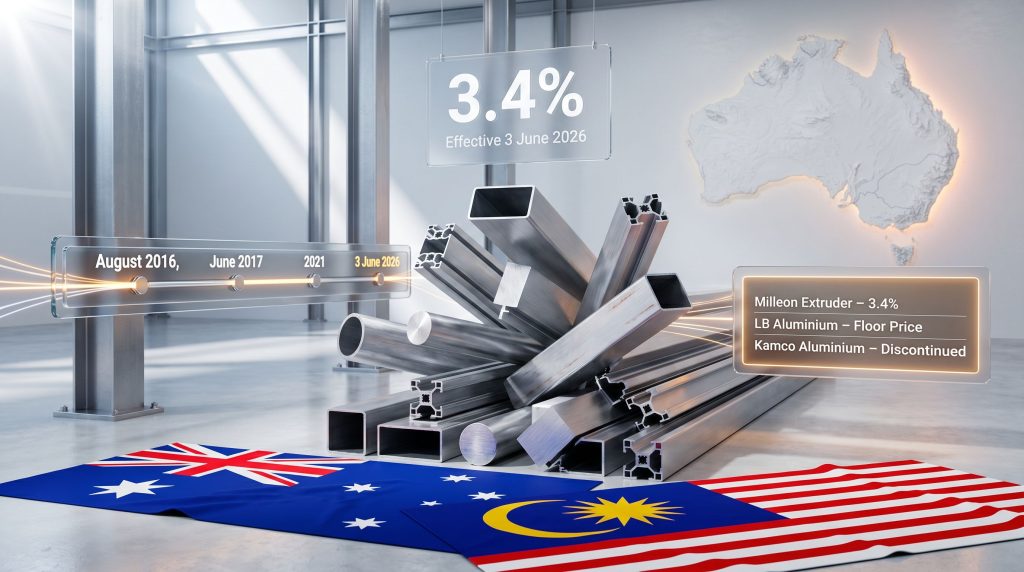
August 2016 marked the formal opening of an ADC investigation into aluminium extrusions from Malaysia and Vietnam, initiated following a petition from Australian extruder Capral Limited. The investigation examined whether below-normal-value pricing was injuring the domestic industry.
June 2017 saw the conclusion of that investigation with an affirmative ruling and the imposition of five-year anti-dumping and countervailing duties on multiple Malaysian producers.
2020 brought a separate ADC investigation specifically targeting surface-polished aluminium profiles from Malaysia. These products had undergone post-extrusion processing, raising distinct classification and evidentiary questions that warranted a standalone inquiry.
2021 produced a final ruling on the surface-polished profiles investigation. The dumping margins established at that time varied considerably across producers:
| Malaysian Producer | Dumping Margin (2021) | Measure Type Applied |
|---|---|---|
| Milleon Extruder | 6.1% | Anti-dumping duty |
| LB Aluminium | 2.6% | Floor price arrangement |
| Kamco Aluminium | 18.5% | Anti-dumping duty |
| Superb Aluminium Industries | 12.8% | Anti-dumping duty |
| Genesis Aluminium Industries | N/A | Removed prior to final ruling |
The wide dispersion of these margins, ranging from 2.6% to 18.5%, reflects a foundational feature of ADC methodology: each exporter is assessed on its own cost structure and export pricing behaviour rather than being assigned a country-wide average. This approach is more demanding on investigative resources but produces far more commercially accurate and legally defensible outcomes.
September 2021 also saw Capral lodge an application for a sunset review of the original 2017 measures, triggering an assessment of whether the five-year duties should be extended or allowed to expire.
What the 2026 Sunset Review Determined: Producer-Specific Outcomes
The most recent chapter in this regulatory story unfolded when Capral Limited filed a new sunset review application in June 2025, prompting the ADC to examine dumping activity occurring between April 2024 and March 2025, with domestic industry injury assessed over a longer window extending back to 2021.
The determination, effective 3 June 2026, produced differentiated outcomes across the three remaining Malaysian producers under review:
- LB Aluminium: Measures retained in the form of a floor price arrangement, indicating that pricing behaviour continues to require regulatory oversight even though the formal dumping margin was relatively modest at 2.6% in 2021.
- Milleon Extruder: Anti-dumping duty maintained but reduced to 3.4%, down from the original 6.1% margin. This reduction signals changed trade conduct while confirming that some level of concern remains.
- Kamco Aluminium: Measures discontinued entirely, reflecting a determination that conditions for this specific producer have materially shifted since the original investigation.
The ADC's decision to simultaneously maintain measures on two producers while discontinuing them on a third producer that previously had the highest dumping margin at 18.5% illustrates a genuinely evidence-based regulatory posture. The removal of Kamco's measures is particularly notable given the severity of its original margin, suggesting substantial changes in that company's pricing and cost structure over the intervening period.
A floor price arrangement operates differently from a fixed percentage duty and is worth explaining in detail. Rather than applying a set tariff rate to the import price, a floor price establishes a minimum transaction value below which anti-dumping duties become payable. When an export price exceeds the floor, no duty is collected. When it falls below, the duty liability adjusts dynamically to cover the gap. This mechanism provides commercial flexibility while maintaining an effective pricing floor that prevents below-cost competition.
Furthermore, Australia's approach to steel and aluminium tariffs in the broader global context underscores how producer-specific determinations are increasingly becoming the international standard for enforcement precision.
The 2025 Federal Court Decision: A Legal Disruption With Limits
Layered on top of the sunset review process is a significant legal development that fundamentally complicates the regulatory picture. In November 2025, Australia's Federal Court set aside the anti-dumping measures originally imposed in the 2017 investigation, with the order taking effect from 15 December 2025.
This ruling affected the original mill-finish extrusion measures that dated back to the initial 2016–2017 investigation. Its practical implications for importers require careful parsing:
- Securities posted during the investigation period convert to duties only up to the rates applicable as of the goods' export date.
- Goods that were in transit at the time of the ruling follow export-date rules for duty assessment.
- The affected measures were removed from the ADC's Dumping Commodity Register.
Critically, however, the Federal Court's ruling did not eliminate all duty exposure on Australian anti-dumping duties on Malaysian aluminium extrusions. The 2021 ruling on surface-polished profiles, and the subsequent 2026 sunset review determination, constitute separate regulatory instruments operating independently of the challenged 2017 measures.
Compliance Warning: Importers who assume the November 2025 Federal Court ruling has cleared all anti-dumping exposure on Malaysian aluminium extrusions are taking a significant commercial risk. The June 2026 sunset review determination applies to a separately defined goods category under a distinct regulatory instrument. Professional customs and legal advice should be obtained before making import commitments.
The next major ASX story will hit our subscribers first
Circumvention Risk: The Chinese Dimension of Malaysian Extrusion Trade
One dimension of Australia's enforcement posture that receives less public attention but carries substantial commercial significance is the ADC's active monitoring of Malaysia as a potential transshipment route for Chinese-origin aluminium extrusions.
Circumvention in the aluminium extrusion trade typically involves minimal processing of Chinese-manufactured profiles in a third country, followed by re-export under a certificate of origin from that country. If the processing is insufficient to qualify as substantial transformation under applicable rules of origin, the goods may technically retain their Chinese origin for duty purposes. Consequently, importers who believe they are sourcing Malaysian product may unknowingly be importing Chinese-origin goods subject to far higher duties.
The ADC maintained five active investigations into aluminium extrusions during 2024–2025, reflecting the sector's status as among the highest-scrutiny import categories in Australian trade enforcement.
The US comparison provides useful context for understanding why trade diversion toward Australia is a credible concern. Indeed, US tariffs impact global metals trade in ways that directly shape where Malaysian exporters redirect their volumes:
| Jurisdiction | Investigation Basis | Key Duty Rate Applied | Scope |
|---|---|---|---|
| Australia | Apr 2024 – Mar 2025 (latest) | 3.4% (Milleon); floor price (LB Aluminium) | Producer-specific, Malaysia |
| United States | 2024 preliminary findings | 27.51% (multiple Malaysian firms); 26.70% (All Others) | 14-country investigation |
The substantial divergence between Australian and US duty rates creates a meaningful commercial incentive for Malaysian producers facing US barriers to redirect export volumes toward the Australian market. This dynamic, sometimes described as trade deflection, is precisely why the ADC's circumvention monitoring function matters even for importers sourcing from producers not previously investigated.
Capral Limited: A Decade of Strategic Trade Remedy Engagement
No analysis of Australia's enforcement on Australia anti-dumping duties on Malaysian aluminium extrusions is complete without examining the consistent role played by Capral Limited, the domestic extruder that has served as petitioner in every major proceeding in this product category.
Capral filed the original 2016 petition that triggered the initial investigation. It filed the 2020 complaint regarding surface-polished profiles. It applied for the 2021 sunset review and filed the June 2025 application that led to the current determination.
This pattern of sustained engagement reflects a deliberate corporate strategy: using trade remedy law as an ongoing competitive management tool rather than a one-time defensive measure. For domestic manufacturers operating in sectors where global oversupply from lower-cost producers generates structural pricing pressure, the anti-dumping system represents a legitimate and legally sanctioned mechanism for levelling the competitive field.
The broader strategic rationale is clear. Maintaining a viable domestic extrusion capacity in Australia supports downstream industries including construction, transportation, and industrial manufacturing, all of which rely on reliably priced locally produced profiles for project planning and procurement. In addition, the broader context of trade wars and supply chains means that Australian domestic producers face sustained competitive pressures from multiple global directions simultaneously.
Practical Compliance Framework for Importers
Given the complexity of the current regulatory environment, importers of Malaysian aluminium extrusions need a structured approach to managing their duty exposure. The following framework provides a practical starting point:
- Verify exporter-specific status on the ADC's Dumping Commodity Register before finalising any import contracts.
- Distinguish goods categories carefully: mill-finish extrusions and surface-polished profiles are governed by different regulatory instruments with different histories and current statuses.
- Assess transitional timing risk for goods exported around the 3 June 2026 effective date of the new determination.
- Do not assume uninvestigated producers are duty-free: new circumvention investigations can be initiated with retrospective effect.
- Seek qualified customs and legal counsel to navigate the intersection of the Federal Court's December 2025 ruling and the June 2026 sunset review outcome. Resources such as ICE Cargo's anti-dumping guidance can provide a useful starting point for understanding import obligations.
| Import Scenario | Duty Exposure Post-June 2026 | Key Commercial Consideration |
|---|---|---|
| Importing from LB Aluminium | Floor price arrangement | Pricing floor limits cost competitiveness at lower price points |
| Importing from Milleon Extruder | 3.4% anti-dumping duty | Moderate landed cost uplift |
| Importing from Kamco Aluminium | No active measures | Full market pricing available |
| Importing from uninvestigated producers | Circumvention risk | Elevated regulatory and retrospective duty uncertainty |
Three Regulatory Scenarios to Watch Through 2027
The current framework is unlikely to remain static. Three distinct scenarios could reshape the compliance landscape over the next 12 to 24 months:
Scenario 1: Stabilisation Under Current Measures
Both Milleon Extruder and LB Aluminium adapt pricing strategies to comply with Australian requirements. Trade volumes normalise at adjusted price points and the ADC's monitoring activity remains at current levels. This is the baseline scenario given both producers' demonstrated long-term market presence.
Scenario 2: New Circumvention Investigation
The ADC initiates a probe into uninvestigated Malaysian producers suspected of routing Chinese-origin extrusions through Malaysia. This scenario is plausible given the ongoing global Chinese aluminium oversupply dynamic and the significant US duty barriers now redirecting Malaysian export volumes.
Scenario 3: Further Legal Challenge
A Malaysian producer or Australian importer challenges the 2026 sunset review determination in the Federal Court, seeking revocation of remaining measures on the precedent established by the successful 2025 challenge to the original 2017 duties. The precedent now exists; whether it is pursued depends on commercial stakes and legal cost calculations.
The existence of a successful Federal Court precedent from 2025 changes the strategic calculus for any Malaysian producer still facing measures. The question is no longer whether a legal challenge is theoretically viable, but whether the commercial value of winning justifies the investment in litigation.
Frequently Asked Questions
What is the current anti-dumping duty rate on Malaysian aluminium extrusions in Australia?
As of the June 2026 determination, Milleon Extruder faces a 3.4% anti-dumping duty, LB Aluminium is subject to a floor price arrangement, and Kamco Aluminium has had its measures fully discontinued. All rates are producer-specific.
Why were Kamco Aluminium's measures discontinued despite having the highest original margin?
The 2026 sunset review assessed current market conditions and exporter behaviour during April 2024 through March 2025. The ADC determined that conditions for Kamco had materially changed since 2021, making continued measures unjustifiable regardless of the historical margin.
Does the November 2025 Federal Court ruling eliminate all anti-dumping duties on Malaysian extrusions?
No. The ruling set aside the original 2017 duty regime only. The 2026 sunset review determination operates under a separate regulatory instrument and remains fully in force from 3 June 2026.
How does a floor price arrangement differ from a standard anti-dumping duty rate?
A floor price sets a minimum export price threshold. Duties are only triggered when the actual transaction price falls below this floor, and the duty payable covers only the gap between the floor and the transaction price. A standard percentage duty, by contrast, applies a fixed rate to the full import value regardless of how the price relates to a floor.
Are Malaysian aluminium extrusions subject to anti-dumping duties in other markets?
The United States imposed preliminary anti-dumping rates of approximately 27.51% on several Malaysian producers in 2024 as part of a 14-country investigation. These rates are substantially higher than Australia's current measures, creating trade flow pressure toward other markets including Australia.
Disclaimer: This article is intended for informational purposes only and does not constitute legal, customs, or financial advice. Duty rates, regulatory determinations, and legal standings can change. Importers and downstream manufacturers should obtain current, qualified professional advice before making commercial or compliance decisions. The scenarios discussed in the regulatory outlook section are speculative projections and do not represent guaranteed future outcomes.
Want to Stay Ahead of Major ASX Mineral Discoveries Before the Broader Market?
Discovery Alert's proprietary Discovery IQ model delivers real-time alerts on significant ASX mineral discoveries, turning complex data across more than 30 commodities into clear, actionable insights for both short-term traders and long-term investors — explore historic discovery returns on Discovery Alert's dedicated discoveries page and begin your 14-day free trial today to secure a genuine market-leading edge.