May 12, 2026
When Global Supply Chains Break Down, Agricultural Giants Become Vulnerable
The most counterintuitive reality in global food systems is that the world's largest agricultural exporters can simultaneously be among the most fragile when it comes to input security. A nation can dominate global soybean, corn, beef, and sugar markets while remaining almost entirely dependent on foreign suppliers for the basic chemistry that makes those harvests possible. This paradox sits at the heart of Brazil's relationship with potassium, and it explains why the projeto Autazes de potássio na Amazônia has attracted both intense investor interest and fierce societal debate.
Understanding what drives this vulnerability, and whether Brazil Potash's Autazes project can meaningfully address it, requires looking beyond the headline figures and into the structural mechanics of how potassium supply actually functions at a global scale. Indeed, resource security risks of this nature are increasingly shaping national policy decisions across multiple continents.
When big ASX news breaks, our subscribers know first
The Structural Fragility Hidden Inside Brazil's Agricultural Dominance
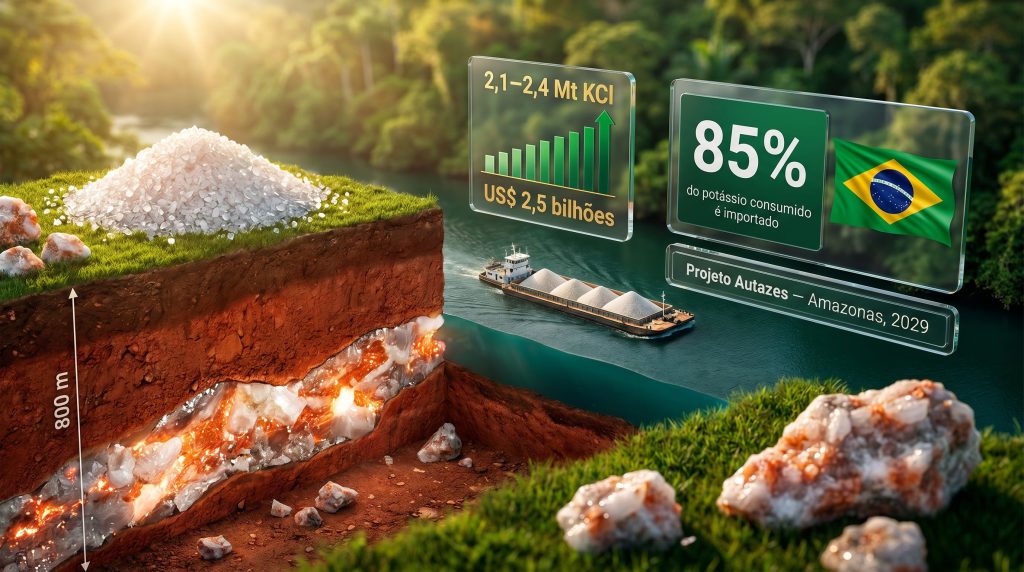
Brazil's position as a top-tier global food producer is well established across multiple commodity categories. Yet beneath this export strength lies a supply chain dependency that few industries in any sector would consider acceptable: roughly 85% of the potassium consumed by Brazilian agriculture is sourced from international markets, according to reporting by Revista Minérios in May 2026.
This is not a minor logistical inconvenience. Potassium, alongside nitrogen and phosphorus, forms the triad of macronutrients that modern industrial agriculture cannot function without. Potassium deficiency in soils produces measurable declines in yield quality and volume across virtually every major Brazilian crop, from soy in Mato Grosso to sugar in São Paulo.
When the supply of this input tightens or prices spike, the economic pain travels directly into farm profitability and, eventually, into Brazil's export competitiveness. This structural fragility has become a central concern for policymakers developing a national fertilizer strategy capable of withstanding external shocks.
Why Global Potassium Supply Is Inherently Geopolitical
The geographic concentration of the world's potassium reserves transforms what should be a routine commodity procurement exercise into a geopolitical risk management challenge. Approximately 80% of global potassium supply flows from just three producing regions, each carrying its own set of structural risks:
| Producing Region | Estimated Share of Global Supply | Key Risk Factor |
|---|---|---|
| Canada (Saskatchewan) | ~35% | Distance, transport costs to Brazil |
| Russia | ~20% | International sanctions, market access restrictions |
| Belarus | ~20% | Western sanctions, export disruptions |
| All Other Producers | ~25% | Fragmented, limited scale |
The 2022 conflict in Eastern Europe and the subsequent sanctions regime imposed on both Russia and Belarus removed a combined estimated 40% of global potassium capacity from predictable market access almost overnight. For Brazil, which draws heavily from these sources, the consequences were immediate: potassium chloride (KCl) prices reached historical highs, compressing agricultural margins at precisely the moment when global food demand remained elevated.
This episode revealed something that supply chain analysts had warned about for years: a dependency structure where a single geopolitical event can simultaneously disrupt 40% of your input supply is not a manageable risk, it is a systemic vulnerability.
The case for domestic potassium production in Brazil, therefore, is not primarily about cost optimisation under normal market conditions. It is fundamentally about reducing the exposure of an entire national agricultural system to forces that lie entirely outside Brazilian control.
What the Autazes Deposit Actually Represents Geologically
Not all potassium deposits are created equal, and the geological characteristics of the Autazes deposit in Amazonas state carry significant implications for how the project would function and what challenges it faces.
The deposit consists of silvinite, a sedimentary evaporite mineral containing potassium chloride (KCl) in commercially viable concentrations alongside halite (sodium chloride, NaCl). Silvinite deposits of this type form in ancient marine basins that experienced evaporation cycles over geological timescales, concentrating dissolved minerals into layered sequences that can extend laterally for hundreds of kilometres.
The Autazes silvinite body sits at approximately 800 metres below surface, which is within the operational range considered standard for underground potash mining globally. Canadian operations in Saskatchewan, widely regarded as the benchmark for the industry, typically mine at depths ranging from 900 to 1,100 metres. The Autazes depth is therefore shallower than many established operations, which in principle reduces shaft sinking costs and hoisting energy requirements, though these advantages must be weighed against the elevated complexity of operating in an Amazonian geological and hydrological context.
Hot Leaching: The Processing Technology That Defines the Project's Economics
The separation of potassium chloride from the silvinite ore matrix is achieved through a process known as hot leaching, or lixiviação a quente in Brazilian technical terminology. This process exploits the differential solubility characteristics of KCl and NaCl across temperature ranges:
- Crushed silvinite ore is dissolved in a heated brine solution, with KCl exhibiting higher solubility at elevated temperatures than NaCl.
- The solution is then cooled in a controlled crystallisation stage, during which the differential solubility reverses and KCl preferentially crystallises out of solution.
- The resulting KCl crystals are separated, dried, and granulated into the product form suitable for direct agricultural application or bulk fertiliser blending.
Hot leaching is a well-established technology used across the global potash industry. Its principal advantages include high product purity and flexibility in handling variable ore grades. The principal operational challenges involve significant energy consumption for heating and cooling cycles, water management at scale, and the disposal of halite-rich process residues, which in an Amazonian context would require careful containment to prevent saline contamination of surrounding freshwater systems. Furthermore, understanding natural capital in mining is increasingly relevant when assessing these environmental trade-offs.
The Financial Architecture of a US$2.5 Billion Bet on Brazilian Food Security
Characterising the Autazes project as anything less than a major capital commitment would be misleading. The total capital expenditure envelope is estimated at US$2.5 billion, placing this firmly in the category of significant mining developments by any international standard. Consequently, the mining project economics underpinning these decisions merit careful scrutiny.
The financial progression of the project to its current stage can be mapped as follows:
| Capital Category | Amount |
|---|---|
| Total project CAPEX estimate | US$2.5 billion |
| Previously invested (exploration, studies, licensing, indigenous consultations) | US$270 million |
| Capital raised from foreign investors (May 2026) | US$63.3 million |
| Structural works investment required for construction commencement | US$400 million |
The US$63.3 million capital raise completed in May 2026, as reported by GlobeNewswire, represents a meaningful signal from international capital markets. Foreign investors committing at this stage of a project carrying the complexity profile of Autazes are, by definition, underwriting a significant risk premium alongside their return expectations.
The stated allocation for these fresh funds covers four parallel workstreams:
- Commencement of underground mine development (shaft sinking and initial development headings)
- Construction of the hot leaching processing facility
- Installation of a dedicated river port terminal on the Rio Madeira
- Expansion of road access infrastructure connecting the mine site to the processing complex
The Financing Gap and What It Means for Project Trajectory
The arithmetic of the capital structure reveals a challenge that Brazil Potash has acknowledged openly. With US$270 million previously invested and US$63.3 million just raised, even adding the US$400 million targeted for structural works leaves a remaining funding requirement that approaches US$2 billion or more before commercial production can commence.
This scale of remaining capital requirement means the company must successfully execute one of the largest mining project financing transactions in recent Brazilian history. Potential capital sources that industry observers typically consider for projects of this type include development finance institutions, strategic industrial partners from the fertiliser sector, and project finance structures backed by long-term offtake commitments. A robust definitive feasibility study will be essential in attracting the institutional confidence required to close this gap.
Investors and analysts should note that the gap between funds secured and total CAPEX remains substantial, and project timelines and financial forecasts are inherently subject to change based on financing conditions, regulatory developments, and market dynamics. This article does not constitute financial advice.
Logistics as a Competitive Weapon: The Rio Madeira Advantage
One aspect of the Autazes project that is frequently cited but deserves deeper examination is the logistics proposition. Brazil Potash projects a freight cost reduction of up to 71% compared to imported potassium reaching the Centro-Oeste agricultural heartland, according to Revista Minérios (May 2026).
This figure stems from the fundamental geography of the project. The Rio Madeira, one of the Amazon basin's major tributaries, flows in a direction that connects the project site directly to the barge networks supplying Brazil's interior agricultural regions. Imported potassium, by contrast, arrives at Atlantic or southern Brazilian ports and must then travel overland, often by truck across heavily congested road corridors, to reach farms in Mato Grosso, Goiás, and neighbouring states.
The waterway route from Autazes leverages the Madeira-Paraná-Tietê river system, which collectively provides one of South America's most cost-efficient bulk freight corridors. Barge transport on this system typically carries a cost-per-tonne-kilometre significantly below road or even rail alternatives for bulk commodities.
The 71% freight cost differential, if it holds through detailed logistics modelling, would represent a structural cost advantage that persists regardless of international potassium prices, giving Brazilian agricultural users a price hedge that no import arrangement can replicate.
This logistical edge partially explains why the project's potential domestic market share estimates range from 20% up to 50% of national demand, with the variation reflecting different assumptions about how aggressively the freight advantage would drive market penetration over time.
Employment, Regional Development, and the Transformation of Autazes
The municipality of Autazes sits in the interior of Amazonas state, classified as a small-scale community with an economic profile typical of interior Amazonian towns. The construction phase of the Autazes project, estimated to extend across approximately four years, is projected to generate around 2,600 direct jobs, a figure that in the context of a community of Autazes's scale represents a potentially transformative economic event.
Direct employment figures in mining construction, however, typically understate total employment impact. Indirect jobs in logistics, food services, accommodation, equipment maintenance, and local supply chains can multiply direct employment numbers by a factor of two to three in resource-intensive projects, depending on how effectively local procurement policies are implemented.
The operational phase would also sustain a permanent workforce, though specific figures for this phase have not been publicly detailed in available sources reviewed for this article.
The next major ASX story will hit our subscribers first
The Socioenvironmental Tension That Cannot Be Separated from the Project's Future
No analysis of the projeto Autazes de potássio na Amazônia is complete without confronting the socioenvironmental controversies that have accompanied it since its earliest public hearings. These are not peripheral concerns that can be resolved through engineering or financial structuring. They go to the heart of how Brazil balances resource development with constitutional protections for indigenous communities and environmental integrity.
The Mura indigenous people have inhabited the region surrounding the proposed mine site for centuries. The project's footprint intersects with territory claimed by or formally associated with three distinct indigenous areas:
- Terra Indígena Paracuhuba, which carries full demarcation and homologation status
- Terra Indígena Jauary, where the demarcation process remains ongoing
- Aldeia Soares/Urucurituba, a community whose territorial claims remain unresolved
The Associação Brasileira de Antropologia (ABA) has issued technical assessments arguing that the project raises serious concerns under Brazilian constitutional provisions protecting indigenous territorial rights and cultural integrity.
The Free, Prior, and Informed Consent Question
A critical but underreported dimension of the Autazes controversy involves the procedural standards applied to community consultation. International labour standards, specifically ILO Convention 169 to which Brazil is a signatory, establish that indigenous communities must receive free, prior, and informed consultation before projects affecting their territories can proceed.
Critics, including researchers associated with the Universidade Federal do Amazonas (UFAM), have argued that the consultation processes conducted since 2015 failed to meet this standard in terms of genuine community participation and access to technical information.
The practical implications of this dispute extend well beyond regulatory compliance. Mining projects globally that proceed without genuine community consent tend to face higher rates of operational disruption, legal challenge, and reputational damage, all of which translate into elevated risk-adjusted costs for investors and developers alike.
The experience of comparable extractive projects in ecologically and culturally sensitive regions across Latin America demonstrates that a formal environmental licence and a genuine social licence to operate are not the same thing, and the gap between them can determine project viability more decisively than any geological or logistical factor.
Against this critique, the Universidade do Estado do Amazonas (UEA) has established a formal partnership with Brazil Potash to develop professional training programmes and applied research initiatives, including a framework described as the Plano Bem Viver Mura, intended to provide structured support to local indigenous communities.
Autazes in the Context of Brazil's National Fertilizer Plan
The Plano Nacional de Fertilizantes (PNF), the federal government's framework for reducing import dependency, sets a target of lowering the current 85% import reliance to approximately 45% by 2050. The Autazes project, given its projected production scale of 2.1 to 2.4 million tonnes of KCl annually over an initial mine life of approximately 23 years, is consistently identified in industry discussions as one of the few individual projects with the physical scale to make a material contribution to this national objective.
The project has drawn public expressions of support from the Governor of Amazonas, who frames it as a regional development priority, and from other political figures who have connected it to Brazil's broader food security agenda. It is important to note that these represent expressions of political support rather than confirmed programme commitments involving specific funding, permitting acceleration, or official designation status.
Comparing Autazes to Global Potash Development Benchmarks
Placing the Autazes project within its global industry context helps calibrate both its ambition and its complexity. For further detail on the Autazes project, the company's investor relations materials provide a comprehensive overview of the deposit's technical and commercial parameters.
| Comparison Factor | Autazes (Brazil) | Saskatchewan (Canada) | Belaruskali (Belarus) |
|---|---|---|---|
| Deposit depth | ~800 metres | 900-1,100 metres | 350-800 metres |
| Extraction method | Underground (chambers and pillars) | Underground and solution mining | Underground |
| Annual production target | 2.1-2.4 Mt KCl | 10-12 Mt KCl | 12-14 Mt KCl |
| Current status | Pre-construction (2026) | Fully operational | Fully operational |
| Socioenvironmental complexity | High (Amazon biome, indigenous territories) | Moderate | Low |
The Canadian and Belarusian operations represent decades of production maturity and infrastructure investment. Autazes, if it proceeds to production on its projected 2029 timeline, would enter as a meaningful but not dominant force in global potassium supply, with its competitive advantage concentrated in the Brazilian domestic market rather than in international export competition.
Environmental Licensing Status and Remaining Approvals
As of the information available through mid-2026, Brazil Potash has obtained the environmental licences required from the IPAAM (Instituto de Proteção Ambiental do Amazonas) for construction to proceed. The existence of formal licences, however, does not extinguish the legal and civil society challenges that have been raised, nor does it resolve the underlying questions about indigenous community consent under ILO Convention 169 standards.
Projects in comparable regulatory environments elsewhere in South America demonstrate that formal licencing and social opposition can coexist for extended periods, with outcomes that range from successful negotiated resolution to project suspension pending additional review.
The Broader Stakes of Getting This Decision Right
The debate surrounding the projeto Autazes de potássio na Amazônia ultimately crystallises a tension that will define Brazilian development policy for years to come. On one side sits an undeniable structural vulnerability in a supply chain that underpins the agricultural exports generating hundreds of billions in annual foreign exchange earnings. On the other side sit constitutional protections, ecological considerations, and community rights that Brazil has committed to uphold both domestically and through international treaty obligations.
Brazil Potash's CEO Matt Simpson has framed the project as a matter of national strategic security in public statements, positioning potassium self-sufficiency as essential to maintaining Brazil's agricultural production capacity when global supply chains face disruption. That framing resonates powerfully in a post-2022 world where commodity supply chain fragility has been repeatedly demonstrated.
Whether the Autazes project can successfully navigate the financing gap, the socioenvironmental opposition, and the technical complexity of deep underground mining in an Amazonian context to reach commercial production by its 2029 target will be one of the more consequential stories in Brazilian mining over the coming years. The answer will determine not just the fate of a single mining project, but whether Brazil can meaningfully reduce its dependence on the geopolitically unstable sources that currently underpin its agricultural dominance.
This article draws on reporting from Revista Minérios (May 11, 2026) and publicly available information. Financial figures, timelines, and production projections are subject to change. Nothing in this article constitutes investment advice. Readers should conduct independent due diligence before making any investment decisions related to companies or projects referenced herein.
Want to Stay Ahead of Major Mineral Discoveries Before the Broader Market Does?
Discovery Alert's proprietary Discovery IQ model delivers real-time alerts on significant ASX mineral discoveries, transforming complex resource data into actionable investment insights for both short-term traders and long-term investors — explore Discovery Alert's discoveries page to understand how historic finds have generated substantial returns, and begin your 14-day free trial today to secure a market-leading advantage.