May 12, 2026
The Hidden Fault Line in Mine Safety: Why Supervisory Culture Determines Whether Workers Live or Die
Every year, mining companies across the world invest billions of dollars in safety equipment, training programmes, and governance frameworks. Fatality rates have declined across many jurisdictions over the past two decades. Yet serious incidents continue to occur with a regularity that defies the scale of investment directed at preventing them. The reason, according to one of the most credible voices in global mining safety, is not found in equipment specifications or training syllabi. It is found in the gap between what organisations say they value and what their supervisors actually do when no one is watching.
That voice belongs to Luis Urzúa mina San José Chile's most recognised crisis leadership figure — the shift foreman who led 33 miners through 69 days of underground survival following the catastrophic collapse of August 5, 2010. His story is one of the most documented crisis leadership cases in modern industrial history. However, the lessons he continues to share with mining professionals in 2026 go considerably deeper than the survival narrative that captured global attention at the time of the rescue.
When big ASX news breaks, our subscribers know first
The Mina San José Collapse: Geology, Depth, and Compounded Risk
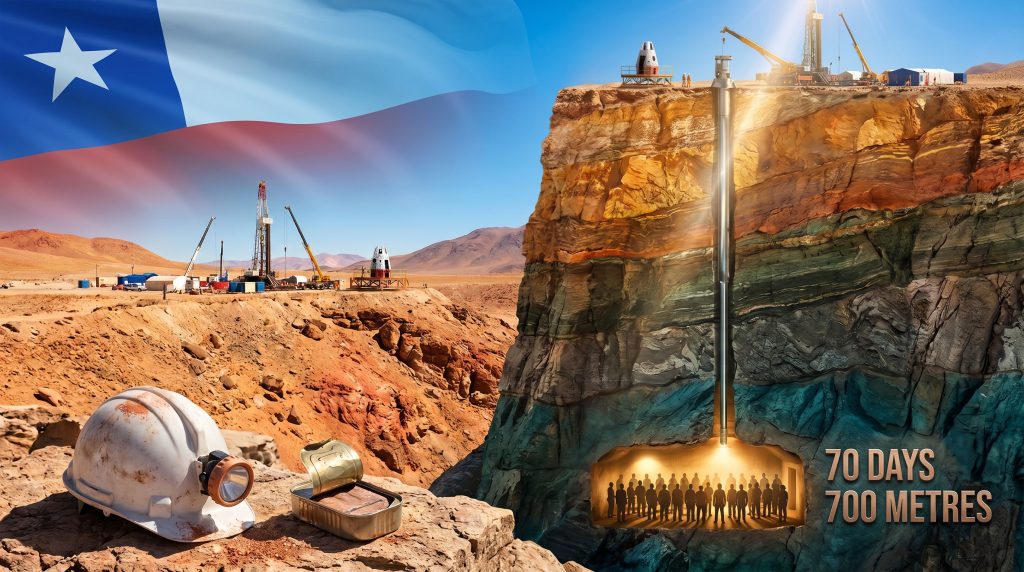
The Mina San José copper-gold mine sits near Copiapó in Chile's Atacama Region, operated by Compañía Minera San Esteban. At approximately 700 metres below the surface, the mine extracted copper and gold through underground methods that exposed workers to the compounding hazards of extreme depth: elevated rock stress, reduced ventilation margins, longer evacuation distances, and structurally complex geology.
Understanding underground mining challenges at this scale reveals what engineers describe as a non-linear risk environment. The deeper the operation, the more variables interact simultaneously. A structural failure at 700 metres is not simply a scaled-up version of a surface incident. It is a categorically different operational scenario with far fewer response options and a much narrower window for intervention.
On August 5, 2010, a section of the mine collapsed, trapping all 33 workers present at the time. The initial period following the collapse was defined by total uncertainty. For approximately 17 days, no communication existed between the trapped workers and rescue teams operating at the surface. The outside world could only assume the worst. The miners, meanwhile, had to function as a self-contained survival unit with no external guidance and finite resources.
Luis Urzúa: Professional Background and Pre-Crisis Authority
Understanding why Urzúa was positioned to lead requires understanding what a shift foreman actually does in a deep underground mining operation. The role is not simply supervisory in the administrative sense. A shift foreman in an underground mine carries direct responsibility for:
- Real-time safety compliance at the operational face
- Task assignment and crew coordination across a shift
- First-response decision-making in the event of an incident
- Communication between executive safety policy and ground-level execution
- Documentation of hazard identification and near-miss events
Urzúa brought specific technical grounding to this role through his background as a topographer, a profession that requires precise spatial reasoning, an understanding of underground geometry, and the ability to interpret structural conditions from physical evidence. In a crisis defined by collapsing geometry and uncertain structural stability, these skills were not incidental. They were operationally critical.
His years of frontline experience across Chilean mining operations meant he understood the behavioural patterns that either hold or fracture under sustained pressure. He had seen how crews respond to stress. Furthermore, he understood which variables could be controlled and which could not.
Why Technical Expertise Alone Was Not Enough
Referring to a solid mining basics guide makes clear that technical competence and leadership capability are distinct skill sets. Urzúa's effectiveness stemmed from the combination of both, applied under conditions that would overwhelm either in isolation.
Inside the Refuge: Leadership Architecture During 69 Days Underground
When the collapse sealed the miners at depth, Urzúa made a series of rapid decisions that would define the group's survival trajectory. Before any external contact was established, before any rescue plan existed, and before anyone could confirm whether rescue was even possible, he organised the group into a functioning unit.
The operational framework he built addressed four simultaneous challenges:
- Resource management under conditions of radical scarcity and an unknown survival window
- Task structure to maintain psychological orientation and prevent individual deterioration
- Authority maintenance that preserved group cohesion without generating resentment or resistance
- Morale architecture that sustained belief in rescue without dishonest reassurance
The resource rationing protocol implemented in the early days was exceptionally severe. Available emergency provisions were distributed in minimal portions across 33 individuals, with each person receiving a fraction of a normal daily caloric intake across multi-day cycles. The physiological and psychological stress this created was significant. Yet, the group held together structurally.
Leadership under zero-information conditions is the most demanding operational scenario a person can face. There is no playbook, no supervisor to escalate to, and no data on which to base projections. What Urzúa demonstrated was that crisis leadership is not improvised at the point of failure. It is either embedded before the crisis occurs, or it does not exist at all.
When surface contact was finally established, the organisational structure Urzúa had built meant that communication could be coordinated, health assessments could be conducted, and rescue sequencing could be planned. The group had not fragmented. They were still functioning as a team.
The Leadership Dimensions That Defined the 69-Day Survival Period
| Leadership Dimension | Operational Approach | Outcome |
|---|---|---|
| Authority structure | Clear hierarchy without domination | Prevented internal power conflicts |
| Resource allocation | Transparent rationing with equal distribution | Extended survival window under scarcity |
| Psychological cohesion | Task assignment and shared purpose framing | Reduced deterioration and maintained morale |
| Medical assessment | Systematic health evaluation for rescue prioritisation | Informed extraction sequencing decisions |
| Communication management | Disciplined structured messaging with surface teams | Enabled coordinated rescue operation |
One symbolic dimension of Urzúa's leadership approach that has been cited in various accounts of the rescue involves his deliberate positioning as a peer rather than an authority figure in certain moments. His willingness to visibly share the same conditions as the workers under his charge, rather than assuming superior status, created a social dynamic of mutual commitment rather than hierarchical compliance.
The Rescue Operation: A Timeline of Critical Milestones
The rescue of the 33 miners from the Mina San José remains one of the most operationally complex emergency mining responses in documented history. It combined deep drilling technology, international expertise, psychological support systems, and sustained logistics over an extended period.
The key operational milestones unfolded as follows:
- August 5, 2010 — Structural collapse seals 33 miners at approximately 700 metres depth near Copiapó, Atacama Region, Chile
- Days 1 to 17 — Complete communication blackout; Urzúa manages internal group dynamics without external contact or guidance
- Day 17 — First bore hole reaches the refuge area; survival confirmed; surface contact established for the first time
- Days 17 to 69 — Supply delivery via bore holes; psychological support protocols introduced; multiple rescue drilling operations run simultaneously
- October 13, 2010 — Capsule extraction begins; all 33 miners retrieved alive over a single extended operation
- Final extraction — Luis Urzúa becomes the last of the 33 to be brought to the surface, consistent with his stated duty as shift leader
It is worth noting that the duration of the entrapment is accurately recorded as 69 days, from August 5 to October 13, 2010. The figure of 70 days appears in some secondary accounts but does not reflect the precise calendar interval between the collapse and the final extraction.
The international dimension of the rescue operation was significant. Drilling teams, technical specialists, and operational advisors from multiple countries contributed to the parallel boring strategy that ultimately created the extraction shaft. Consequently, the coordination required across different organisational, cultural, and linguistic frameworks added a further layer of operational complexity to an already exceptional situation.
The Core Warning: Where Safety Investment Actually Fails
The most operationally significant insight Luis Urzúa mina San José Chile has shared in post-rescue forums, including his presentation at the IBRAM Operational Risks Workshop in Belo Horizonte, Brazil in May 2026, is not about what happens at 700 metres underground. It is about what happens in the management layers between the boardroom and the blast face.
At the IBRAM workshop, Urzúa acknowledged that mining organisations have substantially increased investment in safety strategies over recent years. Equipment is better. Training programmes are more sophisticated. Safety culture frameworks are more formally documented than at any prior point in the industry's history. And yet, he identified a structural vulnerability that these investments consistently fail to address.
The vulnerability is this: substantial capital deployed toward equipment upgrades, training curricula, and safety culture programmes loses effectiveness when intermediate management — including line supervisors, coordinators, and operational chiefs — operates in a manner that is misaligned with the organisation's stated safety priorities (Instituto Brasileiro de Mineração, 2026).
This is not a new observation in safety management theory. However, coming from someone who survived the consequences of a safety governance failure at 700 metres depth, the statement carries a different quality of authority than it would in a textbook.
The Middle Management Gap: Why It Persists
The structural reason this gap persists is worth examining carefully. In most mining organisations, intermediate management layers are evaluated primarily on production metrics. Tonnage moved. Metres drilled. Equipment utilisation rates. Safety compliance is measured, but in many operational cultures it is treated as a constraint on production rather than a parallel value.
When supervisors receive mixed signals from the organisational systems that evaluate their performance, they predictably optimise for the signals that most directly affect their outcomes. If production is rewarded and safety is only measured in the absence of incidents, supervisory behaviour will reflect that asymmetry.
This creates what might be called a safety culture coherence gap: a disconnect between the safety values stated at the executive level and the operational decisions made at the supervisory level every shift, every day. The mining industry evolution has brought considerable technical progress, yet this human governance gap remains stubbornly persistent.
The next major ASX story will hit our subscribers first
Pre- and Post-San José: How Emergency Protocol Design Evolved
The Mina San José rescue prompted measurable changes in how the global mining industry approached emergency preparedness, particularly in the design of underground refuge systems and rescue capability.
| Safety Dimension | Pre-2010 Approach | Post-San José Evolution |
|---|---|---|
| Refuge chamber design | Basic short-duration survival provisions | Extended life support for prolonged entrapment scenarios |
| Communication systems | Single-channel primary only | Multi-bore redundant emergency communication protocols |
| Psychological support | Minimal formal structure in emergency response | Integrated mental health and behavioural support teams |
| Rescue drilling capability | Sequential single-bore operations | Simultaneous parallel boring across multiple rescue drill sites |
| Leadership preparation | Technical competency as primary criterion | Crisis psychology and human performance factors integrated |
These changes represent genuine progress. But Urzúa's ongoing advocacy suggests that technical and structural improvements, while necessary, are insufficient without corresponding improvements in supervisory culture and middle management alignment. In addition, considering mine lifecycle responsibilities from the outset ensures that safety culture is embedded throughout every operational phase, not just during active extraction.
What Modern Mining Operations Should Audit Based on the San José Framework
For mining safety professionals and operational leaders applying the lessons from the Mina San José, the practical audit priorities are clear:
- Leadership alignment assessment: does supervisory behaviour at the shift level actually reflect stated organisational safety policy, or is there a measurable gap between documented culture and observed practice?
- Emergency preparedness depth: are refuge systems, communication redundancies, and rescue protocols genuinely designed for extended-duration scenarios, not just short-term incidents?
- Psychological readiness investment: are workers and supervisors specifically trained in human performance under sustained stress, beyond technical emergency response procedures?
- Middle management accountability design: are intermediate leaders explicitly evaluated on safety culture outcomes, or is their performance measurement still dominated by production metrics?
- Incident learning architecture: does the organisation's incident review process examine supervisory behaviour patterns, or does it stop at immediate physical causation?
These questions align with the requirements of contemporary safety governance frameworks including ISO 45001 and the Mining Association of Canada's Towards Sustainable Mining standard. Furthermore, the mining sustainability transformation underway globally reinforces that culture and compliance must advance together. Frameworks alone cannot close the gap that Urzúa identifies. That gap is closed through consistent supervisory behaviour, reinforced by accountability systems that take culture as seriously as compliance.
Luis Urzúa's Continuing Role in Global Mining Safety Education
Sixteen years after the rescue, Luis Urzúa mina San José Chile continues to engage directly with mining industry professionals, bringing a perspective that no simulation exercise or safety curriculum can replicate. His participation in forums such as the IBRAM Operational Risks Workshop in Belo Horizonte in May 2026 demonstrates that the operational lessons of San José remain actively relevant to contemporary mining safety governance.
At the IBRAM workshop, facilitated with participation from IBRAM's mining affairs and safety processes coordinators, the session was structured to allow direct interaction between industry practitioners and Urzúa himself, enabling professionals to test the San José framework against their own operational contexts (Instituto Brasileiro de Mineração, 2026).
The thematic framework Urzúa brings to professional audiences consistently addresses:
- Decision-making in zero-information environments
- Emotional regulation under sustained and extreme stress
- Team cohesion maintenance without resource incentives
- Communication discipline in both crisis and recovery phases
- The structural vulnerability of intermediate management layers in safety governance
What makes his contribution distinctive is not the drama of the survival story, though that is undeniably powerful. It is the precision with which he has translated an extreme operational experience into actionable diagnostic frameworks for organisations operating in far less extreme conditions. The gap he identified between safety investment and supervisory behaviour does not require a catastrophe to be measurable. It can be observed and addressed before any incident occurs.
Disclaimer: This article contains references to historical events, timelines, and professional assessments drawn from publicly documented sources. Readers should conduct independent verification of specific claims before applying any frameworks to operational decision-making. Information about the IBRAM Operational Risks Workshop is sourced from Instituto Brasileiro de Mineração (ibram.org.br, published May 11, 2026).
Want to Identify the Next Major ASX Mining Discovery Before the Market Reacts?
Discovery Alert's proprietary Discovery IQ model scans ASX announcements in real time, instantly translating complex mineral data across more than 30 commodities into clear, actionable insights — so subscribers can act on significant discoveries as soon as they are announced. Explore historic discoveries and the returns they generated, then begin a 14-day free trial to position yourself ahead of the broader market.