June 4, 2026
Why the Subsea Layer Is the Most Underestimated Phase of Any Offshore Gas Project
When investors and analysts evaluate offshore gas developments, attention tends to gravitate toward headline reserve figures, gas prices, and production capacity. What frequently escapes scrutiny is the subsea infrastructure layer sitting between the reservoir and the market. This is the domain of SURF systems, and it is precisely where the technical complexity, execution risk, and capital intensity of an offshore project are most concentrated. The awarding of the Mako gas field SURF contract in offshore Indonesia marks the moment a development plan moves from paper commitments to physical construction, and understanding the mechanics of what that involves reveals far more about project quality than the headline numbers alone.
When big ASX news breaks, our subscribers know first
What SURF Actually Means and Why It Defines Offshore Project Risk
SURF is an acronym for Subsea Umbilicals, Risers, and Flowlines. Together, these components form the circulatory network of any subsea gas development. Flowlines carry produced hydrocarbons from wellheads along the seabed to a processing facility. Risers are the sections of pipe that transition the flow from the seabed to the surface production unit. Umbilicals are the composite bundles of hydraulic lines, electrical cables, and chemical injection tubes that allow operators to control and monitor subsea equipment from the surface.
When combined with an EPCI mandate, which stands for Engineering, Procurement, Construction, and Installation, the SURF contractor takes on responsibility for the entire lifecycle of that subsea infrastructure from initial design verification through to offshore commissioning support. This is not a single trade. It requires naval architects, pipeline engineers, subsea systems specialists, marine logistics coordinators, and offshore installation teams operating across multiple phases and geographic locations simultaneously.
The reason SURF scope consistently represents the longest-lead and most capital-intensive element of subsea development programs comes down to fabrication complexity, specialist vessel requirements, and the precision demanded during offshore installation in dynamic marine environments. A single misalignment in a subsea tie-in can delay first gas by months.
How the Mako Gas Field Is Positioned Within the Natuna Sea Basin
The Mako gas field lies within the Duyung Production Sharing Contract area in the Natuna Sea, positioned approximately 400 km northeast of Singapore and 100 km north of Matak Island. The geographic remoteness that initially appears to complicate development is offset by the field's proximity to an existing regional midstream network that dramatically reduces the capital burden of bringing gas to market.
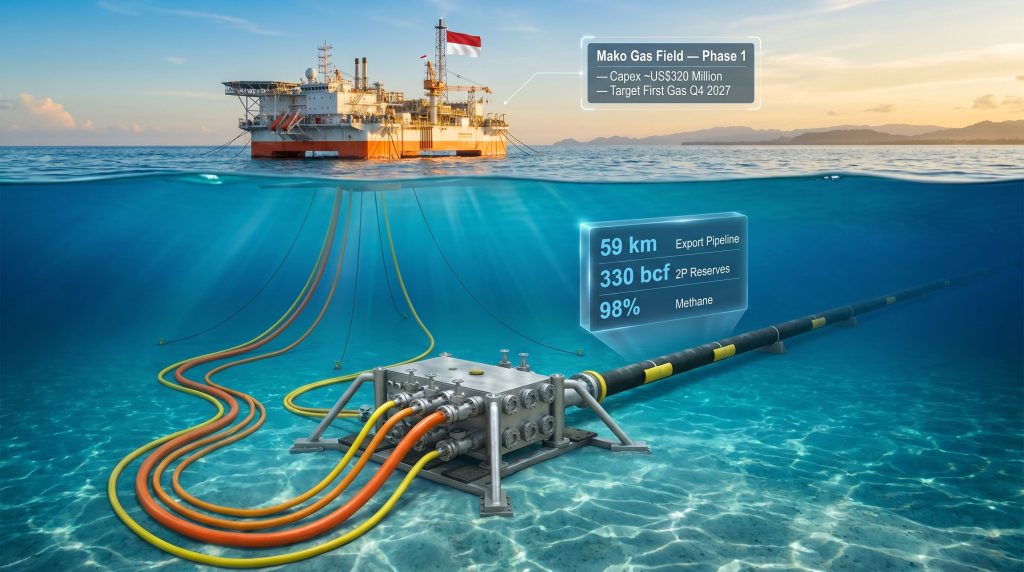
The West Natuna Transportation System (WNTS) is the critical piece of infrastructure that makes Mako commercially viable. Rather than constructing a standalone onshore terminal, Mako's produced gas will travel via a 59 km export pipeline to the KF platform in the adjacent Kakap PSC, then integrate with the WNTS pipeline for delivery to Indonesian domestic industrial and power generation consumers. This infrastructure leverage effect converts a remote offshore field into a connected supply asset without requiring standalone greenfield midstream investment.
Indonesia's domestic gas market has structural supply pressures driven by industrial demand from fertilizer production, power generation, and petrochemical feedstock requirements, particularly across Sumatra and Java. Furthermore, the role of gas and oil in underpinning regional energy security continues to grow. Legacy Natuna Sea fields have been in decline, and new developments capable of channeling high-quality gas directly into established domestic pipelines represent precisely the type of project that fills structural gaps without adding complexity.
Reservoir Quality: What Separates Mako From Comparable Regional Accumulations
The Mako reservoir holds 2C contingent resources of 413 billion cubic feet (bcf) and 2P proved-plus-probable reserves of approximately 330 bcf. To contextualise that distinction: 2C contingent resources reflect accumulations that are technically recoverable but have not yet met all criteria for full commercial classification, while 2P reserves carry higher confidence and are the metric underpinning project financing and development decision-making.
What sets Mako apart from many Natuna Sea accumulations is its gas quality profile:
- Methane content: approximately 98% pure methane
- Mercury: absent entirely
- Heavy metals: none detected
This compositional profile carries real commercial significance that is often underappreciated outside technical circles. Fields with mercury contamination require dedicated mercury removal units, which add capital cost, operational complexity, and regulatory compliance layers. Fields with high levels of carbon dioxide or hydrogen sulfide require acid gas removal facilities that inflate processing capital by tens of millions of dollars.
Mako's gas composition means the downstream processing footprint remains minimal, regulatory clearance pathways are simplified, and the delivered product meets or exceeds industrial specification requirements without intermediate treatment. For a project where total Phase 1 capex is targeted at approximately US$320 million, this compositional advantage directly contributes to maintaining that budget envelope.
The Development Architecture: Six Wells, One Leased MOPU, and 59 Kilometres of Pipeline
The Phase 1 development program is structured around a clearly defined technical blueprint:
| Development Parameter | Specification |
|---|---|
| Phase 1 Development Wells | 6 subsea wells |
| Production Unit Type | Leased Mobile Offshore Production Unit (MOPU) |
| MOPU Design Capacity | 172 MMscfd |
| Export Pipeline Length | 59 km |
| Export Pipeline Diameter | 18-inch OD |
| Total Phase 1 Capex | ~US$320 million |
| Target First Gas | Q4 2027 |
| Destination Market | Indonesian domestic gas market |
The decision to lease a MOPU rather than commission a purpose-built FPSO or fixed topside structure reflects deliberate capital efficiency thinking. Purpose-built vessels require 24 to 36 months of construction and pre-delivery testing before deployment. A leased MOPU compresses that timeline significantly, converting a large upfront capital expenditure into an operational lease structure, and retains flexibility for future redeployment if production profiles or market dynamics shift.
The six subsea wells will be tied back to the MOPU via the SURF system, with produced gas then routed through the 18-inch export pipeline to the KF platform and onward via WNTS to Indonesian domestic consumers. The 172 MMscfd design capacity suggests individual well productivity averaging in the range of approximately 28 MMscfd, which is consistent with well deliverability expectations in the Natuna Sea geological setting with modern subsea completion technology.
The SURF EPCI Contract: Breaking Down Five Phases of Execution
The Mako gas field SURF contract in offshore Indonesia awarded to PT Timas Suplindo covers five distinct execution phases, each carrying its own technical and scheduling dependencies. According to contract details reported by Offshore Technology, the scope represents one of the most comprehensive subsea mandates awarded in the region in recent years.
Phase 1: Engineering
Verification of existing FEED documentation comes before detailed engineering commences. This step matters more than it might appear. FEED assumptions are developed under conditions of incomplete subsea data, and verification against updated bathymetric surveys, geotechnical assessments, and metocean data can reveal design modifications that are far cheaper to address before fabrication than after. Detailed engineering deliverables include flowline design, export pipeline routing over 59 km of seabed, riser configurations, subsea structure engineering, umbilical design specifications, and installation engineering packages.
Phase 2: Procurement
Materials procurement is divided between contractor-furnished materials, which Timas Suplindo sources and manages independently, and company-furnished materials supplied by West Natuna Exploration Ltd. (WNEL). Company-furnished materials include line pipes, umbilicals, subsea production control systems (SPCS), and subsea valves. Managing this dual-supply architecture in a remote offshore environment requires precise coordination of vendor qualification, logistics scheduling, and material traceability documentation.
Phase 3: Construction and Fabrication
Fabrication covers subsea structure assembly, coating application, inspection, and testing of all SURF components. Quality assurance at this stage typically involves third-party inspection programs and non-destructive testing protocols to verify weld integrity, coating adhesion, and dimensional tolerances before load-out. Southeast Asian fabrication yards provide cost-competitive manufacturing infrastructure relative to European or North American alternatives for this type of subsea structure work.
Phase 4: Transportation and Offshore Installation
Load-out transfers fabricated components from onshore yards to marine installation vessels. The offshore installation sequence follows a specific logic: flowlines and export pipeline are installed first to establish the subsea corridor, followed by subsea structures, risers, umbilicals, and final tie-ins to wellheads and the MOPU. Installing 59 km of export pipeline in the Natuna Sea requires a capable marine spread including pipe-lay vessels, anchor-handling tugs, and survey vessels operating within defined weather windows.
Phase 5: Pre-Commissioning and Commissioning Support
Pre-commissioning is the final contractor-led phase before operational handover. Activities include:
- Pipeline cleaning to remove debris and construction residues
- Gauging to verify internal pipeline geometry and detect any deformation
- Hydrostatic pressure testing to confirm structural integrity under operating pressure conditions
- Dewatering to remove test water prior to gas introduction
- Leak testing to verify system integrity at all tie-in connections
Successful pre-commissioning directly gates the timeline to first gas. Any failure at this stage that requires remediation work can compress or eliminate schedule contingency embedded in the Q4 2027 target.
The next major ASX story will hit our subscribers first
Ownership Structure, Contractor Selection, and Local Content Significance
The Duyung PSC equity structure positions West Natuna Exploration Ltd. as both operator and majority interest holder:
| Partner | Equity Interest | Role |
|---|---|---|
| West Natuna Exploration Ltd. (WNEL) | 76.5% | Operator |
| Coro Energy | 15.0% | Non-operating partner |
| Empyrean Energy | 8.5% | Non-operating partner |
WNEL is a subsidiary of Conrad Asia Energy Ltd., a structure that concentrates operational decision-making authority and governance responsibility within a single corporate entity while maintaining PSC compliance with Indonesian upstream regulatory requirements.
The formal contract signing ceremony was held in Jakarta on May 7, 2026, a detail that signals deliberate stakeholder engagement and regulatory alignment at the project's official execution commencement. PT Timas Suplindo, as an Indonesian-domiciled SURF EPCI specialist with established regional offshore project credentials, satisfies Indonesia's local content (TKDN) requirements governing upstream oil and gas contracting. Indonesia's TKDN framework mandates minimum domestic content thresholds across procurement categories, and awarding the SURF scope to a domestic contractor represents regulatory compliance as much as it does commercial selection.
The broader contractor ecosystem for Mako's Phase 1 program extends beyond SURF to include a MOPU contract awarded to Duta Marine, a conductor support frame contract with PAL Indonesia, and a drilling rig contract with ADES of Saudi Arabia. This multi-vendor execution strategy distributes risk across specialist contractors while maintaining local content compliance across the categories where Indonesian firms hold relevant technical capability.
From Discovery to Final Investment Decision: The Critical Path Logic
The Mako project reached Final Investment Decision in March 2026, a threshold that unlocked contractor commitments, financing drawdown capability, and formal authorization for offshore construction activities. The SURF contract award followed approximately six weeks after FID, consistent with the typical sequence where major EPCI contractors are formally mobilized only after FID removes investment uncertainty.
Pre-FID activities that enabled the aggressive post-FID schedule include:
- Resource certification achieving 2P reserve status for 330 bcf of the 413 bcf contingent resource base
- FEED completion providing engineering documentation sufficient for SURF EPCI tender evaluation
- Gas sales agreement negotiations establishing commercial offtake framework for Indonesian domestic market delivery
- Project financing arrangements providing drawdown capability aligned with construction expenditure scheduling
Typical FID-to-first-gas timelines for comparable shallow-water Southeast Asian gas developments range from 18 to 24 months. Mako's approximately 18-month target sits at the aggressive end of this range, achievable primarily because pre-existing FEED work eliminates the front-loaded engineering period that extends timelines in less-prepared projects.
Schedule risk factors that could challenge the Q4 2027 target include Natuna Sea weather windows limiting offshore installation vessel operations during monsoon periods, fabrication lead times for long-lead subsea components, and regulatory inspection milestone sequencing required by SKK Migas for offshore construction activities. In addition, broader geopolitical energy security considerations in the South China Sea region add a layer of contextual risk that operators in this basin must continuously monitor.
The Gas Quality Advantage in Indonesia's Transition Energy Context
Natural gas occupies a specific role in ASEAN's energy transition pathway. Coal-dependent power grids across the region require a bridging fuel capable of supporting lower-emission generation while renewable capacity infrastructure scales over the coming decade. Gas-fired power generation emits roughly half the carbon dioxide of equivalent coal generation and provides the dispatchable capacity that intermittent renewables cannot reliably deliver at current penetration levels.
Mako's 98% methane composition with zero mercury and no heavy metals positions its output favourably against tightening LNG quality specifications and domestic industrial standards. Consequently, the broader LNG market implications for regional supply dynamics make high-quality domestic gas developments like Mako increasingly strategically valuable. Fertilizer producers, in particular, require consistent methane purity for ammonia synthesis feedstock, and mercury-contaminated gas streams require additional treatment steps that reduce process efficiency and increase production costs for downstream industrial consumers.
The Natuna Sea's geographic position within a maritime zone of strategic importance to Indonesia adds a sovereign dimension to domestic gas development that extends beyond pure commercial analysis. Developing offshore fields in this region strengthens Indonesia's energy self-sufficiency and reduces dependence on imported energy sources in a region where regional energy market risks have been rising in policy priority.
Key Takeaways: What the SURF Contract Award Signals About Mako's Execution Readiness
The Mako gas field SURF contract in offshore Indonesia represents a definitive transition from investment decision to physical construction reality. As reported by Upstream Online, several dimensions of this development merit attention from industry observers and investors alike:
- The SURF EPCI award to PT Timas Suplindo is the largest single execution contract in the Mako development program, translating FID commitment into tangible subsea infrastructure construction activity
- Mako's 413 bcf resource base, 98% methane purity, and connection to existing WNTS midstream infrastructure combine to create a low-complexity, high-value domestic gas supply solution
- The US$320 million Phase 1 capex envelope, paired with a leased MOPU strategy, reflects a capital-efficient development model designed to minimise financial exposure while maximising schedule certainty
- Local content emphasis spanning SURF, MOPU, fabrication, and drilling contractors signals alignment with Indonesia's TKDN requirements and SKK Migas development priorities
- A Q4 2027 first gas target creates a critical path requiring parallel execution of drilling, MOPU commissioning, and SURF installation with limited schedule contingency
Disclaimer: This article is intended for informational purposes only and does not constitute financial or investment advice. Forecasts, timelines, and production targets referenced in this article are based on operator estimates and publicly available project documentation. Actual outcomes may differ materially from projections due to technical, regulatory, market, or operational factors. Readers should conduct independent due diligence before making investment decisions.
Want to Identify the Next Major Resource Discovery Before the Market Does?
Discovery Alert's proprietary Discovery IQ model delivers real-time alerts on significant ASX mineral discoveries — turning complex resource data into clear, actionable investment insights the moment they hit the exchange. Explore historic examples of extraordinary discovery returns and begin your 14-day free trial today to position yourself ahead of the broader market.