May 11, 2026
The Aftermarket Advantage: How Strategic Alliances Are Redefining Mining Equipment Reliability
Large-scale surface mining operations live and die by equipment availability. When a haul truck goes offline, the ripple effects move fast through a production schedule, compounding into missed tonnes, stalled revenues, and mounting pressure on maintenance teams already stretched thin. The IPS and Valenhold mining haul truck drive train partnership is one of the most significant responses to this structural challenge in recent years, addressing a persistent gap between technical sophistication and localised execution capability across North American operations.
When big ASX news breaks, our subscribers know first
Understanding What Actually Fails in a Mining Haul Truck Drive System
Before examining how partnerships reshape service delivery, it is worth understanding the mechanical reality these services are built around. Modern electric-drive haul trucks, the kind used in large open-pit copper, coal, iron ore, and oil sands operations, rely on a complex drive train architecture that sits at the intersection of mechanical and electrical engineering.
The critical components that determine whether a haul truck stays productive or enters a costly maintenance cycle include:
- Wheel motors and final drives, which transfer electrical energy into rotational force at each driven wheel and bear enormous loads under loaded haul conditions
- Alternators, which generate the electrical power that feeds the entire drive system and must perform consistently under extreme thermal and vibrational stress
- Front corners, which carry the steering and suspension loads at the front axle and are often subject to fatigue failure in challenging underfoot conditions
- Blower motors, which provide critical cooling to electrical drive components and, when they fail, can trigger cascading thermal damage across the system
Each of these components operates under conditions that accelerate wear, and each failure point carries a different consequence for fleet availability. Furthermore, what makes drive train management particularly complex is that degradation is rarely linear. Components that appear functional during routine inspections can fail suddenly under peak load, making predictive maintenance in mining both essential and technically demanding.
The IPS and Valenhold Mining Haul Truck Drive Train Partnership: What It Is and What It Does
The strategic alliance between Integrated Power Services (IPS) and Valenhold, announced in May 2026, brings together two organisations with distinctly different but highly complementary strengths. IPS has built its position as the leading aftermarket provider of electromechanical and power management solutions across North America, operating an extensive service network with deep field execution capability. Valenhold is the global developer behind the VALC range of advanced drive train products and rebuild technologies, a proprietary system purpose-built for the demands of mining haul truck operations.
The core logic of this partnership is straightforward: technical innovation in drive train rebuild methodology has limited practical value unless it can be delivered at the point of need, consistently and at scale. Valenhold provides the former; IPS provides the latter.
Through the agreement, IPS joins the global VALC Service Network, extending coverage across mining markets in the United States, Canada, and Mexico. This geographic scope is significant because North American mining is geographically dispersed, with major operations located far from major industrial centres, and centralised OEM service models have long struggled to serve remote sites with the speed and flexibility operators require.
How the VALC System Differs from Conventional Drive Train Rebuild Approaches
The VALC product range is not simply a catalogue of replacement parts. It represents a vertically integrated approach to haul truck drive train management, combining proprietary components, specialised tooling, and standardised rebuild methodologies into a coherent system. In addition, the broader shift towards data-driven mining operations means that service networks like VALC are increasingly aligned with how modern mines monitor and manage equipment health.
What distinguishes the VALC methodology from conventional OEM or generic aftermarket approaches can be understood across several dimensions:
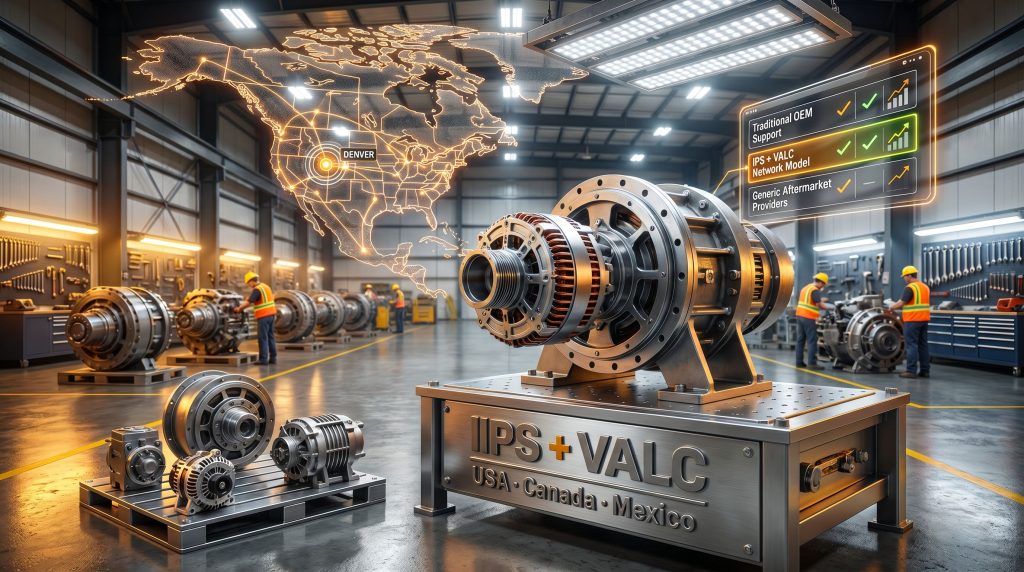
| Service Model | Turnaround Speed | Technical Depth | Geographic Flexibility |
|---|---|---|---|
| Traditional OEM Support | Slower (centralised) | High but rigid | Limited regional reach |
| IPS + VALC Network Model | Faster (localised) | Deep and adaptive | USA, Canada, Mexico |
| Generic Aftermarket Providers | Variable | Often inconsistent | Fragmented |
The proprietary tooling that underpins VALC rebuilds is a less visible but operationally critical element of this differentiation. Specialised tooling ensures that rebuild procedures can be executed to consistent tolerances regardless of which facility in the network performs the work. This matters enormously for mining operators managing fleets of ten, twenty, or fifty trucks across multiple sites, where inconsistent rebuild quality introduces unpredictable variance into fleet availability planning.
The RAM System: Valenhold's Proprietary Rebuild Framework in Practice
Central to how IPS will deliver VALC capabilities is Valenhold's Repair and Maintenance (RAM) system, a proprietary operational framework that standardises rebuild quality and service execution across all partner facilities within the global VALC Service Network.
The RAM system functions as the connective tissue between Valenhold's technical standards and IPS's physical service infrastructure. Without a framework like this, the quality of drive train rebuilds would depend heavily on individual technician experience and local facility capability, introducing the kind of variability that mining procurement teams are specifically trying to eliminate when selecting aftermarket partners.
IPS will initially deploy the RAM system at its Denver facility, which has been designated as the anchor centre of excellence for this programme. Denver was selected as the launch point given its geographic accessibility to major mining regions and its existing electromechanical service infrastructure, which provides the foundation needed to implement Valenhold's rebuild standards from day one.
Expansion beyond Denver will follow a demand-driven model, with additional IPS facilities brought into the VALC Service Network as customer requirements and operational volumes justify the investment. This measured rollout strategy reflects an important principle: it is preferable to establish a benchmark-level facility and expand from that baseline than to deploy rapidly across multiple locations with inconsistent execution.
Why Downtime Economics Make Localised Drive Train Services Non-Negotiable
The financial stakes attached to haul truck availability in large-scale mining are substantial. A single ultra-class haul truck operating in a major open-pit mine can move tens of thousands of tonnes of material per day, and its contribution to site production targets is direct and measurable.
When drive train components fail and replacement or rebuild services require long lead times, the costs accumulate across multiple dimensions simultaneously:
- Lost production from reduced fleet availability, which compounds over extended downtime periods
- Emergency logistics costs associated with sourcing replacement components through expedited channels
- Overtime and labour costs when maintenance teams work extended hours to accelerate component turnaround
- Consequential damage when secondary system failures occur because a primary component was not rebuilt and returned to service promptly
Localised service infrastructure addresses these cost drivers directly. When a wheel motor rebuild can be completed at a nearby facility operating within the VALC Service Network rather than being shipped interstate or internationally to a centralised OEM workshop, the turnaround timeline compresses significantly. That compression translates directly into improved fleet availability and measurable production outcomes.
Mining operators across North America are increasingly placing asset reliability at the centre of their capital planning frameworks, prioritising investments that extend the operational life of existing equipment over the capital expenditure associated with new truck acquisitions.
The next major ASX story will hit our subscribers first
Strategic Implications for North American Mining Operations
The IPS and Valenhold mining haul truck drive train partnership carries implications that extend beyond the two companies involved. It reflects a broader structural shift in how aftermarket service capability is being organised across the mining equipment sector. Consequently, the traditional model, in which OEMs retained most of the high-value technical service work through proprietary parts and service agreements, is increasingly being challenged by specialised aftermarket networks.
Several dynamics are accelerating this shift:
- Mining operators are extending fleet lifecycles rather than replacing trucks on traditional capital cycles, increasing the economic value of sophisticated rebuild and maintenance services
- Geopolitical pressures on global supply chains have elevated the strategic importance of localised service capability that is not dependent on international logistics
- Skilled labour shortages in remote mining regions are making it more attractive to engage service partners with established training programmes and technician pipelines
- The increasing complexity of electric-drive haul truck systems is creating demand for aftermarket providers with deep electrical and mechanical integration capability, a space where generalist providers struggle to compete
However, these trends are not isolated. Mining automation trends and advances in autonomous haulage technology are further intensifying demand for reliable aftermarket partners capable of servicing increasingly sophisticated fleet assets.
What Mining Procurement Teams Should Evaluate When Selecting a Drive Train Service Partner
For mining operations currently evaluating their drive train service arrangements, the emergence of specialised networks like the VALC Service Network raises important questions about partner selection criteria.
Key considerations for procurement and maintenance teams include:
- Does the provider operate within a globally standardised rebuild framework that ensures consistent quality across all service interactions?
- Is there localised service infrastructure positioned within a practical proximity to the mine site, reducing logistics time and cost?
- What is the documented turnaround benchmark for wheel motor and final drive rebuilds, and how is that benchmark enforced across the service network?
- Does the provider offer full lifecycle support, covering both scheduled rebuild activity and unplanned failure response?
- What investment is the provider making in technician training and operational readiness to sustain capability over the long term?
These questions matter because the lowest-cost service provider and the highest-value service provider often look similar on a per-unit rebuild quotation, but diverge significantly on total cost of ownership when fleet availability, turnaround reliability, and build quality are factored into the analysis. Furthermore, AI-powered mining efficiency tools are increasingly helping procurement teams model these total cost comparisons with greater precision.
Building Long-Term Capability Through Training and Operational Investment
Both IPS and Valenhold have emphasised that the partnership is structured around long-term capability building, not just near-term service delivery. This includes joint investment in training programmes, operational readiness frameworks, and the infrastructure needed to sustain and expand the VALC Service Network as North American mining demand evolves.
IPS's Electromechanical Division President, Stuart Cheek, has framed the partnership around a clear operational premise: that mining customers operating in environments where haul truck downtime carries severe production consequences require more than access to advanced technology. They require the localised execution capability to deploy that technology reliably, consistently, and at pace.
Valenhold's Managing Director, Garth Chester, has positioned the network expansion as a mechanism for bringing globally developed innovation to customers through partners with genuine field execution strength, rather than distributing technology through channels that lack the infrastructure to support it effectively.
Frequently Asked Questions: IPS and Valenhold VALC Drive Train Partnership
What is the VALC Service Network?
The VALC Service Network is a global partnership framework developed by Valenhold that connects authorised service providers to deliver VALC drive train rebuild and maintenance solutions to mining operators. Network members operate within Valenhold's proprietary RAM system to ensure standardised rebuild quality.
Which components does the IPS-Valenhold partnership cover?
The partnership covers the full VALC product range for mining haul trucks, including wheel motors, final drives, alternators, front corners, and blower motors.
Where is IPS's primary VALC service facility located?
The initial centre of excellence is located in Denver, with plans to expand to additional IPS facilities based on customer demand.
How does the RAM system ensure consistent rebuild quality?
The RAM system is Valenhold's proprietary operational framework that standardises rebuild procedures, tooling requirements, and quality benchmarks across all facilities within the VALC Service Network, reducing variability in build quality regardless of which facility performs the work.
What types of mining operations benefit most from this partnership?
Large-scale surface mining operations relying on electric-drive haul truck fleets, particularly those in geographically remote locations where centralised OEM service turnaround times create unacceptable availability risks, stand to benefit most significantly.
Will the partnership expand beyond its initial footprint?
Expansion across additional IPS facilities is planned, with the pace of rollout guided by customer demand and operational readiness at each location.
The Road Ahead for the IPS-Valenhold Alliance
The trajectory of this partnership will ultimately be measured by the outcomes it delivers for mining customers, specifically whether the combination of VALC technology and IPS service infrastructure produces the availability improvements, turnaround reductions, and total cost of ownership benefits that the alliance is structured to deliver.
If the Denver centre of excellence establishes a credible performance benchmark, the demand-driven expansion model creates a natural pathway for the alliance to grow across additional IPS facilities and mining markets without overextending before the operational foundation is proven.
More broadly, the IPS and Valenhold mining haul truck drive train partnership represents an instructive example of how the aftermarket services sector is evolving in response to the operational realities of modern large-scale mining: through specialised networks that combine technical depth, standardised execution frameworks, and genuine geographic reach to deliver outcomes that neither partner could produce working independently.
Readers seeking broader context on aftermarket service strategies and mining equipment reliability trends across North America can explore ongoing industry coverage through Global Mining Review at globalminingreview.com.
Want to Invest in the Companies Supplying the Next Wave of Mining Innovation?
Discovery Alert's proprietary Discovery IQ model scans ASX announcements in real time, delivering instant alerts on significant mineral discoveries across more than 30 commodities — turning complex data into actionable opportunities for investors at every level. Explore historic discoveries and their returns to see why being early matters, then begin your 14-day free trial at Discovery Alert to position yourself ahead of the broader market.