May 11, 2026
Mining's Electrification Tipping Point: What a 1,000-Unit Threshold Really Means
Heavy equipment has always been the last frontier of industrial electrification. While passenger vehicles and light commercial transport made headlines throughout the 2010s with rapid battery adoption, the machinery responsible for extracting the minerals that power those very batteries remained stubbornly diesel-dependent. The engineering challenges are not trivial: excavators operating in extreme thermal environments, under continuous high-load cycles, far from reliable grid infrastructure, present a fundamentally different design problem than a commuter vehicle. That calculus is now changing, and the SANY electric excavator milestone of delivering its 1,000th battery-electric unit represents more than a manufacturer achievement. It signals a structural shift in how the mining industry thinks about its own equipment future.
When big ASX news breaks, our subscribers know first
Why the 1,000-Unit Threshold Carries More Weight Than a Round Number
In heavy capital equipment, fleet scale milestones carry specific technical and commercial meaning. The progression from prototype to limited commercial deployment to full fleet validation follows a well-understood arc in industrial manufacturing. Crossing the 1,000-unit threshold in electric excavator deployments signals that the technology has cleared the most critical phase of that arc: real-world validation at scale across diverse operating environments.
Prototype-phase equipment typically operates under controlled conditions with manufacturer supervision. Limited commercial deployments, often numbering in the dozens, expose machines to real operational stresses but do not generate the statistical volume needed to identify systemic reliability patterns. A fleet of 1,000 or more deployed units, operating across different geographies, duty cycles, and climatic conditions, produces the data density that allows manufacturers and operators alike to draw meaningful conclusions about long-term performance.
The significance for the broader mining equipment industry is that the SANY electric excavator milestone, as reported by the Canadian Mining Journal, effectively validates the commercial readiness of battery-electric excavators not as niche technology but as mainline fleet equipment. This is the distinction that moves procurement conversations from pilot programmes to capital planning cycles. Furthermore, the mining electrification trend broadly suggests this shift is accelerating across the sector.
How Battery-Electric Excavators Actually Work Differently From Diesel Machines
Understanding why this milestone matters requires a working knowledge of what makes battery-electric excavators architecturally distinct from their diesel predecessors.
A conventional hydraulic-diesel excavator converts chemical energy stored in fuel through a combustion process, driving hydraulic pumps that actuate the boom, arm, bucket, and slew systems. This conversion chain involves substantial energy losses at each stage: combustion thermal losses, hydraulic transmission losses, and heat dissipation from the engine and hydraulic oil. Internal combustion engines operate at varying efficiency levels across their RPM range, and excavator duty cycles, characterised by frequent load fluctuations, often push engines into lower-efficiency operating zones.
Battery-electric excavators replace this chain with a fundamentally different architecture:
- Energy storage occurs in lithium-based battery packs rather than fuel tanks, with energy density and thermal management being primary engineering variables
- Electric motors drive hydraulic pumps or, in some advanced configurations, replace hydraulic actuation entirely with direct electro-hydraulic systems
- Regenerative recovery captures energy during boom-lowering and swing-deceleration cycles, converting kinetic energy back into stored electrical energy rather than dissipating it as heat
- Thermal output is dramatically reduced, lowering heat load in enclosed environments and reducing cooling infrastructure requirements
This architectural shift produces operational benefits that extend well beyond the emissions reduction headline. Reduced noise levels matter significantly for urban-adjacent construction and port operations. The elimination of exhaust gases has immediate health and safety implications for underground operations, where ventilation systems represent a major ongoing cost. In addition, the reduced mechanical complexity of electric drivetrains alters maintenance schedules in ways that compound across a fleet's operational life.
The SANY Equipment Range: Covering the Full Operational Spectrum
Does Product Range Breadth Signal Genuine Commitment?
One indicator of a manufacturer's genuine commitment to electrification rather than symbolic product launches is the breadth of the electric range it fields. A single electric model marketed alongside a large diesel fleet represents a hedging strategy. A range spanning compact urban machines through to large-format mining excavators signals a deeper technology investment thesis.
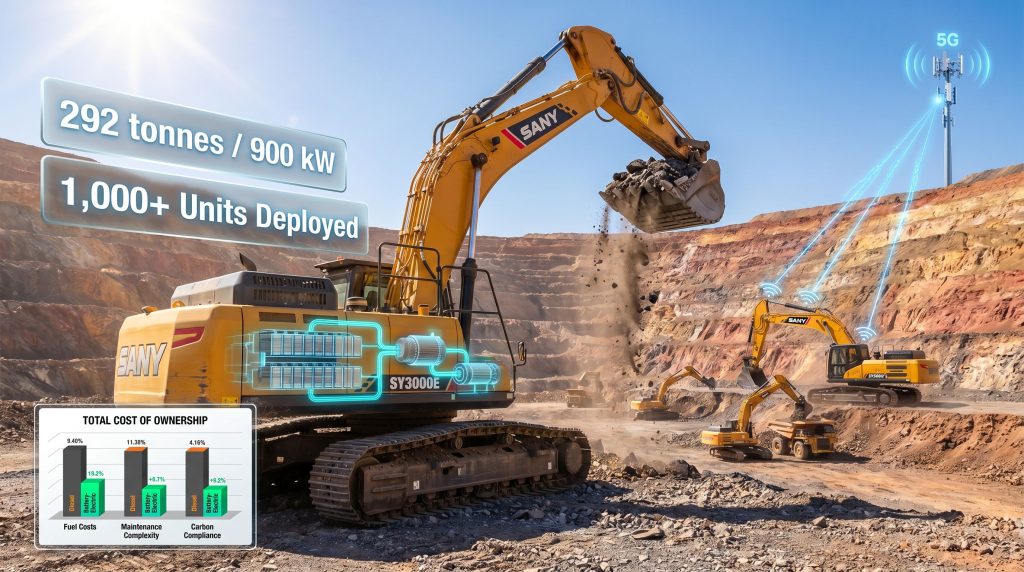
The SANY electric excavator range spans from compact machines suited to urban construction and tight-access sites through to large-format equipment targeting open-cut mining applications. The reported SY3000E, at approximately 292 tonnes operating weight and 900 kW power output, sits at the heavy end of commercially available electric excavators globally. This represents a meaningful demonstration that battery-electric technology can now be engineered at the weight and power class required for serious mining applications. SANY's full milestones page offers further context on the manufacturer's broader development trajectory.
| Model | Operating Weight | Power Class | Primary Environment |
|---|---|---|---|
| SY19E | ~1.95 tonnes | Compact | Urban construction, confined sites |
| Mid-range models | Variable | Medium | Quarrying, infrastructure construction |
| SY3000E | ~292 tonnes | 900 kW | Large-scale open-cut mining |
Note: Specifications cited above are based on publicly reported product information. Independent verification against official SANY technical datasheets is recommended before use in procurement or investment decisions.
The span between the smallest and largest models in this range reflects a total addressable market strategy that treats electrification not as a single-segment opportunity but as a platform transformation applicable across the full equipment lifecycle. This parallels developments in electric mining transport more broadly, where similar range-spanning strategies are emerging.
5G Remote Control: When Two Technologies Converge on the Same Problem
The commercial deployment of 5G remote-controlled excavators, represented by equipment such as the SY550HD platform, introduces a second technology dimension to the electrification story that deserves separate analytical treatment.
Remote control excavator technology is not new. Cable-tethered and radio-frequency remote systems have existed in mining for decades, primarily used in hazardous environments. What distinguishes current 5G-enabled remote operation from those earlier systems is the combination of:
- Ultra-low latency communication enabling responsive, precision control at distances and through network topologies that earlier systems could not support
- High-bandwidth sensor data transmission allowing operators to receive multi-camera video feeds, machine telemetry, and environmental sensor data simultaneously
- Integration with intelligent safety systems including collision avoidance, load monitoring, geofencing, and automated stability checks
- Scalability toward multi-machine supervision where a skilled operator manages several machines from a centralised control environment
"The transition from single-machine cab operation to remote multi-machine supervision represents a fundamental restructuring of labour productivity in excavation-intensive operations. The productivity multiplier from this model change may ultimately prove as economically significant as the fuel cost savings from electrification itself."
However, the dependency between 5G network infrastructure and autonomous equipment capability shapes adoption timelines across different mining jurisdictions. This infrastructure variable is one of the less-discussed but practically significant determinants of how quickly remote and autonomous mine trucks and excavator technology penetrates different market segments.
What Is Actually Driving R&D Investment at This Scale
The scale of R&D investment flowing into electric and autonomous mining equipment across major manufacturers reflects a convergence of demand signals that has become too large to treat as speculative:
- Decarbonisation commitments from major mining operators creating procurement requirements that diesel-only suppliers cannot meet
- Skilled operator shortages across mining regions accelerating the business case for remote and autonomous equipment
- Carbon pricing mechanisms in multiple jurisdictions changing the total cost of ownership calculation for diesel-dependent fleets over 10-year asset life cycles
- Battery technology cost trajectories following declining unit cost curves as production volumes increase globally
The interaction between mining industry decarbonisation goals and equipment manufacturer R&D cycles creates a reinforcing feedback loop. As mining operators announce fleet electrification commitments, manufacturer R&D investment in electric platforms accelerates. As electric platform technology matures and unit costs decline, more operators make credible electrification commitments. This dynamic is a classic technology adoption S-curve in its acceleration phase.
For mining companies evaluating capital allocation decisions, the 10 to 15-year asset life of heavy excavators creates a specific planning pressure. Equipment purchased today will still be in service well into the 2030s, when carbon pricing and emissions regulations are widely expected to be significantly more stringent. Consequently, the risk calculus of locking into diesel platform capital expenditure now, versus accepting the currently higher upfront cost of electric alternatives, is shifting as electric TCO projections improve.
The next major ASX story will hit our subscribers first
The Hidden Constraint: Grid Infrastructure and What It Means for Adoption Timelines
One of the less frequently discussed barriers to full-scale mining electrification is not machine technology at all. It is the power infrastructure required to support electrified fleets at operational scale.
A single large-format electric excavator operating continuously represents a substantial and variable electrical load. Scaling that to a full fleet, alongside electric haul trucks, drill rigs, and ancillary equipment, produces aggregate electrical demand that many existing mine site power systems were not designed to supply.
This infrastructure constraint manifests differently across operating environments:
- Ports and urban-adjacent sites typically have access to existing grid infrastructure capable of supporting electrified equipment with relatively modest upgrades
- Established open-cut mines near population centres face moderate infrastructure investment requirements
- Remote greenfield operations in regions like the Australian outback, parts of sub-Saharan Africa, and northern Canada face the most significant infrastructure challenge, requiring either grid extension or on-site renewable generation with battery storage
The renewable power for mines pathway is increasingly viable as solar, wind, and large-scale battery storage costs continue to decline. The circular appeal of mining the minerals required for renewable energy and battery storage using equipment powered by those same technologies creates a compelling long-term narrative, though the capital deployment sequencing remains complex in practice.
Regional Adoption Patterns and Where the Market Is Actually Moving
The global electric excavator market is not developing uniformly. Understanding regional variation in adoption pace matters for assessing where technology validation is occurring and where commercial-scale deployment will follow.
China functions as the primary proving ground for electric construction and mining equipment. Domestic regulatory pressure on emissions in construction corridors, combined with the scale advantages that Chinese manufacturers derive from a large and accessible home market, has created conditions for faster adoption than any other single market. This dynamic benefits SANY directly as one of China's largest heavy equipment producers.
India's infrastructure construction pipeline, operating in urban air quality environments under tightening pollution regulations, creates demand conditions that favour electric equipment in construction-adjacent applications, though mining-specific adoption remains at earlier stages.
Australia and the Americas present a more complex picture. Large remote open-cut operations face the grid infrastructure constraints discussed above. However, accelerating renewable energy deployment, combined with major mining operators' public decarbonisation commitments, is compressing adoption timelines from what they appeared to be even three years ago.
The Recursive Relationship Between Mining Electrification and Critical Minerals
There is a seldom-discussed analytical dimension to mining fleet electrification that sits at the intersection of industry economics and supply chain strategy. Battery-electric excavators require lithium, cobalt, nickel, and manganese in their battery packs. These are precisely the commodities that many of the mines deploying this equipment are extracting.
This recursive relationship creates an unusual dynamic in demand forecasting. As electric mining fleets expand globally, they generate incremental demand for the critical minerals they are simultaneously producing. For investors and analysts modelling commodity demand trajectories, understanding battery metals demand represents a demand increment that sits outside conventional end-use demand models focused on passenger EVs and consumer electronics.
"The electrification of mining equipment itself is an underappreciated source of incremental critical mineral demand that does not appear prominently in most commodity market forecasts focused on passenger EV adoption curves."
Battery chemistry choices in heavy equipment applications also differ from passenger EV applications in ways that affect mineral demand composition. The high-cycle, high-load requirements of mining equipment favour battery chemistries optimised for durability and thermal stability over energy density per kilogram, potentially influencing the relative demand for different cathode mineral combinations.
Key Metrics: The State of Electric Excavator Deployment in 2026
| Metric | Status as of 2026 | Industry Significance |
|---|---|---|
| SANY electric excavator deployments | 1,000+ units delivered | Commercial fleet validation confirmed |
| Largest electric excavator class | ~292 tonnes / 900 kW | Large-format mining viability demonstrated |
| 5G remote control deployment | Commercial status achieved | Technology graduated from prototype phase |
| Compact model range | ~1.95 tonnes entry point | Full market spectrum coverage established |
| Maximum reported bucket capacity | Up to 15 m³ | Competitive with diesel throughput equivalents |
Data sourced from publicly available product information and industry reporting. Specifications should be verified against official manufacturer documentation for procurement or investment purposes.
Frequently Asked Questions: Electric Excavators in Mining Contexts
How does operating range work for battery-electric excavators on a single charge?
Operating range is a function of duty cycle intensity, ambient temperature, machine size, and the specific battery chemistry deployed. Light-duty cycles in temperate climates produce longer operational windows per charge than high-intensity rock-breaking in extreme heat. Manufacturers and operators are developing both fast-charge and battery-swap strategies to address shift-length requirements, with the appropriate solution varying by site configuration and operational pattern.
What advantages do electric excavators offer in underground mining?
The ventilation cost reduction is one of the most compelling financial arguments for electric excavators in underground settings. Diesel exhaust in confined underground workings requires extensive forced ventilation infrastructure to maintain safe air quality. Eliminating exhaust gases reduces both the capital cost of ventilation systems and the ongoing energy cost of operating them. Furthermore, heat load reduction in deep underground operations provides an additional operating cost benefit that compounds over the asset life.
What maintenance differences should operators expect when transitioning to electric platforms?
The elimination of engine oil changes, fuel system maintenance, exhaust system servicing, and coolant management removes a significant portion of conventional excavator maintenance requirements. New requirements emerge around battery health monitoring, power electronics management, and electric motor servicing. The net effect for most operators is reduced maintenance complexity and more predictable servicing intervals, supported by continuous electrical system telemetry enabling condition-based maintenance scheduling.
What Comes After 1,000 Units: The Path to Industry-Wide Adoption
The progression from 1,000 deployed units to the tens of thousands that would represent genuine industry-wide adoption is not simply a manufacturing scaling exercise. It requires simultaneous advancement across four distinct dimensions that are currently developing at different rates:
- Machine technology — battery energy density, charging speed, and thermal management performance in extreme environments
- Site power infrastructure — grid capacity, renewable generation integration, and charging logistics at remote operations
- Digital connectivity — 5G network deployment at mine sites supporting autonomous and remote operation capabilities
- Workforce capability — training and transition pathways for operators moving from single-machine cab operation to remote multi-machine supervision
The companies and jurisdictions that advance these four dimensions in parallel, rather than sequentially, will define the pace of adoption through the latter half of this decade. The SANY electric excavator milestone establishes that machine technology has cleared its critical validation threshold. The rate at which the other three dimensions follow will determine whether the industry looks back on 2026 as the inflection point it appears to be, or as a false dawn preceding another decade of incremental progress.
This article is intended for informational purposes only and does not constitute financial or investment advice. Specifications, forecasts, and market assessments referenced herein should be independently verified before being relied upon for procurement or investment decisions. Forward-looking statements involve inherent uncertainty and actual outcomes may differ materially from projections discussed.
Want to Profit From the Minerals Powering Mining's Electric Revolution?
The surge in battery-electric excavators is driving accelerating demand for lithium, cobalt, nickel, and manganese — and Discovery Alert's proprietary Discovery IQ model delivers real-time alerts the moment significant ASX mineral discoveries are announced, turning complex data into actionable opportunities before the broader market reacts. Explore historic discoveries and their extraordinary returns on Discovery Alert's dedicated discoveries page, then begin your 14-day free trial to position yourself at the forefront of the critical minerals boom.