May 11, 2026
The Energy Equation Reshaping Australia's Iron Ore Heartland
Across the global mining industry, a quiet but fundamental transformation is underway. The economics of remote energy supply, once dominated by diesel logistics and gas-fired generation, are being dismantled and rebuilt around long-duration renewable contracts. For operators running some of the world's most energy-intensive extraction processes in geographically isolated locations, the strategic calculus has shifted decisively. Energy is no longer simply a cost to be managed. It has become a sovereign capability to be secured.
Nowhere is this transformation more visible than in Western Australia's Pilbara region, where the world's largest iron ore operations are quietly becoming a proving ground for utility-scale renewable infrastructure. The achievement of Financial Close on the Jinbi Solar Project, and the concurrent execution of a 30-year power purchase agreement between Yindjibarndi Energy Corporation and Rio Tinto, represents one of the most structurally significant energy deals in Australia's mining sector to date. Furthermore, the iron ore demand outlook underpinning these long-term investments remains a central driver of capital allocation decisions across the Pilbara.
When big ASX news breaks, our subscribers know first
What the Jinbi Solar Project Actually Is, and Why It Matters
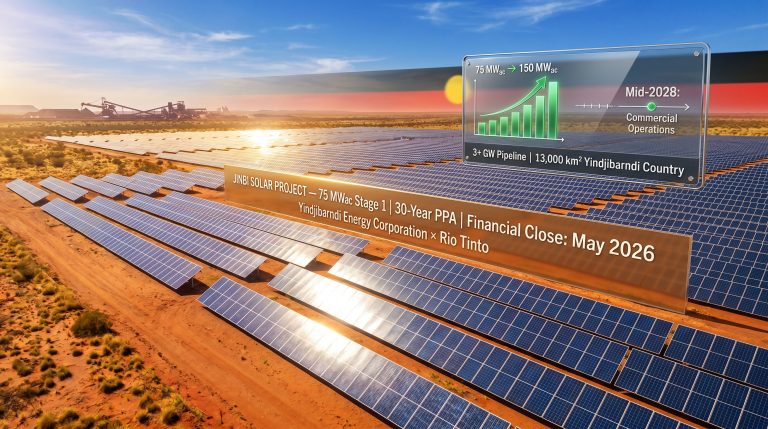
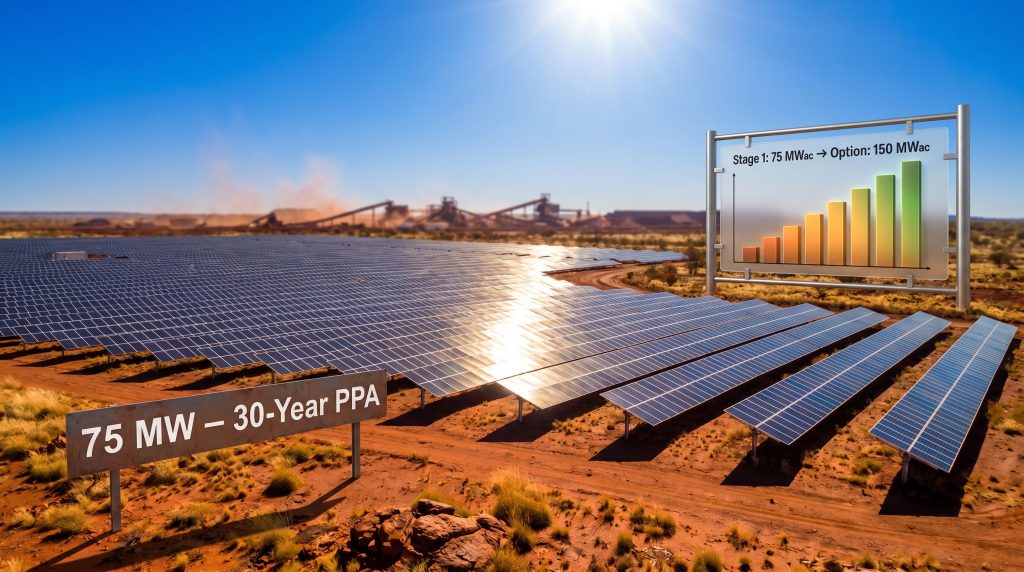
The Jinbi Solar Project is a utility-scale solar photovoltaic facility being developed across the Yindjibarndi Native Title area in the Pilbara region of Western Australia, a landmass spanning approximately 13,000 square kilometres. Stage 1 of the project will deliver 75 megawatts of alternating current (MWac) of generation capacity, with a clearly defined expansion pathway to 150 MWac, incorporating potential Battery Energy Storage Systems (BESS) integration subject to regulatory approvals and future development decisions.
What separates the Jinbi Solar Project from the broader wave of renewable energy in mining procurement across Australia is not its technical specifications alone. It is the ownership architecture sitting behind it.
The project is developed and owned by Yindjibarndi Energy Corporation (YEC), a joint venture formed approximately three years ago between Yindjibarndi Aboriginal Corporation, representing the Traditional Owners of the Yindjibarndi Nation, and ACEN Corporation, a large-scale renewable energy developer operating across the Asia-Pacific region. This structure means that Traditional Owners are not passive recipients of land access payments. They are equity partners in the generation asset itself, with governance rights and economic participation embedded into the project's foundational architecture.
Understanding the Rio Tinto Power Purchase Agreement
The Jinbi Solar Project Rio Tinto power purchase agreement is structured as a 30-year offtake arrangement under which YEC will supply 100 percent of the electricity generated by the Jinbi Stage 1 facility exclusively to Rio Tinto's Pilbara iron ore operations. The supply period commences upon commercial operations, currently targeted for mid-2028.
To understand why this term length is significant, it helps to examine how long-duration PPAs function as financial instruments rather than simply procurement contracts.
How Long-Duration PPAs Work in Practice
A power purchase agreement in the renewable energy sector serves a dual function. For the energy buyer, it provides predictable cost certainty over an extended period, insulating operations from spot electricity price volatility and fuel cost fluctuations. For the project developer, it provides contracted revenue against which project finance debt can be secured, typically enabling lower-cost capital structures than merchant power projects.
The 30-year term of the Jinbi PPA is particularly notable when placed in comparative context:
| Project | Counterparty | Capacity | PPA Duration | Structure |
|---|---|---|---|---|
| Jinbi Solar Project | Rio Tinto | 75 MW (expandable to 150 MW) | 30 years | Indigenous-owned JV |
| Smoky Creek / Guthrie's Gap | Rio Tinto (QLD) | 600 MW solar + 2,400 MWh BESS | 20 years | Commercial developer |
| Ngarluma Solar Farm | Rio Tinto (Karratha) | 80 MW | Undisclosed | Indigenous corporation |
| Richards Bay Minerals | Rio Tinto (South Africa) | 140 MW wind | 20 years | Commercial developer |
| Kennecott Virtual PPA | Rio Tinto (USA) | Wind + 30 MW solar | 15 years | Commercial developer |
At 30 years, the Jinbi PPA is the longest-tenor agreement in Rio Tinto's current disclosed renewable portfolio. This matters because longer tenors reduce refinancing risk for the project developer while signalling deep institutional confidence in the underlying asset's longevity and Rio Tinto's commitment to its Pilbara iron ore operations over a generational timeframe. Rio Tinto's official announcement provides further detail on the strategic rationale behind this commitment.
"A 30-year PPA at this scale functions less like a procurement contract and more like a strategic infrastructure partnership. It fundamentally alters the energy cost base of a mining operation for an entire generation, while providing the developer with revenue certainty that rivals government-backed infrastructure bonds in stability."
Financial Close: What It Means and Why It Eliminates the Critical Risk
Financial Close is the single most consequential milestone in any large-scale infrastructure project, yet it is frequently misunderstood outside specialist project finance circles. It does not simply mean that funding has been arranged. It means that every condition required to commence construction has been formally and legally satisfied simultaneously.
For the Jinbi Solar Project, Financial Close confirmed:
- All binding funding arrangements fully executed and committed
- Every required government approval and regulatory consent formally obtained
- The Engineering, Procurement and Construction (EPC) contract executed with DT Infrastructure
- Construction accommodation arrangements confirmed with Rapid Camps
- Notices to Proceed issued to all principal contractors
- Civil site preparation activities already underway through Yurra, a Yindjibarndi Nation enterprise
The significance of this checklist cannot be overstated. The most common failure point in large-scale renewable infrastructure is not technical feasibility. It is the gap between conditional commitments and fully executed, unconditional financing. Projects routinely stall, are restructured, or collapse entirely at the pre-Financial Close stage. YEC's achievement of Financial Close within three years of the partnership's establishment is therefore a meaningful demonstration of institutional capability.
Construction Timeline at a Glance
| Milestone | Date |
|---|---|
| YEC established (YAC + ACEN JV) | Approximately 2023 |
| Memorandum of Understanding with Rio Tinto | October 2023 |
| Binding PPA executed | Late 2025 |
| Financial Close achieved | May 2026 |
| Notices to Proceed issued | May 2026 |
| Target commercial operations | Mid-2028 |
| PPA supply period commences | Mid-2028 (30-year term) |
Who Is Yindjibarndi Energy Corporation? The Governance Architecture Behind the Deal
YEC's institutional structure is arguably the most distinctive feature of the Jinbi project, and the one with the broadest implications for how Indigenous participation in Australia's energy transition is structured going forward.
The Joint Venture Partnership
The corporation was formed through a partnership between two entities with fundamentally different but complementary institutional strengths:
- Yindjibarndi Aboriginal Corporation (YAC): The representative body for Yindjibarndi Traditional Owners, holding native title rights across the 13,000 km² Yindjibarndi Country in the Pilbara. YAC brings cultural authority, native title standing, and deep stakeholder relationships with Pilbara communities.
- ACEN Corporation: A large-scale renewable energy developer with a substantial Asia-Pacific portfolio, bringing sophisticated project finance structuring expertise, EPC contractor procurement frameworks, and regulatory navigation capability across Australian energy markets.
The governance model YEC operates under is structured around dual accountability. Commercial performance is measured against the standards ACEN applies across its broader portfolio. Cultural and community accountability is governed by Yindjibarndi law, protocols, and the responsibilities of Traditional Ownership.
Why This Structure Could Satisfy Institutional Lenders
Achieving Financial Close requires satisfying institutional lenders that governance frameworks, risk management structures, and contractual arrangements meet the highest standards of commercial due diligence. This is not a low bar. Infrastructure lenders employ specialised legal, technical, and environmental advisory teams whose function is to identify every material risk before committing capital.
YEC's ability to clear this threshold within three years of establishment, with an Indigenous-led governance structure at its core, is a direct rebuttal to any assumption that Indigenous ownership and institutional-grade commercial rigour are incompatible. It is also a data point that will inform how lenders price risk in future Indigenous-led energy projects across Australia.
How Jinbi Fits Into Rio Tinto's Decarbonisation Strategy
Rio Tinto has publicly committed to achieving net-zero Scope 1 and Scope 2 emissions by 2050. Pilbara iron ore operations represent one of the company's largest concentrations of operational emissions, making Pilbara-based renewable procurement a strategic priority rather than a discretionary ESG initiative. In this context, Australia's iron ore advantage in global markets is increasingly tied to the ability of producers to demonstrate credible decarbonisation pathways.
What 75 MW of Pilbara Solar Actually Delivers
The Pilbara is one of Australia's highest solar irradiance zones, receiving substantially more annual solar radiation than most other regions where utility-scale solar is deployed globally. A 75 MWac solar facility in this environment, operating at typical Pilbara capacity factors, can be expected to generate approximately 150 to 180 gigawatt-hours (GWh) of electricity annually, though actual output will depend on final site conditions, array design, and operational parameters.
This generation displaces an equivalent volume of fossil fuel-based electricity, directly reducing the carbon intensity of Rio Tinto's Pilbara iron ore operations and contributing to the company's Scope 2 emissions reduction pathway. Moreover, the transition to green iron production across the Pilbara depends fundamentally on projects like Jinbi providing the renewable energy foundations that make low-emissions processing viable at scale.
The expansion option to 150 MWac with BESS integration carries particular operational significance. Battery storage transforms a solar-only facility from a generation asset that produces power only when the sun is shining into a partially dispatchable resource capable of supplying power across a broader daily operational window, including early morning and evening shift periods critical to continuous mining operations.
The Social Licence Dimension
The strategic logic of the Jinbi structure extends beyond carbon accounting. Social licence to operate has become a genuine constraint on project development timelines in regions with active native title claims and complex community relations histories. The Pilbara is one such region.
By structuring the Jinbi Solar Project as an Indigenous-led venture rather than a conventional land access arrangement, the economics of the relationship are fundamentally reordered. Community interests are aligned with project success rather than positioned as a potential constraint on it. For Rio Tinto, this simultaneously advances decarbonisation objectives and strengthens the community foundations underpinning its Pilbara operations over a 30-year horizon.
The next major ASX story will hit our subscribers first
The Broader Blueprint: Indigenous Energy Sovereignty in Australia's Resource Regions
The Jinbi model represents a structural departure from how renewable energy development has historically intersected with Indigenous land rights in Australia. Consequently, its implications extend well beyond a single solar project, offering a replicable framework for Indigenous communities across resource-rich regions. The WA resources sector impact of such models, if adopted more broadly, could reshape how economic value is distributed across Western Australia's most productive landscapes.
Traditional Model vs. Jinbi Model
| Feature | Conventional Renewable PPA | Jinbi / YEC Model |
|---|---|---|
| Indigenous role | Land access provider | Equity partner and project proponent |
| Economic benefit | Lease payments or royalties | Equity returns and retained value |
| Governance | Developer-controlled | Dual accountability (commercial + cultural) |
| Local enterprise | Minimal embedded participation | Yurra (civil works) embedded in EPC framework |
| Expansion optionality | Developer discretion | Structured pathway (75 to 150 MW + BESS) |
| PPA duration | Typically 10 to 20 years | 30 years |
This structural inversion has material consequences for how economic value is distributed across the project's operating life. Under a conventional land access model, the developer captures the majority of equity returns while the Traditional Owner group receives fixed periodic payments. Under the YEC model, equity returns flow to the joint venture, with the Yindjibarndi Nation retaining a direct ownership stake in the revenue-generating asset.
"When development is Yindjibarndi-led, underpinned by strong governance and the right partnerships, it can deliver outcomes that are both commercially sound and culturally grounded." This principle, demonstrated through YEC's Financial Close achievement, has broader implications for Indigenous communities across Australia's resource-rich regions. As RenewEconomy notes, the deal represents a landmark moment for Indigenous-led clean energy development in Australia.
What Comes Next for YEC
YEC leadership has consistently framed the Jinbi Solar Project as the first in a sequenced development pipeline, not an isolated transaction. The 13,000 km² Yindjibarndi Native Title area represents substantial land area with potential for additional renewable energy development as Australia's energy transition accelerates.
The immediate next decision point is the Stage 2 expansion from 75 to 150 MWac, incorporating BESS, subject to regulatory approvals. Beyond that, YEC's demonstrated ability to achieve Financial Close on a complex infrastructure project positions it as a credible proponent for future projects across the Pilbara renewable energy landscape.
Frequently Asked Questions
What is the Jinbi Solar Project?
The Jinbi Solar Project is a utility-scale solar facility being developed by Yindjibarndi Energy Corporation in the Pilbara region of Western Australia. Stage 1 delivers 75 MWac of solar generation capacity, with an expansion pathway to 150 MWac including potential battery storage. Financial Close was achieved in May 2026, with commercial operations targeted for mid-2028.
Who owns the Jinbi Solar Project?
The project is owned by Yindjibarndi Energy Corporation, a joint venture between Yindjibarndi Aboriginal Corporation, representing the Traditional Owners of Yindjibarndi Country, and ACEN Corporation, a major Asia-Pacific renewable energy developer.
What are the key terms of the Rio Tinto power purchase agreement?
The Jinbi Solar Project Rio Tinto power purchase agreement is a 30-year offtake arrangement under which YEC supplies 100 percent of Jinbi's Stage 1 electricity output to Rio Tinto's Pilbara iron ore operations. The supply period commences upon commercial operations, targeted for mid-2028.
What does Financial Close mean for this project?
Financial Close confirms that all funding arrangements, contractual obligations, government approvals, and regulatory consents required to commence construction have been formally satisfied. For Jinbi, this included executed EPC and accommodation contracts, Notices to Proceed to all principal contractors, and all required regulatory consents.
What is the expansion potential of the Jinbi Solar Project?
Stage 1 is a 75 MWac solar facility. YEC holds an option to expand to 150 MWac, including potential BESS integration, subject to regulatory approvals and future development decisions.
How does the Jinbi project support Rio Tinto's emissions targets?
The project directly addresses Scope 2 emissions from Rio Tinto's Pilbara iron ore operations by supplying renewable electricity in place of fossil fuel-based generation. This contributes to Rio Tinto's publicly stated commitment to net-zero Scope 1 and Scope 2 emissions by 2050.
Disclaimer: This article contains forward-looking statements regarding project timelines, commercial operations dates, and expansion options. These statements are subject to regulatory approvals, financing conditions, and development decisions that have not yet been finalised. Readers should not rely on forward-looking statements as representations of future performance. This article does not constitute financial advice.
Want to Stay Ahead of the Next Major ASX Mining Discovery?
While long-term energy infrastructure deals reshape Australia's resource sector, the biggest investment opportunities often emerge from significant mineral discoveries announced on the ASX — and timing is everything. Discovery Alert's proprietary Discovery IQ model delivers real-time alerts the moment a major discovery hits the ASX, transforming complex mineral data into actionable insights for investors at every level; explore historic discoveries and their exceptional returns to understand the magnitude of what's possible, then start your 14-day free trial and position yourself ahead of the broader market.