June 23, 2026
The Systemic Shift Reshaping How Nations Extract and Create Value From the Ground Up
Global mining has always been cyclical, but the transformation unfolding across the world's largest mineral-consuming economies is something structurally different. It is not simply another technology refresh or productivity initiative. What is happening is a fundamental renegotiation of how the mining sector creates value, how it manages risk, and how it fits within the broader architecture of a modern industrial economy. Nowhere is this renegotiation more consequential, or more urgent, than in India.
With ambitions to become a $30 trillion economy by 2047, India faces an unavoidable question: can its mining sector evolve fast enough to underpin that growth, rather than constrain it? The answer, according to a detailed framework report published jointly by Deloitte India and the Indian Chamber of Commerce (ICC), lies in the transition to what the industry is beginning to call Mining 5.0 in India.
When big ASX news breaks, our subscribers know first
What Separates Mining 5.0 From Everything That Came Before It
To understand why Mining 5.0 matters, it helps to trace how the industry's evolution has progressed. Mining 4.0 brought automation and digital tools into individual operational functions. Sensors were installed on equipment. Drones replaced manual surveying. Enterprise resource planning software streamlined procurement and logistics. These were meaningful upgrades, but they shared a structural limitation: each improvement operated within its own silo.
Production data stayed within production systems. Safety monitoring rarely fed into maintenance planning. Environmental measurements were collected for compliance rather than operational insight. What resulted across many operations was a patchwork of disconnected digital investments generating limited compound value.
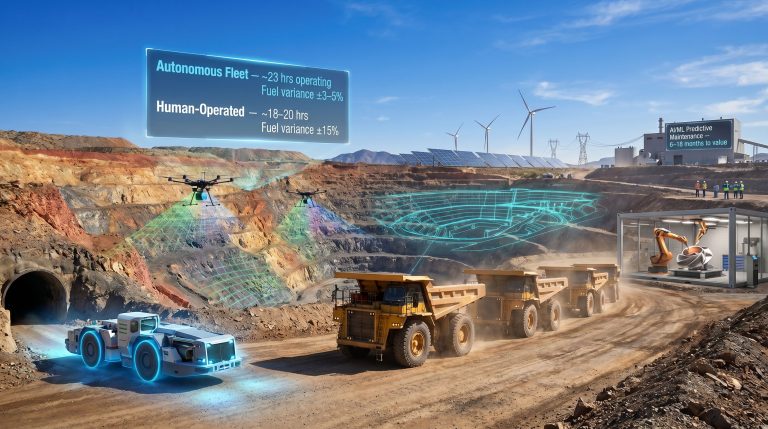
Mining 5.0 breaks this pattern by treating data not as a departmental resource but as an enterprise-wide intelligence layer. According to the Deloitte-ICC report Mining 5.0: Emerging Mining Technologies by 2030, this evolution is defined as a shift from volume-centric extraction toward a value-driven, technology-enabled, sustainable, and human-centred mining ecosystem, as reported by ET EnergyWorld in May 2026.
The structural differences between these two paradigms deserve careful examination:
| Dimension | Mining 4.0 | Mining 5.0 |
|---|---|---|
| Core Focus | Automation and digitalisation of discrete functions | Integrated AI-driven decision-making across the enterprise |
| Data Architecture | Siloed, function-specific tools | Unified cognitive backbone connecting all operational domains |
| Sustainability Approach | Compliance reporting | Embedded, measurable, data-led performance |
| Human Role | Operator-supervised automation | Human-AI collaborative systems with shared decision authority |
| Infrastructure Model | On-premise or basic cloud | Hybrid cloud-edge infrastructure suited to remote environments |
| Value Orientation | Volume of material extracted | Sustainable, high-value outcomes per unit of resource consumed |
The distinction between these models is not merely philosophical. It has direct implications for capital allocation, workforce development, regulatory engagement, and long-term competitive positioning.
The Scale of India's Mining Opportunity: Current Baselines and Future Projections
India's mining sector currently contributes approximately 2 to 3 percent of national GDP directly, while serving as a foundational input for a much larger industrial ecosystem encompassing steel manufacturing, cement production, power generation, automotive assembly, and infrastructure development. The direct contribution figure, while modest relative to the sector's downstream influence, reflects years of underinvestment in technology, exploration, and operational efficiency.
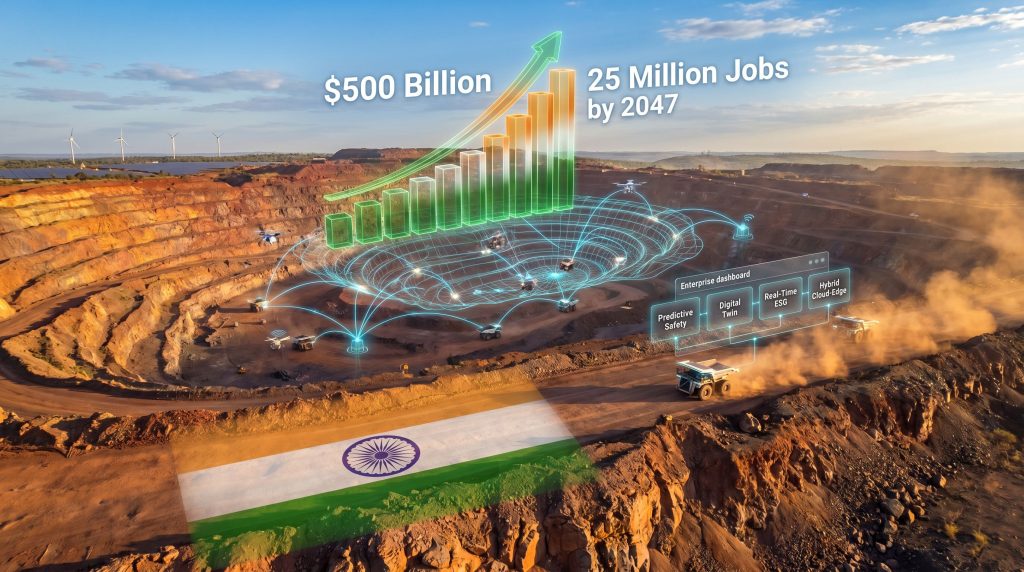
The Deloitte-ICC report, as reported by ET EnergyWorld, projects that a successful transition to Mining 5.0 in India could contribute an additional $500 billion to India's GDP and generate as many as 25 million incremental jobs by 2047. These projections are explicitly framed as contingent outcomes, not guaranteed trajectories. They depend on comprehensive implementation of integrated, AI-driven operational transformation across the sector.
Understanding where those 25 million jobs could emerge requires looking beyond the mine site itself:
- Direct operational roles in AI-augmented mining environments, including data scientists, autonomous equipment operators, and digital systems engineers
- Downstream manufacturing positions in steel, cement, and critical minerals processing benefiting from more reliable and lower-cost mineral inputs
- Technology services roles supporting platform deployment, maintenance, and continuous improvement
- Environmental compliance, land rehabilitation, and sustainability management positions created by the shift from periodic reporting to continuous performance monitoring
- Infrastructure and logistics network roles supporting more efficient supply chains connecting mining regions to processing and manufacturing centres
The report's authors frame mining's role in India's economic future as disproportionately transformative relative to its current GDP share. The leverage effect is the key insight: every dollar of mining efficiency gain ripples through six to eight downstream industry segments simultaneously.
Technologies Powering the Mining 5.0 Transition in India
AI as an Enterprise Intelligence Layer, Not a Departmental Tool
The Deloitte-ICC report makes a distinction that many technology-focused analyses miss. AI in mining operations is not deployed as a standalone tool solving a specific operational problem in a Mining 5.0 context. It functions as the connective tissue binding geological data, production telemetry, maintenance records, safety incident patterns, environmental monitoring, and workforce performance into a single real-time decision-support system.
This architecture enables correlations that fragmented systems cannot detect, such as the relationship between a subtle shift in ore grade variability and an emerging equipment wear pattern that precedes failure.
Predictive Safety: From Reactive Incident Management to Risk Elimination
AI-based predictive safety systems represent one of the most compelling technology applications within the Mining 5.0 framework. Rather than recording incidents after they occur, these systems continuously analyse environmental sensor data, equipment performance metrics, and worker behaviour patterns to identify and flag elevated-risk conditions before incidents materialise.
In underground mining environments, where India has significant coal and metallic mineral operations, early warning capability of this kind is not merely a productivity advantage. It is a matter of lives and legal liability.
Digital Twins: Simulating Before Committing
Digital twin technology creates virtual replicas of mine environments that can be stress-tested under different operational scenarios before physical interventions are executed. Blast optimisation, ore grade variability response, ventilation system adjustments, and pit design modifications can all be trialled in simulation. The result is a reduction in costly operational errors and an acceleration of the decision cycle between planning and execution.
Hybrid Cloud-Edge Architecture: Built for India's Remote Reality
India's mining heartland, concentrated across states including Odisha, Chhattisgarh, Jharkhand, Karnataka, and Andhra Pradesh, presents significant connectivity challenges. Many operations are located in geographically remote areas where reliable high-bandwidth internet connectivity cannot be assumed. This makes the architecture choice for Mining 5.0 implementation particularly important.
Hybrid cloud-edge configurations address this constraint by processing time-critical decisions locally at the edge, within the mine site itself, while simultaneously transmitting aggregated data to cloud platforms that support multi-mine analytics and enterprise-level reporting. This design enables low-latency operational decisions even in connectivity-constrained environments while preserving access to the broader intelligence ecosystem.
Talk-to-Data Interfaces: Democratising Operational Intelligence
One of the less-discussed but potentially high-impact technologies referenced in the Mining 5.0 framework is the emergence of natural language interfaces that allow non-technical operational staff to query complex datasets using conversational language. A shift supervisor who needs to understand current ore recovery trends or equipment availability rates should not require a data science degree to access that information.
These interfaces lower the barrier to data-driven mining operations, accelerating adoption and increasing the return on underlying data infrastructure investments.
India's Digital Infrastructure Foundation for Mining 5.0
A critical and often underappreciated element of India's Mining 5.0 readiness is the suite of national digital platforms already under development or operational. These systems provide the data infrastructure backbone on which enterprise-level integration depends:
| Platform | Function | Strategic Role in Mining 5.0 |
|---|---|---|
| National Geoscience Data Repository (NGDR) | Centralised geological data storage and access | Enables AI-driven mineral prospectivity mapping and resource estimation |
| National Minerals Information (NMI) | Mineral resource tracking and production reporting | Supports integrated planning and regulatory compliance workflows |
| National Digital Aerial Platform (NDAP) | Aggregation of aerial survey data from multiple sources | Feeds real-time environmental monitoring and spatial analytics systems |
| Unified Mining Portal | Single regulatory and operational interface | Enables risk-based, interoperable governance and reporting |
The strategic value of these platforms lies not in their individual functionality but in their interoperability. Common application programming interfaces connecting these systems create the potential for a near real-time national intelligence backbone for India's mineral sector. When geological prospectivity data, production statistics, aerial environmental monitoring, and regulatory compliance information flow seamlessly between platforms, the result is a systemic intelligence capability that no individual mining company could build independently.
Digital Fragmentation: The Silent Value Destroyer
Despite the technology opportunity, the Deloitte-ICC report identifies digital fragmentation as the primary structural risk facing India's mining companies. Many organisations have invested in Mining 4.0 tools: monitoring dashboards, automated equipment, ERP systems, and environmental sensors. However, these investments frequently exist in operational isolation.
When production systems cannot communicate with maintenance platforms, and when safety incident data is not integrated with equipment performance analytics, each system delivers partial value at best. The compound benefits that justify technology investment, such as reduced downtime, improved ore recovery, lower incident rates, and better resource allocation, only materialise when systems are connected across functional boundaries.
According to the Deloitte-ICC report as covered by ET EnergyWorld, without integration, digital investments risk remaining isolated pilots with limited enterprise value. Effective integration, by contrast, could help India build system-level capabilities aligned to national priorities including energy security, sustainability, and inclusive growth.
True Mining 5.0 integration means connecting the following operational domains into a single decision-making ecosystem:
- Planning and resource modelling
- Production operations and throughput management
- Logistics, fleet management, and supply chain coordination
- Predictive and preventive maintenance scheduling
- Safety risk monitoring and incident prevention
- Environmental performance tracking and sustainability reporting
The cost of failing to achieve this integration is not merely efficiency loss. It is the forfeiture of the systemic competitive advantage that separates genuinely transformed operations from companies that have simply purchased new software without changing how decisions are made.
The next major ASX story will hit our subscribers first
Sustainability as Operational Performance, Not Compliance Theatre
The Mining 5.0 framework fundamentally reframes how sustainability is understood within the sector. Under conventional approaches, sustainability is treated as a reporting obligation, something to be documented annually and disclosed to regulators and investors. Under Mining 5.0 in India, sustainability becomes a real-time operational performance standard measured, monitored, and managed with the same rigour applied to production tonnage and equipment utilisation.
India's Securities and Exchange Board (SEBI) mandates Business Responsibility and Sustainability Reporting (BRSR) for the top 1,000 listed companies. This regulatory requirement creates a compliance floor. Mining 5.0 enables companies to build well above that floor by embedding sustainability intelligence into daily operational decisions:
-
Carbon and energy management: AI-optimised energy dispatch across mining operations, integration of fleet electrification pathways, and real-time emissions tracking embedded in operational dashboards. Furthermore, renewable energy in mining is increasingly central to reducing operational carbon footprints rather than being relegated to annual reports.
-
Waste and water stewardship: Predictive analytics applied to tailings facility management, water recycling efficiency monitoring, and proactive land rehabilitation scheduling driven by data rather than regulatory deadlines.
-
Governance transparency: Continuous ESG performance data accessible to regulators, investors, and affected communities, shifting the accountability relationship from periodic disclosure to ongoing visibility.
Companies that embed sustainability at this level of operational depth gain a tangible competitive advantage. They demonstrate verifiable ESG performance to investors with increasing capital allocation sensitivity to environmental and social metrics. They reduce the regulatory friction associated with approvals and compliance reviews. And they are better positioned to compete for increasingly sustainability-conscious supply chain partnerships with downstream manufacturers.
Demand Forces and Policy Drivers Accelerating Adoption
India's mineral requirements are expanding on multiple fronts simultaneously, creating a structural urgency beneath the Mining 5.0 transition that is independent of any single policy initiative:
| Demand Driver | Key Minerals Required | Connection to Mining 5.0 |
|---|---|---|
| Infrastructure Expansion | Iron ore, limestone, construction aggregates | Drives volume growth requiring operational efficiency gains |
| Energy Transition Goals | Lithium, cobalt, graphite, rare earth elements | Creates critical mineral urgency and domestic supply chain pressure |
| Steel Sector Growth | Iron ore, coking coal, manganese | Demands higher-grade extraction at lower cost per unit |
| Atmanirbhar Bharat Self-Reliance | Broad mineral basket across industrial applications | Accelerates domestic production investment and technology adoption urgency |
The Atmanirbhar Bharat initiative, India's domestic self-reliance agenda, has particular relevance to the Mining 5.0 transition. By prioritising domestic mineral production and processing over import dependence, the policy framework creates an economic incentive for mining companies to improve operational efficiency and expand capacity, both of which Mining 5.0 technologies are designed to enable.
Critical minerals and energy security add another layer of urgency. The battery minerals required for electric vehicle manufacturing and grid-scale energy storage, including lithium, cobalt, and graphite, are central to India's energy transition ambitions. Developing domestic supply capability for these materials requires modern exploration tools, efficient extraction technologies, and integrated processing capabilities: precisely the components of a Mining 5.0 operational model. India's critical minerals strategy offers a useful comparative framework for understanding how nations are responding to these supply chain pressures.
Why This Is a Leadership Challenge Before It Is a Technology Challenge
Perhaps the most strategically significant insight from the Deloitte-ICC report is its insistence that Mining 5.0 in India is fundamentally a leadership agenda rather than a technology roadmap, as reported by ET EnergyWorld. This framing has important implications for how mining companies prioritise their transformation investments.
Technology deployed without aligned governance, incentive structures, and organisational culture produces disappointing results. When performance metrics still reward volume over value, when AI tools are assigned to IT departments rather than embedded in executive decision-making, and when data ownership is fragmented across functional silos, even sophisticated technology investments deliver fragmented outcomes.
The Deloitte-ICC framework identifies three leadership imperatives for genuine Mining 5.0 success:
- Treating AI and data as enterprise capabilities rather than functional tools owned by individual departments. This requires establishing data governance at board level, not just within technology teams.
- Redesigning performance incentive structures to reward value creation, safety outcomes, and sustainability performance rather than pure throughput metrics. Organisations reward what they measure, and if measures have not changed, behaviour will not change either.
- Building cross-functional governance frameworks that establish clear data ownership, AI ethics standards, interoperability requirements, and accountability for integrated outcomes across the full mining value chain.
Workforce development represents a connected imperative. The transition to human-AI collaborative systems requires a mining workforce with meaningful digital literacy. Building that capability across India's mining labour force requires sustained investment in training, reskilling, and educational pipeline development.
A Practical View: What a Mining 5.0 Transition Looks Like Over Five Years
To make the Mining 5.0 framework concrete, consider the trajectory a mid-scale Indian iron ore producer might follow through a structured transformation:
Starting position (2025): Disconnected monitoring systems across production, maintenance, and safety functions. Sustainability data collected manually for quarterly compliance reporting. Limited real-time visibility into ore grade variability or equipment health trends.
Phase one, foundation building (2025 to 2027): Deployment of hybrid cloud-edge infrastructure connecting mine-site sensors to a centralised data platform. Initial AI-powered predictive maintenance implementation, with early evidence of reduced unplanned equipment downtime in the range of 20 to 30 percent according to comparable global implementations. Workforce digital literacy programmes initiated.
Phase two, integration (2027 to 2029): Digital twin models deployed for blast optimisation and ore grade variability management. Planning, logistics, maintenance, and environmental monitoring unified into a single operational dashboard. Safety incident rates decline as AI-driven risk prediction flags elevated-risk conditions before incidents occur.
Phase three, value realisation (2029 to 2030): Real-time ESG reporting satisfies BRSR obligations as an automated by-product of operational monitoring rather than a separate administrative process. Operational cost per tonne decreases as integrated efficiency gains compound across connected systems. The company demonstrates system-level capabilities that translate into competitive advantages in supply chain partnerships, regulatory relationships, and capital market positioning.
Key Takeaways for Understanding India's Mining 5.0 Trajectory
The Mining 5.0 transformation in India is not a distant aspiration. The foundational digital infrastructure, the policy framework, and the demand pressures driving mineral requirements are all converging in the present decade. What remains variable is the speed and quality of organisational adoption.
- India's mining sector currently contributes 2 to 3 percent of GDP directly while underpinning a far larger industrial ecosystem
- The Deloitte-ICC report projects $500 billion in additional GDP and 25 million incremental jobs by 2047, contingent on integrated Mining 5.0 adoption
- National digital platforms including the NGDR, NMI, NDAP, and the Unified Mining Portal provide a competitive data infrastructure foundation
- Digital fragmentation is the primary risk: isolated technology pilots without enterprise integration generate limited compound value
- Sustainability must shift from a compliance obligation to an embedded operational performance standard
- Ultimately, Mining 5.0 success will be determined not by technology budgets but by the willingness of leadership teams to redesign incentives, governance structures, and organisational culture around value creation over volume extraction
This article draws on reporting from ET EnergyWorld (May 10, 2026) citing the Deloitte India and Indian Chamber of Commerce report titled Mining 5.0: Emerging Mining Technologies by 2030. Projections regarding GDP contribution and job creation represent the report's estimates under optimal adoption scenarios and should not be interpreted as guaranteed outcomes. Forward-looking statements involve inherent uncertainty and readers should conduct independent analysis before drawing investment or strategic conclusions.
Want To Spot The Next Major Mineral Discovery Before The Market Does?
Discovery Alert's proprietary Discovery IQ model delivers real-time alerts on significant ASX mineral discoveries, transforming complex mineral data into actionable insights for both short-term traders and long-term investors. Explore Discovery Alert's dedicated discoveries page to understand how historic discoveries have generated substantial returns, and begin your 14-day free trial today to position yourself ahead of the broader market.