May 9, 2026
North African Oil and the Illusion of Recovery
Energy markets often price in hope before testing the foundations beneath it. Nowhere is that clearer than in Libya, where a genuine crude recovery in 2025 collided with the same structural weakness seen before: there is still no unified, institutional protection for critical energy assets. The Libya Zawiya refinery shutdown on May 8, 2026 was not an isolated shock.
Instead, it was the latest sign of how fragile the country’s energy ambitions remain. Furthermore, it underlined a broader truth about Libya’s oil system: production gains can look impressive on paper, yet they rest on infrastructure that remains exposed to armed conflict and political fragmentation.
Understanding why this matters requires stepping back from the immediate incident. A refinery processing more than 120,000 barrels per day should not become a casualty of clashes on an otherwise ordinary Thursday morning. However, in Libya, that outcome has become disturbingly familiar.
Libya's Oil Sector: Enormous Potential, Chronic Vulnerability
Libya holds the largest proven oil reserves in Africa, estimated at roughly 48 billion barrels by OPEC data. Yet reserve size has never been the core constraint. The country’s problem is not geological capacity, but institutional weakness.
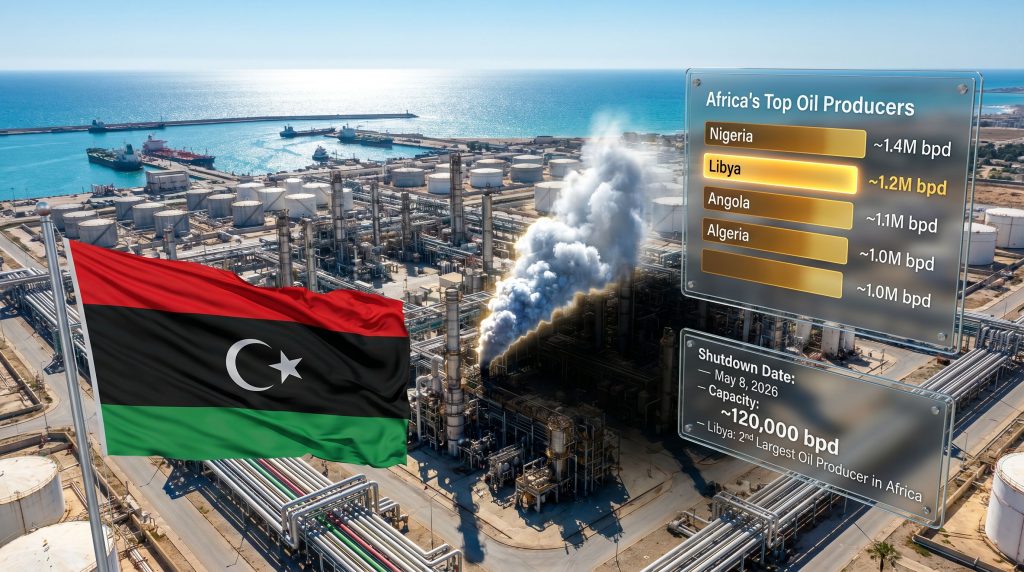
As Africa’s second-largest oil producer, Libya reached about 1.2 million barrels per day in 2025. That marked a decade-high recovery for the National Oil Corporation, or NOC. In continental terms, Libya trailed only Nigeria while remaining ahead of Angola and Algeria.
| Country | Estimated Daily Output (bpd) | Continental Rank |
|---|---|---|
| Nigeria | ~1.4 million | 1st |
| Libya | ~1.2 million | 2nd |
| Angola | ~1.1 million | 3rd |
| Algeria | ~1.0 million | 4th |
That recovery came with a hidden qualification. Libya’s production grew despite its governance environment, not because the environment improved. Rival administrations, armed groups, and factional networks did not disappear. Instead, they adapted and remained capable of interrupting operations whenever tensions rose.
The downstream dimension that gets overlooked
Most international coverage focuses on crude output and exports. However, the downstream picture is arguably more important for daily life inside Libya.
Refining capacity determines whether Tripoli and nearby population centres can access fuel for transport, electricity generation, and household use. Consequently, a refinery shutdown is not just a market event. It can quickly become a social and economic crisis.
That is why Zawiya matters far beyond its headline throughput. A disruption there affects both commercial flows and daily living conditions in western Libya.
What Makes the Zawiya Refinery a Strategic Target
Located roughly 40 to 60 kilometres west of Tripoli, the Zawiya refinery is operated by Azzawiya Oil Refining Company, a subsidiary of the NOC. With capacity above 120,000 barrels per day, it is Libya’s largest operational refinery and a vital fuel source for the west of the country.
The facility sits at a crossroads of two essential supply chains:
- Upstream: It receives crude from fields including Sharara, which has a nameplate capacity of up to 300,000 barrels per day.
- Downstream: It feeds refined products into Tripoli’s distribution system for a population of several million.
This dual role creates compounded vulnerability. If Zawiya stops, crude offtake pressure builds upstream while fuel distribution tightens downstream. In effect, the refinery is a linchpin of western Libya’s energy security.
Its port also adds strategic value. Tanker logistics through Zawiya help support imports and coastal fuel movements. In addition, those logistics can become highly sensitive when conflict nears the site, as seen in reporting on the halt of operations at Libya’s largest refinery.
The May 8, 2026 Shutdown: Sequence of Events
The events behind the Libya Zawiya refinery shutdown unfolded quickly. Armed clashes broke out near the facility, and projectiles hit several parts of the complex. Tripoli’s security directorate described the action as an operation targeting criminal elements, though no specific factions were publicly identified.
Azzawiya Oil Refining Company responded by taking several emergency steps:
- Declaring an emergency
- Suspending all refinery operations
- Withdrawing personnel
- Evacuating tankers from the port
- Beginning preliminary damage checks
- Coordinating public communication with the NOC
Importantly, officials said no major structural damage had been confirmed as of May 8. The NOC also stated that fuel supplies to Tripoli and nearby areas were not immediately affected. However, that likely reflected storage reserves and buffer stocks rather than ongoing live production.
The refinery operator also urged authorities to keep armed conflict away from critical industrial facilities. That appeal was more than procedural. It was an implicit admission that the site cannot secure itself against repeated threats.
For additional context, wider regional coverage also described heavy clashes near the refinery, reinforcing how closely security conditions and energy operations remain tied.
A Pattern, Not an Exception
For analysts following Libyan energy risk, this incident felt familiar. The refinery also suffered a shutdown after clashes in September 2025, while further unrest in the Zawiya corridor later that year caused more operational disruption.
| Incident | Period | Facility | Trigger | Structural Damage |
|---|---|---|---|---|
| Armed clashes | September 2025 | Zawiya Refinery | Militia activity | Not confirmed |
| Further unrest | Late 2025 | Zawiya corridor | Factional fighting | Not confirmed |
| Security operation | May 8, 2026 | Zawiya Refinery | Armed clashes near perimeter | None confirmed |
Three shutdowns in roughly eight months are not random. Rather, they show a facility operating under chronic insecurity.
Why Zawiya is repeatedly targeted
Several structural factors make the refinery especially vulnerable:
- Proximity to Tripoli gives it political value
- Persistent militia presence keeps the corridor unstable
- Economic leverage logic makes disruption a bargaining tool
- Security gaps leave infrastructure reliant on ad hoc protection
In that sense, Zawiya reflects a wider geopolitical risk landscape in which strategic assets become pressure points during fragmented governance.
Economic and Energy Security Consequences
The immediate fuel supply question
The NOC’s assurance that Tripoli’s fuel supply remained steady was reassuring. Nevertheless, it should be interpreted carefully. Short-term continuity during a refinery closure usually depends on inventories or supplemental imports rather than active refining.
If the outage stretches from days into weeks, the risk rises significantly. Libya’s western fuel system has limited redundancy, so there is no easy substitute for prolonged lost capacity at Zawiya.
The broader development cost
The longer-term damage goes well beyond missed revenue. Each disruption tends to:
- Deter foreign investment
- Raise insurance and operating costs
- Delay capital spending plans
- Increase implementation risk for international partners
Libya’s failure to turn vast reserves into durable downstream growth is therefore not mainly a technical issue. It is a governance problem with direct industrial consequences.
How oil markets read Libya
Global oil markets usually respond less dramatically to Libyan disruptions than they do to Gulf supply shocks. That is because chronic instability in Libya is already partly priced in. Similar dynamics appear in broader discussions of oil price movements and recurring supply risk.
This muted response helps explain why the May 8 event did not move crude prices sharply. Even so, repeated outages still matter. They reinforce perceptions of Libya as an unreliable supplier, especially when combined with wider geopolitical oil risks and uncertainty around OPEC’s market influence.
In addition, when traders downplay each individual incident, they may underestimate the cumulative burden on Libya’s own population and institutions. A local infrastructure shock does not need to trigger a global market rally to be economically severe.
Governance Fragmentation as the Root Cause
The Libya Zawiya refinery shutdown cannot be properly understood without looking at Libya’s fragmented political order. Since 2011, no single authority has established accepted control across the country. Rival governments and armed groups have repeatedly competed over territory, revenue, and energy assets.
The NOC has shown notable technical resilience. Its ability to sustain output near 1.2 million barrels per day in 2025 demonstrated operational competence. Yet technical capability is not the same as institutional control.
As one structural insight makes clear: technical capacity and institutional capacity are not interchangeable. The NOC can operate wells and maintain equipment. It cannot, however, secure a coastal industrial corridor against armed groups on its own.
That gap matters not only for domestic operators but also for foreign firms. Commercial partnerships may look attractive during periods of higher output or an oil price rally, yet without enforceable security guarantees, physical asset risk remains elevated.
Scenarios for Libya's Energy Future
Three broad paths stand out:
- Continued fragmentation: shutdowns remain frequent, investment stays cautious, and output gains plateau.
- Negotiated security perimeters: buffer arrangements reduce some disruption, but root causes persist.
- Governance convergence: a political settlement enables unified protection and more credible long-term investment.
At present, the most realistic base case still looks closest to the first scenario, with occasional features of the second.
Key Facts at a Glance
| Metric | Detail |
|---|---|
| Shutdown Date | May 8, 2026 |
| Facility | Zawiya Oil Refinery |
| Operator | Azzawiya Oil Refining Company |
| Processing Capacity | Over 120,000 barrels per day |
| Trigger | Armed clashes and projectile strikes |
| Structural Damage | None confirmed |
| Fuel Supply Impact to Tripoli | Unaffected initially, per NOC |
| Prior Comparable Events | September 2025; late 2025 |
| Libya’s Production Rank | 2nd in Africa |
| Upstream Connection | Sharara oilfield, up to 300,000 bpd |
Frequently Asked Questions
What caused the Libya Zawiya refinery shutdown in May 2026?
The Libya Zawiya refinery shutdown was triggered by armed clashes near the facility on May 8, 2026. Projectiles struck several points within the complex, prompting an emergency declaration and precautionary suspension of operations.
How large is the Zawiya refinery?
It is Libya’s largest operational refinery, with processing capacity above 120,000 barrels per day. It sits west of Tripoli on the Mediterranean coast.
Was fuel supply to Tripoli affected?
According to the NOC, fuel flows to Tripoli were not immediately interrupted. However, that does not remove the risk if shutdowns become prolonged.
Has the refinery been shut down before?
Yes. Comparable disruptions linked to armed activity occurred in September 2025 and later in 2025, showing a repeated pattern rather than a one-off event.
What is Libya’s oil production rank in Africa?
Libya produces about 1.2 million barrels per day, making it Africa’s second-largest oil producer behind Nigeria.
Disclaimer: This article presents factual reporting and analytical commentary based on publicly available information. Forward-looking scenario analysis reflects possible trajectories rather than confirmed outcomes. Readers should conduct independent research before making decisions based on energy market or geopolitical assessments.
Want To Stay Ahead of High-Impact Resource Discoveries Before the Broader Market Reacts?
While Libya's fragile energy infrastructure highlights the risks of geopolitical exposure, Discovery Alert's proprietary Discovery IQ model delivers real-time alerts on significant ASX mineral discoveries, transforming complex resource data into actionable investment insights — explore historic discovery returns that demonstrate why early positioning matters, and begin your 14-day free trial today to secure a market-leading edge.