June 30, 2026
The Physics Problem That $145 Million Is Trying to Solve
Every barrel of oil produced from the Bakken tells an incomplete story. For every barrel lifted to surface through a hydraulically fractured horizontal well, roughly nine more remain locked in the formation below, trapped in ultra-tight rock that conventional recovery physics simply cannot reach. This is not a drilling failure or an engineering oversight — it is a fundamental consequence of reservoir geology, and it represents one of the most persistent and expensive unsolved problems in North American unconventional production.
Understanding why this happens requires a brief detour into reservoir physics. In conventional oil fields, natural drive mechanisms — water influx, gas cap expansion, and reservoir pressure gradients — work in tandem with permeable rock to push hydrocarbons toward producing wells. The Bakken's matrix permeability, measured in nanodarcies (roughly a million times less permeable than a conventional sandstone reservoir), renders these mechanisms almost entirely ineffective. Oil molecules are effectively immobilised within the rock fabric, unable to migrate meaningfully toward fracture networks without a deliberate external intervention.
This is the technical problem that the DOE awards $36 million for Bakken CO2 EOR program in North Dakota initiative has been specifically designed to address, through one of the most structurally ambitious enhanced oil recovery research programs the United States has assembled in the unconventional space. Furthermore, understanding this context matters greatly against the broader backdrop of crude oil price trends that continue to shape investment decisions across North American basins.
When big ASX news breaks, our subscribers know first
Why CO₂ Is the Right Tool for an Unusually Difficult Reservoir
The Supercritical Advantage
Carbon dioxide behaves differently from most injection fluids when it encounters crude oil under reservoir conditions. When pressurised beyond its critical point (above approximately 31°C and 74 bar), CO₂ enters a supercritical state where it simultaneously carries gas-like mobility and liquid-like density. In this state, it becomes highly soluble in crude oil, producing three simultaneous effects that matter enormously in tight formations:
- Viscosity reduction: CO₂ dissolved in oil can reduce crude viscosity by a factor of two to ten depending on oil gravity and reservoir temperature, dramatically improving flow potential
- Oil swelling: The dissolved CO₂ causes the oil volume to expand, sometimes by 10–30%, which increases pore pressure and drives additional oil toward the wellbore
- Interfacial tension reduction: CO₂ lowers the surface tension between oil and rock, releasing oil from smaller pore throats that would otherwise retain it under capillary pressure alone
For Bakken crude, which is a light sweet oil typically in the 40–50° API gravity range, CO₂ is a particularly well-matched injectant. Light oils generally reach miscibility with CO₂ at lower pressures, meaning full mixing between the two fluids can occur within the formation at achievable injection pressures.
Huff-and-Puff: The Only Viable Injection Architecture
In conventional reservoirs, CO₂ is typically injected through dedicated injection wells and floods toward a pattern of producers in a continuous process. This flood-based approach requires permeable rock that allows CO₂ to sweep through the reservoir matrix. In the Bakken, however, that permeability simply does not exist at the scale needed.
The solution is cyclic injection, commonly called huff-and-puff, where a single well alternates between roles:
- Injection phase (the "huff"): CO₂ is pumped into the well at high pressure, forcing it into the hydraulic fracture network and then allowing it to diffuse slowly into the adjacent matrix rock over time
- Soak phase: The well is shut in for a defined period, allowing CO₂ to interact with in-situ oil, swell it, reduce its viscosity, and build local pore pressure
- Production phase (the "puff"): The well is returned to production, and the pressure differential draws the mobilised oil toward the wellbore
Earlier research phases conducted in the Williston Basin validated that this approach can mobilise oil from Bakken matrix rock, even under the low-injectivity conditions that make continuous flooding impractical. Laboratory studies confirmed the CO₂-oil interaction mechanism; the current program is designed to translate that chemistry into commercial field performance.
The Dual-Purpose Carbon Equation
One of the more strategically significant dimensions of CO₂-EOR in the Bakken is that it creates a practical use case for captured industrial carbon dioxide that exists in the region in substantial volumes.
North Dakota operates coal-fired power generation assets whose CO₂ emissions currently represent a liability under tightening environmental frameworks. By routing captured CO₂ from these plants into EOR operations, the program creates a regional industrial symbiosis with genuine economic logic: coal generators gain a carbon management pathway, and EOR operators gain a potentially cost-competitive CO₂ supply chain compared to purchasing commercial CO₂.
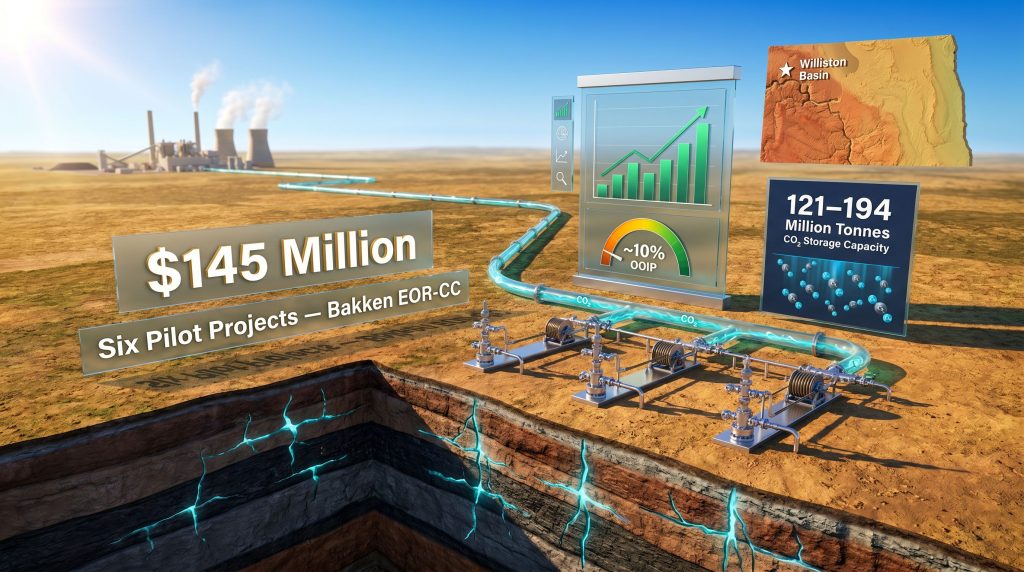
The geological case for CO₂ storage in the North Dakota Bakken adds another layer to this equation. Research has estimated that the formation holds between 121 and 194 million tonnes of CO₂ storage capacity, creating a significant geological sink for regional emissions. This storage potential has direct relevance to 45Q tax credit incentives for qualifying carbon capture and storage operations, which can materially improve the economics of CO₂-EOR projects that meet verification requirements.
The intersection of EOR economics and carbon credit frameworks is not a peripheral consideration — it may ultimately determine whether CO₂-EOR in the Bakken is commercially viable at scale, irrespective of oil prices alone.
The table below summarises the key distinctions between CO₂-EOR in conventional vs. unconventional settings to contextualise the technical challenge the program is addressing:
| Parameter | Conventional Reservoirs | Bakken Unconventional |
|---|---|---|
| Permeability | Millidarcies to Darcies | Nanodarcies |
| Injection Pattern | Continuous flood | Cyclic huff-and-puff |
| Primary Recovery Rate | 20–40% OOIP | ~10% OOIP |
| CO₂ Miscibility Pressure | Established | Formation-depth dependent |
| EOR Uplift Potential | Well-established | Emerging — high upside |
| CO₂ Storage Co-benefit | Moderate | High (121–194M tonnes ND Bakken) |
Breaking Down the $36 Million Program Architecture
Who Is Leading This and Why the EERC?
The University of North Dakota's Energy and Environmental Research Center (EERC) is the anchor institution for the Bakken EOR-CC program. This is not an arbitrary selection. The EERC carries multi-decade expertise in Williston Basin reservoir characterisation, earlier phases of CO₂ injection field testing in the region, and energy systems modelling that bridges laboratory chemistry and commercial field operations. Notably, the EERC received $25 million as part of a broader federal funding package that underscores the institution's central role in domestic energy research.
The program is administered through the DOE's Hydrocarbons and Geothermal Energy Office (HGEO), which has oversight of federal investment in optimising domestic hydrocarbon resource recovery.
How the $145 Million Is Structured
The financial architecture of the Bakken EOR-CC program is designed to leverage federal investment as a catalyst for significantly larger state and private capital deployment:
| Funding Source | Amount | Scope |
|---|---|---|
| U.S. DOE (HGEO) | $36 million | Program-wide federal contribution |
| EERC and Project Partners | $9 million | Cost-share for one pilot project |
| State and Private Sources | ~$100 million | Five remaining pilot projects |
| Total Program | ~$145 million | Six pilot projects combined |
The DOE's $36 million thus catalyses approximately $109 million in non-federal co-investment, a leverage ratio that reflects the degree to which state and private stakeholders view the technical and commercial opportunity as credible enough to back with their own capital.
DOE Assistant Secretary Kyle Haustveit described the program as critical to establishing a commercially deployable pathway for enhanced oil recovery across the Bakken at national scale, with the six integrated pilot projects providing the technical foundation for that transition. In addition, Senator Hoeven's work to advance the Crack the Code initiative alongside Energy Secretary Wright has been instrumental in securing the political framework underpinning this investment.
What the Six Pilots Are Actually Testing
The six-pilot architecture is deliberately diversified. Rather than validating a single injection approach in a single set of reservoir conditions, the program tests distinct combinations of variables across all projects simultaneously:
- CO₂ injection volumes and cycling frequencies
- Reservoir pressure and temperature conditions across different formation depths and zones
- Well completion design and fracture geometry variations
- CO₂ source types, including captured industrial emissions vs. commercial supply
- Monitoring and verification protocols required for permanent CO₂ storage certification
This experimental design is significant. A single-pilot program produces results that are inherently site-specific and difficult to extrapolate. A six-pilot program, with AI analytics connecting performance data across all sites, produces a statistically robust dataset that can be used to derive universal best practices applicable across the broader Bakken.
The Technology Stack: Where AI Meets Reservoir Physics
How Machine Learning Changes the Research Equation
Traditional oil recovery research operates sequentially: run a pilot, collect data, analyse results, adjust approach, run another pilot. This process can take years to generate actionable commercial insights.
The Bakken EOR-CC program embeds artificial intelligence and machine learning tools into the research architecture from the outset, enabling a fundamentally different analytical model. Rather than evaluating each of the six pilots in isolation, the AI layer continuously processes performance data streams from all sites simultaneously, identifying cross-pilot patterns that no individual site analysis could reveal.
Practically, this means the program can identify in near real time which combinations of injection pressure, soak duration, CO₂ volume, and well geometry are producing the highest incremental oil recovery per tonne of CO₂ injected. Those insights feed back into operational adjustments at active pilot sites, compressing the learning curve substantially.
Machine learning models are also being used to generate operational benchmarks and best-practice protocols — standardised playbooks for commercial operators who want to deploy CO₂-EOR beyond the program's direct footprint.
The Six-Phase Research Framework
The program's integrated approach unfolds through a structured sequence:
- Laboratory characterisation: Core sample analysis, CO₂-oil interaction testing under simulated reservoir conditions, and fluid property measurement
- Reservoir modelling: Construction of geological and dynamic simulation models calibrated to Bakken formation data from pilot sites
- AI and ML integration: Deployment of machine learning tools to process multi-variable datasets across all six pilots
- Field pilot execution: CO₂ injection operations at six sites with real-time monitoring and continuous data collection
- Cross-pilot synthesis: AI-driven analysis connecting results across all pilots to identify universal performance drivers
- Commercial pathway development: Translation of pilot findings into scalable deployment protocols for the Bakken and analogous unconventional plays
The integration of AI analytics into a multi-site field program is a relatively novel approach in unconventional EOR research, and its success here could establish a template for how future resource optimisation programs are designed across the U.S. unconventional sector.
What This Means for North Dakota's Energy Ecosystem
Coal, Carbon, and Industrial Symbiosis
The program's potential to extend the productive life of North Dakota's coal-fired power infrastructure is a secondary outcome with significant regional economic implications. Coal generation in the state faces mounting pressure from carbon intensity frameworks, and without a viable carbon management strategy, many of these assets face economic headwinds.
By creating a direct demand pathway for captured CO₂ from coal combustion, the Bakken EOR-CC program could provide coal plant operators with a commercially meaningful solution: their emissions become a valued input for enhanced oil recovery rather than a regulatory liability. The CO₂ supply economics would also benefit EOR operators, who currently rely on commercially purchased CO₂ at prices that can materially affect project economics.
Production Ambitions and the Recovery Efficiency Gap
North Dakota has set production targets of reaching 2 million barrels per day in total oil output, a goal that requires more than incremental new drilling activity. With the most accessible untapped acreage already developed and new well productivity plateauing in mature areas, meaningful production growth increasingly depends on recovering more oil from existing wellbores. Consequently, the ongoing US oil production decline in certain basins only amplifies the strategic urgency of initiatives like this one.
The DOE awards $36 million for Bakken CO2 EOR program in North Dakota directly addresses this constraint. If pilot results demonstrate commercially viable incremental recovery, the scaling implications are substantial. A modest improvement in recovery efficiency across the full Bakken, applied to the billions of barrels of oil currently stranded in already-drilled formations, could add meaningful production volumes without the surface disturbance, capital expenditure, or environmental footprint associated with drilling new wells.
A National Template in Development
The DOE has positioned the Bakken EOR-CC program not as a regional initiative but as a national template. The technical foundation being built through these six pilots is explicitly intended to support broader adoption of CO₂-EOR across analogous unconventional reservoirs throughout the United States, including portions of the Permian Basin, Eagle Ford, and Niobrara formations that share comparable recovery challenges. Moreover, US resource policy shifts under the current administration have reinforced federal commitment to domestic energy production optimisation, lending additional political momentum to programs of this nature.
The next major ASX story will hit our subscribers first
The Research Legacy That Preceded This Investment
The Bakken EOR-CC program did not emerge from a standing start. It represents the most capital-intensive phase of a multi-decade research trajectory conducted primarily through the EERC and its Williston Basin field partners:
| Research Phase | Period | Key Technical Outputs |
|---|---|---|
| Phase I: Feasibility | Pre-2014 | Confirmed CO₂-Bakken oil interaction potential; identified matrix injectivity constraints |
| Phase II: Field Testing | 2014–2018 | Validated huff-and-puff in Williston Basin; established 121–194M tonne CO₂ storage capacity estimate |
| 2024 Field Laboratory | Oct 2024 onward | $11.6M DOE cooperative agreement; 18+ months active CO₂ injections with Chord Energy as field partner |
| Bakken EOR-CC (Current) | 2025 onward | $36M DOE + ~$145M total; six-pilot integrated program with AI and ML analytics overlay |
Each phase has progressively reduced the technical and commercial risk associated with large-scale deployment. By the time the current program was initiated, the basic science was validated, field-scale injection had been demonstrated, and the primary unknowns shifted from whether CO₂-EOR could work in the Bakken to how it should be optimised for commercial viability.
Key Risks That Could Limit Commercial Success
No research program of this complexity is without execution risk, and a balanced assessment requires identifying where the current program's conclusions could be constrained. These risks are particularly relevant given the sensitivity of energy investment to an oil price shock or an unexpected oil price rally driven by policy shifts:
- CO₂ supply chain immaturity: Industrial CO₂ capture infrastructure in North Dakota remains in early development stages. Scaling EOR operations to commercial volumes requires a reliable large-volume supply that does not yet exist at the necessary scale
- Matrix injectivity limitations: The fundamental permeability constraints of the Bakken may prove difficult to overcome at commercially viable injection rates, even with optimised cycling protocols. Pilot results will be the first definitive test
- Oil price sensitivity: CO₂-EOR carries higher per-barrel lifting costs than primary production. Commercial viability projections are sensitive to sustained oil price levels, creating exposure to commodity price cycles
- Monitoring and verification costs: Demonstrating permanent CO₂ storage to the standard required for 45Q tax credit eligibility demands long-term subsurface monitoring programs that add meaningful operational cost
- Regulatory complexity: Multi-state and federal permitting requirements for CO₂ injection wells and storage certification introduce timeline risk that could delay commercial-scale deployment decisions
Disclaimer: This article contains forward-looking statements regarding potential oil recovery volumes, commercial viability timelines, and production outcomes. These are based on current research projections and pilot program expectations and are subject to material uncertainty. Actual results may differ significantly from those projected. Nothing in this article constitutes investment advice.
Frequently Asked Questions: DOE Bakken CO₂ EOR Program
What is the Bakken EOR-CC program?
The Bakken Enhanced Oil Recovery–Cracking the Code program is a federally co-funded research initiative led by the University of North Dakota's EERC. It combines laboratory science, reservoir modelling, AI analytics, and six field pilot projects to develop commercially viable CO₂-based enhanced oil recovery methods for the Bakken shale.
How much total investment is involved?
The U.S. Department of Energy is contributing $36 million to the program. The EERC and project partners are providing $9 million in cost-share for one pilot, while state and private sources are contributing approximately $100 million across the remaining five pilot projects, bringing total program investment to roughly $145 million.
Why does the Bakken only recover about 10% of its oil?
The Bakken's matrix permeability, measured in nanodarcies, is so low that conventional pressure depletion mechanisms cannot drive oil from the rock to producing wells at meaningful rates. Without connected pore networks that allow fluid migration, the vast majority of oil in place remains immobilised after primary production. The DOE awards $36 million for Bakken CO2 EOR program in North Dakota specifically targets this recovery gap through cyclic CO₂ injection.
What role does AI play in the program?
Machine learning tools will analyse performance data from all six pilot projects simultaneously, identifying which combinations of injection parameters produce the highest incremental oil recovery per tonne of CO₂ injected. This cross-pilot intelligence is designed to accelerate the development of standardised commercial protocols.
How does this benefit North Dakota's coal industry?
By creating a demand pathway for captured CO₂ as an EOR injectant, the program offers coal-fired power plants a potential carbon management solution, converting their emissions into a commercially useful input rather than a regulatory liability.
How much incremental oil could this unlock?
The DOE has indicated the potential to unlock billions of additional barrels from the Bakken — a formation where approximately 90% of original oil in place remains unrecovered following primary production. Precise volumes depend on pilot outcomes and are subject to significant uncertainty. The DOE awards $36 million for Bakken CO2 EOR program in North Dakota represents the most advanced effort yet to quantify and realise that potential at commercial scale.
Want to Stay Ahead of Major Resource Discoveries Before the Broader Market Reacts?
While the Bakken's $145 million CO₂ EOR programme underscores the enormous value locked within established resource formations, Discovery Alert's proprietary Discovery IQ model delivers real-time ASX mineral discovery alerts — transforming complex resource data into actionable investment insights the moment they are announced. Explore historic examples of exceptional discovery returns and begin your 14-day free trial today to position yourself ahead of the market.