June 30, 2026
The Race to Lock In Long-Duration Gas: Why Unconventional Basins Are Reshaping LNG Supply Chains
The global LNG industry is undergoing one of its most consequential structural shifts in decades. Following Russia's curtailment of pipeline gas flows to Europe and the acceleration of Asia's clean energy transition, buyers across both continents are urgently diversifying their long-term supply portfolios. Traditional LNG powerhouses built their dominance over thirty years of incremental capacity expansion. The next generation of supply, however, is being assembled at extraordinary speed, and it is being built in places that were barely on the LNG map a decade ago.
Argentina sits at the centre of this emerging supply realignment. Its Vaca Muerta formation in the Neuquén Basin holds technically recoverable shale gas resources that rank among the largest in the Western Hemisphere, with the U.S. Energy Information Administration estimating Argentina's technically recoverable shale gas at approximately 802 trillion cubic feet, second only to China globally. For context, that figure represents resources that could sustain large-scale LNG exports for generations, if the upstream, midstream, and export infrastructure can be assembled at the necessary scale and pace.
The Eni and XRG Vaca Muerta blocks acquisition, formalised in June 2026, represents the most concrete upstream commitment yet made toward translating that geological potential into operational LNG export volumes.
When big ASX news breaks, our subscribers know first
Vaca Muerta in Global Context: How Argentina's Shale Stacks Up
The Geological Characteristics That Make Vaca Muerta Exceptional
Not all shale is created equal. The commercial viability of unconventional gas development depends on a combination of formation thickness, total organic carbon (TOC) content, thermal maturity, reservoir pressure, and regional geology that controls how efficiently rock can be fractured and how long wells sustain production.
Vaca Muerta consistently scores highly across these metrics. The formation spans roughly 30,000 square kilometres, with organic-rich shale intervals reaching thicknesses of up to 500 metres in the most productive zones, a geological attribute that is unusually generous compared to formations like the Marcellus or Eagle Ford in the United States. TOC values in the core of the play regularly exceed 4%, and reservoir pressures in the gas-condensate window are high enough to support strong initial production rates without artificial lift.
Critically, Vaca Muerta's stratigraphy contains both oil and gas windows within the same basin, meaning operators already possess extensive drilling knowledge, operational infrastructure, and production data from the oil-producing zones. This accumulated technical understanding materially reduces the subsurface risk profile for new entrants targeting the deeper gas window.
Comparing Unconventional Basins by LNG Export Potential
| Basin | Country | Shale Gas Resource (Tcf, Technically Recoverable) | Current Development Stage |
|---|---|---|---|
| Vaca Muerta | Argentina | ~802 (national total) | Early commercial, scaling rapidly |
| Marcellus / Utica | United States | ~600+ | Mature, fully commercial |
| Sichuan Basin | China | ~1,115 | Developing, domestic focus |
| Karoo Basin | South Africa | ~390 | Pre-commercial |
| Cooper Basin | Australia | ~200+ | Limited development |
The data above reinforces a point that sophisticated LNG buyers have been noting privately for several years: Argentina is not a speculative frontier play. It is a world-class resource base at a relatively early stage of commercial development, with upstream costs that have fallen sharply as drilling efficiency has improved across the Neuquén Basin. Furthermore, Argentina resource investment signals across multiple commodities have been strengthening as the country's regulatory environment stabilises.
Breaking Down the Eni and XRG Vaca Muerta Blocks Acquisition
The Three Blocks at the Core of the Transaction
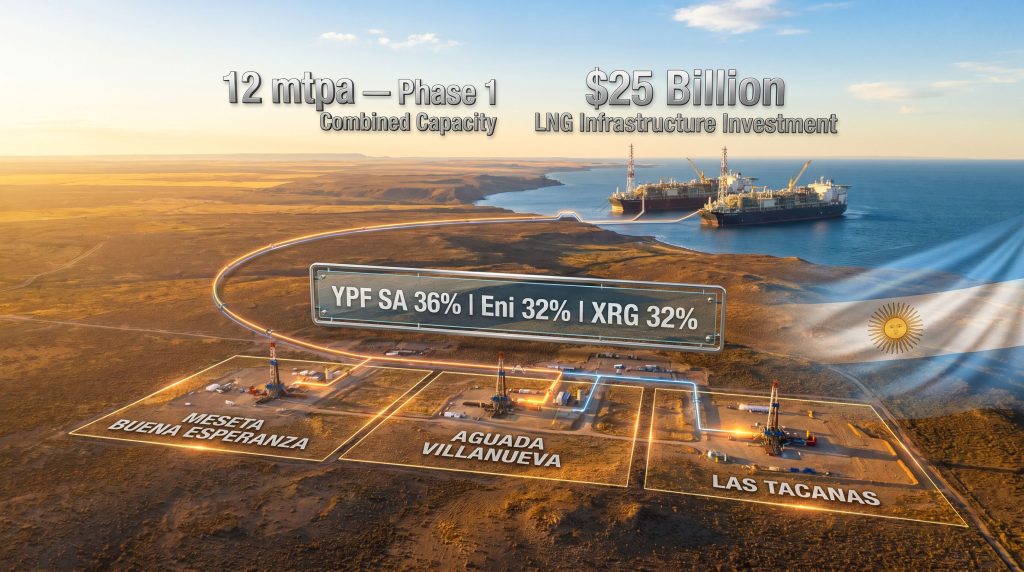
The June 2026 sale and purchase agreements involve three unconventional upstream blocks within the Vaca Muerta formation: Meseta Buena Esperanza, Aguada Villanueva, and Las Tacanas. These blocks were specifically selected to function as the dedicated gas supply backbone for Argentina's integrated LNG export project, not as standalone production assets.
The ownership structure following completion of the transaction is as follows:
| Party | Ownership Interest | Operational Role |
|---|---|---|
| YPF SA | 36% | Block Operator |
| Eni | 32% | Upstream partner and FLNG lead developer |
| XRG (ADNOC) | 32% | Strategic investor and midstream co-developer |
YPF SA, Argentina's state energy company, retains the operating role across all three blocks, maintaining sovereign alignment with the development while international partners contribute capital, technology, and offtake relationships.
Understanding the SPA Structure and What Completion Requires
A sale and purchase agreement in the upstream context is a binding contractual commitment to transfer working interests, subject to the satisfaction of defined conditions. In this case, completion remains contingent on approval from relevant Argentine regulatory authorities. Until those approvals are secured, the working interests have not formally transferred, though the commercial terms are locked.
It is worth clarifying a misconception that has circulated in some coverage of this transaction. Eni and XRG are not transacting with each other. Both parties independently acquired their respective 32% stakes from YPF SA, making them co-investors in the same assets rather than counterparties to each other's deal. XRG is the international investment vehicle of Abu Dhabi National Oil Company and is a strategic participant in this consortium, not a company being acquired.
The Integrated Architecture: From Wellhead to FLNG Vessel
How Upstream Gas Flows Into the LNG Export Chain
The blocks are not being developed in isolation. They form the upstream pillar of a fully integrated value chain that connects Vaca Muerta gas production directly to floating LNG export infrastructure on Argentina's Atlantic coast. The design calls for two FLNG vessels, each with a nameplate capacity of 6 million tonnes per annum (mtpa), delivering a combined first-phase export capacity of 12 mtpa.
| Project Phase | LNG Capacity | Key Milestone |
|---|---|---|
| Phase 1 (dual FLNG deployment) | 12 mtpa | First cargoes targeted 2030-2031 |
| Expansion target | Up to 30 mtpa | By 2030-2031 |
| Final Investment Decision (FID) | Subject to approval | Second half of 2026 |
The FID is a critical threshold. Once taken, it triggers the capital deployment cycle across both the upstream drilling programme and the FLNG vessel construction contracts, typically placing orders with major LNG engineering firms. Missing the FID window in the second half of 2026 would likely compress the timeline to first cargo delivery, given the multi-year lead times involved in FLNG vessel fabrication.
Why Floating LNG Is the Right Technology for Argentina's Coastline
Argentina's geography creates specific infrastructure challenges that make FLNG a more practical solution than onshore liquefaction terminals. The country lacks an established LNG export port with sufficient water depth and jetty infrastructure along the Patagonian coast. Building a greenfield onshore terminal with loading jetties, storage tanks, and associated utilities would require substantially more permitting time and civil engineering complexity than deploying purpose-built FLNG vessels.
FLNG technology, pioneered commercially by Shell's Prelude facility off the coast of Western Australia, places the gas treatment, liquefaction, and storage functions on a floating vessel moored offshore. This approach compresses the onshore infrastructure footprint, accelerates the path to first cargo, and provides a degree of operational flexibility that fixed onshore terminals cannot match. For an emerging LNG nation with limited coastal export infrastructure, it is a logical entry-point technology.
Technical Note: Developing three large unconventional blocks simultaneously to supply twin 6-mtpa FLNG units demands sustained high-volume well drilling campaigns, advanced hydraulic fracturing operations across thick shale intervals, and significant gathering pipeline and compression infrastructure, all of which must reach operational readiness before 2030-2031 first cargo targets can be achieved.
The Capital Commitment: Sizing One of Latin America's Largest Energy Projects
Total Investment Requirements Across the Integrated Project
The scale of capital involved in the Eni and XRG Vaca Muerta blocks acquisition and the associated LNG development is striking even by global energy sector standards. Total LNG infrastructure investment is estimated at approximately $25 billion, with upstream development across the Vaca Muerta blocks requiring a further $15-20 billion, bringing aggregate project capital requirements toward the $40-45 billion range over the development period.
To contextualise that figure: this would represent one of the largest integrated energy investments in Latin American history, surpassing most individual LNG developments globally outside Qatar's North Field expansion programme.
Key capital deployment milestones include:
- FLNG vessel fabrication contracts, typically awarded to Korean or Japanese shipyards, with lead times of approximately four to five years from order to delivery.
- Upstream well drilling programmes across three blocks, requiring hundreds of horizontal wells with multi-stage hydraulic fracturing to reach plateau gas supply rates.
- Gathering pipeline networks and compression stations within the Neuquén Basin to aggregate production from individual well pads.
- Subsea or nearshore pipeline connections linking onshore gathering infrastructure to the FLNG vessels' offshore mooring location.
How the Consortium Was Built: A Timeline of Binding Agreements
The partnership structure did not emerge from a single negotiation. It was assembled through a deliberate sequence of escalating commitments over approximately eight months:
- November 2025 – ADNOC, acting through XRG, formally joined the Argentina LNG project framework at the ADIPEC energy conference in Abu Dhabi, signalling Gulf sovereign capital's entry into the South American LNG opportunity.
- February 2026 – All three parties executed a binding Joint Development Agreement (JDA), establishing the commercial and technical framework for advancing the integrated project toward FID.
- June 2026 – Eni and XRG independently signed Sale and Purchase Agreements with YPF SA for the three Vaca Muerta upstream blocks, locking in working interest allocations ahead of the FID process.
This sequencing is deliberate in the LNG industry. JDAs define cost-sharing, governance, and decision-making rights before the far larger capital commitments of FID are triggered. The signing of upstream SPAs in June 2026 represents the consortium moving from development-phase collaboration to asset-level ownership, a meaningful step in the project maturation curve.
The next major ASX story will hit our subscribers first
XRG and ADNOC's Strategic Logic: Why Gulf Capital Is Targeting South American Gas
Abu Dhabi's International Diversification Playbook
XRG's participation in the Eni and XRG Vaca Muerta blocks acquisition is not an isolated transaction. It reflects a broader strategic reorientation by ADNOC toward building an international upstream and midstream portfolio that complements its enormous domestic production base. Abu Dhabi holds the world's sixth-largest proven oil reserves, and its sovereign energy ambitions increasingly extend beyond the Gulf.
For ADNOC, securing long-duration gas equity positions in emerging LNG export jurisdictions serves multiple strategic purposes. In addition, the energy trade geopolitics reshaping global supply chains make diversified upstream ownership increasingly valuable to sovereign producers seeking influence across the full LNG value chain.
- It diversifies revenue exposure away from oil price cycles and Middle Eastern geopolitical risk.
- It positions XRG as a supplier to the same Asian and European buyers that ADNOC supplies from its domestic LNG facility at Das Island.
- It builds technical and operational expertise in unconventional resource development, a domain where Argentine Vaca Muerta is now generating extensive real-world knowledge.
- It provides leverage in future LNG offtake negotiations by controlling gas at the upstream level, not just at the liquefaction or trading stage.
Investor Perspective: The entry of sovereign-backed Gulf energy capital into Vaca Muerta's upstream blocks suggests that long-duration, export-oriented gas assets in politically reforming jurisdictions are being actively repriced upward by institutional energy investors, a dynamic with implications for how similar emerging LNG nations attract capital through the 2030s.
Argentina vs. Global LNG Peers: Where the Country Can Compete
Supply Cost and Market Positioning
| Country | Current LNG Capacity | Projected Capacity by 2031 | Key Competitive Advantage |
|---|---|---|---|
| Qatar | ~77 mtpa | ~126 mtpa | Lowest-cost producer globally, integrated infrastructure |
| Australia | ~88 mtpa | Modest growth | Proximity to Asian demand centres |
| United States | ~90 mtpa | Expanding via Gulf Coast projects | Scale, flexibility, Henry Hub pricing |
| Argentina | Less than 1 mtpa | Up to 30 mtpa targeted | Massive resource base, new supply entrant with competitive costs |
Argentina's structural cost advantage lies in Vaca Muerta's combination of high productivity wells and increasingly efficient drilling operations. Well costs per unit of production have fallen dramatically as the basin has matured operationally, and Argentine operators now regularly achieve lateral lengths and fracturing stage counts comparable to the best Permian Basin benchmarks.
For European buyers particularly, Atlantic-basin Argentine LNG offers a geographically and commercially diversified alternative to US Gulf Coast supply, without the pipeline transit dependencies that have historically characterised European gas security. For Asian buyers, the Atlantic routing is longer, but long-term LNG supply considerations and supply diversity arguments remain compelling in a tightening global LNG market.
Operational Challenges That Remain Before First Cargo
Infrastructure Complexity Across Three Development Fronts
The ambition embedded in the Eni and XRG Vaca Muerta blocks acquisition is significant, but the operational pathway between today's SPA signings and a first LNG cargo in 2030-2031 involves navigating several layers of complexity. Furthermore, resource export challenges faced by emerging LNG nations underscore just how critical infrastructure planning and regulatory coordination are during this phase.
- Upstream drilling intensity: Sustaining plateau gas supply rates across three large unconventional blocks requires a continuous, high-pace drilling programme across hundreds of well locations. Any slowdown in rig availability, well completion services, or fracturing fleet capacity could constrain gas supply volumes ahead of FLNG operational start.
- Water management: Hydraulic fracturing in the Neuquén Basin requires substantial water volumes. Managing produced water disposal and freshwater sourcing at scale is an operational challenge that has required increasingly sophisticated solutions as the basin has intensified.
- Gathering infrastructure buildout: Connecting individual well pads across three geographically distinct blocks to a centralised export pipeline corridor requires significant mid-gathering investment that must proceed in parallel with drilling.
- FLNG vessel schedule risk: Shipyard construction programmes for vessels of this scale carry inherent schedule risk. Any delay in delivery or commissioning of the FLNG units directly delays first cargo.
Argentina's Energy Policy Shift and What It Means for FDI
Regulatory Confidence and the Significance of International Capital Commitment
The simultaneous commitment of a European energy supermajor and a Gulf sovereign investment vehicle to the same Argentine upstream assets carries a signal value beyond the economics of any individual transaction. Both Eni and ADNOC operate across dozens of jurisdictions globally, and their upstream capital allocation decisions reflect rigorous assessments of regulatory stability, fiscal terms, and operational risk.
Argentina's upstream regulatory framework has historically been a source of investor caution, given episodes of price controls, export restrictions, and nationalisation that characterised earlier decades. However, shifts in oil and gas drilling policy across the region have contributed to a more favourable investment environment, and the willingness of Eni and XRG to commit at the scale implied by this transaction suggests that the current regulatory and fiscal environment has achieved a degree of credibility with sophisticated international investors.
This matters beyond the energy sector. Upstream FDI of this magnitude generates extensive supply chain activity, generates significant royalty and tax revenues at both provincial and national levels, and builds technical human capital within the Argentine hydrocarbon sector. If the project proceeds to FID and ultimately to production, the fiscal impact for the province of Neuquén and the Argentine national government could be transformative over a multi-decade operating life.
Policy Lens: Argentina's ability to simultaneously attract capital from a European supermajor and a Gulf sovereign energy fund into its upstream gas sector reflects a meaningful evolution in how international investors assess the country's hydrocarbon framework, though the full test of that confidence will come when FID is formally committed in the second half of 2026.
Frequently Asked Questions: Eni and XRG Vaca Muerta Blocks Acquisition
What blocks did Eni and XRG acquire in Vaca Muerta?
Eni and XRG each acquired a 32% working interest in three upstream blocks within the Vaca Muerta formation: Meseta Buena Esperanza, Aguada Villanueva, and Las Tacanas. The transactions were executed through Sale and Purchase Agreements with YPF SA in June 2026.
Is Eni acquiring XRG in this transaction?
No. This is a common misconception. Eni and XRG are independent co-investors who each separately acquired a 32% stake from YPF SA. XRG is the international investment arm of ADNOC and functions as a strategic partner within the consortium, not as a company being acquired by Eni.
What will the gas from these blocks be used for?
The three blocks are designed to supply gas to two floating LNG vessels, each with a capacity of 6 mtpa, delivering a combined first-phase export capacity of 12 mtpa under the Argentina LNG integrated project.
When is the Final Investment Decision expected?
The FID is targeted for the second half of 2026, with first LNG cargoes planned for 2030-2031 if the FID proceeds on schedule.
What is the total investment scale of the project?
LNG infrastructure capital requirements are estimated at approximately $25 billion, with upstream development across the Vaca Muerta blocks requiring a further $15-20 billion, placing aggregate project capital in the range of $40-45 billion across the full development period.
What is Argentina's long-term LNG capacity target?
The integrated project aims to scale toward approximately 30 mtpa of LNG export capacity by 2030-2031, which would position Argentina among the world's top five LNG exporting nations if achieved.
This article contains forward-looking statements regarding project timelines, capacity targets, and capital estimates. All projections are subject to regulatory approvals, Final Investment Decision outcomes, construction schedules, and commercial negotiations. Readers should conduct independent analysis before drawing investment conclusions based on the information presented here.
Want to Stay Ahead of the Next Major Resource Discovery?
Discovery Alert's proprietary Discovery IQ model delivers real-time alerts on significant ASX mineral discoveries — turning complex resource data into actionable investment insights the moment announcements hit the exchange. Explore why major discoveries have historically generated extraordinary returns on Discovery Alert's dedicated discoveries page, and begin your 14-day free trial today to position yourself ahead of the broader market.