June 29, 2026
The Hidden Cost of Fragmented Mill Lining Supply in High-Throughput Grinding Circuits
Every tonne of ore processed through a grinding circuit passes through a system that depends on one underappreciated component: the mill liner. Liner geometry controls charge trajectory, wear rates govern shutdown frequency, and the cumulative performance of liner generations across a contract lifecycle either compounds value or compounds cost. Yet for much of the industry's history, mill liners were procured transactionally, managed reactively, and treated as consumables rather than engineered performance systems.
That framing is changing. Across Asia Pacific mining operations, a structural shift is underway toward integrated, long-term mill lining service arrangements that embed technical expertise, predictive maintenance scheduling, and continuous improvement frameworks into a single managed relationship. The expansion of Metso mill lining Life Cycle Services agreements in Asia Pacific offers one of the clearest illustrations of how this model is reshaping operational standards across the region.
When big ASX news breaks, our subscribers know first
Why Grinding Circuit Reliability Has Become a Strategic Priority
Comminution — the process of crushing and grinding ore to liberate valuable minerals — accounts for between 30% and 50% of a typical mine's total energy consumption according to widely cited industry data. Within that process, the grinding circuit represents the most capital-intensive and operationally sensitive component. Any unplanned stoppage, whether caused by accelerated liner wear, emergency liner replacement, or inconsistent liner specification across mills, translates directly into lost throughput and elevated cost per tonne pressures.
The traditional approach to managing this risk relied on sourcing liners from multiple suppliers across different circuits, benchmarking on unit price, and scheduling replacements based on observed wear rather than predictive data. This model generated several structural inefficiencies:
- Inconsistent liner profiles across mills within the same site, leading to variable wear rates and unpredictable change-out intervals
- Coordination overhead associated with managing multiple supplier relationships and delivery schedules
- Limited accountability for throughput outcomes, since no single supplier held responsibility for circuit performance
- Reactive maintenance planning, where liner replacement was triggered by failure indicators rather than scheduled optimisation windows
The cumulative cost of these inefficiencies is rarely captured in a single line on a procurement report, which is precisely why it persisted for so long.
What Metso's Life Cycle Services Model Actually Delivers
Defining the LCS Framework for Mill Lining Applications
A Life Cycle Services agreement in a mill lining context is not simply a long-term supply contract with a preferred vendor. It is a structured performance partnership that integrates liner design optimisation, scheduled delivery aligned to production plans, on-site technical support, shutdown assistance, and systematic performance review into a single managed service offering.
The distinction matters. Under a conventional supply arrangement, the supplier's obligation ends at delivery. Under an LCS framework, the supplier's accountability extends across the full operational lifecycle of the liner, with performance measured against jointly agreed targets. Furthermore, this approach directly supports broader operational transformation goals that many regional operators are now actively pursuing.
A properly structured mill lining LCS agreement transforms the supplier from a parts provider into a co-owner of grinding circuit outcomes, with shared KPIs creating genuine alignment between commercial incentives and operational performance.
The Four Structural Components That Define LCS Value
The architecture of a well-designed mill lining LCS agreement typically rests on four integrated elements:
- Liner design and optimisation — Continuous refinement of liner profiles based on wear data collected throughout the contract, ensuring each successive liner generation incorporates improvements validated by operational evidence
- Logistics and inventory management — Consignment stock arrangements and scheduled deliveries eliminate emergency procurement scenarios and align liner availability with planned production windows
- On-site technical presence — Embedded technical support during shutdowns and inspection cycles reduces reliance on in-house engineering capacity and accelerates knowledge transfer to site maintenance teams
- Performance monitoring and review — Regular inspection cadences, data collection protocols, and structured performance reviews against agreed KPIs create a closed-loop improvement system
The Asia Pacific Expansion: Four Agreements, Two Structural Models
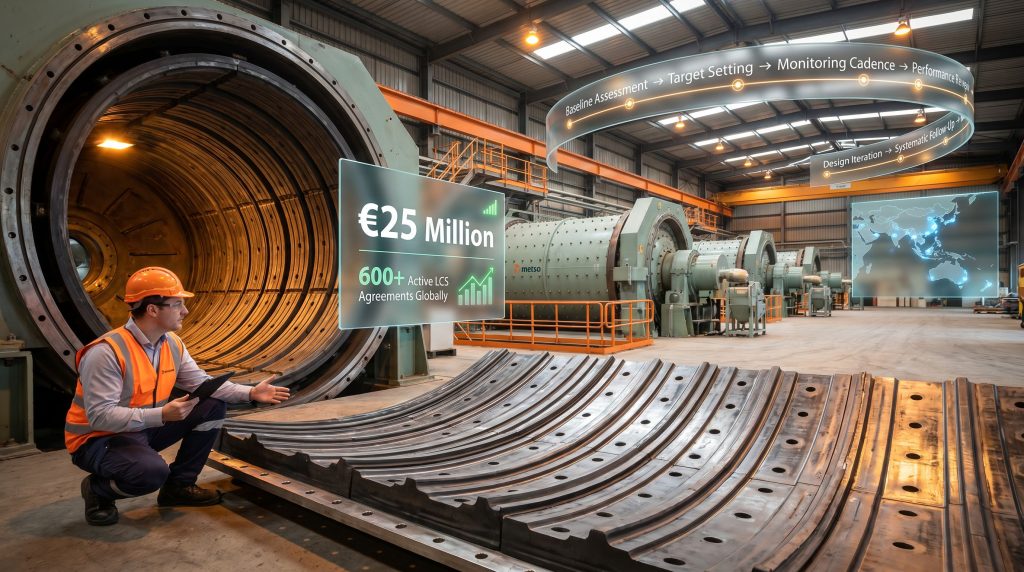
Metso's recent activity in Asia Pacific demonstrates both the breadth and adaptability of the LCS model. Four agreements secured across 2025 and the first half of 2026 carry a combined value exceeding €25 million, with individual contract durations of up to three years and orders booked on a quarterly cycle. Two agreements were secured in 2025, with two additional agreements following in H1 2026, signalling sustained and growing regional demand.
The four agreements span two distinct structural approaches, each addressing different operational priorities:
| Agreement Type | Core Features | Primary Operational Benefit |
|---|---|---|
| Performance-Based LCS | Throughput-linked liner outcomes, shared KPIs, joint risk allocation | Reduced operational risk, improved maintenance forecasting |
| Site-Integrated LCS | Consignment stock, scheduled delivery, on-site support, shutdown assistance | Operational consistency, supply chain simplification |
| Full-Site Liner Supply | Complete liner supply across all site mills, ongoing technical guidance | Supplier consolidation, standardised operating practices |
| Continuous Improvement LCS | Regular inspections, systematic performance follow-up, optimisation initiatives | Long-term efficiency gains, reduced unplanned downtime |
Performance-Based Agreements: Redistributing Risk Through Shared Accountability
Two of the four agreements incorporate performance-based structures that directly link liner outcomes to throughput contribution and service life. This is a meaningful commercial innovation. Rather than specifying liner performance in terms of material properties or dimensional tolerances, performance-based agreements define success in terms that are directly relevant to the mine operator: tonnes processed per liner generation and the operational availability of the grinding circuit.
This structure redistributes performance risk. The service provider cannot optimise for margin by supplying a cheaper liner if that liner degrades throughput or accelerates wear beyond agreed parameters. The KPI framework creates genuine alignment between supplier incentives and operator objectives.
Site-Integrated Agreements: Solving the Supplier Fragmentation Problem
The remaining two agreements address a different operational challenge: the coordination cost and performance inconsistency associated with managing multiple liner suppliers across a single site. By extending comprehensive service packages that combine liner delivery with technical expertise and standardised specifications across all mills, these agreements enable customers to consolidate their supplier base and establish consistent operating practices across circuits.
Consignment stock arrangements embedded within these agreements eliminate one of the most operationally disruptive scenarios in mill maintenance: the emergency liner procurement event. When a liner fails ahead of schedule or a shutdown reveals accelerated wear, the absence of on-site stock forces unplanned procurement cycles that extend downtime and inflate cost. Consignment arrangements remove this exposure entirely.
How Continuous Improvement Compounds Value Across a Contract Lifecycle
One of the less visible but commercially significant features of the LCS model is the compounding effect of systematic improvement over time. A liner design installed at contract commencement is not the same design that will be installed in year three. The continuous improvement framework built into LCS agreements ensures that each liner generation incorporates lessons learned from the previous cycle.
The improvement process follows a structured sequence:
- Baseline establishment — Document current wear rates, throughput metrics, and liner change-out intervals at contract start
- Target alignment — Define performance improvement objectives jointly with the mine operator
- Inspection cadence — Implement scheduled inspection and data collection protocols throughout the operating period
- Performance benchmarking — Compare actual outcomes against agreed KPIs at defined review intervals
- Design iteration — Incorporate operational data into revised liner profiles for subsequent generations
- Documentation and follow-up — Record and communicate improvement outcomes to support ongoing optimisation decisions
This cycle, repeated across a three-year contract period, can generate performance gains that far exceed what is achievable through a single optimised liner design supplied at the outset. In addition, data-driven mining operations increasingly depend on precisely these kinds of structured improvement loops to sustain competitiveness across extended production cycles.
Global Scale, Regional Depth: The Foundation of LCS Credibility
The credibility of any long-term service model depends on demonstrated capability at scale. Metso currently supports more than 600 active Life Cycle Services agreements globally, spanning multiple commodities and processing environments. This level of deployment is not incidental. It reflects the replicability of the framework across diverse operational contexts and provides a substantial base of performance data that informs site-specific implementations.
For Asia Pacific operations, the application of globally validated methodology is balanced against region-specific operational conditions. Geographic complexity, logistical lead times for remote site locations, and the availability of local technical expertise all influence how the LCS framework is configured for individual sites.
Jarrod Pyke, Director of Solution Group Grinding for Asia Pacific at Metso, has outlined that the LCS model draws on the combination of technical expertise, asset management capabilities, and a strong local presence to improve operational performance, increase predictability, and deliver measurable long-term value for customers across the region.
This emphasis on local presence is operationally material. In remote or logistically complex Asia Pacific mine site environments, the response time for technical interventions is a genuine differentiator. An embedded local service network reduces the lag between identifying a liner performance issue and implementing a corrective response.
The next major ASX story will hit our subscribers first
What This Signals for the Broader Industry Transition
From Procurement Strategy to Outcome-Based Contracting
The growth of Metso mill lining Life Cycle Services agreements in Asia Pacific reflects a broader repositioning of how capital-intensive mining operations approach supplier relationships. The lowest-cost tendering model, which optimises for unit price at the expense of total operational value, is increasingly recognised as a poor fit for high-throughput grinding circuits where liner performance has direct revenue implications.
The shift toward total-value contracting — where performance accountability, maintenance predictability, and continuous improvement are valued alongside unit economics — is redefining procurement strategy across the sector. This evolution sits firmly within the wider mining industry evolution that is transforming how operators structure supplier relationships across entire asset portfolios.
Comparing the Two Service Models Side by Side
| Performance Dimension | Traditional Supply Model | Life Cycle Services Model |
|---|---|---|
| Supplier Structure | Multiple fragmented vendors | Single integrated service partner |
| Performance Accountability | Supplier-limited responsibility | Shared KPI-based accountability |
| Maintenance Planning | Reactive, event-driven | Proactive, schedule-driven |
| Liner Design Evolution | Static specification | Data-informed iterative improvement |
| Inventory Risk | High (emergency procurement exposure) | Low (consignment stock arrangements) |
| Total Cost Visibility | Limited, transactional | Contracted, predictable cost structure |
A Growing Pipeline as a Leading Indicator
Beyond the four agreements already secured, Metso has indicated a growing pipeline of future LCS opportunities across Asia Pacific. This pipeline is significant for two reasons. First, it suggests that the operational benefits being demonstrated by early LCS adopters in the region are generating observable interest from adjacent operations. Second, it points toward the potential for the LCS model to expand beyond mill liners into broader comminution circuit services over time.
Early adopters of integrated mill lining services are effectively establishing competitive benchmarks for grinding circuit efficiency that will become reference points for regional operations evaluating their own maintenance and procurement strategies. Consequently, the mining efficiency gains unlocked by these arrangements are increasingly shaping how the broader sector benchmarks operational excellence.
Frequently Asked Questions
What distinguishes a mill lining LCS agreement from a standard long-term supply contract?
A standard supply contract governs delivery terms and pricing for a specified product. An LCS agreement integrates supply with technical support, performance monitoring, continuous improvement frameworks, and shared accountability for operational outcomes, creating a fundamentally different commercial and operational relationship.
How are jointly agreed KPIs defined in performance-based agreements?
KPIs in performance-based Metso mill lining Life Cycle Services agreements in Asia Pacific typically reference throughput contribution per liner generation and service life measured against baseline wear rates. The specific metrics are negotiated to reflect site-specific production objectives and operational constraints.
What is the practical significance of quarterly order booking cycles?
Quarterly booking cycles allow mine operators to align liner procurement with production planning cycles, maintaining flexibility to adjust volumes in response to operational changes while preserving the supply certainty and service continuity benefits of a long-term agreement.
Why does supplier consolidation improve operational performance?
Standardising liner specification across all mills within a site eliminates the variability in wear rates and charge trajectories that arises when different liner designs operate across circuits managed by different suppliers. Consistency in specification creates predictability in maintenance intervals and supports more reliable production planning.
Disclaimer: This article contains references to contracted values, performance projections, and operational outcomes associated with Metso's Life Cycle Services agreements. All financial figures are sourced from publicly available industry reporting. Forward-looking statements regarding pipeline development and future contract growth involve uncertainty and should not be interpreted as guarantees of future performance.
Want to Identify the Next Major Mineral Discovery Before the Broader Market?
Discovery Alert's proprietary Discovery IQ model scans ASX announcements in real time, delivering instant alerts on significant mineral discoveries across more than 30 commodities — turning complex data into actionable investment insights for both short-term traders and long-term investors. Explore historic discoveries and the returns they generated, then begin your 14-day free trial to position yourself ahead of the market.